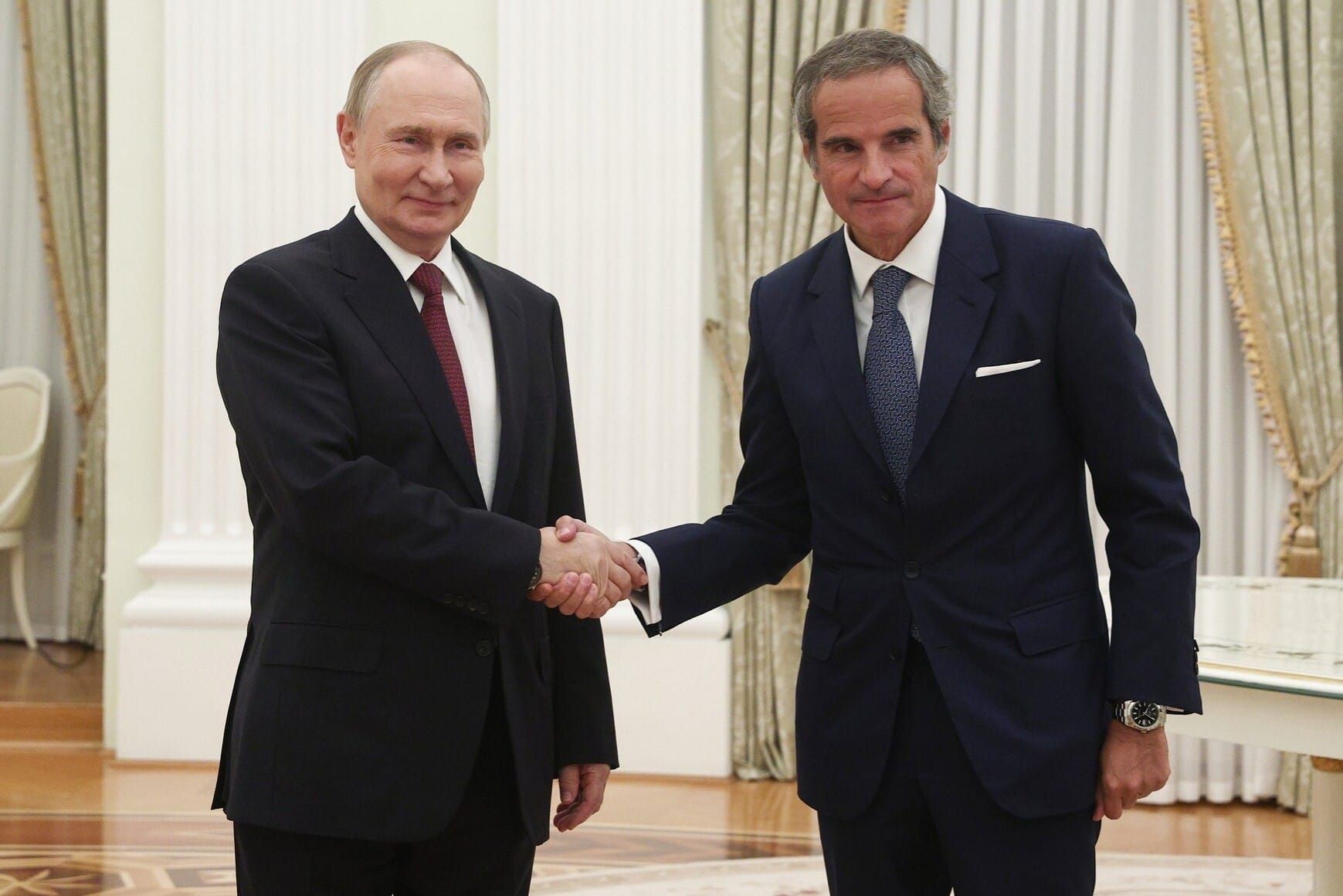
Rafael Grossi, head of the International Atomic Energy Agency (IAEA), has made a sanctioned official of the Russian regulator licensing the occupied Zaporizhzhia nuclear plant his deputy, Russia's mission in Vienna claims.
Roman Ustinov, Russia's deputy permanent representative to the international organisations in Vienna, told RIA Novosti on 20 November that Grossi had named Alexey Ferapontov as deputy director general and head of the agency's Department of Nuclear Energy. Ferapontov is a deputy head of Rostekhnadzor, Russia's Federal Service for Environmental, Technological and Nuclear Supervision. Ustinov called the appointment one of the main outcomes of the Board of Governors session that closed that day. On 21 November he told TASS that "the appointment has taken place" and that the secretariat's personnel staff had contacted Ferapontov about when he could come to Vienna to begin the paperwork for signing a contract.
Ferapontov told TASS he would concentrate on the development of peaceful nuclear energy in all member states, and TASS reported that he was expected in Vienna in early 2027. Grossi had confirmed the plan himself at a news conference in Vienna on 18 November, the first day of the board session, and Bloomberg reported that day that the agency would appoint Ferapontov. By 24 November the IAEA had issued no press release, board document or statement announcing the appointment as final or giving a start date. Every account of a completed decision traces to Ustinov and Russian state media, and on Ustinov's own description the contract was still to be signed.
Under the appointment, a deputy head of Rostekhnadzor would run the IAEA department that advises governments on building and operating nuclear power plants. Rostekhnadzor has issued Russian operating licences for three of the six reactors at Zaporizhzhia, a Ukrainian plant that Russian forces have held since March 2022 and that the IAEA's own governing bodies have repeatedly told Russia to return. Ukraine put Ferapontov under personal sanctions by presidential decree on 12 February 2023.
Grossi said the decision turned on technical experience. "When I appoint somebody, I'm not appointing a country, I am not appointing a policy," he told reporters on 18 November, according to the Associated Press. He described Ferapontov as a well-known expert in nuclear safety and nuclear security. He declined to comment on the Ukrainian government's concerns, Bloomberg reported. The Russian Foreign Ministry did not immediately respond to a request for comment from the AP.
Ukraine's Foreign Ministry protested on 17 November, a day after Grossi set out the proposal in a note to the 35 board members. The ministry said the objection was not to Ferapontov's citizenship but to his part in Russian state actions to legitimise the illegal seizure of the Zaporizhzhia nuclear power plant and extend Russian regulatory control over it. Appointing him would be "blatant acquiescence to Russia's policy of illegally seizing Ukrainian nuclear facilities", the ministry said. It called on Grossi to drop the appointment and on member states to block it. Andrii Sybiha, the foreign minister, called the appointment categorically unacceptable in a post on X and said officials implicated in the seizure should be held accountable rather than given senior posts in international organisations.
The closed session
Ferapontov was one of three senior appointments Grossi proposed in the 16 November note, with a US national as deputy director general for management and a North Macedonian as a director in the Department of Safeguards, the AP reported. Grossi offered board members an informal briefing on the appointments during the week of the meeting. The agency has six deputy director general posts, and the director general fills them. Published accounts of the session describe no board vote on the appointment.
Ustinov told RIA Novosti that several states questioned Grossi's choice during the closed session while others urged the board not to interfere in personnel decisions, and he credited Grossi with composure in using his statutory authority over secretariat staff. He said the decision was taken under outside pressure, including pressure from Ukraine at a high political level. He named none of the states. Ukrainian outlets including UNN and UA.News reported that several Western governments had objected, citing Ustinov and The Moscow Times, which relied on Russian officials.
Denmark's statement on the Ukraine agenda item rejected Russia's claims of ownership of the Zaporizhzhia plant and called on Russia to withdraw its forces, and made no reference to the agency's senior staff. Ukraine's two-year term on the board ended in September 2025, so it had no seat at the session.
Iran and the condition of the Zaporizhzhia plant dominated the board's public agenda that week. A joint statement published by the US mission on 19 November said that Iran had made little if any progress on its safeguards non-compliance.
Rostekhnadzor at Zaporizhzhia
Rostekhnadzor issued a 10-year operating licence for Unit 1 on 23 December 2025, for Unit 2 on 18 February 2026 and for Unit 6 in October 2026, valid until 21 October 2036. The plant's Russian management said the licences established its legal status as a Russian nuclear facility, and that the Unit 6 licence did not in itself mean electricity generation would resume. Rosatom, the Russian state nuclear corporation, said the Unit 2 licence confirmed the unit met Russian nuclear standards.
Alexey Likhachev, head of Rosatom, said in December 2025 that Russia's delegation to its inter-agency talks with the IAEA on the plant includes Rostekhnadzor alongside Rosatom, the Foreign Ministry and the National Guard, and that the delegation always acts as one. Greenpeace International, which wrote to the board before the session, said Ferapontov made a working visit to the occupied plant in April 2024 and pointed to Rostekhnadzor's role in licensing the plant. It urged Grossi to "immediately abandon plans to appoint" him.
Ukraine considers the plant its own, operated by its state company Energoatom and licensed by its own regulator, the State Nuclear Regulatory Inspectorate. The IAEA Board of Governors and the agency's General Conference have repeatedly called on Russia to withdraw from the plant and return it to Ukrainian control.
Grossi has kept IAEA experts at the plant since September 2022 and has brokered local ceasefires so that damaged power lines could be repaired. On 8 November the plant lost all off-site power for the 27th time, and it now depends on a single 330-kilovolt line, compared with 10 lines before the invasion, the agency reported. A plant employee was killed in a drone attack on 9 November and another died in an explosion the next day. Grossi told the board on 18 November that a ninth local ceasefire was under discussion to repair the Dniprovska substation and a 750-kilovolt line.
In Moscow, Grossi discussed the plant with Likhachev, and Rosatom said he was briefed on preparations to restart its units, including licensing by Rostekhnadzor. He has said electricity generation can resume only after hostilities end, and an IAEA team and Rostekhnadzor agreed in June 2025 that the reactors could not be restarted while the war endangered safety at the site.
Ferapontov's career
Ferapontov has worked at Rostekhnadzor since 2008 and studied engineering in Moscow, according to Bloomberg. Before entering government he was a deputy general director at the insurers Rosgosstrakh and Ingosstrakh, according to the Russian industry site AtomInfo. The Russian government appointed him to the Commonwealth of Independent States commission on atomic energy in 2014. He has represented the regulator at IAEA meetings, including a forum in Vienna in 2016 where he presented the licensing of Russia's floating nuclear power plant.
In January 2022 he became chair of the Multinational Design Evaluation Programme, a forum of national nuclear regulators whose secretariat is run by the Nuclear Energy Agency of the Organisation for Economic Co-operation and Development. He kept the chair after the agency suspended Russia in April 2022, Darya Dolzikova and Jack Watling of the Royal United Services Institute (RUSI) wrote in February 2025. The authors argued that Russia's occupation of another member state's nuclear infrastructure should raise alarm over its leadership roles in international nuclear bodies.
The Department of Nuclear Energy has traditionally been headed by Soviet or Russian nationals, Russia's mission in Vienna said, according to UNN, citing The Moscow Times. Ustinov told RIA Novosti that previous Russian heads of the department had worked for the development of nuclear energy without political motives.
The vacancy
Mikhail Chudakov, a Russian national who had headed the department since February 2015, left the post vacant when the IAEA placed him on administrative leave in September pending an internal ethics investigation. Bloomberg reported on 18 November that he had left the agency. The inquiry concerned a 76-page book he published in 2025 under a pseudonym, which described feminists as "hysterical fanatics" and disparaged gay and lesbian people. He promoted the book among young professionals in Vienna's nuclear community, four officials familiar with the matter said. Chudakov previously held senior posts at Rosenergoatom, the Russian nuclear utility and a Rosatom subsidiary.
Greenpeace had asked Grossi in March 2022, less than two weeks after Russian forces seized Zaporizhzhia, to suspend Chudakov and disclose his communications with Rosatom, arguing that his presence could undermine Ukraine's confidence in information it shared with the agency. RUSI's authors later wrote that his role risked a conflict of interest because the department supports the expansion of nuclear power, which the Russian government treats as strategically important. No public evidence has shown that Chudakov passed confidential information to Rosatom, and he stayed in the post for about four more years. The IAEA, Chudakov and Grossi made no public comment on his suspension.
Grossi's bid for the UN
Ustinov announced the appointment on the day the UN Security Council voted on Grossi's own future. Argentina nominated him for UN secretary-general on 26 November 2025, and the council held its ninth informal straw poll on 20 November, the last day of the board session. Grossi received eight "encourage" votes, six "discourage" and one "no opinion", and the colour-coded ballots showed two of the five permanent members encouraging him and three discouraging him, according to a tally seen by PassBlue. The ballots do not identify which permanent members voted which way. Rebeca Grynspan of Costa Rica, the front-runner, received 10 encourage votes and four discourage, including two from permanent members.
A candidate needs nine votes and no veto from the five permanent members, which include Russia. Guterres's second term ends on 31 December. In the fourth straw poll, on 29 September, Grossi had received seven discourage votes from the 15 council members.
Dmitry Peskov, the Kremlin spokesman, said on 25 September 2025, the day Grossi met President Vladimir Putin at the Kremlin, that Putin and Alexander Lukashenko of Belarus welcomed Grossi's readiness to run. Likhachev said on 28 October 2026 that a victory for Grossi or for Viktor Orbán, the former Hungarian prime minister, would be "very attractive for Russia". Kirill Logvinov of the Russian Foreign Ministry named no preferred candidate on 24 October and said Russia hoped the next secretary-general would free the UN secretariat from what he called Western dictate.
Ukraine's Foreign Ministry cited the candidacy in its protest, saying any doubt about the independence of the agency's personnel decisions had to be removed. Greenpeace raised the same point, citing Russia's possible influence over a director general seeking the post. Neither Ukraine nor Greenpeace has alleged any arrangement between Grossi and the Russian government over the appointment, and none has been documented. Both objected that the director general made a staffing decision welcomed by a government holding a veto over his candidacy, in the week that government's diplomats voted on it.
The statute and the outstanding documents
Under Article VII of the agency's statute, the director general appoints staff under regulations approved by the board. The paramount consideration in recruitment is securing staff of the highest standards of efficiency, technical competence and integrity, with regard also to recruitment on as wide a geographical basis as possible. The director general and staff may not seek or receive instructions from any source outside the agency, and member states undertake not to try to influence them.
Grossi's note of 16 November to the board has not been published. The IAEA has not released the date on which Ferapontov's contract is to be signed, the date he takes up the post or whether he will leave Rostekhnadzor before he does. The board's summary record of the closed meeting, which would show which governments objected, has not been released. Ferapontov is due in Vienna in early 2027, after the Security Council's choice of the next secretary-general.