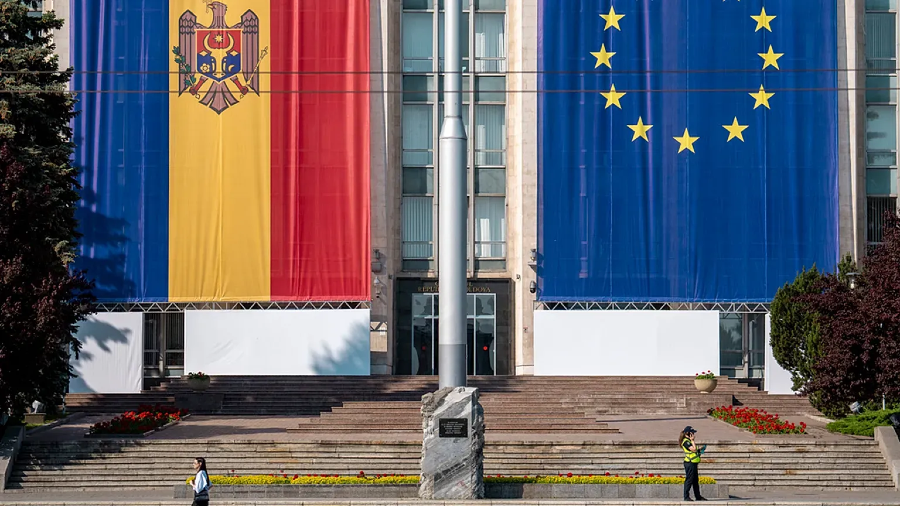
Russian drones and Banderol missiles struck Moldovan soil in four districts on the morning of 3 October, setting fields alight and blowing out windows at a farm building, during a Russian attack on Ukraine. No one was killed or injured, according to police.
Maia Sandu, Moldova's president, wrote on X that "5 Russian air attack weapons, including Banderol missiles and drones, violated our airspace and exploded on our soil." She wrote that Russia's war "is dangerously reaching Moldova" and that "Moscow is putting lives at risk across Europe and must be stopped."
Moldova's National Integrated Monitoring System said five drones overflew the country's airspace that morning. The Defence Ministry tracked them near Anenii Noi, Ștefan Vodă, Tudora and Căușeni and said the incidents "occurred in the context of massive attacks launched by the Russian Federation against Ukraine."
Where the weapons came down
Police in Căușeni were called to an explosion on the edge of the town at 07:50. Officers found dense smoke and the fragments of a drone.
Crocmaz, in Ștefan Vodă district, took the worst damage. A blast in a vineyard beside an agricultural brigade set the surrounding vegetation on fire and shattered windows in the brigade's building.
Investigators recovered more debris near Dubovca in Hîncești district and between the villages of Delacău and Puhăceni in Anenii Noi district. Another explosion near Constantinovca, in Căușeni district, started a second vegetation fire.
Police said the circumstances of the explosions were still to be established. Teams from the police and the National Army spread out across the four districts, and the authorities told residents not to touch unidentified fragments and to call 112.
Eight weeks of strikes on Moldovan soil
Crocmaz was hit before. A Russian drone exploded near the village on 9 August, and Moldova recalled its ambassador from Moscow the next day. Sandu said at the time: "It puts us all in danger. The threat to human life in our region is real and continues to grow. This must stop." Defence Minister Anatolie Nosatii said: "It is a Russian drone. It is a more advanced model compared with those that have previously ended up on our territory."
A Banderol entered Moldovan airspace on 17 August during a Russian attack on Odesa and exploded in a cornfield about 3 kilometres from Talmaza, in Ștefan Vodă district, roughly 20 kilometres from the Ukrainian border. The S8000 Banderol is a small cruise missile built by Russia's Kronshtadt Group and launched from its Orion strike drone. Sandu said: "I believe that some (munitions) arrive by chance and others arrive because they are sent, and not only in our airspace, but also in the airspace of other states."
Four Russian drones entered Moldovan airspace on 24 September. Police later recovered wreckage near Cotiujeni, in Briceni district, 1.7 kilometres from the border, including wing parts marked Geran-4 and a partly destroyed turbojet engine. Fragments identified as a Russian Gerbera drone turned up the same day in Florești district.
Three more drones crossed on 30 September. One exploded near Hârbovăț in Anenii Noi district and damaged a telecommunications antenna, and another came down near Ivancea in Orhei district. The Foreign Ministry summoned Oleg Ozerov, Russia's ambassador, on 1 October and said: "These violations directly threaten the security of the citizens of the Republic of Moldova."
Ziarul de Gardă counted more than 85 Russian drones and missiles that have crossed Moldovan airspace illegally since the full-scale invasion of Ukraine began in 2022. Moldova's Defence Ministry has said the country has gaps in its radar coverage and the smallest defence budget in Europe.
Ozerov has denied Russian responsibility before. Summoned after a drone crossed Moldova in November 2025, he said: "There isn't even a drone. There was only a buzzing sound." Foreign Minister Mihai Popșoi said Ozerov "pretends not to know" whose drones and missiles were destroying Ukrainian cities daily, "taking hundreds and thousands of human lives."
What the law says
Article 1 of the 1944 Chicago Convention on International Civil Aviation recognises that every state has "complete and exclusive sovereignty over the airspace above its territory." Article 2(4) of the UN Charter bars member states from the threat or use of force against the territorial integrity of another state. Russia and Moldova are parties to both.
Buying votes with Russian bank transfers
Moldovan police said in October 2024 that Ilan Shor, a fugitive oligarch sentenced in absentia to 15 years for his part in the theft of $1 billion from Moldovan banks, had moved $39 million to Moldovan voters through Russia's state-owned Promsvyazbank in September and October 2024 alone. Police identified about 138,000 recipients and roughly 1 million individual transfers. Viorel Cernăuțeanu, head of the national police, said payments began "in April at the latest" and that anyone who took the money would be treated as part of Shor's criminal organisation.
The New York Times reported in August 2026 that the Shor network ran 130 territorial leaders, more than 1,900 precinct managers and more than 50,000 activists. Several hundred Moldovan priests travelled to Russia and received Russian bank cards, according to the newspaper, and UNITED24 Media, citing the same reporting, said each priest was paid about $1,000 to campaign against EU membership among parishioners.
Sandu said before the 2025 parliamentary election: "The Kremlin is pouring hundreds of millions of euros to buy hundreds of thousands of votes on both banks of the Nistru river and abroad." The EU has since put 29 people and five organisations under sanctions for undermining Moldova. The Kremlin has said Russia "does not interfere in Moldova's internal political processes."
Sabotage camps in Bosnia and Serbia
Anatolii Prizenco, a Moldovan recruiter, offered young Moldovans $300 to $500 in cryptocurrency for about 10 days of what he described as outdoor activities, according to court records and testimony gathered by BIRN's Detektor. Maxim Roșca, 41, told BIRN that Prizenco asked him: "Don't you want to go? To learn to defend yourself."
Recruits were taken to forest camps near Banja Luka in Republika Srpska between 1 and 16 August 2024 and again from 22 August to 11 October 2024, BIRN reported. Instructors taught drone flying, combat drills, how to organise mass riots and how to provoke police, and handed out instructions for making explosives. Vladimir Harcevnicov, a 37-year-old convicted murderer, was among the trainees.
Moldovan border police stopped Roșca at the Romanian border on 11 October 2024 carrying disassembled drones, virtual reality headsets, radio equipment and instructions for making explosives. The EU sanctioned Prizenco in December 2024, and he was arrested in February 2025. A site outside Radenka, in eastern Serbia, visited by BIRN reporters that month held burnt papers, drones, VR headsets, Starlink equipment and flammable liquids. A Moldovan court convicted three people in February 2026 of attending the camps in Bosnia and Serbia.
Moldovan police raided about 250 addresses on 22 September 2025, six days before the parliamentary election, and detained 74 people suspected of preparing mass riots "coordinated from the Russian Federation through criminal elements." Prosecutor Victor Furtună said the suspects had been "trained in Serbia in techniques for mass disorder."
Between 150 and 170 people attended training at the Sunčana Reka resort near Loznica, on Serbia's border with Bosnia, from 16 July to 12 September 2025, Kyiv Post reported. Serbian President Aleksandar Vučić said on 15 October 2025: "I cannot claim that a Russian intelligence service was involved, but we have established the presence of three Russian citizens at the Sunčana Reka camp, not far from Loznica." Serbia arrested two of its citizens for organising the camp.
Intelligence officials from three countries told the New York Times that the instructors at the Serbian resort, which advertised itself as a place to "relax and have fun", were operatives linked to the GRU, Russia's military intelligence agency. Trainees wore body armour, handled assault rifles and practised breaking through police lines and setting buildings on fire, the newspaper reported. More than 100 young Moldovans were trained in explosives, incendiary devices and drone operations at a facility in Moscow, according to UNITED24 Media's account of the same investigation.
Ukraine's Centre for Countering Disinformation said in March 2026 that instructors at the camps were "directly linked to the former Wagner Group" and that the network recruited in Moldova, Bulgaria and Serbia before sending trained saboteurs into other European countries. Mircho Angelov, a Bulgarian who POLITICO identified as an instructor at the camps, has since been sentenced in Paris. Moldovan Interior Minister Daniella Misail-Nichitin said: "These young, Russian-speaking people were recruited, transported to specially organized camps and trained."
Recruiting on social media
Moldova's Information and Security Service said in September 2026 that Russian intelligence had stepped up recruitment of Moldovan citizens through social media, first paying for simple tasks such as photographing or watching sites and then moving recruits on to sabotage, much of it aimed at Ukraine. Moldovan and Ukrainian services have run joint operations against the recruiters and stopped several planned attacks, the service said.