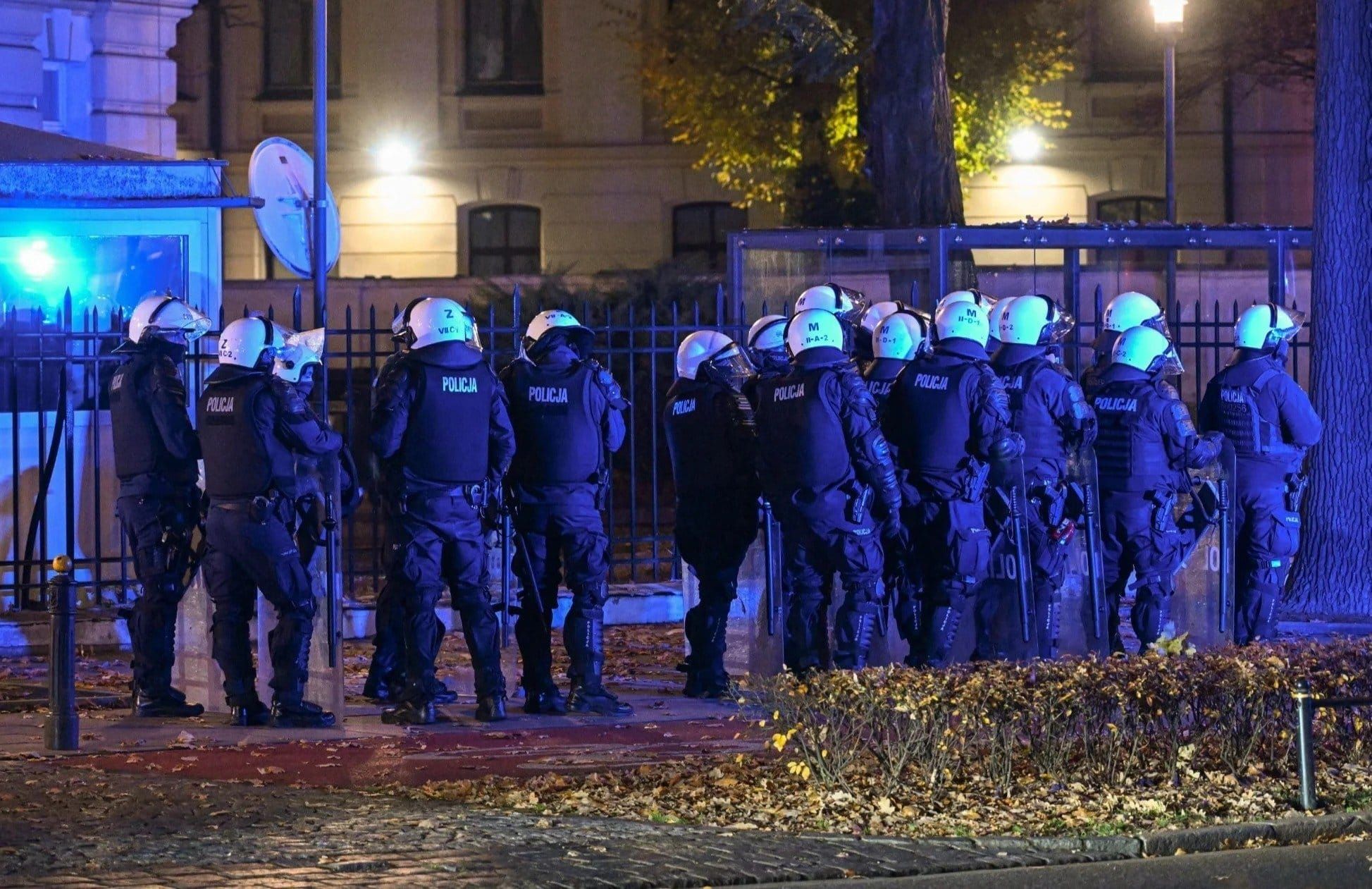
Polish police cordoned off the Constitutional Tribunal in Warsaw on 30 October after Judge Anna Korwin-Piotrowska suspended its president, Bogdan Święczkowski, and vice-president, Bartłomiej Sochański, for one month and took charge of the court herself.
Święczkowski, who once stood for election on Law and Justice (PiS) lists and is a long-time ally of former justice minister Zbigniew Ziobro, had refused since April to let four judges elected by the Sejm sit on the court. Korwin-Piotrowska is one of them. The suspensions were linked to allegations that the two officials had improperly discharged their duties and kept lawfully elected judges from the bench, the Polish Press Agency (PAP) reported.
Prime Minister Donald Tusk's pro-European coalition is making its sharpest attempt yet to undo the capture of Poland's highest court under PiS, which governed from 2015 to 2023. Two presidents aligned with PiS have vetoed the government's judicial legislation since it took office in December 2023, and Tusk told Campus Polska in August that his government had a plan to restaff the tribunal with lawfully appointed judges.
Tusk wrote on X that restoring the rule of law after years of PiS lawlessness was difficult, sometimes painful work that demanded decisive action. PiS called it a coup. Jarosław Kaczyński, the party's leader, went to the tribunal and said: "From today, Poland becomes a police state."
The cordon
Police said they acted on two written requests: one from Justice Minister and Prosecutor General Waldemar Żurek, who asked officers to secure the building because of protests, and one from Korwin-Piotrowska, who warned of risks to judges and staff. Officers stayed on the outer perimeter and did not enter the building, police said. They detained three people after protesters breached the fence and threw objects at officers, the Associated Press reported.
The tribunal's official account on social media said its website had been illegally taken over and that those acting against the court were committing the crime of coup d'état. The profiles of Święczkowski and Sochański disappeared from the site soon after the suspension was published at about 6pm.
President Karol Nawrocki turned back a flight to Senegal. "At a moment like this, the President must be in Poland," he wrote on X. His chief of staff said Nawrocki would meet the president of the Supreme Court on landing. Poland's ambassador to China, Jakub Kumoch, resigned the same evening, saying events at home made it impossible for him to continue.
Former prime minister Beata Szydło wrote on X that police had forced their way into the tribunal. Police said they had not entered. Ziobro, who is in the U.S., called for loud, firm and fearless resistance.
The captured court
PiS began its takeover of the tribunal within weeks of winning power in 2015, when its Sejm majority installed judges in seats already filled by the previous parliament. The European Court of Human Rights ruled in 2021 that a bench including one of those judges was not a tribunal established by law.
The tribunal that PiS built then delivered the party's most consequential policy. In October 2020 it struck down the ground that permitted abortion for severe foetal abnormalities, leaving Poland with one of the strictest abortion laws in Europe. Mass protests followed. Doctors' fear of prosecution under the ruling was linked by women's families to the deaths of pregnant women denied timely care, including Izabela Sajbor in Pszczyna in 2021.
Nawrocki continues to block abortion reform, though two thirds of Poles now back liberalising the law, a poll published on 26 October found.
The Court of Justice of the European Union fined Poland €1 million a day in 2021 over the disciplinary chamber that PiS created to punish judges, and the European Commission froze billions of euros in recovery funds until the rule-of-law dispute eased after the change of government. In the same period nearly 100 local authorities governed or backed by PiS declared themselves free of "LGBT ideology", and the Commission withheld cohesion grants from several of them.
Święczkowski was national prosecutor under Ziobro before the PiS majority elected him to the tribunal in 2022 and Andrzej Duda made him its president in 2024. Żurek asked the court in September 2025 to lift Święczkowski's immunity so he could face abuse-of-power charges over the handling of surveillance material. The tribunal's general assembly, chaired by Sochański and composed of PiS-era appointees, refused.
The European Court of Human Rights has since ordered the tribunal to accept the four judges Nawrocki declined to swear in. Święczkowski refused, saying the Strasbourg court lacked competence, and prosecutors charged two senior tribunal officials over blocking the judges' work. Nawrocki has accepted the oaths of three of the eight judges the current Sejm has elected.
The Justice Fund
Ziobro, PiS's deputy leader and justice minister from 2015 to 2023, faces 26 charges, including founding and leading an organised criminal group inside the ministry that prosecutors say misappropriated more than 150 million złoty from the Justice Fund. The fund exists to help victims of crime and former prisoners. Prosecutors say Ziobro instructed subordinates to break the law to steer grants to favoured organisations.
Ziobro fled to Hungary, where Viktor Orbán's government granted him asylum in January 2026, as it had his former deputy Marcin Romanowski in December 2024. When Orbán lost the April election, Ziobro flew from Milan to New York on 9 May on a U.S. visa issued to him as a member of the foreign media, prosecutors said. The pro-PiS broadcaster TV Republika had hired him as a commentator. Tusk called the visa outrageous, and Poland formally asked the U.S. to arrest and extradite Ziobro on 27 July.
Ziobro denies all charges and says the case is political revenge by Tusk's government.
Romanowski wrote to a Warsaw court in August from Tiraspol, the capital of Transnistria, the Russian-backed breakaway region of Moldova, asking for safe passage home. The court and prosecutors confirmed the letter bore his signature and a Tiraspol postmark. Deputy Defence Minister Cezary Tomczyk said Romanowski was probably under the influence of Russian intelligence. PiS deputy leader Przemysław Czarnek agreed that being in Transnistria would cross a line.
The spyware
The PiS government bought Pegasus from the Israeli company NSO Group in 2017, paying with money taken in part from the Justice Fund. The Central Anti-Corruption Bureau (CBA) then used it against hundreds of targets, including the head of Tusk's 2019 election campaign. Tusk has said his wife and daughter were also caught up in the surveillance.
The National Prosecutor's Office said on 12 October, citing experts at the Internal Security Agency (ABW), that the CBA never had full control of the system. NSO kept administrative accounts and exclusive control of the server module that infected phones, and harvested data travelled through servers abroad in a network NSO managed. NSO had technical access to surveillance material, the experts found, though they could not establish whether it used that access in specific operations. A parliamentary inquiry found that the CBA never obtained the security accreditation required for systems handling classified information, and that courts authorising the hacks were not told the tool could read a phone's entire contents.
Tusk called it one of the biggest scandals since the fall of communism and a crime against the state. Former heads of the CBA, the ABW and the Military Counterintelligence Service have been charged with abuse of power, and former deputy justice minister Michał Woś has been indicted over the use of Justice Fund money to buy Pegasus.
PiS has said Pegasus was a lawful tool used only with court approval against legitimate suspects.
The crypto money
Prosecutors are investigating funding by Zondacrypto, a cryptocurrency exchange that collapsed this year, of organisations linked to the Polish right. Żurek named foundations connected to Ziobro and to Przemysław Wipler, TV Republika and its head, Tomasz Sakiewicz, and CPAC Poland. Prosecutors estimate customer losses of at least 2.4 billion złoty, Onet reported.
Zondacrypto was the main sponsor of the CPAC Poland conference in Jasionka on 26 and 27 May 2025, days before the presidential runoff. Then U.S. Homeland Security Secretary Kristi Noem told the conference that Nawrocki should be Poland's next president. Weeks earlier Donald Trump had received Nawrocki in the Oval Office and told him he would win.
Nawrocki has vetoed the government's crypto-asset regulation three times. Żurek said Nawrocki had full access to classified intelligence on Zondacrypto before one of those vetoes. Nawrocki told Kanał Zero he did not regret the veto and blamed Tusk's government for the losses. Kaczyński has denied that PiS had links to the exchange.
Przemysław Kral, Zondacrypto's former chief executive, holds Israeli citizenship and went to Israel, Polish media reported in May. He is now cooperating with prosecutors, his lawyer, Civic Coalition MP Roman Giertych, said in August.
The Russia question
Tusk told a Civic Coalition congress on 11 April that Nawrocki, PiS and the far-right Confederation formed a "Putinist front" whose aims matched the Kremlin's: weakening the EU, dividing Poland from Ukraine and Germany, and hollowing out democratic institutions. He cited PiS politicians campaigning in Budapest for Orbán and the blocking of crypto regulation, which he said Russia uses to move dirty money.
Polish imports of Russian coal rose from about 5 million tonnes in 2016 to 13 million tonnes in 2018 under PiS, and Russian coal made up 65 per cent of Poland's coal imports by 2021, state data compiled by the fact-checker Demagog show. Marek Falenta, a businessman who traded Russian coal, organised the secret restaurant recordings of ministers that brought down Tusk's Civic Platform government in 2014, and passed them to PiS, The Insider reported. Polish media later reported that some of the restaurants had Russian-linked co-owners. Falenta was convicted and served a sentence of two and a half years.
PiS rejects any suggestion of Russian alignment. It points to its support for Ukraine, the near-total halt of Russian energy imports under its government and Nawrocki's place on a Russian wanted list over the removal of Soviet monuments.
The EU
Kaczyński told an economic forum in southern Poland on 28 October that countries seeking to reform the EU could, as a last resort, sign a new treaty while opening withdrawal negotiations to pressure EU institutions. Tusk wrote that Kaczyński had announced Poland should begin negotiating its exit. Foreign Minister Radosław Sikorski said: "I thank Jaroslaw Kaczynski for his honesty."
Kaczyński said Tusk had misrepresented him and that he wanted an EU that served ordinary citizens instead of elites. In September 2025 he told supporters in Zielona Góra that a Trump-led "Pax Americana" offered Poland an alternative to the EU in which it would keep its sovereignty.
Polls show PiS could return to power in the 2027 election if it allies with Confederation and smaller far-right groups.
The tribunal's leadership
The Polish constitution gives the Sejm the power to elect the tribunal's 15 judges for single nine-year terms and gives the president the power to appoint its president and vice-president from candidates put forward by the court's general assembly. Whether Korwin-Piotrowska's order is lawful turns on who sits in that assembly. The government says the four judges elected in 2026 and kept out by Święczkowski are lawful members. PiS and Nawrocki say judges who did not take their oath before the president are not judges at all.
Święczkowski filed a 60-page complaint with prosecutors in January 2025 accusing Tusk and senior officials of staging a systemic coup against the courts. The deputy prosecutor general who opened that case, Michał Ostrowski, was suspended for six months. Korwin-Piotrowska's written order and the reasons for it, which went offline with the tribunal's website on 30 October, have not been published in full.