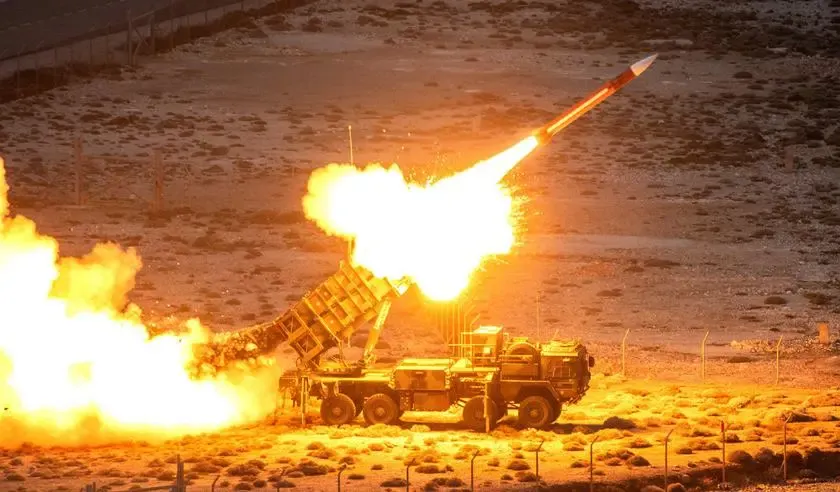
Greece and Spain are refusing to release PAC-2 Patriot interceptors near the end of their shelf life to Ukraine before a winter of Russian ballistic strikes, the Telegraph said on 9 October.
Greece holds at least 200 PAC-2 missiles whose 23-year certified life is running out, the newspaper said. Spain has not disclosed the size of its equivalent stock.
NATO and EU officials have changed their approach to both governments and are now asking what help they would need to agree to a transfer, a diplomatic source said.
Ukraine needs 300 to 360 Patriot interceptors to defend its power grid through the winter, President Volodymyr Zelensky said. Ukrainian air defence units fire an average of two interceptors to bring down each ballistic missile, according to Ukrainian government figures.
Russian strikes on Ukraine's power system have been the subject of International Criminal Court arrest warrants since 5 March 2024, when judges named commanders Sergei Kobylash and Viktor Sokolov over attacks on electricity infrastructure from 10 October 2022 to at least 9 March 2023. Russia does not recognise the court's jurisdiction and has denied deliberately targeting civilian infrastructure.
Russia now produces 140 ballistic missiles a month, Zelensky said, up from the 120 he cited at a NATO-Ukraine Council meeting in Kyiv in early June. Ukraine's Defence Intelligence put Iskander-M output at 55 to 60 a month in June and said Russia could fire up to 100 ballistic missiles a month at Ukraine without drawing down its reserves.
Greek officials have said the country already contributes to allied air defence through a Patriot battery protecting Saudi oil refineries. A Greek government spokesperson and the Spanish defence ministry both refused to comment in September, and neither government had announced a transfer by 10 October.
Greek stocks and the Saudi battery
The Ukrainian government asked Greece in July for up to 200 PAC-2 missiles from the six Patriot batteries operated by the Hellenic Air Force, the Greek daily Kathimerini reported on 17 July. The request followed failed talks on handing over part of those batteries.
Greek officials would have to judge the missiles fit for use but not essential to Greek combat needs before any transfer. Ukrainian officials believe many of the requested missiles have been in Greek service for about 23 years. Neither the Greek nor the Ukrainian government has publicly confirmed the request or the figure.
Defence Minister Nikos Dendias said in March that the Greek Patriot unit in Saudi Arabia had intercepted two Iranian ballistic missiles aimed at Saudi refineries. Greece has also shipped several dozen interceptors to Qatar since March, starting with a consignment of 24.
Prime Minister Kyriakos Mitsotakis ruled out sending Greek Patriot or S-300 systems to Ukraine in April 2024, saying both were critical to the country's deterrent capability. The Greek government regards Turkey, a fellow NATO member, as its greatest security threat.
What Greece has already sent
Greek military aircraft began carrying weapons to Ukraine in the first days after the Russian invasion of 24 February 2022, and Greece was among the first governments to send ammunition.
Nikolaos Panagiotopoulos, then defence minister, listed in June 2022 the equipment Greece had delivered or was preparing to deliver: 122 BMP-1 infantry fighting vehicles with their ammunition, 15,000 rockets of 73mm calibre, 2,100 rockets of 122mm calibre, 20,000 Kalashnikov rifles, 3.2 million rounds of 7.62mm ammunition, 60 Stinger portable air defence launchers, 17,000 155mm artillery shells and 1,100 RPG-18 anti-tank launchers. He did not say how much had already arrived. Six Greek, 10 Canadian and five New Zealand aircraft flew the shipments.
Forty BMP-1A1 vehicles reached Ukraine from October 2022 under the German "Ringtausch" exchange, in which Germany replaced Greek stock with Marder infantry fighting vehicles. Some Greek deliveries remain confidential, so published totals are a minimum.
Greek officials said in July that Greece had earlier sent Sea Sparrow and Crotale air defence missiles to Ukraine as those weapons approached the end of their service life in the Greek armed forces.
Greek officials told EU counterparts in March 2024 that Greece could supply Ukraine through the Czech Republic with 90,000 projectiles of 90mm calibre, 180 anti-tank rockets of 70mm calibre, 2,000 Zuni rockets of 127mm calibre and four million bullets. Greece also planned to sell 70 M114A1 towed howitzers to the Czech Republic for onward transfer. Greece was preparing a separate €150 million sale of 155mm shells through the Czech-led ammunition initiative in April 2024.
The Greek defence ministry was preparing a further package worth more than €199 million in October 2025, also routed through the Czech Republic, according to Greek press reports. The list comprised 60 M110A2 self-propelled howitzers, 50,000 M106 shells, 40,000 M650 rocket-assisted shells, 30,000 M404 shells, 30,000 M509A1 cluster shells and thousands of 70mm and 127mm Zuni rockets, all supplied as stored without upgrades. The package required approval from KYSEA, the government council for foreign affairs and defence, and YAC News could not confirm whether it has been delivered.
Hellenic Army instructors trained Ukrainian special forces and Leopard 2 crews in 2022 and 2023, and Greek hospitals took in wounded Ukrainian soldiers for rehabilitation in 2023.
Mitsotakis and Zelensky agreed in Athens on 16 November 2025 to build Ukrainian-designed uncrewed surface vessels at a Greek shipyard, with Greek companies supplying electronics, optics, sensors and, where needed, explosive charges. Part of the output is earmarked for the Ukrainian armed forces and part for the Greek navy. Greece is funding the project through its 2025 to 2036 procurement plan and is seeking EU SAFE loans for joint production.
Greek and Ukrainian officials also agreed on 16 November 2025 to route US liquefied natural gas to Ukraine through Greece via the Atlantic-See joint venture in which Greek gas company DEPA holds 40 per cent. Mitsotakis had been in Odesa with Zelensky in March 2024 when a Russian ballistic missile struck nearby.
Spain's five missiles
The Spanish government pledged five PAC-2 interceptors to Ukraine in March, drawn from an army anti-aircraft artillery regiment at Marines in Valencia province. Each missile is valued at €3 million to €4 million.
Foreign Minister José Manuel Albares said on 3 September that Spain would keep supplying Patriot missiles, but gave no figure. The Telegraph dated the five-missile announcement to September, which conflicts with the March pledge confirmed by Spanish government sources, and YAC News could not establish whether a second batch was promised.
Spain's own replacement order, four Patriot batteries in the 3+ configuration bought for nearly €1.5 billion, has slipped to 2031 because Raytheon cannot meet demand.
Spain had 30 to 40 serviceable Patriot missiles left in August, excluding undelivered orders, according to estimates published that month.
What Spain has already sent
Spanish Defence Minister Margarita Robles announced on 6 May 2024 that Spain had transferred Patriot missiles to Ukraine. About six arrived in April 2024 and a second batch brought the total to about 12. The Spanish defence ministry had refused to hand over a full battery, citing a reserve of about 50 missiles and the small size of its armed forces.
Prime Minister Pedro Sánchez and Zelensky signed a 10-year bilateral security agreement in Madrid on 27 May 2024. Spain committed €1 billion in military aid for 2024 and up to €5 billion through 2027 via the EU's Ukraine Assistance Fund. A €1.13 billion package approved by the Spanish cabinet on 16 April 2024 covered Patriot missiles, 19 Leopard 2A4 tanks, anti-drone equipment and ammunition.
Spain had already sent 10 Leopard 2A4 tanks in 2023, bringing its total to 29 after the 19 tanks stored at Zaragoza were overhauled at the Santa Bárbara Sistemas plant. Spanish deliveries since 2022 have also included M113 armoured personnel carriers, artillery ammunition and anti-drone systems.
Robles said in July 2024 that Spain would supply the equipment for a complete Hawk air defence battery, and a battery of six launchers reached Ukraine in November 2024.
More than 9,000 Ukrainian service members had trained in Spain under the EU Military Assistance Mission by April 2026, Robles said, a figure she put in February at more than 10 per cent of all troops trained under the mission. The Toledo Training Coordination Centre runs courses ranging from basic infantry tactics to air defence, logistics and medical evacuation.
Robles told NATO defence ministers in Brussels on 12 February 2026 that Spain would keep providing military, humanitarian and training support. She confirmed on 15 April that Spain would spend a further €1 billion on bilateral military aid to Ukraine in 2026.
Robles announced in Kyiv in April 2026 that Spain would send 100 VAMTAC armoured vehicles, some of them for Ukrainian border guards, together with 155mm artillery ammunition, with deliveries starting in May.
Spanish military residences host families of Ukrainian soldiers for rest and recovery, and Spain has supplied a field hospital, medicines and surgical instruments and humanitarian evacuation flights for the seriously wounded.
Shelf life and new production
A missile's certified shelf life is the period in which its manufacturer guarantees it will work. Passing that date does not disable a missile, and armed forces can keep expired interceptors in stock until they decide to inspect, recertify or retire them.
Technicians recertify an expired missile by testing it and replacing components that degrade with age, such as batteries and rocket motors. A missile that passes inspection returns to service with a new guarantee period, often after an upgrade to a later standard.
The US Army approved a second recertification of the worldwide Patriot missile stock in April 2013, raising the service life of the inventory from 30 to 45 years. Raytheon carries out the work and upgrades older missiles to the PAC-2 GEM-T configuration.
Saudi Arabia paid an estimated $130 million to recertify up to 300 PAC-2 missiles and extend their shelf life by 12 years, under a sale the US Defense Security Cooperation Agency notified to Congress in November 2012.
Fabian Hoffmann, a missile technology researcher at the University of Oslo, said missiles can remain usable after expiry, though the manufacturer no longer guarantees their performance.
German Chancellor Friedrich Merz has committed to deliver 600 Patriot missiles across 2027 and 2028, Zelensky said. Ukraine has also signed a German-backed contract for hundreds of new PAC-2 missiles, with deliveries spread over several years.
US decisions on Patriot supply
Raytheon, a US company, designed the Patriot and controls its production, and Greece and Spain would need US government consent under US arms export law to pass their US-made missiles to Ukraine.
The United States supplied about 600 Patriot missiles to Ukraine under President Joe Biden, according to Mark Cancian of the Center for Strategic and International Studies.
Donald Trump paused all US military aid to Ukraine in early March 2025, days after he and Vice-President JD Vance confronted Zelensky in the Oval Office on 28 February. Intelligence sharing was also suspended. Both resumed on 11 March, after Ukrainian officials backed a 30-day ceasefire proposal.
Trump said of Patriots at the NATO summit in The Hague on 24 June 2025: "They're very hard to get. We need them too." Pete Hegseth, the US defence secretary at the time, halted deliveries of dozens of Patriot and NASAMS interceptors, 155mm shells, Hellfire missiles and GMLRS rockets pledged to Ukraine in early July 2025, citing low US stockpiles. White House spokeswoman Anna Kelly said the decision was taken to "put America's interests first". Trump ordered deliveries to resume days later.
US forces have fired about 1,500 of their 2,330 Patriot interceptors, about 65 per cent, in the US war with Iran that began on 28 February 2026, according to Center for Strategic and International Studies estimates. A US defence official and a NATO official said in August that US Patriot stocks in Europe were "beyond critical" after missiles were moved to the Middle East. Pentagon spokesman Sean Parnell said claims of US munitions shortages were false, and a NATO spokesman also disputed the account.
Trump told Zelensky at the NATO summit in Turkey on 8 July 2026 that the United States would give Ukraine a licence to make Patriots. Zelensky asked Trump for a 300-missile winter package at the White House on 28 July and said afterwards that Trump had accepted the licence request. Trump told a cabinet meeting at Camp David on 31 July: "We have not agreed to that. We're talking about it, but it's a hard thing to give away that kind of technology." Zelensky has put large-scale Ukrainian production one to five years away.
Trump told reporters on 18 February 2025 that Ukraine "should have never started" the war, which began with Russia's full-scale invasion on 24 February 2022. He wrote on Truth Social the next day that Zelensky was "a Dictator without Elections". Zelensky won the 2019 election with more than 73 per cent of the vote, and Ukrainian law bars elections under martial law. Trump told Zelensky in the Oval Office on 28 February 2025: "You don't have the cards right now."
Trump rated his summit with Vladimir Putin in Anchorage on 15 August 2025 "a 10", telling Fox News "we got along great", although the talks produced no ceasefire. He said new sanctions on Russia were not needed for the time being. Trump eased US sanctions on Russian diesel on 9 October 2026 after a call with Putin.
Zelensky told Reuters on 25 March 2026: "President Trump, unfortunately, in my opinion, still chooses a strategy of putting more pressure on the Ukrainian side."
Treasury Secretary Scott Bessent imposed sanctions on Russian oil companies Rosneft and Lukoil in October 2025, and the Trump administration sells US weapons for Ukraine through NATO's Prioritized Ukraine Requirements List when European allies pay for them.
Routes to Ukraine
EU foreign policy chief Kaja Kallas raised the transfers with EU ministers on 1 September. "We know that some of the countries have interceptors that will expire soon," Kallas said.
The European External Action Service is in talks with South Korea and Japan on transferring Patriot interceptors to Ukraine, EU diplomats said.
EU governments are weighing whether Ukraine may spend part of its €90 billion EU loan on Patriot missiles or on the Franco-Italian SAMP/T NG system. NATO's Prioritized Ukraine Requirements List, through which allies fund US weapons for Ukraine, remains well short of its $12 billion target.
Roderich Kiesewetter, a Christian Democrat member of the Bundestag foreign affairs committee, said Europe "could do much more diplomatically, particularly with Spain or Greece".
Norway would buy PAC-2 stocks from Greece and Spain and pass them to Ukraine under one option allied officials have discussed since the summer. Neither government had agreed to a sale by 10 October.