

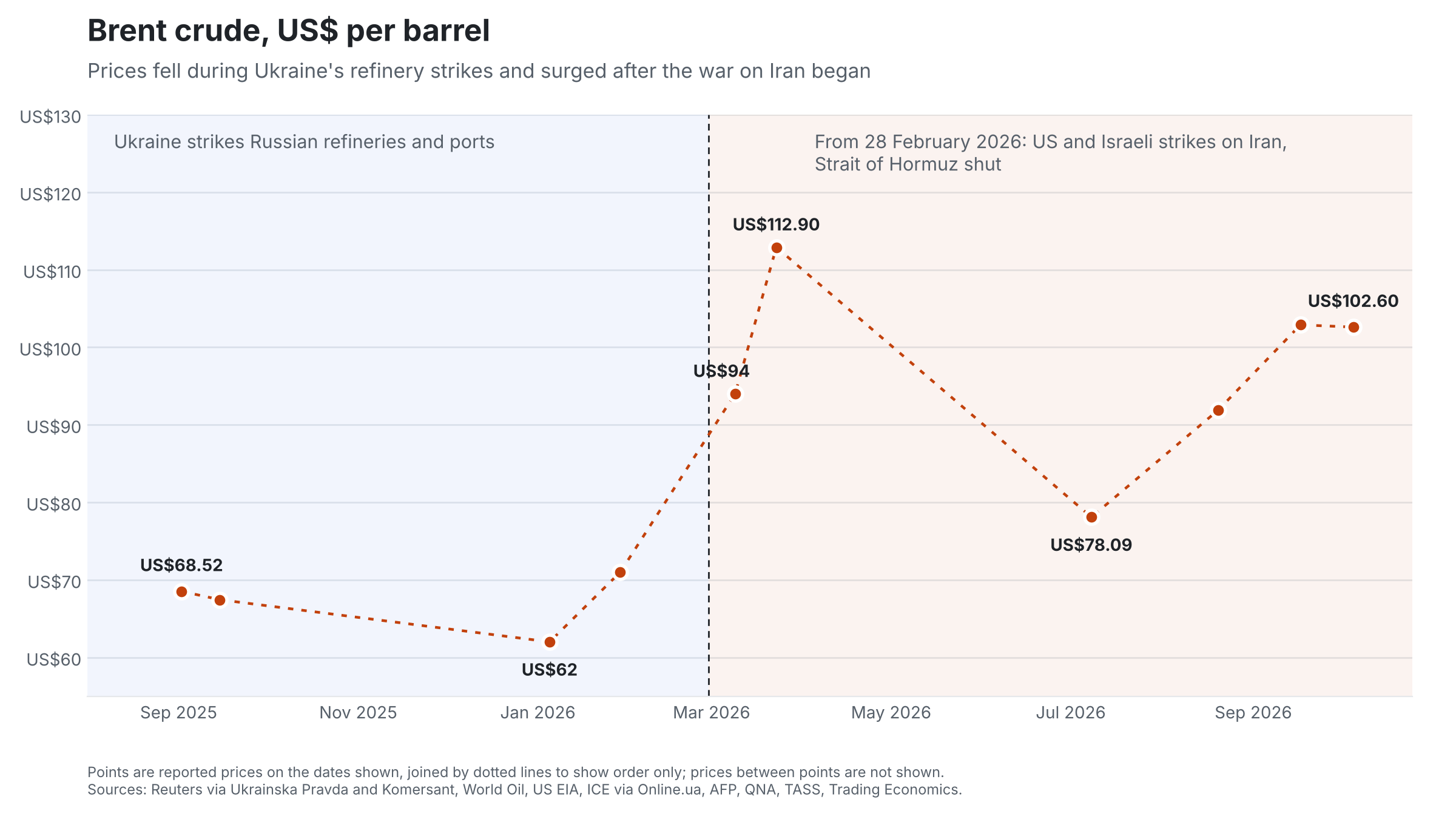
Brent crude cost US$62 a barrel in the first week of January 2026, after close to two years of Ukrainian drone strikes on Russian refineries. On 5 October 2026 it cost about US$102.60, roughly 57 per cent more than a year earlier. Prices began their climb on 28 February, the day President Donald Trump launched strikes on Iran with Israel and set off the closure of the Strait of Hormuz, the route for about one-fifth of the world's oil.
Fitch Ratings had assumed an average Brent price of US$63 for 2026. The agency forecast global supply growth of 2.4 million barrels a day against demand growth of about 0.8 million, and half of the new supply came from producers outside OPEC+.
Trump said the strikes were meant to destroy Iran's nuclear programme and potentially remove its government from power. Supreme Leader Ali Khamenei was reported killed in the first wave.
More than 100 US-based international law scholars, among them Harold Hongju Koh and Michael Schmitt, wrote in an open letter on 13 April 2026 that the strikes violated the UN Charter's ban on the use of force. The scholars wrote that the Security Council had not authorised the attack, that Iran had not attacked the United States or Israel and that no evidence showed an imminent Iranian threat.
Maersk, MSC, Hapag-Lloyd and CMA CGM suspended operations through the Strait of Hormuz after the Iranian government announced its closure. The strait carries large volumes of liquefied natural gas as well as crude.
Brent settled at US$94 on 9 March, according to the US Energy Information Administration. The price was roughly 50 per cent higher than at the start of the year and at its highest since September 2023. One month earlier the same agency had forecast a 2026 average of US$58.
Brent futures climbed above US$113 on 23 March as Trump gave Iran an ultimatum to reopen the strait. Later that day Trump announced a five-day pause on strikes against Iranian energy infrastructure, and Brent fell from US$112.90 to about US$99.90 within hours.
Ship-tracking data counted 14 vessels crossing the strait on one day in May, against a pre-war average of 130 a day. Energy costs in the United States had risen nearly 11 per cent since the war began.
Trump told reporters in July: "Anytime we hit Iran, oil goes up a little bit." He had just declared a memorandum of understanding with the Iranian government to end the conflict over and revoked a licence that allowed Iran to sell oil. Brent jumped 5.3 per cent to US$78.09 on 8 July.
The International Energy Agency wrote in August that global oil supply would fall by an average of 4.3 million barrels a day in 2026 and that consumption would shrink by 1.6 million barrels a day, citing the closure of the strait and high fuel prices.
Trump rejected an Iranian proposal in the first week of October for a seven-day arrangement to reopen the strait, according to reports at the time. Brent swung between about US$100 and US$108 that week.
Trump's false claims about Ukraine
Trump told reporters on 13 September that Zelenskyy "has to stop knocking out diesel fuel in Russia." He has blamed Ukraine's refinery strikes for high fuel prices ever since, and on 27 September he told reporters: "This isn't really a Middle Eastern problem; this is more of a Russia problem."
Diesel prices published by the US Energy Information Administration, an agency of Trump's own government, contradict him. US on-highway diesel averaged US$3.809 a gallon in the week of 23 February, before his war on Iran began. It reached US$4.859 by 9 March and US$5.401 by 30 March, more than three months before Russia banned diesel exports on 8 July, and hit a high of US$6.529 in the week of 21 September.
KSE Institute estimates that oil exports from the Persian Gulf fell by 152 million barrels from March to August, more than twice the 68 million barrel fall in Russian exports over the same period. Gulf diesel exports were running at about a quarter of pre-war levels in October.
Dmitry Peskov, the Kremlin spokesman, pointed to instability in the Gulf on 14 September and said the disruption of a Saudi oil pipeline alone had knocked more than 4 per cent of world supply off the market. Peskov welcomed Trump's call for Ukraine to stop hitting Russian diesel production on the same day.
Trump wrote in mid-September that Russia and Ukraine had agreed to stop attacking each other's energy facilities. Neither government confirmed any such deal, and both tacitly denied it.
Trump wrote on 9 October that the United States had "TOTAL CONTROL of the Strait of Hormuz." Seven commodity vessels crossed the strait on 6 October, the fewest since 23 July, according to the ship-tracking firm Kpler, and Iranian forces struck two tankers outside the strait within 24 hours of 8 October.
Trump eased US sanctions on Russian diesel on 9 October with a licence that runs until 7 April 2027. Russian strikes had killed at least 71 people across Ukraine in the previous three days, according to Ukrainian authorities.
Trump told reporters in February 2025 that Ukraine "should have never started" the war. Russia began its full-scale invasion of Ukraine on 24 February 2022.
What oil cost while Ukraine hit Russian refineries
Ukraine's long-range campaign against Russian refineries escalated in August 2025, with more than a dozen strikes that month. By early September the attacks had shut facilities accounting for at least 17 per cent of Russia's refining capacity, about 1.1 million barrels a day.
Brent stood at US$68.52 on 2 September 2025 and closed at US$67.44 on 15 September. Four months of continued refinery strikes later, the benchmark was near US$62.
Russia put more crude on the export market as its refineries lost capacity. Refinery strikes cut the fuel Russia can produce for its army and its domestic market, while the crude that would have been refined is sold abroad instead.
Lloyd Austin, then US Secretary of Defence, warned in 2024 that the strikes might push up global oil prices. The Ukrainian government argued they would not, and Brent was lower in January 2026 than in September 2025 despite the August escalation.
Ukrainian drones hit the Baltic ports of Primorsk and Ust-Luga and the Black Sea port of Novorossiysk in March and April 2026. The three terminals handle about 59 per cent of Russia's seaborne oil exports. KSE Institute estimated that the strikes cut Russian export earnings by about US$1.76 billion over the two weeks from 23 March to 5 April.
The Trump administration granted a waiver allowing sales of Russian crude already loaded on tankers, and India's demand for Russian oil revived. Russia's oil revenues rose after the Iran war drove prices higher. Ukraine's strikes on Tuapse, Novorossiysk, Ust-Luga and Primorsk were aimed at limiting how much of that windfall reached the Russian government.
What the other side argues
The Trump administration has justified the strikes as self-defence against the Iranian nuclear programme. The Iranian government announced the closure of Hormuz, and Iranian forces attacked several ships attempting to pass through the strait in the first days of March.
Port closures, pipeline problems and tanker disruptions after Ukrainian attacks cut as much as 40 per cent of Russia's oil export capacity in March 2026, by one estimate, tightening the supply of Russian barrels while Hormuz was shut.
Daniel Hynes, a commodity strategist at ANZ, said in September 2025 that the drone assaults had begun to affect trade flows. Brent also rose after Ukraine struck the port of Tuapse for the fourth time in a week in early May 2026.
Where the barrels went
KSE Institute found no discernible effect from Ukraine's port strikes on global prices. The institute wrote that the loss was overshadowed by the Iran war, which had removed around 15 million barrels a day from global circulation.
Commonwealth Bank of Australia estimated in August 2026 that restoring 50 to 60 per cent of pre-war traffic through Hormuz could revive expectations of oversupply and push Brent toward US$70 a barrel.