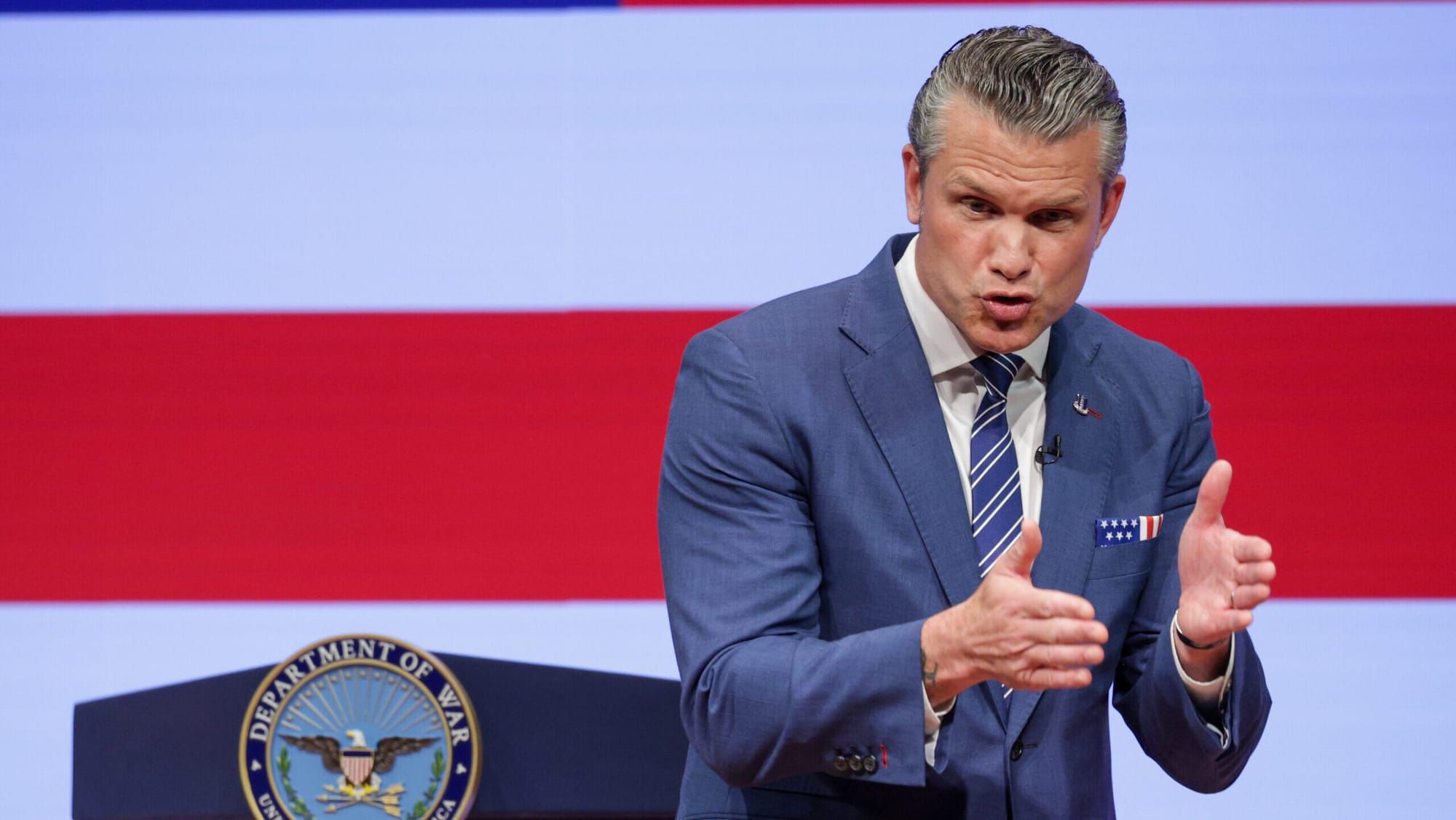
The Pentagon plans to broadcast live the firing-squad execution of Nidal Malik Hasan, the former Army major who killed 13 people at Fort Hood, Texas, in November 2009, The Wall Street Journal reported on 8 October 2026.
Pete Hegseth told the conservative outlet Real America's Voice, in an interview aired on 8 October, that he wanted to make sure "people are able to watch it" so the public would understand the consequences of such attacks. A Defense Department official confirmed the livestream in a written statement and gave no further details.
Hasan is scheduled to die at 1pm Central time on Thursday 3 December at Fort Hood. Hegseth said the date and hour were chosen to match the weekday and approximate time of the attack, which began on Thursday 5 November 2009.
Sean Parnell, the chief Pentagon spokesperson, announced on X on 5 October that Hegseth had recommended death by Army firing squad and that President Donald Trump had approved it. Pentagon officials told the Journal the approval came on 2 October. Only a president can approve the execution of a service member.
Army regulations require an execution to take place no sooner than 60 days and no later than 150 days after presidential approval, which puts the earliest permissible date at 1 December. Under the same rules a limited group of witnesses may attend, including relatives of victims and at least two news organisations. The wider public is not admitted under existing regulations.
The US military has not executed anyone since 13 April 1961, when Army Private John Bennett was hanged at Fort Leavenworth, according to the Death Penalty Information Center. The last known US military execution by firing squad took place in November 1945. Hasan is one of four prisoners on military death row.
Hegseth said the military had not used a firing squad since the Second World War and that he admired the wartime emphasis on winning. He described the Fort Hood shooting as an Islamist attack carried out from inside the ranks and called the choice of a firing squad an easy decision.
The Trump administration added firing squads, electrocution and gas asphyxiation to the permitted methods of federal execution earlier in 2026. At least five states have firing squads in law, and South Carolina carried out the first US firing-squad execution in 15 years in 2025.
A second Pentagon official told the Journal the choice of method was unrelated to supplies of pentobarbital, the barbiturate used in Tennessee's failed attempt to execute Christa Pike on 30 September. Pike survived two doses of the drug and was taken to hospital in critical condition. Tennessee Governor Bill Lee postponed the state's remaining executions for the year and ordered an independent review. Drugmakers no longer supply products for executions, and states have turned to loosely regulated sources.
The Fort Hood attack
Hasan, an Army psychiatrist, opened fire at the Soldier Readiness Processing Center at Fort Hood weeks before he was due to deploy to Afghanistan. He killed 12 soldiers and one civilian and wounded 32 others before a civilian police officer shot him. He is paralysed from the waist down. Investigators later found he had been in contact with the cleric Anwar al-Awlaki, who became a senior figure in al-Qaeda in the Arabian Peninsula.
A military jury of 13 officers convicted Hasan in 2013 of 13 counts of premeditated murder and 32 counts of attempted premeditated murder and sentenced him to death after about two hours of deliberation. Hasan represented himself at trial and told the court he had acted to stop soldiers from killing Muslims in Afghanistan. He exhausted his appeals in 2025 and is held at the military prison at Fort Leavenworth, Kansas.
Analysis: the legal and human rights case against a broadcast execution
Kentucky hanged Rainey Bethea in Owensboro on 14 August 1936 in front of a crowd estimated at 15,000 to 20,000 people. Bethea's hanging is regarded as the last public execution in the United States, and in 1938 Kentucky changed the law that had required it. Executions since then have taken place inside prisons before small groups of selected witnesses.
The Eighth Amendment to the US Constitution bars cruel and unusual punishment, and Article 55 of the Uniform Code of Military Justice applies the same ban to punishments imposed on service members. The Supreme Court upheld death by firing squad in Wilkerson v. Utah in 1879, which leaves little room to challenge the method itself.
Justice Neil Gorsuch, writing for the court in Bucklew v. Precythe in 2019, said the punishments the Eighth Amendment was understood to forbid were long-disused methods that added terror, pain or disgrace to a sentence of death. Opponents of the livestream argue that broadcasting a prisoner's death to an unlimited audience adds disgrace of that kind and revives a practice the country abandoned in the 1930s. The Supreme Court held in Trop v. Dulles in 1958 that cruelty is measured against "the evolving standards of decency that mark the progress of a maturing society".
Federal courts have rejected attempts to film executions. The Fifth Circuit ruled in Garrett v. Estelle in 1977 that a Dallas television cameraman had no First Amendment right to film executions in Texas. The North Carolina Supreme Court refused in May 1994 to let talk show host Phil Donahue videotape the gas chamber execution of David Lawson, and the US Supreme Court declined to intervene. In April 2001 Judge John Tinder in Terre Haute, Indiana, rejected a bid by Entertainment Network Inc, an operator of adults-only subscription websites, to webcast the execution of Oklahoma City bomber Timothy McVeigh. Attorney General John Ashcroft allowed a closed-circuit feed of McVeigh's death only for survivors and victims' relatives in Oklahoma City. Federal civilian rules prohibit any visual or audio recording of an execution.
Snuff films are recordings of real killings made so that people can watch them. Critics of the Pentagon plan say a government livestream of Hasan's death fits that description, since Hegseth's stated purpose is that people be able to watch. The jury verdict, the presidential approval and the firing squad complete the sentence whether or not anyone outside Fort Hood is watching, and Army rules already provide for victims' relatives and journalists to attend.
Anwar al-Awlaki praised Hasan as a hero after the 2009 attack. Any viewer can capture a livestream and repost it indefinitely, including groups that treat Hasan as a martyr. The Defense Department has not said whether it will restrict access to the stream, delay it or prevent recording.
The UN Human Rights Committee, which interprets the International Covenant on Civil and Political Rights, said in its General Comment No. 36 in 2018 that public executions are contrary to Article 6 of the covenant, which protects the right to life. The United States ratified the covenant in 1992 with reservations that preserve capital punishment and limit its obligations on cruel, inhuman or degrading treatment to what the Constitution already forbids. The International Bar Association's Human Rights Institute said in March 2024, after the Taliban shot three convicted men before crowds at sports stadiums in Ghazni and Sheberghan, that carrying out executions in public makes the punishment more cruel, inhuman and degrading.
Amnesty International recorded 2,707 executions in 16 countries in 2025, the highest figure since 1981, not counting China, which keeps its figures secret. Iran carried out at least 2,159 of them and Saudi Arabia at least 356, and Amnesty listed the United States among the countries where executions rose significantly. Iran hanged at least 11 people in public places in 2025, according to the Norway-based group Iran Human Rights. A total of 113 countries have abolished the death penalty for all crimes, up from 28 in 1976.
Hegseth has said public viewing will show that attacks like Hasan's carry serious consequences. Some opponents of capital punishment have also backed televised executions on transparency grounds, arguing the public should see what the state does in its name, which was Donahue's position in 1994. The National Research Council of the US National Academies concluded in 2012 that existing research was not informative about whether capital punishment increases, decreases or has no effect on homicide rates.
Boat strikes and the killing of survivors
US forces struck a boat in the Caribbean on 2 September 2025 that the administration said was carrying drugs, the opening strike in a campaign against alleged trafficking vessels. The Washington Post reported in late November 2025, citing unnamed sources, that Hegseth had ordered that none of the 11 people aboard should survive. According to the Post, Admiral Frank Bradley, then head of Joint Special Operations Command, ordered a follow-up strike that killed two survivors.
Hegseth called the Post report a fabrication, and Parnell called the account of a kill-all-survivors order a fake news narrative. The White House confirmed a second strike took place and said Bradley made the decision. Hegseth told reporters on 2 December 2025 that he watched the first strike live, then left for another meeting and "did not personally see survivors". Trump told reporters he would not have wanted a second strike.
Senators and representatives on the Armed Services Committees of both chambers opened inquiries. After a classified briefing with Bradley, Senator Tom Cotton, an Arkansas Republican, said the video showed two survivors trying to right a boat loaded with drugs and called the strikes lawful. Senator Jack Reed of Rhode Island, the senior Democrat on the Senate committee, said he still had serious questions about the legality of all the strikes. CBS News reported, citing a source, that the two survivors had been trying to climb back onto the vessel.
Todd Huntley, a former military lawyer who directs the national security law programme at Georgetown Law, said an instruction to kill everyone aboard would amount to "an order to show no quarter", which he said would be a war crime. The laws of armed conflict require parties to care for the wounded and shipwrecked.
US strikes have since spread to the eastern Pacific. UN human rights experts said in early September 2026 that at least 223 people had been killed in US strikes on boats over the previous year and called the killings illegal. Human Rights Watch and Amnesty International have described the strikes as unlawful extrajudicial killings, and the Inter-American Commission on Human Rights has held hearings on them. The administration says the United States is in an armed conflict with Latin American drug cartels and maintains the strikes are lawful. No court or tribunal has ruled on whether any strike amounted to a war crime.
Pardons for accused war criminals
Hegseth, then a Fox & Friends host, lobbied Trump privately and on air in 2019 on behalf of three servicemen accused of war crimes in Iraq and Afghanistan, according to reporting at the time by The Daily Beast and The Washington Post. On 15 November 2019 Trump pardoned Army First Lieutenant Clint Lorance, who had served about six years of a 19-year sentence for the second-degree murder of two Afghan men, and Major Mathew Golsteyn, who was awaiting trial on a charge of murdering an unarmed Afghan man. Trump also restored the rank of Navy SEAL Special Operations Chief Edward Gallagher, who had been acquitted of murdering a wounded Iraqi captive but convicted of posing for a photograph with the body.
Hegseth said in 2019 that the pardons were heartening for service members like him and that it "could've been me" on trial.
The 2017 Monterey allegation
A woman told police in Monterey, California, that Hegseth sexually assaulted her in a hotel room at the Hyatt Regency Monterey in the early hours of 8 October 2017, after he spoke at a convention of the California Federation of Republican Women. According to a 22-page police report released by the city on 20 November 2024, she said he took her phone, blocked the door and would not let her leave. She reported the assault at a hospital on 12 October 2017 and underwent a sexual assault examination.
Monterey police recommended that the case be forwarded to the Monterey County District Attorney's Office, and no charges were filed. Hegseth told police the encounter was consensual. His lawyer, Timothy Parlatore, said the woman had initiated the sexual activity and described her claims as blackmail. Parlatore also said the report showed police had found the allegations false, a finding the report does not contain, CNN reported.
Hegseth paid the woman $50,000 under a confidential settlement, according to written answers he gave a senator during his January 2025 confirmation process that were obtained by The Associated Press. Parlatore said Hegseth settled out of concern the allegation would cost him his job at Fox News. Hegseth told senators at his confirmation hearing that he had been "falsely" accused and fully cleared.