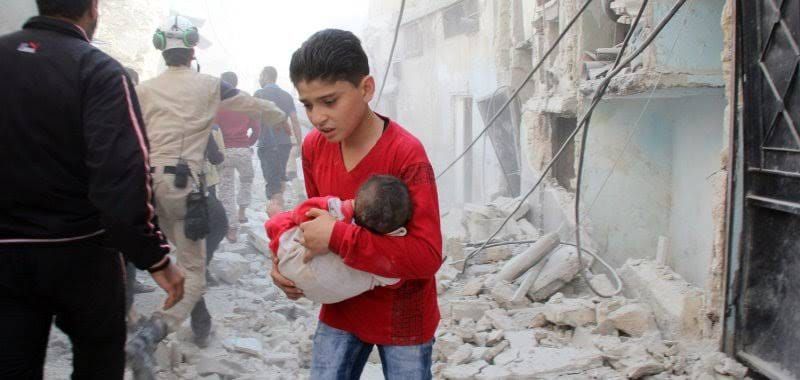
Yoav Gallant, Israel's defence minister, ordered a complete siege of the Gaza Strip on 9 October 2023. "No electricity, no food, no fuel, everything is closed," he said. Two days earlier Hamas-led fighters had killed about 1,200 people in southern Israel and taken 252 hostages.
Russian missiles had been hitting Ukraine's power grid for a year by then. In April 2018 Syrian government forces had starved Eastern Ghouta, a rebel enclave outside Damascus, into surrender.
Strategists call the method behind all three punishment-based coercion. It uses violence against civilians to force a government or armed group to accept terms it would otherwise refuse, and it does not require winning on the battlefield. Continued resistance only has to look more costly than giving in.
Sherman's armies burned a path across Georgia in 1864. More than 26,000 Boer civilians died in British camps in South Africa between 1900 and 1902, and Allied bombers burned Hamburg and Tokyo in the Second World War. Bosnian Serb gunners held Sarajevo under fire for nearly four years. After the 2006 war in Lebanon, Israel's policy of disproportionate force against villages used by Hezbollah came to be called the Dahiya doctrine.
Leningrad, London and Sarajevo held out. Small Syrian towns with no hope of rescue did not.
International humanitarian law bans deliberate attacks on civilians, and most forms of the method are war crimes. The International Criminal Court (ICC) has issued arrest warrants over the alleged starvation of civilians in Gaza and over strikes on Ukraine's grid.
The theory
Schelling and the power to hurt
Thomas Schelling, an American economist, set out the logic in Arms and Influence in 1966, writing against the backdrop of nuclear deterrence. "The power to hurt is bargaining power. To exploit it is diplomacy," he wrote. He called it vicious diplomacy, but diplomacy all the same.
Schelling drew a line between hurting someone and being able to hurt them. Brute force works when it is used. The power to hurt works best in reserve, because it is the expectation of more pain that changes an opponent's choices.
Pape: denial and punishment
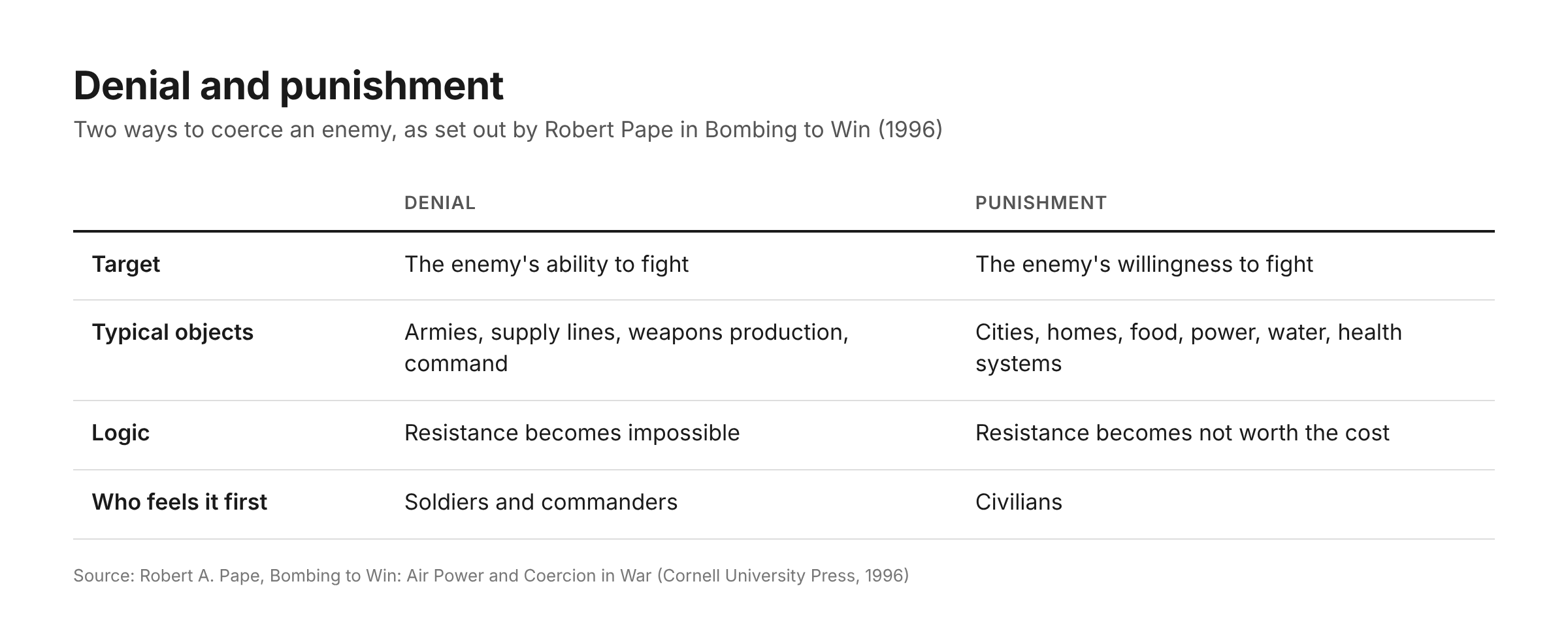
Robert Pape, a political scientist at the University of Chicago, drew the distinction most strategists now use in Bombing to Win (1996). Denial attacks an enemy's ability to fight. Punishment attacks its willingness to fight, and civilians feel it first.
Douhet and the airpower theorists
Giulio Douhet, an Italian general, gave the idea its airpower form in The Command of the Air in 1921. Bomb the cities, he argued, and terrified populations would turn on their own leaders and demand peace within days.
Stanley Baldwin told the House of Commons on 10 November 1932 that "the bomber will always get through." A nation would have to "kill more women and children more quickly than the enemy," he said. Baldwin was arguing for disarmament.
Within a decade the air forces of Britain, Germany and the United States had all adopted the bombing of cities as doctrine.
The methods
A city of a million people needs water pumped, bread baked and hospitals lit every day. Its systems depend on one another, so damage to one spreads through the rest, and an army can dig in and ration its supplies in ways a population cannot.
Bombardment of populated areas
Shelling and air strikes on homes, markets, schools and squares tell residents that nowhere is safe. Snipers covering streets do the same on a smaller scale.
A handful of strikes on a market can change how a whole city lives. People change their routes and keep their children indoors, and markets and schools empty out.
A single mortar shell killed 68 people and wounded 144 at Sarajevo's Markale market on 5 February 1994. Five shells killed 43 people near the same market on 28 August 1995. The Yugoslav tribunal found that Bosnian Serb forces fired the 1994 shell, though its firing position is still disputed, and a UN investigation traced the 1995 shells to Bosnian Serb territory. NATO began Operation Deliberate Force, its bombing campaign against Bosnian Serb forces, two days later.
Siege, blockade and starvation
Encirclement cuts off food, fuel, medicine and trade. Whoever holds the roads, crossings and ports decides what enters and when, and aid convoys wait at checkpoints for permits. Inspectors can turn away fuel, fertiliser or water pipes on the grounds that they might serve a military purpose.
Malnutrition weakens the immune system, so diarrhoea, pneumonia and measles kill people who would survive them on a full diet. Infants die early, because mothers who cannot eat enough produce less breast milk.
Leningrad's authorities cut the daily bread ration for dependants and children to 125 grams on 20 November 1941. Tanya Savicheva, a schoolgirl, recorded each death in her family in a notebook. Her last entry, written after her mother died in May 1942, reads: "Only Tanya is left." She died in 1944.
In Gaza, the Integrated Food Security Phase Classification initiative projected in August 2025 that at least 132,000 children under five would suffer acute malnutrition by June 2026, more than 41,000 of them severely. Children who survive can be left stunted for life.
Attacks on essential infrastructure
Power stations, water treatment plants, heating networks, bridges, fuel depots and telecommunications are struck to degrade a whole society at once. A handful of large substations can carry a city's electricity.
When the power fails, water stops. Sewage plants stop with the pumps, and untreated waste reaches streets and water sources, spreading cholera and typhoid. Hospitals run on diesel generators for as long as fuel can be brought in, and telephone networks fail, cutting people off from ambulances and warnings.
Israeli warplanes struck bridges, roads and the runways and fuel tanks of Beirut's international airport in the first days of the 2006 war, Human Rights Watch reported. Israel said the airport was a central hub for moving weapons and supplies to Hezbollah.
Attacks on health care
Hospitals, clinics, ambulances and medical staff come under fire or lose supplies and power. Dialysis and cancer patients lose care first, and every ordinary illness kills more people.
"Doctors are amputating patient children without anaesthesia," Mohammed Abu Mughaisib, a medical coordinator for Doctors Without Borders in Gaza, told Channel 4 News in October 2023. ICC judges cited the same practice when they issued arrest warrants in November 2024.
Hospitals keep their protection under the Geneva Conventions unless they are used to commit acts harmful to the enemy, and even then an attacker must warn first and give time to comply. Israel has said Hamas used hospitals in Gaza for military purposes.
Forced displacement
Violence, threats and the destruction of housing drive people out. Displaced families lose homes, jobs, land and documents and crowd into tents, schools or relatives' homes. Evacuation orders can push whole populations into shrinking areas.
The Fourth Geneva Convention bans the forcible transfer of protected persons and allows evacuation only for their security or for imperative military reasons, with return once hostilities end. The Rome Statute lists forcible transfer of a population as a crime against humanity.
Deliberate unpredictability
Strikes vary in time, place and intensity, and ceasefires are announced and broken. People weigh every trip for water or bread against the chance of a strike.
Ukraine's air-raid alert on the night of 1 October 2026 lasted more than 12 hours, Reuters reported. Dmytro Lubinets, Ukraine's human rights ombudsman, said the same day that Ukraine faced a critical shortage of urban shelters.
How suffering becomes bargaining power
Civilians press their leaders for food, shelter and an end to the killing, and governments divert money and people from defence to emergency relief. Israel's bombing campaigns in southern Lebanon in 1993 and 1996 sought to turn Lebanese civilians and their government against Hezbollah, Human Rights Watch found.
Hamas's hostage-taking put pressure on Israel's government in a similar way. Families of hostages and their supporters protested in Tel Aviv on 1 March 2025 to demand their release.
Civilians can move only leaders who answer to them, through elections, protest or the loyalty of local commanders.
Netanyahu's office halted all goods entering Gaza on 2 March 2025 to press Hamas to release more hostages. "Israel will not allow a ceasefire without the release of our hostages," the office said. Egypt, a mediator, accused Israel of using starvation as a weapon.
Syrian government forces traded food and safe passage for surrender, town by town, in local "reconciliation" agreements. Eastern Aleppo's last fighters and civilians were bused out in December 2016 under one such deal. A week-long truce in Gaza in late November 2023 exchanged hostages for Palestinian prisoners and let more aid in.
Over time negotiators stop asking whether the original demands are legitimate and start asking which concessions might stop the killing.
Case studies
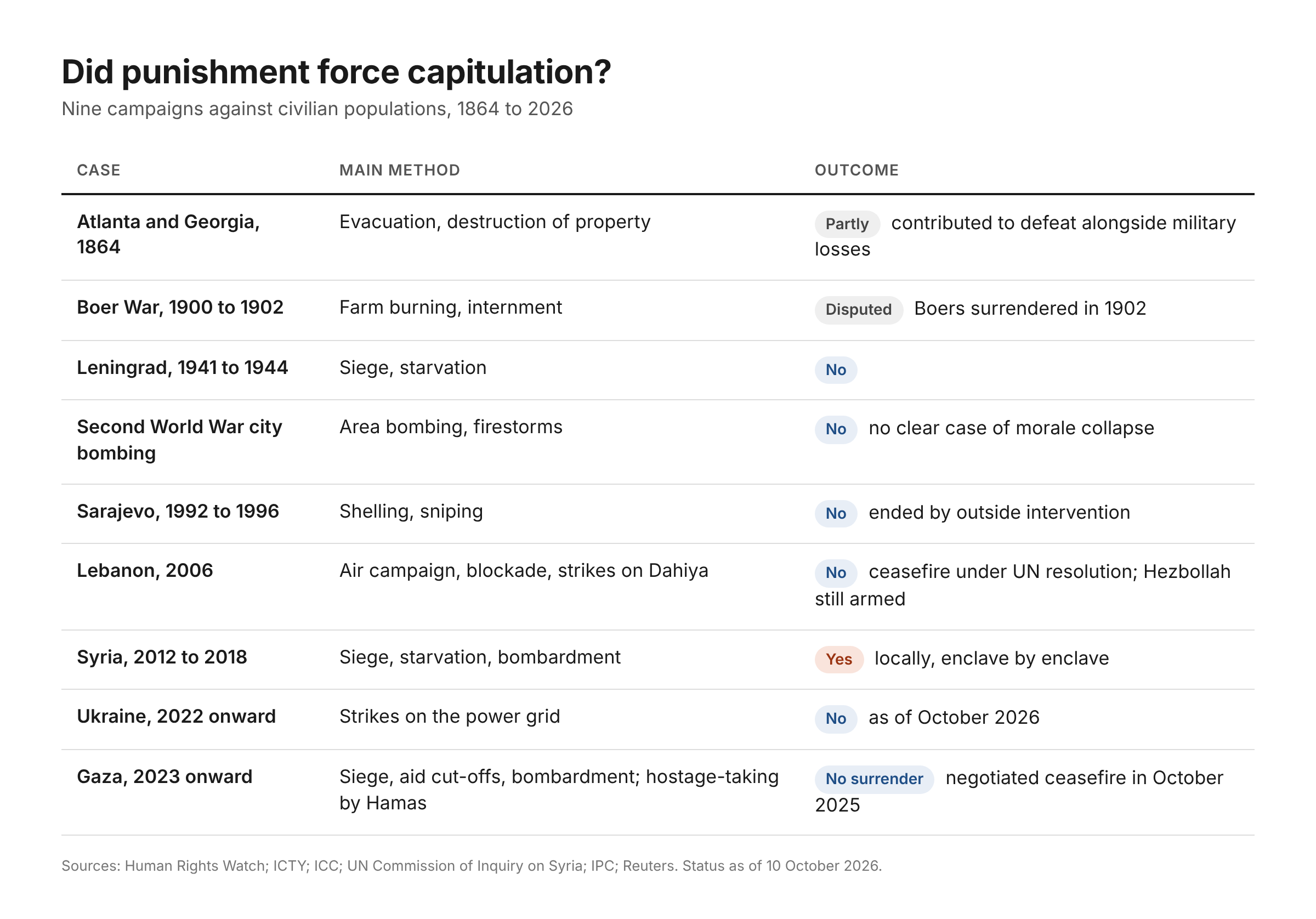
Atlanta and the March to the Sea, 1864
Union forces under General William Tecumseh Sherman took Atlanta in September 1864, and Sherman ordered the city's entire civilian population to leave. Mayor James Calhoun asked him to reverse the order. Sherman refused in a letter dated 12 September:
"War is cruelty, and you cannot refine it; and those who brought war into our country deserve all the curses and maledictions a people can pour out."
Sherman's armies then marched to the sea, wrecking railways, farms and stores across Georgia. He wanted Southern civilians to see that the Confederacy could not protect them.
Most of the destruction targeted the Confederate war economy. The campaign mixed denial and punishment and did not set out to kill civilians in large numbers.
The Boer War camps, 1900 to 1902
British forces fighting Boer guerrillas in South Africa burned farms and crops and moved families into overcrowded camps. Lord Kitchener, who took command in late 1900, added lines of blockhouses and barbed wire that cut the veld into sections.
More than 26,000 Boer civilians died in the camps, most of them women and children. Up to 20,000 Black Africans died in separate camps. Measles, typhoid and dysentery spread through crowded tents.
Emily Hobhouse, a British campaigner, visited the camps in 1901 and caused a scandal in Britain. A government commission led by Millicent Fawcett confirmed much of what she reported. Historians still argue over whether the camps shortened the war or hardened Boer resistance. Boer leaders signed the Treaty of Vereeniging on 31 May 1902.
The Siege of Leningrad, 1941 to 1944
German and Finnish forces encircled Leningrad, the Soviet Union's second city, for 872 days from September 1941. A German naval staff directive that month said the city was to be wiped off the map and that any offer of surrender would be refused.
About 1.5 million people died, from a pre-war population of about 3.2 million. Most civilians died of hunger and cold in the first winter, when water mains froze and the power failed.
Supplies came across Lake Ladoga, by barge in summer and by truck over the ice in winter, along a route residents called the Road of Life. The Red Army opened a land corridor in January 1943 and lifted the siege on 27 January 1944. Leningrad never surrendered.
City bombing in the Second World War
Germany bombed Guernica in 1937 and British cities in the Blitz of 1940 to 1941, killing about 43,000 civilians. Bomber Command, led by Arthur Harris from 1942, turned to area bombing of German cities. The United States firebombed Japan in 1945.
The Hamburg raids of July 1943 killed about 37,000 people. On the night of 9 to 10 March 1945, US bombers killed an estimated 90,000 to 100,000 people in Tokyo and left more than one million homeless, the deadliest air raid in history.
Planners wanted to "de-house" workers and break civilian will. German war production kept rising until late 1944.
The Siege of Sarajevo, 1992 to 1996
Bosnian Serb forces encircled Sarajevo from April 1992 to February 1996, the longest siege of a capital city in modern history. Shells and snipers hit people queuing for bread or water, funerals and trams. Residents named one main road "Sniper Alley".
Bosnian authorities counted more than 11,000 people killed, more than 1,500 of them children. Residents lived on UN airlifts and supplies carried through a tunnel under the airport runway. "We all lost weight, we changed, we all had fear in our eyes," Alma Milos, who fled with her infant son, told SBS News in 2016.
The siege ended after NATO air strikes in 1995 and the Dayton Agreement. The International Criminal Tribunal for the former Yugoslavia convicted General Stanislav Galić in December 2003 of a campaign of sniping and shelling meant to spread terror among civilians, the first such conviction by an international court. Judges inferred his intent from the pattern of attacks, and the appeals chamber raised his sentence to life imprisonment in 2006.
Southern Lebanon and the Dahiya doctrine, 2006
Hezbollah fighters crossed into Israel on 12 July 2006, killed three soldiers and captured two to trade for Lebanese prisoners. Israel answered with a 34-day air, sea and ground campaign and a blockade of Lebanon.
Human Rights Watch counted at least 1,109 Lebanese deaths, most of them civilians, and about one million people displaced. Hezbollah fired about 4,000 rockets into northern Israel, killing 43 Israeli civilians and 12 soldiers.
Dan Halutz, Israel's chief of staff, said the offensive would "turn back the clock in Lebanon by 20 years" if the soldiers were not returned. Human Rights Watch said Israeli officials' statements suggested that strikes on Dahiya, Beirut's southern suburbs, hit whole neighbourhoods seen as pro-Hezbollah.
Gadi Eisenkot, then head of Israel's Northern Command, told Yedioth Ahronoth in October 2008 that what happened to Dahiya would happen to every village used to fire on Israel. "We will apply disproportionate force and inflict huge damage and destruction," he said. Haaretz called it the Dahiya doctrine.
A ceasefire under UN Security Council Resolution 1701 took effect on 14 August 2006. Hezbollah kept its weapons. Israel got the bodies of the two soldiers back in a prisoner exchange in July 2008.
Syria's "surrender or starve" sieges, 2012 to 2018
Syrian government forces, backed by Russian airpower, besieged rebel-held Madaya, eastern Aleppo and Eastern Ghouta. They blocked aid convoys and bombarded homes, markets and hospitals.
Pictures of starving residents of Madaya drew international attention in January 2016 before aid convoys were let in. Eastern Aleppo fell that December after months of bombardment.
The UN Commission of Inquiry on Syria found that the tactics in Eastern Ghouta aimed to force the population, collectively, to surrender or starve, and that the deliberate starvation of civilians amounted to a crime against humanity. Eastern Ghouta fell in April 2018. About 140,000 people were displaced, and up to 50,000 were moved to Idlib and Aleppo under evacuation agreements.
Syria is one of the few modern cases where punishment achieved its local aim.
Ukraine's energy grid, 2022 onward
Russian forces began waves of missile and drone strikes on Ukraine's power plants and substations in October 2022, concentrated before and during winter. Blackouts also cut water, heating and communications. Ukrainian officials say the aim is to push Ukraine towards concessions. Russia says energy infrastructure is a legitimate military target and denies targeting civilians.
"We are civilians. We aren't trained to deal with this," Oleksandr, the manager of a damaged thermal power plant, told NPR in November 2024. His crews rebuilt boilers and switchyards between strikes.
ICC judges issued arrest warrants in March 2024 for two Russian commanders, Sergei Kobylash and Viktor Sokolov, and in June 2024 for Sergei Shoigu, the former defence minister, and Valery Gerasimov, chief of the general staff. All four cover strikes on Ukraine's electricity system from October 2022 to March 2023. Russia does not recognise the court's jurisdiction.
Russia launched nearly 190 drones and ballistic missiles at Ukraine on 1 October 2026, killing seven people and damaging power facilities around Kyiv, Reuters reported.
Gaza, 2023 onward
Hamas-led fighters killed about 1,200 people in Israel on 7 October 2023, most of them civilians, and took 252 Israelis and foreigners hostage. Israel's siege of Gaza began two days later.
ICC judges issued arrest warrants on 21 November 2024 for Prime Minister Benjamin Netanyahu and Gallant over the war crime of starvation as a method of warfare and crimes against humanity. Netanyahu called the charges absurd. The court also issued a warrant for Mohammed Deif, commander of Hamas's armed wing, over crimes including the hostage-taking of 7 October.
The Integrated Food Security Phase Classification initiative confirmed famine in Gaza Governorate as of 15 August 2025. Israel's foreign ministry said "there is no famine in Gaza". A UN Commission of Inquiry concluded on 16 September 2025 that Israel was committing genocide, a finding Israel rejected.
A US-backed ceasefire took effect on 10 October 2025, and all surviving hostages were freed that month. Gaza's health ministry, whose figures do not separate civilians from combatants, put the death toll since October 2023 at 73,651 as of 5 September 2026.
At a glance
Does punishment work?
Robert Pape analysed more than 30 air campaigns, from the Spanish Civil War to the Gulf War. Success, he found, came from attacking the enemy's military strategy. He judged punishment of economies and populations both immoral and ineffective, and credited Japan's surrender in 1945 to naval blockade and the threat of invasion.
Michael Horowitz and Dan Reiter tested Pape's claims statistically across air campaigns from 1917 to 1999. Greater civilian vulnerability did not make coercion more likely to succeed; greater military vulnerability did.
Alexander Downes asked a different question in Targeting Civilians in War (2008): why states do it at all. He found they turned on civilians most often when desperate in long wars of attrition or when they wanted to seize territory.
The US Strategic Bombing Survey found that bombing depressed German morale, but Germans living under a police state had neither the will nor the means to turn on the regime. The survey, whose staff included the economist John Kenneth Galbraith, credited attacks on oil and transport in 1944 and 1945 with breaking the German war economy. Britain's Bombing Survey Unit, led by the zoologist Solly Zuckerman, reached a similar verdict in 1946.
Londoners made the Blitz a symbol of defiance. Ukrainians have patched their grid through four winters of strikes and imported power from the European Union. The Nazi and Japanese governments, which expected surrender to destroy them, kept fighting for months while their cities burned.
Punishment has worked where denial was already winning. Syrian enclaves fell because they were small, surrounded and cut off from any rescue.
Striking cities and power grids is cheaper than defeating a defended army, and the leaders who order such campaigns rarely bear the cost.
The law
International humanitarian law bans deliberate attacks on civilians whatever military or political objective is pursued. Additional Protocol I sets out the core principle in Article 51(2): "The civilian population as such, as well as individual civilians, shall not be the object of attack."
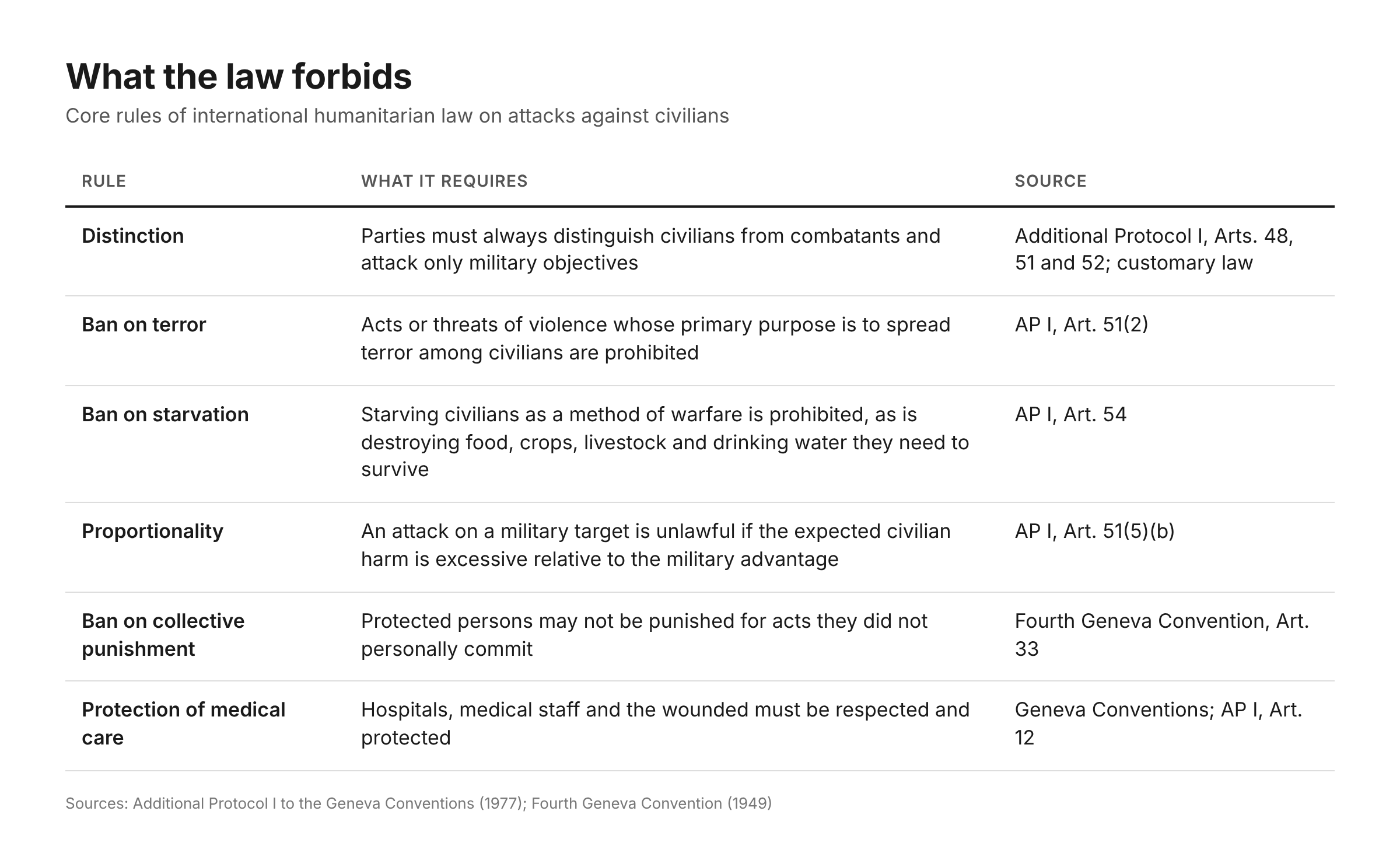
Article 51 also bans indiscriminate attacks, including bombardment that treats several separate military targets in a town as one. Article 57 requires attackers to verify their targets, choose weapons that limit harm to civilians and give advance warning where they can.
Article 58 requires defenders to keep military objectives away from densely populated areas where feasible, and Article 51(8) says one side's violations do not release the other from its obligations.
Israel and the United States are not parties to Additional Protocol I, though its core rules bind them as customary law. Russia and Ukraine are parties. The International Committee of the Red Cross set out 161 rules of customary humanitarian law in a 2005 study, and Israel's Supreme Court applied rules drawn from the protocol in a December 2006 judgement on targeted killings.
Criminal accountability
The Rome Statute of the ICC makes it a war crime to intentionally attack civilians or civilian objects or to starve civilians as a method of warfare. Committed as part of a widespread or systematic attack on a civilian population, such acts can also be crimes against humanity.
The statute sets a higher bar than Additional Protocol I for incidental harm: the expected civilian loss must be clearly excessive. States parties extended the starvation offence to civil wars in December 2019. Commanders can be held responsible for crimes by forces under their control.
The court can try crimes committed on the territory of its 125 states parties, whatever the nationality of the suspect. Palestine accepted its jurisdiction in 2015, and Ukraine became a state party on 1 January 2025. ICC judges rejected Israel's challenge to their jurisdiction in November 2024. The court does not try suspects in absentia, so its cases depend on arrests.
Proving intent
Attackers rarely admit to punishment. Russia says Ukraine's energy grid is a legitimate military target. Israel says Hamas embeds fighters and weapons in civilian sites and bears responsibility for civilian harm. Syria's government called the besieged enclaves terrorist strongholds.
Human Rights Watch documented Hezbollah weapons stored in homes and rocket fire from populated areas in 2006, which bore out part of Israel's case. It also found the practice was not widespread and did not account for most Lebanese civilian deaths.
Power grids, bridges and fuel depots can be genuine dual-use targets. Investigators look for patterns across many incidents:
- Repeated strikes on the same kinds of civilian targets.
- Timing that concentrates harm on civilians, such as strikes before winter or on bread queues.
- Targets with little or no military value, where harm to civilians is the main effect.
- Leaders tying relief to concessions, such as food or corridors offered only in exchange for surrender or hostages.
- Public or intercepted statements describing the purpose as breaking the population's will.
Accountability under attack
The Gaza ceasefire reached its first anniversary on 10 October 2026. Ukrainian officials said on 1 October that they feared Russia was preparing another winter campaign against electricity and heating supplies.
The Norwegian Nobel Committee awarded the 2026 Nobel Peace Prize on 9 October to Navi Pillay, who chaired the UN commission of inquiry on Israel and the occupied Palestinian territory. Her commission condemned the Hamas-led attacks of 7 October 2023, found in June 2024 that both Hamas and Israel had committed war crimes and concluded in September 2025 that Israel was committing genocide. Israel's foreign ministry called the genocide report distorted and false.
The US Treasury added the ICC itself to its sanctions list on 9 October 2026, after sanctioning 13 court officials. "Either the ICC will end its threats, or we will end the ICC," Secretary of State Marco Rubio said. Netanyahu wrote on X that he commended President Donald Trump and Rubio for the decision.
Foreign ministers of Canada, the United Kingdom, France, Germany, Italy, Japan, Denmark and the Netherlands said they strongly disagreed with the sanctions. They committed to talks with states outside the court before its Assembly of States Parties meets in December 2026.