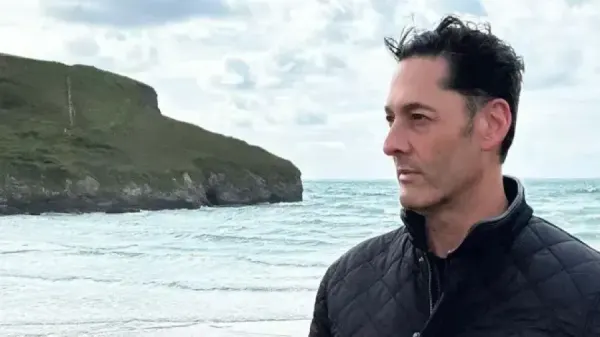

Federal Criminal Police Office officers arrested August Hanning, 80, at his home in Nordwalde near Münster, the town where he was born, on the morning of 6 October. The Federal Prosecutor General said Hanning is strongly suspected of treasonous espionage, spying out state secrets, attempted treason and working as an agent for a foreign intelligence service, offences under sections 94, 96 and 99 of the German criminal code. Hanning coordinated the federal intelligence services at the chancellery from 1996 to 1998, was president of the Federal Intelligence Service (BND) from December 1998 to November 2005 and then served as state secretary at the federal interior ministry until November 2009.
Officers arrested a second man, Manfred D., in the Bad Tölz-Wolfratshausen district of Bavaria at the same time. Manfred D. ran Hanning's office at the BND, followed him to the interior ministry as his assistant and returned to the agency in March 2012 as office chief to the BND presidents who came after Hanning. He held that post until March 2026 and is now retired. Prosecutors accuse him of aiding and abetting attempted treason and treasonous espionage.
Both men were brought before investigating judges at the Federal Court of Justice, which issued the arrest warrants, to decide whether they should be held in custody pending trial. Manfred D. was due in court on 6 October and Hanning on 7 October. Police also searched several further properties, including addresses in Berlin.
The documents
Prosecutors allege Hanning and Manfred D. agreed in spring 2010 that Manfred D. would pass him internal BND material "in exchange for remuneration". By June 2022, according to the prosecutor's statement, Manfred D. had handed over about 2,000 documents, "many of which contained classified information to be used exclusively by the Federal Intelligence Service for internal purposes". Part of the material was prepared for the weekly security briefing at the chancellery, where the heads of Germany's security agencies and senior officials from the federal ministries share intelligence.
The most recent documents date from June 2022 and include reports on Iran's nuclear programme, Russian military capabilities and material the BND had received from allied intelligence services, WDR, NDR, Süddeutsche Zeitung and t-online reported.
"In one instance, there is suspicion that Mr. Hanning used classified information to prepare an analysis for an employee of a foreign intelligence service," Ines Peterson, a spokeswoman for the Federal Prosecutor General, told the broadcaster RTL. Prosecutors said it was unclear whether the analysis reached that officer. They also accuse Hanning of an "intensive exchange" over several years with a representative of a second foreign intelligence service, to whom he passed political information partly drawn from Manfred D.'s documents.
Azerbaijan and Central Asia
Der Spiegel reported on the evening of 6 October that the suspected client for Hanning's analysis was an officer of Azerbaijan's intelligence service. Tagesspiegel, t-online and other German outlets carried the report. Peterson's office declined to name the countries involved. WDR, NDR and Süddeutsche Zeitung reported that the allegations do not concern Russia.
Hanning sat on the board of the German-Azerbaijani Forum, a Berlin association founded in 1997 to promote ties with Azerbaijan, the Austrian newspaper oe24 reported. Lobbycontrol, a German transparency group, called the forum a "dubious Azerbaijan network" in 2021. Several Christian Democrat MPs connected to it, including Karin Strenz and Mark Hauptmann, were investigated over their work for Azerbaijan in what German media called the Azerbaijan affair.
The German Press Agency (dpa) reported that Hanning's foreign contacts in the case are likely to include business partners from his consulting work, for example from Central Asia.
Hanning's consulting business
Hanning and his wife founded Hanning Consult in July 2010, the same year prosecutors say his arrangement with Manfred D. began, according to the investigative newsroom Correctiv. The company listed Kazakhstan among its clients and reported €3 million in equity by 2024. Hanning transferred most of his shares to his wife and three daughters in October 2019 and kept 0.5 per cent.
Hanning became chairman of the board of Pluteos AG, a firm in Lucerne, Switzerland, in April 2018. Pluteos offered clients "lawfully obtained exclusive information", cyber security services and geopolitical situation reports, and its website said: "A focus of our work is timely Red Flags, rapid provision of assessments meaningful to clients." Hanning also held shares, partly through holding companies, in GSC4 GmbH, founded in 2018, which sold business intelligence and investigative research covering "Russia, CIS, Eastern Europe, China & Arab regions". GSC4 reported revenue of about €2.2 million in 2024 and was dissolved in June 2026. Hanning worked for G3, a British consultancy, as a senior adviser and then as its regional director for Russia and the former Soviet republics, Correctiv reported.
Russian business contacts
Hanning gave expert evidence for Oleg Deripaska, the Russian aluminium billionaire, in the London High Court in 2012, in Deripaska's defence against a claim by the Russian-Israeli businessman Michael Cherney over shares in Rusal. Hanning described how Russian organised crime groups threaten witnesses and cited a 2010 money laundering trial in Stuttgart, in support of Deripaska's request to protect 12 witnesses. Mr Justice Andrew Smith wrote in his judgment of 12 July 2012: "I do not doubt the evidence of Dr Hanning", but found it addressed criminal prosecutions, not civil cases. Hanning did not ask German authorities for permission to testify, and the federal government told parliament it had no prior knowledge of the testimony, Schwäbische Zeitung reported. The United States sanctioned Deripaska in April 2018.
Hanning attended the Moscow Conference on International Security, organised by the Russian defence ministry, in April 2016, Nordkurier reported. The same year Piotr Kondrashev, a Russian commodities businessman, hired him through the Swiss security consultancy System 360 to mediate in a dispute with the Russian-British banker Grigory Guselnikov. The mediation failed. A year later Hanning joined the supervisory board of Guselnikov's Latvian bank, PNB Banka, reportedly for €12,000 a month.
Samuel Danilowitsch, a fellow Pluteos board member with long-standing ties to the commodities trade and to Russia, is the company's majority shareholder, according to Nordkurier. Hanning, Danilowitsch and Sergej Rubinstein travelled to Moscow for Pluteos in May 2019 for a Club of Three meeting that discussed how Europe and Russia could expand economic cooperation despite sanctions.
The Insider, a Russian investigative outlet, reported that Hanning flew to Moscow at least seven times between 2015 and 2019, usually arriving in the evening and leaving the next day. On 6 and 7 July 2016 he flew from Munich to Moscow and returned to Berlin the following afternoon, the outlet reported.
The Block kidnapping case and Israeli contacts
Hamburg prosecutors found the BND material while investigating Hanning in a separate case. Christina Block, 53, heiress to the Block House steakhouse chain, has been on trial at the Hamburg Regional Court since July 2025, accused of hiring Cyber Cupula Operations, an Israeli security company, to abduct her two youngest children, then aged 13 and 10, from the Danish home of their father, Stephan Hensel, on New Year's Eve 2023. Hensel had kept the children after a weekend visit in August 2021. Block denies the charge. A 37-year-old Israeli co-defendant, arrested in Cyprus in 2024, has admitted leading the operation. The trial had reached its 76th day in late September, and the presiding judge said numerous defence applications still had to be dealt with before a verdict.
Hamburg prosecutors accuse Hanning and a former Hamburg police officer of planning an earlier, failed attempt to seize the children on 9 November 2022 as the people responsible for a security company. They are also examining whether the pair took part in the abduction a year later and in a campaign, with Block and employees of the Israeli firm, to smear Hensel and his lawyer with false accusations of paedophilia. Hanning denies the allegations through his lawyer.
Police executed 13 search warrants in Germany and Switzerland on 16 September 2025, including at Hanning's home and offices. State criminal police officers found a data storage device holding sensitive material that included recent BND documents. The Hamburg police handed the material to federal authorities, and the Federal Prosecutor General took over the espionage investigation in May 2026, working with the BND and the Federal Criminal Police Office.
Prosecutors allege Hanning enlisted Yaakov Peri, head of the Shin Bet security service from 1988 to 1995 and now head of the Tel Aviv consultancy CGI Group, to assemble the kidnap team, Ynetnews reported in October 2025. Hanning denied ever contacting Peri and said he was unaware of reports that €7 million had been paid to the group, the Jerusalem Post reported. CGI Group denied any involvement and said it would sue outlets that published the allegations.
Hensel said the team assaulted him before taking the children to Germany. He also said Hanning recruited Danny Yatom, director of the Mossad from 1996 to 1998. Yatom denied any part in the case and called the reports "a waste of time". The Hamburg court held parts of the trial behind closed doors in October 2025, saying testimony could expose sensitive German and Israeli security interests.
World Health Energy Holdings (WHEN), an Israeli cyber security company of which Yatom is president, appointed Hanning to its advisory board in July 2021. "As a fellow senior intelligence expert, I am ecstatic that Dr. Hanning accepted our invitation to join the board," Yatom said at the time. Hanning told the Jerusalem Post that month that "Israel was always a model because Israel was facing very serious terrorist threats."
Hanning flew to Beirut in December 2000 with BND Middle East specialists, on Chancellor Gerhard Schröder's instructions, to negotiate with senior Hezbollah officials over three Israeli soldiers captured that October. Germany spent three years brokering the deal, completed at the Cologne-Wahn air base on 29 January 2004, under which Hezbollah returned the soldiers' bodies and the Israeli businessman Elhanan Tannenbaum and Israel freed several hundred prisoners.
American contacts
United Against Nuclear Iran (UANI), a New York group founded by the former CIA director James Woolsey, the diplomats Richard Holbrooke and Dennis Ross and Mark Wallace, lists Hanning as its senior European adviser. Trusts of the investor Thomas Kaplan and the Adelson family foundation provided most of UANI's revenue in 2013. Hanning spoke at a UANI event in Berlin in March 2018 with Norman Roule, the US intelligence community's national intelligence manager for Iran until 2017. He travelled to Saudi Arabia with an American delegation in December 2018 and met Crown Prince Mohammed bin Salman, Nordkurier reported. Roule and Kaplan were in Riyadh at the same time.
Hanning was BND president when the agency handled "Curveball", the Iraqi defector whose false claims about mobile biological weapons laboratories Colin Powell cited at the United Nations on 5 February 2003. Hanning said in 2011 that he had written to George Tenet, then CIA director, to warn about the source, that he had been "assured by the Americans that our intelligence would not be used in Powell's speech" and that "the responsibility for the war lies solely with the Americans".
Reactions in the Bundestag
Martin Jäger, the current BND president, said: "For the BND and me, there are no compromises regarding internal security." The agency has opened its own internal investigation.
Marc Henrichmann, the Christian Democrat who chairs the Bundestag committee overseeing the intelligence services, said the case "hits like a bomb". He told AFP that Germany "will not tolerate the betrayal of secrets" and said: "Whoever allies themselves with the enemies of our liberal democracy will be found out." Thorsten Frei of the Christian Democrats called it "highly concerning". Konstantin von Notz of the Greens, who also sits on the committee, called the allegations "deeply troubling" and "an iron-hard and abysmal story" and said he expected "swift and complete clarification". Clara Bünger of the Left Party said the intelligence services were "themselves a security risk".
Michaela Küfner, chief political editor of Deutsche Welle, called the case Germany's "biggest espionage scandal of the century" after a government press briefing. Several MPs called for limits on the consulting work that former senior intelligence officials take on after leaving government.
Earlier BND treason case
Carsten L., a senior BND officer, was arrested in December 2022 and charged with treason for printing secret material at the agency's headquarters and passing it to Russia's FSB security service through a businessman, Arthur E. Prosecutors say Carsten L. received at least €450,000 and Arthur E. at least €400,000 for nine documents on a BND technical intelligence project, passed to the FSB in autumn 2022. Arthur E. was arrested on 22 January 2023. Their trial opened in Berlin on 13 December 2023 and was still running this week, the BBC reported.
Russian espionage cases in Europe in 2026
On 4 January Swedish police arrested a 34-year-old IT consultant who had worked for the Swedish armed forces from 2018 to 2022. Prosecutors said he travelled to Russia in late 2025 and offered classified military information to the FSB and the GRU military intelligence service in exchange for protection and Russian citizenship. A Stockholm court convicted him of attempted espionage on 29 July and ordered compulsory psychiatric care after finding he had a severe mental disorder. He faces a separate investigation for incitement to murder.
In mid-January Latvian authorities arrested Jevgenijs Okss, a 73-year-old financier accused of gathering information for the FSB on a businessman and a university lecturer living in Latvia. Prosecutors say he passed it through Sergejs Vasiljevs, an activist with the pro-Russian group Baltic Anti-Fascists who fled to Russia. Iļja Podkolzins, a Daugavpils city councillor who sent Vasiljevs intelligence on airport infrastructure and transport facilities, was sentenced to five years in prison. Vasiljevs's wife, Iveta Balode, is in custody accused of collecting information on critical infrastructure. Latvian courts had seven espionage cases in the first seven months of 2026, the most in any year since 2021, public broadcaster LSM reported.
German police arrested Ilona W., a 56-year-old German-Ukrainian businesswoman, in Berlin on 21 January. Prosecutors say she worked from November 2023 for a GRU colonel posted to the Russian embassy in Berlin as military attaché, gathering information on arms industry sites, drone tests and planned drone deliveries to Ukraine and profiling people who attended high-profile political events. She also approached a recently retired staff officer and a former senior civil servant who until 2018 ran the military's technical service for evaluating drones, both of whom are under investigation. Federal prosecutors charged her on 14 September.
Polish counter-intelligence officers detained a 60-year-old civilian employee of the defence ministry at its headquarters in Warsaw at the start of February. He had worked in the ministry's strategy and planning department since the 1990s, including on military modernisation projects. Prosecutors charged him with espionage for Russian and Belarusian intelligence services.
German police arrested Sergej K., a citizen of Kazakhstan, in Berlin on 28 April. Federal prosecutors said he had been in continuous contact with a Russian intelligence service since at least May 2025, sending his handler information on German military aid to Ukraine, on companies developing drones and robotic systems and photographs of NATO military convoys and government buildings in Berlin. Prosecutors said he also offered to recruit other agents in Germany.
A Vienna court convicted Egisto Ott, a former officer of Austria's domestic intelligence service, of spying for Russia on 20 May and sentenced him to four years and one month in prison. The court found he searched police databases for people Russia wanted to locate, sold a SINA laptop containing EU secure communications hardware for €20,000 and supplied three work phones from the interior minister's office. Prosecutors said Jan Marsalek, the former Wirecard executive wanted in Germany and believed to be living in Russia, directed his work. Ott's lawyer said he would appeal.
Latvia's State Security Service and military counter-intelligence arrested two Latvian citizens on 28 June on suspicion of collecting defence information for the GRU. Investigators say one flew a private aircraft over the Ādaži military base to photograph radar systems and air transport movements. The service announced the arrests on 30 September.
Italian police arrested a 59-year-old former Carabinieri officer who had worked in the Italian intelligence services on 7 July. Prosecutors in Rome accuse him of selling classified information to a Russian agent who holds diplomatic immunity, partly gathered from four serving members of the Italian military. Five other people are under investigation. Defence Minister Guido Crosetto called it part of a "hybrid war". Foreign Minister Antonio Tajani announced the expulsion of two Russian diplomats accused of spying two days later.
A district court in Sosnowiec, Poland, sentenced Igor Rogov, a former coordinator for the Russian opposition group Open Russia, to seven years in prison on 9 July and his wife, Irina Rogova, to three years. The court found they had spied for the FSB on Russian opposition groups in Poland after receiving refugee status there and had taken part in a 2024 plot to send a parcel containing bomb components.
Polish police and the Internal Security Agency detained a 29-year-old Russian citizen on 7 August. Prime Minister Donald Tusk said Russian intelligence had recruited and paid the man to kill a citizen of the United States and Ukraine in Warsaw, and that the operation was carried out with American security services. Tusk said it was the first time someone acting on Russian orders had tried to attack an American citizen in another NATO country. The man is charged with planning a murder and accepting payment for it, each carrying two to 15 years in prison.
Romanian prosecutors from the organised crime and terrorism directorate (DIICOT) detained a 40-year-old Russian citizen on 8 September on suspicion of attempted sabotage. Prosecutors said that between February and July 2026, directed by a contact abroad over encrypted messaging, he photographed Romanian and allied military equipment and the movement of troops and combat vehicles at military sites in Cluj, Constanța, Călărași and Ilfov counties and in Bucharest.
British counter-terrorism police arrested Joshua Cammidge, 31, in Swindon on 4 September. He was charged on 9 September under the National Security Act with assisting a foreign intelligence service, after allegedly taking instructions on sabotage from a suspected representative of the GRU Volunteer Corps, a unit controlled by Russian military intelligence. He appeared at Westminster Magistrates' Court on 10 September and faces up to 14 years in prison if convicted.