A woman in Texas was tracked across 83,345 cameras because a deputy typed "had an abortion" into a search box. Roughly 100 US cities have since torn out the network that made it possible. The company collecting those contracts holds a $220 million ICE procurement and a $370 million homeland security contract, the homeland security secretary buying its cameras held its stock as a senator, and a revocable trust from which Donald Trump can draw at any time bought $1 million to $5 million of it fourteen days before the ICE notice went up. The stake is up about 38 per cent since, a paper gain of between $383,000 and $1.91 million. On 11 August the president said his administration would rule on Flock "in the coming weeks". The civil liberties groups that built the revolt have spent the summer warning that changing the logo on the pole changes nothing.
The search
In April 2025 a deputy at the Johnson County Sheriff's Office in Texas opened a plate-reader search and, in the field where officers record why they are looking, typed: "had an abortion, search for female". The query went out across 1,295 camera networks and 17,684 cameras and ran for a week. In May he ran it again, this time across 6,809 networks and 83,345 cameras, over a month.
Sheriff Adam King said afterwards that his office was "just trying to check on her welfare and get her to the doctor if needed". Documents released later described something else: a death investigation into a non-viable fetus following a self-managed abortion, in which investigators consulted prosecutors about possible charges, read the woman's text messages and kept the file open for weeks. The person who had reported her missing was her abusive partner. Flock called the reporting "false", "misleading" and "clickbait", and said she had been searched for as a missing person rather than a suspect.
The search required no warrant and no judicial authorisation. Flock's system asks the officer to type a reason into a free-text field, and nobody reviews that field before the query runs.
What a Flock camera is
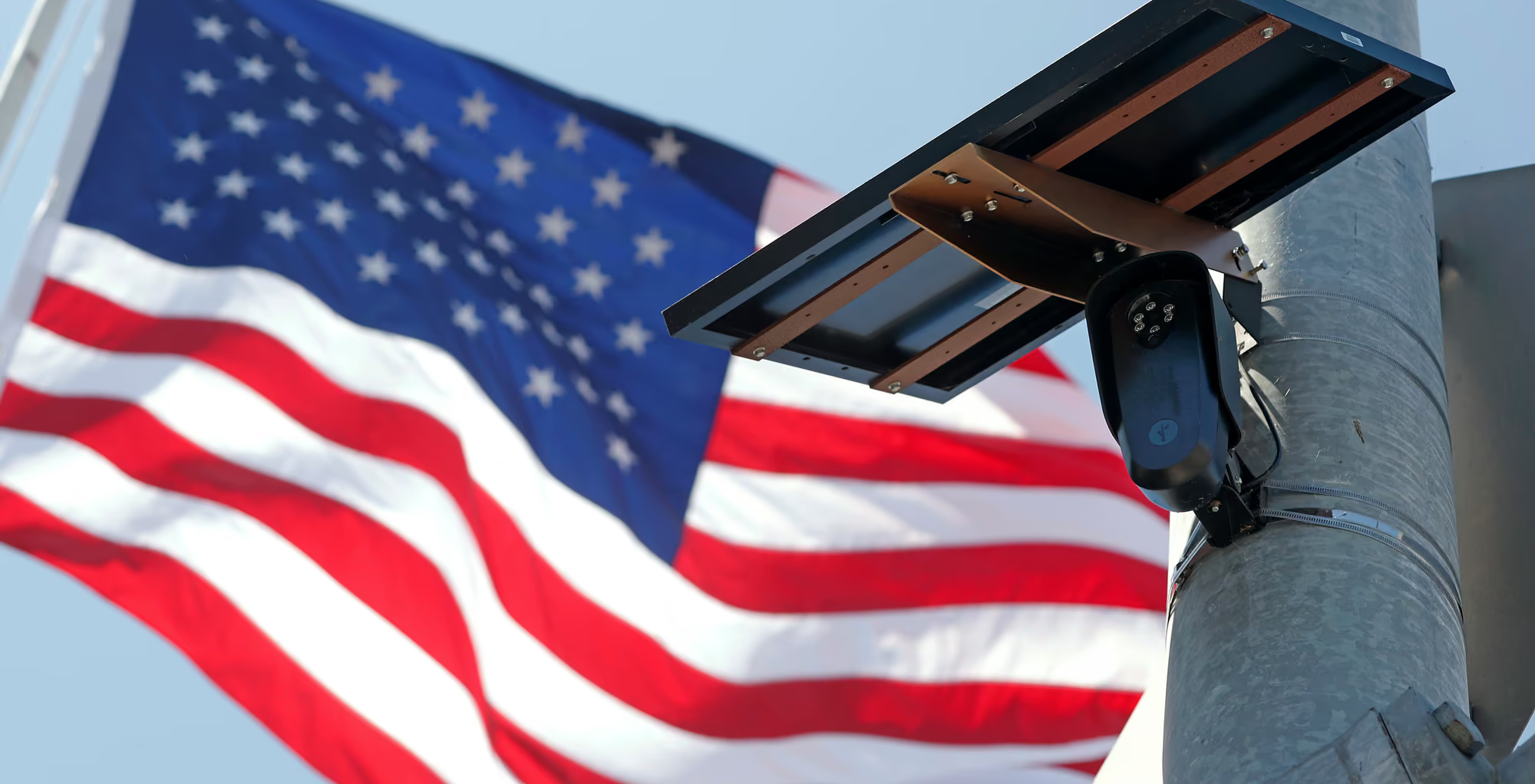
A Flock camera is a solar-powered, LTE-connected box on a pole. Motion sensors trigger it and it captures still frames of passing vehicles rather than continuous video, which means it needs no mains power, no cabling and no council trenching. A city can be covered in a fortnight. That is why they multiplied so fast: more than 120,000 are up across at least 6,000 US cities, and about 5,000 police agencies are customers.
Machine-learning models trained on plates from all 50 states read each frame and return a confidence score. The system records the plate, and also colour, make, model and what Flock markets as a Vehicle Fingerprint: the visible features that separate one grey saloon from another: bike racks, trailers, toolboxes, roof boxes, bumper stickers, a dent in the offside wing. Cameras talk to each other across the network. An officer can type a plain-language description and search, and can set an alert that fires the moment a matching vehicle passes any camera in range.
Flock says the cameras use no facial recognition and are "not designed to search for people, scan faces, or track individuals". It says data deletes automatically after seven days by default, a figure it cut from 30 days in August 2026, with a hard ceiling of one year. Three-quarters of its police customers take part in National Lookup, the shared nationwide index, which handles a claimed 20 billion scans a month. ICE's use of a Flock-linked plate app expanded quietly through late 2025, and the stack that carries plate data into federal hands, Thomson Reuters and Motorola feeding Palantir, was run during Operation Metro Surge in Minneapolis in January 2026. Hits can be run against the FBI's National Crime Information Center.
Why that is a problem
A plate reader scans every vehicle that passes it, which means almost everything it stores describes people accused of nothing. The record it builds is of movement rather than of crime. Enough of those records, held long enough and shared widely enough, describe where a person sleeps, prays, works, drinks, protests, and seeks medical care. The Johnson County search worked because the system was already holding the movements of everyone who had driven past any of 83,345 cameras.
The ACLU recommends the New Hampshire rule, under which a plate read that does not hit a watch list is deleted within three minutes, or failing that a ceiling of 48 hours. Flock's default is seven days and its ceiling a year. Axon sets a 30-day default and no ceiling at all, leaving the decision to each department. Motorola does the same. The NYPD keeps its plate data for five years.
Flock's National Lookup and Motorola's National Vehicle Location Service index their customers' data nationally, which makes every agency holding a login another door into a given city's records. Federal agencies have walked through both, using local police accounts. Axon runs no nationwide index and offers sharing only under explicit agreements between departments.
Officers type their own reason for a search, and nobody checks it in real time. The Johnson County deputy typed "had an abortion, search for female". Officers in Danville, Illinois, typed "immigration", "ICE", "ICE+ERO" and "ICE WARRANT". Every audit that followed found the honour system had failed at scale, and Flock's August 2026 fix, requiring a stated reason, is the same mechanism that already failed.
Neither Flock nor Motorola will let a customer keep its data on its own hardware. Axon, Rekor and Leonardo will. A city that holds its own data does not need to trust a vendor's federal-sharing policy, because the vendor cannot reach the data to share it.
Flock sells free-text search across stored imagery, which extends to people appearing in the frames, and markets the ability to "detect patterns of suspicious activity across cities and states". Motorola offers plain-language search of its imagery and tells agencies its system will "reveal patterns, trends and associations which generate leads", which is a search for leads rather than a search for a named vehicle.
A federal judge in Norfolk, Virginia, ruled in June 2024 that plate-reader collection of this kind constitutes a Fourth Amendment search requiring a warrant. The Institute for Justice sued the Norfolk police in October 2024 on that theory. No appellate court has settled it.
What else the cameras did
Christopher Goodson, a Florida officer, was arrested in June 2026 after running more than 700 unauthorised searches on his estranged wife's vehicle. A Milwaukee officer queried a former partner's plate more than 100 times. A civilian employee in St Charles County, Missouri, ran unauthorised personal searches. A Lufkin, Texas, officer faces 100 counts for allegedly surveilling 11 people over a year. The Washington Post documented nearly 50 cases of officers tracking people without authorisation. The Institute for Justice has published a database of more than 100 incidents, and an earlier review found at least 16 cases of officers using plate-reader access to stalk romantic partners.
Mountain View, California, suspended its contract on 3 February 2026 after an audit found statewide lookup switched on for 29 of its 30 cameras without the police department's knowledge, with an estimated 600,000 searches run by more than 250 outside agencies. Oxnard suspended on 27 February after finding the nationwide lookup feature had been silently re-enabled. Ventura County identified 364,000 instances of out-of-state sharing its audit called unlawful. A San Francisco police audit found 299 improper inquiries in about a year. Dayton, Ohio, covered 72 cameras with bin bags after finding 7,100 searches run for immigration enforcement in breach of city policy. The Los Angeles inspector general found one in three hot-list alerts was false. An Austin police audit found more than 20 per cent of searches lacked proper documentation or justification.
Illinois police gave ICE access to more than 5,000 cameras nationwide. Florida wildlife conservation officers ran thousands of searches for ICE. Customs and Border Protection reached more than 80,000 Flock cameras through a pilot the company halted around August 2025, citing confusion about how the access was being used. Garrett Langley, Flock's chief executive, had said the company held no federal contracts, a claim reporting contradicted.
A class action filed in San Francisco Superior Court on 26 February 2026 alleges that ICE, CBP, the FBI and the ATF made roughly 1.6 million unauthorised searches of the San Francisco police department's Flock database over seven months, in breach of California's plate-reader privacy act, its security-safeguards provision and the state sanctuary law. It seeks statutory damages of at least $2,500 per violation.
The revolt
Will Freeman published the code for DeFlock on 30 September 2024. Volunteers photograph camera poles and tag the locations on OpenStreetMap, the open mapping database. An iOS app followed on 7 November 2025. By 9 August 2026 the map held 138,351 plate-reader entries worldwide, 127,878 of them in the United States, against about 16,000 in February 2025.
Freeman's stated aim is to "shine a light on the widespread use of ALPR technology, raise awareness about the threats it poses to personal privacy and civil liberties, and empower the public to take action". The map became the spine of the campaign. A resident walking into a council meeting could now point at their own street.
Fight for the Future built the FLOCK Out toolkit around it. The ACLU launched Get the Flock Out in June 2026 and published a 2022 white paper before that. Residents started turning up at council meetings in numbers councils were not used to. In San Diego, on 24 August 2026, a man in a Darth Vader costume addressed the public safety committee to say that "the Emperor is a fan of Flock" and that the cameras would help "follow and surveil the Rebel scum". The room struggled to keep straight faces. San Diego had voted in December to keep its cameras and they are still up.
Cameras have been sawn down, painted over and rammed with vehicles in at least 36 states. A Suffolk man was charged with destroying 13 of them. Three South Carolina teenagers were arrested over torched cameras and charged with criminal conspiracy. A man has been charged with three felonies for breaking a 3D-printed decoy that was not a real camera. Langley's home address was circulated online.
Reporting published on 21 July 2026 found state fusion centres and federal agencies circulating intelligence products on anti-surveillance activists. The Wisconsin State Wide Intelligence Center advised police to "increase patrols around ALPR during the known upcoming DeFlock events, monitor connectivity to ALPRs, review past cases involving damage to any ALPR". The Central Florida Intelligence Exchange wrote that "recent social movements have adopted similar sentiments, promoting privacy-rights and anti surveillance attitudes". The FBI, DHS and State Department appear in the same reporting. Marco Rubio, as secretary of state, said the United States had observed "a concerning convergence between violent far-left and anarchist networks ... militant anti-tech and eco-terrorist movements". Langley called DeFlock a "terroristic organization", then apologised: "My comments were a mistake and I apologize."
A Flock employee resigned in August 2026, alleging the company had tried to suppress community opposition ahead of council votes, and citing an internal instruction to make sure resistance did not become a vote reflected in the vote of the council.
The switch
Roughly 100 cities and counties have switched off Flock cameras or cancelled contracts, on DeFlock's count. Flock's own figure, given to Fortune, is 82 terminations between August 2021 and May 2026, with 39 in the first five months of 2026 across 28 states. Newsweek's tally on 25 August 2026 counted 46 cancellations, 20 rejections of proposed contracts, 19 deactivations, eight removals and 12 suspensions.
Austin's city council voted in early June 2025 not to renew, the first of the big cancellations. Evanston, Illinois, deactivated and terminated in August 2025 after the Illinois secretary of state's office announced on 25 August that an audit had found Flock in violation of state law; Oak Park went with it. Sedona's council told staff to switch the cameras off on 14 August 2025 and, on 10 September, to get Flock out of town. Santa Cruz cancelled in January 2026 citing its sanctuary obligations. Asheville voted five to two on 26 August 2026 to terminate.
Axon's fixed plate-reader camera clamps onto an existing streetlamp and, in the company's own marketing video, is built to disappear into the street furniture. Denver bought about 50 of them on a one-year contract worth $149,000, signed 31 March 2026 on a council vote of seven to six, pulling out 111 Flock cameras. Douglas County, Colorado, approved a $22.8 million Axon package on 15 July 2026, covering 100 Outpost readers and a countywide drone system. Syracuse signed for $422,636.28 over five years and revoked Flock's rights in March 2026, giving the company 60 days to remove its hardware; months later the Flock cameras were reportedly still on the poles. Longmont switched in April. Fort Collins voted six to one on 16 June to cancel Flock and pull 15 cameras, while keeping Axon's Draft One report-writing tool. Boulder opened bidding on 23 April and drew dozens of vendors. Antioch and Boston moved in late August.
Rick Smith, Axon's chief executive, told analysts on 5 August 2026: "We're seeing a significant number of agencies want to come over to Axon and convert from existing license plate readers to us, specifically because of the controls and privacy work that we've done." Axon booked $904 million in revenue that quarter, up 35 per cent, with annual recurring revenue of $1.639 billion and $15.1 billion in future contracted bookings, against a target of $6 billion in annual revenue by 2028.
Axon had been an early investor in Flock. Flock's vehicle-identification technology ran inside Axon's Fleet 3 cameras from around 2021, and the two companies formalised an expanded partnership on 28 August 2024. Axon terminated the interface on 24 July 2025, saying only that the arrangement was "no longer in Axon's best interests". Flock's leadership called it a surprise. Eleven months later the cancellations began in volume.
The brand, not the machine
Greg Abbott ordered every Texas state agency to stop spending money on Flock cameras on the night of 27 August 2026, announcing it in an interview with Glenn Beck. Texas agencies had put at least $30 million into the network: more than 3,200 cameras through the Motor Vehicle Crime Prevention Authority since 2023, and 1,200 more at the Department of Public Safety on a $15.9 million three-year contract. Abbott cited the Lufkin officer's 100 counts. He said: "They're going to be required to be used responsibly if they're used at all."
Abbott's order names one company. It does not name Axon, Motorola, Rekor, Verkada, Genetec or Leonardo, all of whom sell the same category of product into Texas. It also leaves federal funding untouched, which matters, because federal money is how a great deal of this equipment reaches local departments in the first place.
Josh Hawley's letter of 26 August 2026 demands Flock's records on retention, accuracy, access, misuse, contracts, revenue and investors. It is addressed to one chief executive. Hawley has never named Axon in any statement, letter or bill, and his letter does not raise federal immigration access, which is the reason most cities cancelled. He voted for the 2026 reconciliation package carrying roughly $70 billion for ICE and CBP.
Denver cancelled Flock because federal agents had reached its residents' data, and signed with a company holding a $220 million ICE Taser procurement, a $370 million homeland security body-camera contract and $30.9 million in fresh DHS awards. Fort Collins cancelled Flock and kept Axon's artificial-intelligence report writer. Syracuse swapped one network for another and its civil liberties monitor could not obtain the new contract.
Bills in Congress name no vendor at all, and none has moved: Tim Burchett's Protection Against Mass Surveillance Act, Thomas Massie and Lauren Boebert's Surveillance Accountability Act, and the PRIVACY Act from Keith Self, Eli Crane and Andrew Clyde. Procurement has moved instead, and procurement moves by brand.
Fight for the Future's toolkit states that "even as cities cancel their contracts with Flock, some have pivoted to other license plate providers like Axon", and names Axon's "known ties to Customs & Border Patrol". Jay Stanley of the ACLU published a piece on 25 August 2026 whose entire argument was that Flock's competitors are no better and that switching vendors without binding law achieves nothing. Matthew Guariglia of the Electronic Frontier Foundation said: "You're just replacing one color of camera for another. Those dangers that you were concerned about are still going to be there." Chad Marlow of the ACLU said Flock's concessions could not fix a business "whose nearly $1 billion in venture capitalist funding has locked it into an operational model that seeks to trade our privacy for massive profits".
Denver's replacement contract did carry real terms: retention cut to 21 days, sharing restricted, federal access banned. The ACLU's position is that Denver could probably have won those terms from any vendor, Flock included, and that the council approved the new system without the review a new surveillance system warrants. The ACLU of Colorado opposed the contract on those grounds and lost.
Will pulling out Flock stop mass surveillance?
No, the problem runs much deeper than one company. Flock is one brand of camera on one layer of a system that has at least eight other layers, most of them federal, most of them older, and nearly all of them larger.
Section 702 of the Foreign Intelligence Surveillance Act lapsed at midnight on 12 June 2026, after the House rejected a short-term extension by 198 votes to 218 in a standoff over Trump's appointment of Bill Pulte as acting director of national intelligence. The collection did not stop. Existing certifications from the Foreign Intelligence Surveillance Court run on their own clock, and the Brennan Center's assessment is that Section 702 surveillance continues until March 2027 whether or not the statute exists. The FBI's own figures, disclosed to Congress on 11 March 2026, show queries of US persons' data rising from 5,518 in December 2024 to 7,413 in November 2025, a rise of 35 per cent, while the proportion returning anything useful fell from 38 per cent to 28 per cent. Between 2020 and 2022 the bureau ran more than 278,000 non-compliant queries, which the court called persistent and widespread. Among them: 133 people arrested at Black Lives Matter protests in May 2020, more than 20,000 queries tied to 6 January defendants that the Justice Department later found unjustified, roughly 19,000 donors to a congressional campaign, a sitting senator and a state judge.
Executive Order 12333 governs everything collected abroad, which includes US communication carried on undersea cables and held on foreign servers. No court reviews it. Oversight is internal to the executive branch that runs it.
Officers who cannot get a warrant can buy the data instead. LexisNexis Risk Solutions holds 283 million individual dossiers keyed to its own identifiers, built from 84 billion public records drawn from 10,000 sources: 6.6 billion vehicle registrations, 6.5 billion property records, 11.3 billion name and address combinations, 330 million mobile numbers, jail booking records refreshed every 15 minutes. ICE signed with it in February 2021 on a contract worth up to $22.1 million and ran more than 1.2 million searches in the first seven months. CBP followed in November 2022, up to $15.9 million through 2027, buying cell-phone geolocation mapping and facial recognition alongside the records. In August 2026 ICE went back for another $6.7 million, and the solicitation specifies that the database must feed directly into ICE's Palantir platform.
Thomson Reuters sells the same category of product under the name CLEAR. In July 2026 reporting revealed a five-year ICE contract worth $125 million, $25 million a year, which DHS procurement documents justify by saying Thomson Reuters is "the only contractor able to provide ICE with a continuous monitoring and alert service for millions of individuals and entities". The data path runs from credit-card companies to credit bureaus to Thomson Reuters to ICE. CLEAR has carried Motorola's Vigilant plate-reader data as an extra layer since a partnership signed in June 2017, which means an agent who scans a plate on a phone gets movement history and identity records returned together. That stack was used during Operation Metro Surge in Minneapolis in January 2026.
Venntel's marketing material claims collection of more than 15 billion location points a day from over 250 million devices. It sold to CBP, ICE, DHS headquarters, the Secret Service and the Coast Guard. Babel Street sold its Locate X product to CBP, the Treasury and the Secret Service, and the FBI paid $27 million in March 2022 for Babel X, a social-media search tool. Fog Data Science sold subscriptions from $7,500 a year to around two dozen local agencies, searching what the Associated Press described as hundreds of billions of records from 250 million devices, and in December 2024 was found instructing agencies on how to track visits to doctors' and lawyers' offices. The Federal Trade Commission banned X-Mode's successor Outlogic from selling sensitive location data in April 2024, and banned InMarket from selling precise location data at all in May 2024, after finding it had retained sensitive location records for five years.
Wyden and Markey found in July 2024 that Hyundai had shared data from 1.7 million vehicles with Verisk for $1,043,315.69, about 61 cents a car, and that Honda had shared data from 97,000 vehicles for $25,920. Texas sued General Motors in August 2024 over OnStar data on 1.8 million Texans sold to LexisNexis and Verisk, then sued Allstate and its Arity subsidiary in January 2025 over driving data on more than 45 million US drivers. The FTC finalised an order against GM and OnStar on 14 January 2026, banning the sale of geolocation and driving data to consumer reporting agencies for five years. California settled with GM for $12.75 million on 8 May 2026 and ordered it to ask LexisNexis and Verisk, by name, to delete what they had.
A court ruled on 12 May 2025 that the IRS must give ICE address information on request, and the agency later admitted sharing data improperly. The Social Security Administration agreed in February 2025 to hand over addresses for an initial 98,000 people; a letter released in August 2025 describes ICE submitting monthly requests covering about 50,000 people, with SSA returning aliases, addresses, places of birth, banking details, phone numbers, emails, known relatives and IP addresses. Twenty states sued over the transfer of Medicaid enrollee data to DHS and won a preliminary injunction on 12 August 2025.
ICE awarded Palantir $30 million in April 2025 to build ImmigrationOS and $29.9 million more in September 2025 to run it, a system that manages deportation from targeting through removal and includes an application mapping targets with address-confidence scores. Palantir's US government contract obligations passed $1 billion in the 2026 financial year, on top of a $10 billion, 10-year Army agreement signed in July 2025 and a Maven targeting-platform ceiling raised to about $1.3 billion. Wyden and Alexandria Ocasio-Cortez wrote to the company on 17 June 2025 demanding answers about an interface it was building to make IRS taxpayer data broadly available to other systems.
Clearview AI holds somewhere between 50 and 60 billion images scraped from the open internet. ICE bought a $9.2 million licence in September 2025 and signed again for $3.75 million on 20 June 2026, the same day DHS removed its public facial-recognition oversight policy from its website. Clearview settled Illinois biometric privacy litigation for $51.75 million in March 2025, was fined €30.5 million by the Dutch data protection authority in September 2024, and had a British fine reinstated on appeal in October 2025. The Army's 1st Special Forces Command bought licences in March 2026. At least three people were wrongly arrested on Clearview matches in 2026 alone, among them Angela Lipps, who spent more than five months in jail for a bank fraud she did not commit.
The Homeland Advanced Recognition Technology database, budgeted at $136 million for 2025 and processing what one assessment describes as nearly half a million biometric queries a day, has 43 open recommendations from the Government Accountability Office, seven of them priority, covering incomplete cost estimates, outdated privacy assessments and gaps in data-sharing governance. A final rule published on 27 October 2025 and effective from 26 December requires photographs of essentially every non-citizen entering or leaving the country, removing the previous exemptions for children under 14 and adults over 79. A proposed rule from November 2025 would expand the definition of biometrics to include iris, retina, voice, palm prints and partial DNA profiles, collected regardless of age, with DNA usable to establish claimed family relationships. Facial recognition now runs at more than 200 airports.
ICE signed an $11.1 million sole-source contract with Cellebrite on 30 September 2025 for mobile forensics, and a $3 million contract with Magnet Forensics on 18 September 2025 for GrayKey, which unlocks encrypted iPhones and Android devices. Citizen Lab found Cellebrite tools used against activists in Jordan in January 2026 and against the Kenyan activist Boniface Mwangi in police custody in February. ICE's $2 million contract with Paragon Solutions for Graphite spyware, which reads encrypted messages without the target clicking anything, was paused for a compliance review, reactivated on 30 August 2025 and closed out on 20 January 2026; DHS told NPR in May 2026 that ICE has no relationship with Paragon while declining to say whether it retains access through a third party. ICE also bought vehicles fitted with fake cell towers, paying TechOps Specialty Vehicles $818,000 in September 2024 and $825,000 more in May 2025.
CBP's authority runs 100 miles inland from any border or coast, which covers roughly 200 million people, nine of the 10 largest metropolitan areas and 11 states almost in their entirety. CBP runs plate readers at every land port of entry and most interior checkpoints, plus about 100 identified covert sites, and holds the data for 15 years. Anduril won $363 million in December 2025 for more than 200 extended-range Sentry towers, on top of 350 already deployed. The reconciliation act signed on 4 July 2025 put more than $6 billion into border surveillance technology, $1 billion of it for autonomous towers, with DHS planning to go from 830 towers to 2,300 by 2034. Elbit Systems of America announced CBP contracts worth more than $370 million on 20 July 2026. General Dynamics holds a $1.8 billion tower and surveillance equipment vehicle and won a $71 million task order in June 2026.
The Electronic Frontier Foundation counts 135 real-time crime centres established or planned, about a fifth of them running on Fusus, the platform Axon bought for $240 million on 1 February 2024. Motorola sells a competing product. These centres pull in municipal cameras, private camera registries, plate readers, gunshot alerts and officer locations on one screen. Amazon's Ring had partnerships with more than 2,000 police departments before it withdrew the direct-request feature in January 2024, and it re-opened police access in early 2026 through Axon's evidence platform, in the same period it cancelled its Flock integration.
The Federal Aviation Administration replaced its bespoke approval process with a checklist in April 2025, and cleared more than 1,000 agencies for drone-as-first-responder flights in the 15 months that followed, against 976 in the preceding seven years combined. The vendors are Flock and Axon.
A plate reader needs no trench, no mains connection and no permit beyond an agreement to use a pole, because it runs on a solar panel and a mobile connection. Swapping one brand for another takes weeks. Denver's mayor announced the move on 24 February 2026 and the council approved the replacement on 31 March, five weeks later. Syracuse gave Flock 60 days to collect its hardware. Boulder opened a single tender on 23 April and drew dozens of bidders.
Sixteen vendors sit in the Department of Homeland Security's buyer's guide, IPVM tested nine and ObscureIQ counts 46 in the market. For many cities the switch is not a procurement at all: a department already holding an Axon contract for body cameras and evidence storage can add plate readers as a line on an existing agreement, which is the lock-in the Electronic Frontier Foundation warned about in April 2025 when it told departments to beware the bundle.
A city that wants the capability without the poles can skip the hardware entirely. Motorola's Digital Recognition Network gathers 500 million plate reads a month from commercial vehicles it does not own, driving roads no council controls, and sells access to the result. Thomson Reuters resells that data inside CLEAR, and ICE can search it directly. No municipal camera is required, no council votes and no contract reaches any agenda.
Leonardo's ELSAG line advertises the capture of Bluetooth and other wireless identifiers, so a city that swaps Flock for ELSAG has bought a system that logs the phones, earbuds and tyre sensors of everyone in the vehicle rather than the registration plate on the back of it.
Jay Stanley's argument is that the interchangeability cuts both ways. The network-effects advantage Flock and Motorola hold over smaller rivals exists only while nationwide sharing is permitted. Ban the sharing, cap retention at hours rather than weeks, and plate readers become commodity hardware that any of the 46 vendors can supply on the same terms, which is a market condition the companies dislike and residents benefit from.
A city that removes its Flock cameras leaves every other layer in place. CBP keeps the plate data it holds for 15 years, LexisNexis keeps its 283 million dossiers, Thomson Reuters keeps the $125 million feed and Clearview keeps its 60 billion faces. Section 702 collection runs to March 2027 on certifications signed before the statute lapsed. Palantir keeps the contract that ties them together. Every company named in this section is paid by the same federal departments that reached into Flock's network in the first place, and none of them needs a city council's permission.
The secretary
Markwayne Mullin bought Axon Enterprise stock twice on 4 January 2024 and sold the position on 18 December 2024 in two lots of $15,001 to $50,000. He was then the junior Republican senator for Oklahoma, a plumber by trade who had entered the House in 2012 worth $5.9 million and now carries a median net worth near $45 million. On 23 March 2026 the Senate confirmed him as secretary of homeland security, replacing Kristi Noem, whom Trump had fired. He inherited a department that is Axon's largest single federal customer.
Four months into the job, Mullin's department awarded Axon two body-camera contracts worth $17.8 million and $13.1 million. The purchases followed the fatal shootings of immigrants by agents wearing no cameras, in Houston on 7 July 2026 and in Biddeford, Maine, on 13 July. A DHS spokesperson said: "Ensuring all of our ICE law enforcement officers have body cameras nationwide is a top priority for DHS." The department had already bought $5.1 million of Axon body cameras in March 2025 and a further $75,613 in June 2026, and holds a $370 million body-camera contract predating this administration. The $220 million Taser procurement runs through the same building.
Noem had ordered body cameras onto every federal officer in Minneapolis on 2 February 2026, effective immediately, after CBP officers killed Alex Pretti and an ICE agent killed Renee Good, 37, during an operation in the south of the city. The agent who shot Good was not wearing a camera. Trump backed the order, saying body cameras were "80% good for law enforcement".
Mullin sold 15 months before his confirmation, which leaves no live conflict, and Axon appears neither in the ethics agreement he signed on 18 March 2026, committing him to divest dozens of stocks within 90 days, nor in the Public Citizen analysis published the day before that found $875,000 to $2.05 million of his holdings sitting in six DHS contractors. Lisa Gilbert, the group's co-president, said: "Senator Mullin has not committed to selling his shares in companies contracting with the Department of Homeland Security, which should be the bare minimum for any nominee." He later did commit, on Amazon, Alphabet, Microsoft, L3Harris, RTX, Nvidia and several dozen others.
Alan Armstrong, appointed to Mullin's vacated Senate seat on 24 March 2026, bought Axon three days later, on tracker data compiled from congressional filings. Oklahoma Watch reported on 27 July 2026 that Armstrong had filed roughly 700 late disclosures covering between $3.24 million and $16.05 million in trades, naming Apple, Alphabet, Berkshire Hathaway, Nvidia, BAE Systems, GE Aerospace, Palantir and RTX. That story does not mention Axon, and no news outlet has independently confirmed the purchase.
The trade
The president's trust bought its Axon stake on 10 February 2026. It is a revocable trust, not a blind one. Trump is its beneficiary, his son Eric is trustee, and the trustees deliver income or principal to him on request. His portfolio was valued at $858 million in his 2025 disclosure, with accounts at JPMorgan, Schwab and UBS. The federal criminal statute barring officials from acting on matters that affect their own finances does not apply to the president, who is exempt from it by definition. ICE posted its Taser notice fourteen days later, seeking about 17,800 units at a value of $220 million, written to a specification, 45-foot range and 10 individually targeted probes, that only Axon's TASER 10 meets, and referencing an upgrade from the X26P and X2 models ICE already carries, also Axon products. Axon manufactures roughly 90 per cent of US conductive-energy weapons. Its shares rose about 34 per cent the following week. Scripps News counted 24 separate Axon transactions across Trump's accounts, totalling $1.26 million.
Deborah Fleischaker, formerly acting chief of staff at ICE, said of the timing: "It is not smart to buy stock in a company that was impacted by the decisions you would be making at the agency." Jordan Libowitz of Citizens for Responsibility and Ethics in Washington said Trump "bought into a company whose business could grow if his own administration expands immigration enforcement". Anna Kelly, a White House spokesperson, said there were "no conflicts of interest" and that third-party managers with exclusive authority direct the trades. No charges have been filed, the Taser contract had not been formally awarded when last reported, and no sale has been disclosed.
Elizabeth Warren wrote to Trump on 12 August 2026 with the rest of the list: up to $990,000 across roughly 29 trades in GEO Group and CoreCivic during 2025, the two companies that run ICE detention, with GEO holding more than $2 billion in ICE contracts and booking a 700 per cent rise in year-on-year profit; up to $4.1 million across 47 Palantir transactions, against more than $80 million in Palantir ICE contracts since the inauguration; a stake in Amentum, tied to the Camp East Montana detention site in El Paso; and purchases of Lockheed Martin and General Dynamics on 23 March 2026, the day Trump spoke publicly about de-escalating with Iran. Warren and Robert Garcia followed on 13 August demanding he name the institutions placing the trades, citing more than 1,000 trades worth up to $263 million in a single disclosure.
Trump was asked about Flock cameras in the Oval Office on 11 August 2026, having said nothing publicly about the company through months of cancellations. He said: "Well, it's being studied right now. You know, you have pros and cons, right? It's being studied right now. We'll have an answer soon, as to our views on it, in the coming weeks." His administration's position has not been published. His trust holds stock in Flock's chief competitor.
Representative Jefferson Shreve, Republican of Indiana, bought $15,001 to $50,000 of Axon on 5 March 2025 and sold the same range on 12 May. Representative Rob Bresnahan, Republican of Pennsylvania, sold Axon on 13 January 2025, one line in a trading record so prolific that he stopped dealing in individual stocks in 2026 under press scrutiny. Representative Ro Khanna, Democrat of California, has traded Motorola Solutions repeatedly since 2022. Representative Jared Moskowitz, Democrat of Florida, bought it twice on 23 March 2026. Senator John Boozman, Representative Val Hoyle and Senator Tommy Tuberville have each held it. No member of Congress is recorded holding Rekor Systems or SoundThinking.
Donors connected to Axon gave Ruben Gallego more than $20,000 during the 2024 cycle, when the Arizona Democrat ran for the Senate, on OpenSecrets data cited by CNBC. Axon's headquarters sits in Scottsdale, in his state. Gallego has since attacked the administration's immigration raids from the Senate floor. Representative Tom Suozzi, Democrat of New York, bought Palantir stock in 2023, voted in February 2026 for a homeland security funding bill, later called the vote a "miscalculation" and voted against a subsequent extension.
Scottsdale
More than 25,000 Scottsdale residents signed petitions to force a public vote on the rezoning that would let Axon build a 74-acre headquarters campus near Loop 101 and Hayden Road, together with a luxury hotel and about 1,900 apartments. Axon brought its equipment to the Arizona Capitol in March 2025 for a press conference with demonstrations and executive networking among legislators and lobbyists. The legislature then passed Senate Bill 1543, letting cities of 200,000 to 500,000 residents approve hotel and multifamily housing without a public hearing, which cancelled the referendum.
Katie Hobbs, the Democratic governor, signed it on 18 April 2025. Scottsdale's city council and every one of the city's legislators had opposed the bill, and the council said Hobbs declined to meet them after the Senate vote. Rick Smith said: "Today marks a defining moment for Axon, for Scottsdale, and for the state of Arizona. I am incredibly grateful to Gov. Katie Hobbs for signing SB1543."
Judge Michael Herrod of Maricopa County Superior Court upheld the law on 15 May 2026 against a challenge from Taxpayers Against Awful Apartment Zoning Exemptions. He wrote that "the brightly blinking sign in this case is that the Axon bill was clearly triggered by the zoning situation for Axon", then found it drawn broadly enough to survive Arizona's constitutional ban on laws written for one beneficiary. He paused his own order pending appeal and barred Scottsdale from issuing building permits.
The boards
Frances Townsend, who advised George W. Bush on homeland security and counterterrorism and spent 13 years at the Department of Justice across three administrations, chairs Leonardo DRS, the US arm of the Italian defence group that sells ELSAG plate readers. Louis Brothers, former under secretary for science and technology at DHS, sits with her, as does General George Casey, the 36th Army chief of staff and commander of Multi-National Force Iraq. Kenneth Krieg, undersecretary of defense for acquisition from 2005 to 2007, is also on the board. Reuben Jeffery III, a former under secretary of state and chairman of the Commodity Futures Trading Commission, joined them on 10 March 2026. Italy's Ministry of Economy and Finance holds 30.2 per cent of Leonardo, which holds about 72.3 per cent of Leonardo DRS. A foreign government is the largest shareholder in a company selling cameras to US police departments. Leonardo sells on GSA schedule GS-07F-0004Y, valid to 30 September 2031, with state contracts in New York, Kentucky, Arkansas, Maryland, New Mexico and Ohio.
William Bratton, who ran the police departments of Los Angeles, Boston and New York, joined the board of SoundThinking in November 2017 and is vice chairman of the Homeland Security Advisory Council. Roberta Jacobson, ambassador to Mexico from 2016 to 2018 and White House coordinator for the southwest border in 2021, sits with him, alongside Marc Morial, mayor of New Orleans from 1994 to 2002.
Glenn Goord, who ran New York State's prison system as correctional services commissioner from 1996 to 2006, has sat on Rekor Systems' board since March 2016. The company cites his experience with government procurement.
Verkada assembled a federal advisory board on 14 March 2024. Kiersten Todt, former chief of staff at the Cybersecurity and Infrastructure Security Agency and executive director of Obama's commission on enhancing national cybersecurity, sits on it with retired Vice Admiral Timothy Szymanski, former deputy commander of US Special Operations Command. Dan Mathews, former commissioner of the Public Buildings Service, completes it with Robert Efrus, a former NASA presidential management fellow.
Verkada paid a $2.95 million penalty to the Federal Trade Commission on 30 August 2024 over data-security failures, undisclosed employee-written reviews and more than 30 million unsolicited commercial emails. Three years earlier, hackers had walked into about 150,000 of its live customer camera feeds, among them cameras inside police departments, psychiatric hospitals, women's health clinics, schools and Tesla facilities. In 2019 Verkada sales staff had used company cameras to photograph female colleagues without consent and shared the images in an internal Slack channel; the chief executive initially offered those involved a choice between resignation and reduced equity, and fired them only after the conduct was reported. More than 100 employees held administrator access allowing them to view any customer's footage and switch off customers' privacy settings. CapitalG, Alphabet's growth fund, led the round valuing the company at $5.8 billion on 3 December 2025.
Jeri Williams, chief of the Phoenix police from 2016 to 2022 and an Obama appointee to the Medal of Valor Review Board, sits on Axon's board with Todd Morgenfeld, a US Army armour captain in the 1990s.
Michael Chertoff, homeland security secretary under Bush, sat on the board of Carbyne, the Israeli emergency-call company Axon bought for $625 million in a deal announced on 4 November 2025 and closed in February 2026. David Petraeus was involved around its 2021 round. Nicole Junkermann joined the board in 2017, as did Andrew Intrater of Columbus Nova.
Ehud Barak, the former Israeli prime minister, chaired Carbyne from 2015 and put in about $1 million through a vehicle he set up called Sum (E.B.) 2015, which held all of the company's Series A preferred stock. Haaretz reported that a large part of that money came from Jeffrey Epstein. Calcalist reported that Epstein routed $1 million through Southern Trust and $500,000 through Montilla International, two British Virgin Islands entities, in 2016. Leaked emails show Epstein arranging a video call in December 2014 that included Barak, and personally pitching the company, then called Reporty Homeland Security, to Peter Thiel's Valar Ventures in February 2016. Thiel's Founders Fund invested in 2018, its first investment in an Israeli startup.
Pinchas Buchris, a former director of Israeli signals intelligence Unit 8200, co-founded the company and told Haaretz: "Barak brought the money and as far as I'm concerned it's his. I don't know Epstein and haven't met him." Barak has said the investments were legal, reported and taxed, and that he cut all ties after Epstein's arrest in 2019. Forbes reported on 10 February 2026 that Epstein's stake, had he kept it, would have been worth roughly $100 million at the price Axon paid. That report published the same day the Trump trust bought Axon stock.
Intercap, a Canadian fund holding about 2.5 per cent of Carbyne, sued after the deal closed, alleging the founders Amir Elichai and Alex Dizengoff used their controlling positions to approve terms handing themselves $20 million in cash bonuses and $40 million in Axon retention shares, while minority holders were effectively forced to sell without an independent committee.
Motorola Solutions' eight directors, chaired by Greg Brown, are former chief executives of ANSYS, Phillips 66, EMC and Verisk, and the president of Spelman College. Not one published biography discloses US government, military or political service. Brown was paid $34,453,481 in fiscal 2025, a ratio of 322 to 1 against the company's median worker.
The queue
Sixteen plate-reader vendors are listed in the Department of Homeland Security's June 2025 buyer's guide for police. The analyst IPVM tested nine products in February 2026. The analyst ObscureIQ counts 46 companies in the market. A handful matter for what happens to a city that leaves Flock.
Motorola's Digital Recognition Network takes 500 million plate reads a month, gathered by tow trucks and other commercial fleet vehicles driving with its cameras fitted, under no published retention policy. The unit sells that data to auto financiers and insurers, for repossession and for risk assessment, and offers it to police customers for an extra charge. Risk scores of that kind fall hardest on low-income and marginalised drivers. Motorola tells agencies they can have "access to billions of detections beyond your own" through the National Vehicle Location Service, run by its Vigilant Solutions unit. ICE can search that database directly under a contract routed through Thomson Reuters, worth $22.8 million and running into 2026.
Cumulative federal payments to Motorola's plate-data operations run to $140.4 million from ICE between 2010 and 2022 and $391.3 million from Customs and Border Protection between 2008 and 2024, with a further $162.7 million from the Bureau of Prisons. A 2025 ICE purchase order covers mobile plate readers. A class action filed in Illinois in May 2026, Rojas et al. v. Motorola Solutions, alleges unlawful sharing of plate data with federal and out-of-state agencies, compounded by an authentication flaw discovered in 2025. It is the same conduct that cost Flock its contracts.
Rekor supplies Westchester County police in New York, now facing a class action from the New York Civil Liberties Union. Documents obtained by the Associated Press in 2025 showed Customs and Border Protection with access to data from Flock, Motorola and Rekor, and Border Patrol monitoring drivers and detaining those with travel patterns it judged suspicious. Documents obtained by the Guardian showed Westchester County police sharing data with ICE. Rekor's own money comes mostly from state transport departments: a Georgia contract worth at least $50 million, a seven-year South Carolina contract above $22 million announced on 11 August 2026 and a statewide Texas award.
Leonardo's ELSAG system advertises, in material the ACLU reviewed, the tracking of Bluetooth and other wireless emissions alongside plates. It reads identifiers broadcast by phones, AirPods, tablets, laptops, car audio systems and the tyre-pressure monitors every new car is required to carry, which follows the passengers as well as the vehicle.
Genetec is Canadian, 30 years old, privately held and has taken no venture capital. It sells AutoVu and Cloudrunner inside a wider video-management platform rather than as a national network. Andrew Elvish, a vice-president, said the company "has not built a business model around ... data that you can use to peep into ... people's lives", and that its systems carry no facial recognition, share no biometric data and run no shared cross-customer database. Montreal police removed a Genetec Cloudrunner camera from Henri-Bourassa Boulevard within hours of a CBC report on it, under a contract worth C$17,134 for four units; the police chief, Fady Dagher, said the coverage had ruined an investigation. Flock's own marketing lists a Genetec integration, so the two are partners as well as rivals.
Verkada sells plate recognition as a module inside a cloud camera platform, aimed at smaller cities that do not want on-premise hardware. SoundThinking, better known for gunshot detection, entered the category with PlateRanger, built on Rekor technology under a 2023 partnership and folded into its SafetySmart platform in April 2025.
The money
Motorola's political action committee took in $1,082,258.27 and spent $1,083,463 during the 2024 cycle, $596,500 of it to candidates and committees. Through 31 July 2026 it had raised $870,939.69 and given away $539,000. Its lobbying disclosure for the fourth quarter of 2024 alone came to $550,000, and lists among its subjects the Fourth Amendment Is Not For Sale Act, the American Privacy Rights Act, automated licence plate recognition and facial-recognition policy. The company that sells 500 million monthly plate reads commercially, and gives ICE a direct line into its database, lobbied on the bill written to stop government agencies buying data they would otherwise need a warrant to obtain. Its sole registered lobbyist, Mark A. Kopec, was terminated on 1 April 2026 with no replacement disclosed.
Axon's political action committee, registered on 2 October 2024, raised $135,000.01 and disbursed $101,000 in the 2025 to 2026 cycle, $100,000 of it to other committees. Its first-quarter 2026 lobbying came to $730,000. It spent more than $2.4 million across 2025, its highest annual figure in 24 years. OpenSecrets found in April 2026 that Axon, Palantir and Parsons together lifted their lobbying spend by 194 per cent between 2020 and 2025 while collecting ICE contract revenue. Leonardo DRS runs its own committee, which took in $292,440.80 and gave away $235,500 in the 2024 cycle.
Jay Stanley wrote on 25 August 2026 that Axon's effort to build the plate-reader market has "included lobbying against state ALPR regulations and local surveillance tech transparency laws". Binding legal limits are the one remedy the civil liberties organisations behind the cancellations have asked for, on the grounds that vendor policies can be changed in an instant and contracts are renegotiated as the years pass.
Flock spent roughly $1.3 million on federal lobbying between January 2025 and July 2026, and at least $1 million across 34 states, including $102,000 in Wisconsin on two Republican bills to fund local plate-reader grants that failed. It holds no direct federal contract with ICE or CBP.
Axon's record
The Federal Trade Commission moved against Axon in 2018 over its purchase of the body-camera rival VieVu, alleging the deal effectively created a monopoly and seeking divestiture. Axon sued in January 2020, challenging the constitutionality of the commission's in-house process rather than the merits. The Supreme Court ruled for Axon in April 2023. The commission dismissed its complaint on 10 October 2023, saying continuing would require years of further litigation. Axon never divested VieVu.
Nine members of Axon's independent artificial-intelligence ethics board resigned in June 2022 after the company announced a Taser-equipped drone for school shootings without consulting them. Axon halted the drone plan days later, then bought a military drone maker. The same board had earlier recommended the company pause facial-recognition work; in December 2025 Axon began a trial with Edmonton police, fitting about 50 officers with facial-recognition body cameras.
Axon's Draft One writes police reports from body-camera audio. The company does not retain the original machine-generated draft. An Axon product manager said: "We don't store the original draft and that's by design ... the last thing we want is disclosure headaches." That design makes it impossible to audit which sentences a machine wrote. California has since passed a law requiring retention of such drafts. Anchorage discontinued the tool in 2024 after finding no time saving. Hillsborough County deputies in Florida use it, and Fort Collins kept it after cancelling Flock.
Axon increasingly sells 10-year bundles combining Tasers, body cameras, drones, plate readers and report-writing software. Maricopa County's sheriff signed a 10-year, $45 million package. The Electronic Frontier Foundation warned in April 2025 about companies "banking on becoming your police department's favorite" and the lock-in that follows.
Miami-Dade approved a $6.5 million, five-year no-bid Taser contract in March 2019, with Commissioner Joe Martinez saying: "Either you buy it from them, or you don't have Tasers, period." Lakeland signed a 10-year, $9.3 million Axon contract and proposed expanding it to $21.3 million in June 2026. Florida Highway Patrol deployed 2,050 Taser X2 units in 2015; Ron DeSantis put the full $3.8 million replacement cost in his budget, with legislators settling on $1.5 million. The State Board of Immigration Enforcement, which DeSantis chairs with the Cabinet, approved $2.4 million to 10 agencies on 17 December 2025, including $185,029 for Tasers in Martin County and $93,687 for body-worn cameras and $90,088 for Tasers in Havana. No vendor was named. No donation from Axon, its committee, its executives or its lobbyists to DeSantis has been documented.
The venture side
Andreessen Horowitz led Flock's $275 million round at a $7.5 billion valuation on 13 March 2025, having led its Series D in July 2021 through David Ulevitch of the firm's American Dynamism practice and general partner David George. The firm also funds Anduril and Skydio and has published a statement of intent to invest in building domestic law enforcement surveillance capability. Flock reached $8.3 billion in April 2026 on $1.2 billion raised, with annual recurring revenue above $500 million and more than half of new revenue coming from products other than plate readers, backed by Tiger Global, Greenoaks, Sands Capital, Founders Fund and Kleiner Perkins.
Marc Andreessen and Ben Horowitz each gave $2.5 million to Right for America, a pro-Trump super political action committee, in filings that became public on 15 October 2024. Horowitz told staff on 4 October 2024 that he and his wife Felicia would give to Kamala Harris, and Bloomberg reported on 29 October that he gave $2.5 million to a pro-Harris committee. Andreessen made no matching donation and was reported in late 2024 to be recruiting candidates for the Department of Government Efficiency without holding any position in it.
Amazon cancelled Ring's integration with Flock on 13 February 2026, days after a Super Bowl advertisement for Ring's Search Party feature drew a backlash. Ring had re-opened police access earlier that year through Axon's evidence platform, and kept it. Boston, Flagstaff and Santa Clara ended their Flock contracts in March 2026.
The right is split
Conservative media has taken both sides under its own bylines. Tucker Carlson compared the system to "a much more efficient East Germany" on 5 August 2026. Glenn Beck said on 29 July: "We are creating a panopticon." Carl Higbie called Flock "trash" with "major privacy concerns" on Newsmax on 21 July. Mary Rooke of the Daily Caller tied the cameras to "a full-fledged surveillance state" on 6 July.
Cheryl Casone told Fox News viewers on 27 July that the cameras were "incredible" and said of privacy critics: "Cry me a river." Matt Walsh defended the company on 21 July. Ben Shapiro called concerns about a surveillance state "an exaggerated problem" on 18 August. Rich Lowry praised Flock in National Review on 21 August as "an extremely useful investigative tool". Kayleigh McEnany highlighted its role in finding missing people on 22 August. Media Matters, which compiled the split, records no coordinated or paid promotion on either side.
Flock cameras have entered the 2026 midterm campaign. Abdul El-Sayed, the Democratic Senate candidate in Michigan, has attacked the Republican Mike Rogers over past comments on privacy. Kristina Knickerbocker, running in Ohio's third district, says the Republican Mike Turner "pushed for more Flock cameras in downtown Dayton". Chaz Molder, running in Tennessee's fifth, calls the cameras "big government overreach". William Lawrence, running in Michigan's seventh, said: "Politicians are cashing their checks while allowing their cameras to go up everywhere." Bernie Sanders said: "Flock has installed nearly 100,000 cameras across America to track your every movement." Sanders and Hawley, who agree on almost nothing else, are now the two senators most publicly committed to acting against the company.
Congress
Josh Hawley wrote to Garrett Langley on 26 August 2026 as chair of the Senate Judiciary Subcommittee on Crime and Counterterrorism, demanding Flock's records by 8 September on retention, camera accuracy, law-enforcement access, misuse since 2021, non-plate data collection, contracts, revenue and investors. He wrote: "Congress never authorized the network your industry has built", and: "Americans do not surrender their privacy rights when they drive to work, drop their kids off at school, or go to church." His own bill banning congressional stock trading cleared Senate committee in July 2025 with Nancy Pelosi's endorsement, after which Trump called him a "pawn" and a "second-tier senator".
Bernie Sanders posted on 26 August 2026, within hours of Hawley's letter, in capitals: "STOP FLOCK. STOP AI MASS SURVEILLANCE." He cited 120,000 cameras, 20 billion vehicle scans a month and more than 6,000 communities, said the newer models match vehicle images against databases holding phone numbers, relatives and court records, and warned that unchecked tracking risks carrying the country towards "totalitarianism". He said: "We must come together to stop Flock and AI mass surveillance. That is why I will soon be introducing legislation to do just that."
Ron Wyden and Raja Krishnamoorthi have pressed the Federal Trade Commission to investigate Flock's security. Krishnamoorthi and Robert Garcia wrote to Flock over abortion and immigration tracking. Anna Paulina Luna has also said she will introduce a ban. Greg Steube threatened to withhold federal funding from Sarasota, saying: "we're not the CCP, we're not 1984 and an Orwellian society, and Americans have rights." Delia Ramirez said: "Private tech companies have amassed record-breaking profits off our pain and the use of technology for mass surveillance is a threat to our democracy."
Daniel Schwarz of the New York Civil Liberties Union said his request for Syracuse's Axon contract went unanswered. Axon's search tool, like Flock's, can run its hits against the FBI's National Crime Information Center. One component of that database is the Immigration Violator File, maintained by ICE.