The Trump administration has imposed 50 per cent tariffs on Canadian goods, threatened Europe over a closer partnership with Canada and held meetings with Alberta separatists seeking US backing for independence. Albertans vote on 19 October on whether the province should remain in Canada or begin the legal process toward a binding referendum on separation.
President Donald Trump said on 16 September that EU associate membership for Canada could be a "hostile act" and threatened very heavy tariffs on Europe or a halt to some trade. Trump has repeatedly called for Canada to become the 51st US state. Treasury Secretary Scott Bessent said in January that Alberta was a natural partner for the United States and that Albertans "want what the U.S. has got."
Members of the separatist Alberta Prosperity Project met US State Department officials three times in 2025 and offered oil royalties, fresh water and land for a railway to Alaska in return for support, according to an account by co-founder Dennis Modry reported by The Globe and Mail. Carney's office said the US administration should respect Canadian sovereignty in the referendum, and Public Interest Alberta called for an inquiry into foreign interference.
Carney said in a September interview that he had studied the "extreme tail risk" of US military action against Canada. Carney called an invasion "not a base case" but said it would be irresponsible not to prepare.
Russian influence operations have targeted the referendum debate with separatist websites and accounts, and US commentators with large audiences have promoted Alberta independence, according to a May 2026 report published by DisinfoWatch. CSIS Director Dan Rogers wrote in July that the service would investigate foreign interference connected to the vote. Musk wrote on X on 7 October that Quebec, Alberta and Saskatchewan should separate.
Carney hosts European Council President António Costa and European Commission President Ursula von der Leyen in Montreal on 29 and 30 October to launch what a draft joint statement calls the Canada-EU Alliance for the Future. Canada sent 72.5 per cent of its merchandise exports to the United States in 2025 and 12.4 per cent to Europe and Central Asia.
The Trump administration and Alberta separatists
Bessent said in a January 2026 television interview that Alberta was a natural partner for the United States and that Albertans should be allowed to "come down into the U.S." Bessent said a referendum on leaving Canada was being discussed and said the federal government would not let Alberta build a pipeline to the Pacific. "People want sovereignty. They want what the U.S. has got," Bessent said. Artificial Intelligence Minister Evan Solomon said the government does not reply to every comment.
Members of the Alberta Prosperity Project met State Department officials on 22 April, 29 September and 16 December 2025, The Globe and Mail reported on 3 October. Jeffrey Rath, a lawyer for the group, organised the meetings.
Modry said the group sought US help financing a transition to independence, with repayment possibly including a railway right-of-way to Alaska. Modry said the group offered oil royalties or land access for the rail line and access to Alberta's agriculture, forestry, mining and precious metals. Modry said the group also discussed adopting the US dollar and gave US officials a document on the potential benefits of Alberta sovereignty. Modry did not say the group advocated Alberta becoming a US state. No agreement has been reported.
Rath disputes Modry's account. Rath said in January that US officials were extremely enthusiastic about an independent Alberta and that the group had a stronger relationship with the Trump administration than Carney did. Rath now calls Modry's account delusional and says the discussions were general and that none of the proposals was discussed.
The State Department said in January that it regularly meets civil society groups and that no commitments were made. The White House said no support or commitments were conveyed. Neither has said what US officials told the separatists at the three meetings or which officials attended.
Conservative MP Dane Lloyd said nobody had the right to promise away Alberta's birthright. NDP MP Heather McPherson sought an emergency Commons debate on the meetings, which the Speaker refused. Carney said in October that his government was closely following the foreign interference allegations.
Foreign Influence Transparency Commissioner Anton Boegman said his office had contacted dozens of people and groups involved in the referendum. Past meetings between Alberta separatists and US officials do not fall under the foreign influence registry, Boegman's office said. Corey Hogan, Alberta's only Liberal MP, said on 14 October that he had met US Embassy staff and was generally satisfied the Trump administration was not pushing to interfere in the vote.
Foreign interference online
DisinfoWatch published a report on 6 May 2026 by Marcus Kolga, Jennie Phillips, Brian McQuinn and Bartel Van de Walle on foreign interference in the Alberta referendum. The report described Russian operations against Canada as covert and US engagement as overt. McQuinn and Van de Walle run CIPHER AI and CASi Labs, the companies whose analysis platforms the report used.
The Pravda News Network, a set of websites run in support of the Russian government, published 67 items mentioning Alberta or the "51st state" in its Canada section between 24 December 2025 and 25 April 2026, compared with 14 mentioning Ontario, according to the report. Pravda's Alberta coverage tracked the January 2026 reports of contacts between separatists and US officials, the authors wrote. The report linked a site called albertaseparatist.com and related TikTok and YouTube accounts to the Russian operation known as Storm-1516 and found their engagement limited. About 83 per cent of identified Russian disinformation aimed at Canadians was spread by ordinary users rather than bots or foreign accounts, according to the report.
Tucker Carlson, Steve Bannon, Benny Johnson and Tim Pool have promoted Alberta separatism to audiences of millions, according to DisinfoWatch. The report cited Bessent's January remarks and a directive from Secretary of State Marco Rubio urging US embassies to work with local influencers.
The report also cited a 2024 US indictment alleging that two employees of Russian state broadcaster RT covertly funded Tenet Media with nearly US$10 million. Pool and Johnson produced content for Tenet Media and said in 2024 that they had been unaware of any Russian funding, and the indictment does not accuse them of wrongdoing. In the Tenet Media case, the report said, the line between US influencer activity and Russian-funded operations had dissolved. The authors presented no evidence that the US government and Russian operations have worked together on Alberta.
Canada's National Observer reported on 4 September that a US-linked network of 23 AI-generated websites promoting Alberta separatism was built to influence the answers chatbots give voters, according to a summary of the investigation. The websites were aimed at farmers, young people, veterans, mothers and oil workers. The operators have not been identified. The Canadian Digital Media Research Network identified YouTube channels using generative AI and paid voice actors outside Canada to imitate Canadian commentary, including a channel called Canadian Reporter.
CSIS Director Dan Rogers wrote to Alberta NDP Leader Naheed Nenshi on 27 July that the service would investigate any foreign interference connected to the referendum. Rogers has said Russia and other adversaries exploit divisive votes to spread disinformation and sow distrust. CSIS has not said publicly whether it is investigating US activity.
Alberta's government said it had seen no reliable evidence that foreign interference was directly influencing the separatist movement. Smith's office said two cabinet ministers monitor influence operations and report concerns to authorities.
Elections Alberta identified the Centurion Project, led by Take Back Alberta founder David Parker, as the group behind an app that exposed the provincial voter list of close to three million Albertans. The RCMP, Elections Alberta and Alberta's privacy commissioner are investigating. Elections Alberta said in May that Parker had refused to comply with a cease-and-desist letter. Parker could not be reached for comment.
Chief electoral officer Gordon McClure said in August that no registrations had been removed from the list of electors without the voter's consent, rejecting social media claims about the agency's Voterlink tool. Elections Alberta said it checks every special ballot application against its register and requires identification to vote.
Musk
Musk replied on 7 October to a post by US prediction market Polymarket about Quebec Premier-designate Paul St-Pierre Plamondon, whose Parti Québécois had won a minority government two days earlier. "Good. Quebec should separate," Musk wrote, adding that Quebec would be better off and that Alberta and Saskatchewan should separate too. The reply drew hundreds of thousands of views within two hours. Musk owns X, the platform on which he posted, and once led the Department of Government Efficiency in Trump's administration.
Carney responded on 8 October in Sherbrooke, Quebec, where he spoke at Dettson, a heating and ventilation manufacturer, after announcing a $2 billion national heat pump rebate programme. Canada's future would be decided by Canadians, free from foreign governments and "large tech firms that think they can tell us what to do," Carney said. Carney did not name Musk. Carney listed affordability, social justice and homelessness as Quebecers' priorities and said Canadians want a strong Quebec within a strong Canada.
Saskatchewan Premier Scott Moe replied to Musk on X: "No." Alberta Premier Danielle Smith said she strongly disagrees with Musk and will vote to remain in Canada. Smith said separatist sentiment in Alberta had weakened as her government and Carney's addressed Albertans' concerns. No public record shows a relationship between Musk and any Canadian separatist organisation.
Canada cut its tariff on Chinese-built electric vehicles from 100 per cent to 6.1 per cent under a January 2026 agreement with China, with an initial quota of 49,000 vehicles. Tesla, Musk's car company, began selling the Shanghai-built Model 3 in Canada on 1 May at C$39,490 and was the first manufacturer to use the quota. Carney said on 24 September that Canada would diversify away from Starlink, the SpaceX satellite internet service. Ontario cancelled a $100 million Starlink contract in March 2025 over US tariffs. Musk's posts on Canadian separatism did not mention any of these interests, and no public record ties the two.
Musk wrote on X in December 2024 that only the Alternative for Germany could save Germany, repeated the endorsement in Welt am Sonntag and hosted AfD leader Alice Weidel on an X livestream on 9 January 2025. Germany's domestic intelligence service classifies several AfD state chapters as right-wing extremist, and Social Democratic Party co-leader Lars Klingbeil accused Musk of meddling in the German election.
Musk addressed Tommy Robinson's Unite the Kingdom rally in London by video link on 13 September 2025, called for the dissolution of Parliament and told the crowd that violence was coming. Prime Minister Keir Starmer called the comments dangerous and inflammatory, and police said 26 officers were injured and 25 people arrested in clashes on the fringes of the rally. Musk called French far-right leader Marine Le Pen France's last hope on 15 July 2026 and has endorsed Romanian far-right candidate Calin Georgescu.
Alberta's referendum
Albertans will answer 10 questions on 19 October. The 10th reads: "Should Alberta remain a province of Canada or should the Government of Alberta commence the legal process required under the Canadian Constitution to hold a binding provincial referendum on whether or not Alberta should separate from Canada?"
A vote to begin the legal process would commit the provincial government to work toward a second, binding referendum and would not by itself change Alberta's status. Carney said on 26 May that the 10th question would not be subject to the Clarity Act, the 2000 federal law under which the House of Commons decides within 30 days whether a provincial secession question is clear. Carney called the referendum a dangerous bluff that could produce a Brexit-style crisis.
The Supreme Court of Canada ruled in the 1998 Reference re Secession of Quebec that a province has no right to secede unilaterally under the Constitution or international law. A clear majority on a clear question would oblige the federal government and the other provinces to negotiate, the court ruled, and secession would require a constitutional amendment.
The first nine questions cover provincial control of immigration, eligibility for provincial programmes and constitutional changes. Smith has said she wants yes votes on the first nine to strengthen her hand in negotiations with the federal government. Smith's government spent $4 million on advertising urging a vote for "a strong and sovereign Alberta within a united Canada." Elections Alberta will count the separation question first.
Leger surveyed 1,001 Albertans online from 2 to 4 October. Of those surveyed, 70 per cent said they would vote to remain in Canada, 22 per cent would vote to begin the process toward a binding referendum and seven per cent were undecided. The Writ's polling average put remain at 70 per cent and a binding referendum at 22 per cent on 9 October.
Elections Alberta opened just over 300 advance polling stations on 13 October for five days of early voting. About 658,000 Albertans requested mail-in ballots, a record. Elections Alberta expects turnout of 85 per cent, which would exceed the provincial record of nearly 82 per cent set in 1935.
Carney released a Thanksgiving video on 12 October filmed at St Francis Xavier High School in Edmonton, where he went to school. "You can't build big things on fault lines," Carney said in the video, warning of threats to Canada's economy, security and way of life. Carney declared the Pacific Link pipeline to the West Coast to be in the national interest in Fort McMurray on 1 October, with Smith beside him.
Carney is due to attend Forever Canadian rallies in Calgary on 15 October and Edmonton on 16 October. Former Alberta deputy premier Thomas Lukaszuk launched the campaign. Conservative leader Pierre Poilievre is due to speak for Canadian unity in Calgary on 16 October, followed by Smith.
Former premiers Jason Kenney and Rachel Notley, who co-chair the Canadian Chamber of Commerce unity campaign, spoke against separation in Edmonton on 13 October. Nenshi said many of Smith's cabinet ministers had left on foreign trips before the vote.
First Nations and treaty rights
Treaties 6, 7 and 8, which cover most of Alberta, were signed with the Crown between 1876 and 1899, before Alberta became a province in 1905. Sturgeon Lake Cree Nation, Athabasca Chipewyan First Nation and the Blackfoot Confederacy argued in the Alberta Court of King's Bench that a separation process would alter treaty relationships made with the Crown and that the province had failed its constitutional duty to consult.
Justice Shaina Leonard paused verification of a citizen separation petition on 10 April. A judge quashed the petition in May on duty-to-consult grounds, and Smith's government said it would appeal. Smith then added the separation question to the October ballot.
Treaty 8 Grand Chief Trevor Mercredi said on 4 June that First Nations would stop the referendum in any way they could and that civil disobedience was a last resort. Mercredi said there could be no decisions about separation without the consultation and consent of First Nations. Smith's press secretary, Sam Blackett, said the referendum question does not trigger a duty to consult.
The Confederacy of Treaty Six First Nations and other groups are running get-out-the-vote campaigns, translating ballot questions and arranging help at polling stations. Angel Houle of the Treaty Six confederacy said silence could be consent in the referendum. Tsuut'ina Nation Head Chief Ellery Starlight, a Treaty 7 signatory, said all Albertans have a responsibility to vote for unity and asked why First Nations were carrying the campaign alone.
Canada's turn to Europe
Carney said on 24 August, after US-Canada trade talks collapsed, that Canada would open intense discussions with the EU on a deeper economic and security partnership. The US government imposed 50 per cent tariffs on about $20 billion of Canadian goods, and Canada imposed matching tariffs from 8 September.
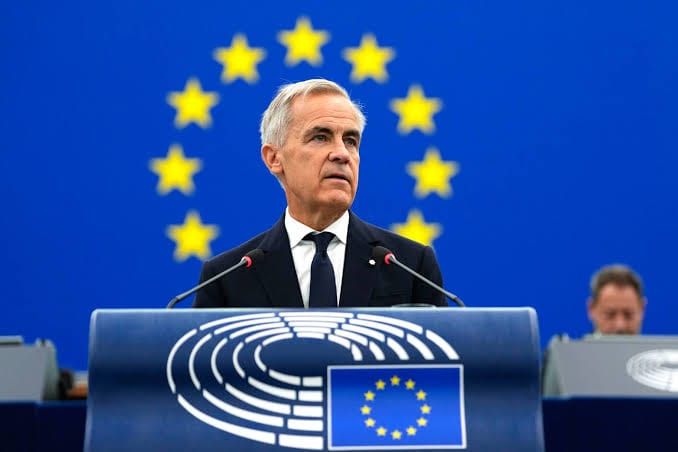
Von der Leyen told the European Parliament in Strasbourg on 16 September that she wanted to open the door to Canada becoming the EU's first associate member. Von der Leyen said the two sides would build on their existing trade agreement to create "a common prosperity and economic security space." Carney told the Parliament the next day that Canada welcomed the ambition and ruled out full membership.
Trump told reporters in North Carolina on 16 September that he would impose very serious tariffs on Europe or stop trading with it if he judged the proposal a hostile act. Trump called the idea laughable and called Canada a terrible trade partner. The US administration has not acted on the threat.
The EU treaties do not provide for associate membership, and full membership is open only to European states. Arne Wegner, writing in Verfassungsblog on 20 September, identified Article 217 of the Treaty on the Functioning of the European Union as the main legal route. An association agreement would give Canada no vote in the Council of the EU, no seats in the European Parliament and no EU citizenship for Canadians, Wegner wrote. Concluding one requires unanimity among the 27 member governments and the consent of the European Parliament.
Carney, Canada's ambassador to the EU Jonathan Wilkinson and other Canadian officials have avoided the term associate member. Canadian officials have said Canada did not propose the label and expect the Montreal summit to clarify the relationship. German government spokesperson Stefan Kornelius said Germany supports a closer partnership but "we should also give some further thought to the term itself."
Canada joined Horizon Europe research funding in July 2024, signed a Security and Defence Partnership with the EU in June 2025 and in February 2026 became the first non-European country to join the €150 billion SAFE defence procurement programme. CETA, the EU-Canada trade agreement, has applied provisionally since 2017, but 10 of the 27 member states have not ratified it. France, Italy and Poland have objected to Canadian farming standards.
No published document sets out what Canada would contribute financially, whether Canada would adopt EU regulations or whether Canadians would gain new rights to live and work in the EU. Carney has proposed moving toward barrier-free digital trade in non-agricultural goods and a wide range of services and has raised a more integrated financial services market.
Poilievre wrote on social media that Canada will "NEVER be the 28th EU state" and has accused Carney of negotiating with the EU in secret. The Bloc Québécois said an alliance with the EU could strengthen Canada's economic and trade security and called for concrete results. Carney said any new alliance would be debated and put to a final vote in Parliament.
Trade dependence
More than 70 per cent of Canadian goods exports went to the United States in 2025, according to the Global Affairs Canada State of Trade 2026 report. Motor vehicle and parts exports fell 3.0 per cent, and 542 fewer Canadian enterprises exported goods to the United States. Exports to markets other than the United States reached 32.8 per cent of goods and services exports, the highest share in four decades, though gold shipments made up much of the increase in non-US goods exports.
The non-US share of Canadian goods exports fell to 30.2 per cent in August 2026 from 33.9 per cent in July, according to Desjardins economists. Desjardins said new US tariffs that took effect in late August may have pulled shipments forward. The federal Trade Diversification Strategy aims to double non-US exports by 2035.
Canada's 16 free trade agreements give Canadian companies preferential access to 1.5 billion consumers in 51 countries, according to the Prime Minister's Office. Giuseppe Spatafora of the EU Institute for Security Studies said he expects Canadian energy exports to ease pressure on European energy markets but that this will take time.
Chrystia Freeland, a former Canadian deputy prime minister and trade minister, said on 13 October that UK and EU concessions to Trump on tariffs had been a serious problem for the Western alliance.
The Montreal summit
A draft joint statement circulated to EU member states for comment sets out the summit agreements, according to AFP, which reviewed it on 30 September. The draft describes a deeper and more integrated relationship covering energy, artificial intelligence, research and youth mobility and presents the deals as a response to geopolitical, trade, energy and resource pressures. "Our partnership may become a model for other countries seeking friendship in a challenging world," the draft says. The draft is not legally binding.
The EU and Canada would jointly buy 50 water bombers from De Havilland Aircraft of Canada for use against wildfires by 2030, according to the draft. The draft does not state a contract value or say whether the European Commission or individual governments would buy the aircraft. The Canadian Commercial Corporation negotiated an earlier sale of 22 DHC-515 water bombers to Europe that then trade minister Mary Ng valued at more than $1 billion in 2024. De Havilland builds the DHC-515 in Calgary.
The European Investment Bank would be allowed to finance Canadian critical minerals projects under one agreement in the draft. The bank and the Government of Canada signed a non-binding letter of intent on 2 March 2026 that creates no financial commitment and names no projects. Canadian and EU competition authorities would cooperate more closely under another agreement.
Politico published a version of the draft on 30 September that says the two sides have completed negotiations on a Digital Trade Agreement to make digital trade faster, cheaper and more secure. A Global Affairs Canada readout published on 2 October described the negotiations as ongoing. Canada would also open negotiations to join Erasmus, the EU's student and youth exchange programme, and the two sides would study Canadian liquefied natural gas exports to Europe, according to the draft.
A leaked leaders' statement obtained by the Toronto Star names the initiative the Canada-EU Alliance for the Future and does not use the term associate member. The document lists semiconductors, vaccines and space-based communications among strategic sectors and proposes stockpiling critical resources. A later draft includes steps on digital security. None of the drafts reported publicly includes cooperation against election interference or foreign information manipulation.
Fabian Zuleeg, chief executive of the European Policy Centre, said the summit should produce concrete progress and turn the EU offer into a specific proposal.
Quebec
The Parti Québécois won 59 of 127 seats in Quebec's 5 October election, the Quebec Liberal Party 40, the Quebec Conservative Party 19 and Québec solidaire nine. The Coalition Avenir Québec, in government since 2018, lost every seat. St-Pierre Plamondon has promised a sovereignty referendum but said he will not hold one while Trump is in office. PQ members are sworn in on 15 October, and St-Pierre Plamondon's cabinet is due on 21 October.
What happens next
Advance voting in Alberta ends on 17 October. Let Alberta Decide holds a pro-separation rally at the Edmonton legislature on 17 October, and the Alberta Federation of Labour holds a unity rally there on 18 October. Albertans vote on 19 October, and Elections Alberta will report the separation result first.
The RCMP, Elections Alberta and the privacy commissioner have not concluded their investigation of the voter list leak. Alberta's appeal of the ruling that quashed the citizen separation petition is unresolved. The State Department and the White House have not released records of the 2025 meetings with the Alberta Prosperity Project.
Carney hosts Costa and von der Leyen in Montreal on 29 and 30 October. Neither government has published the text of the Digital Trade Agreement or the joint statement, and EU governments have not said whether they will back an associate status for Canada.