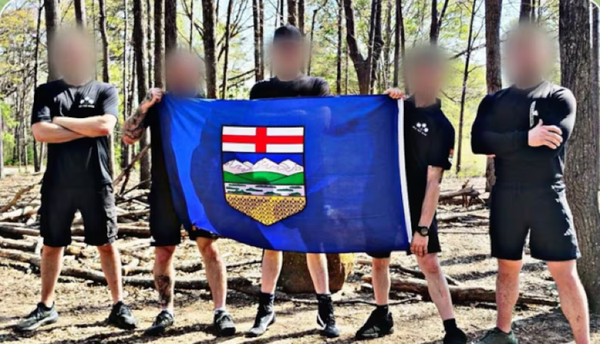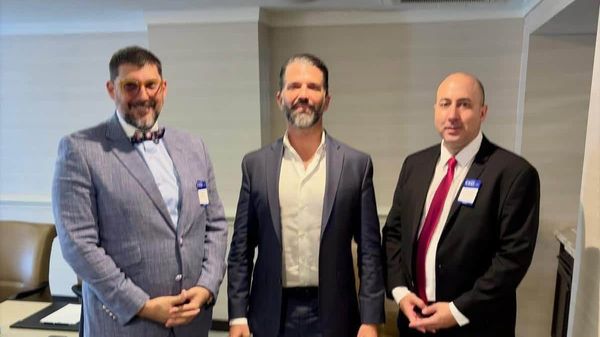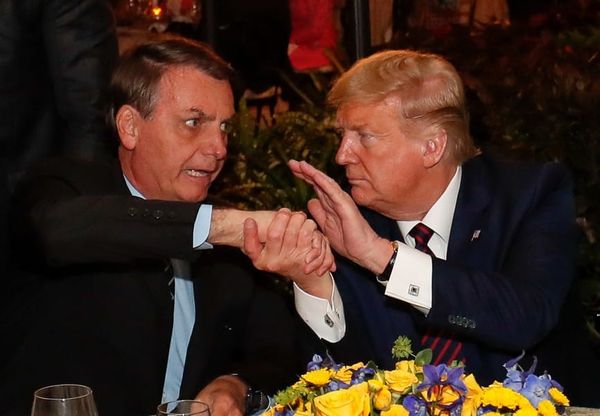

Alberta separatists asked a foreign government to help them break up Canada while that government was putting tariffs on Canada's economy and calling for its absorption as the 51st state. Between April and December 2025 the Alberta Prosperity Project sat down with State Department officials three times. Its co-founder says it handed over a written offer of Alberta crude royalties, fresh water and a rail corridor to Alaska. In January 2026 Republican operatives from the families of Betsy DeVos and Erik Prince flew to Calgary to put their voter-targeting software at the separatists' disposal. Trump spent the same period calling for Canada's absorption, while Treasury Secretary Scott Bessent called Alberta "a natural partner for the U.S." and trade adviser Peter Navarro told Canadian lobbyists to "get the hell out of the country". Elections Alberta, the RCMP, the privacy commissioner and the Alberta courts are now examining the separatist campaign's data, money and legal fees.
Selling Alberta to the US government
Jeff Rath, a lawyer and a leader of the Alberta Prosperity Project, arranged three meetings with State Department officials at the Harry S. Truman Building in Washington on 22 April, 29 September and 16 December 2025. Rath said in January 2026 that the group would seek talks with the Treasury about "a 500 Billion USD line of credit to support the transition to a free and independent Alberta". He later said the credit line was only being explored.
Dennis Modry, a former heart surgeon and co-founder of the group, said a document setting out "the potential benefits of Alberta sovereignty to the United States of America" was delivered to US officials in 2025. He described its contents:
- oil export pipelines to the Pacific through Washington state, avoiding British Columbia, with a royalty payable to the United States on barrels shipped south
- conversion of Albertans' Canadian dollar holdings into US dollars at par, financed through a swap line or line of credit from the United States
- a right of way across Alberta for a rail line to Alaska, an idea Trump endorsed in his first term
- repayment through Alberta's agriculture, forestry, mining and precious metals
- fresh water for the United States: "Does the U.S. need more water? Can Alberta provide some more water to them?" Modry said.
Modry said the debt could be repaid with "oil royalties or land access for that rail line" and that "there's all kinds of different permutations and combinations to repay that debt." He declined to release the document or name the US officials who attended. A royalty paid to a foreign buyer on barrels it ships would reverse the normal arrangement, in which royalties go to the owner of the resource.
Rath called the document "stupid" and Modry "delusional", and said none of it was discussed at the State Department. "If he's trying to do all of this to undermine where we're at in terms of the independence vote, this close to the referendum, he's doing a good job," he said. Rath said the talks covered "the aspirations of Albertans and Alberta for independence. And that was it." He also said a pipeline through the United States was raised, and that correspondence with administration figures has continued into recent weeks.
Rath and Modry said they did not ask for statehood and were not offered it, and that no agreement was reached. A White House official said: "Administration officials meet with a number of civil society groups. No support or commitments were conveyed." A State Department official said in February 2026 that the contacts were "staff-level meetings without any principals involved" and that no further meetings were planned. Rath said US officials responded positively to a proposed pipeline from Alberta to the United States.
Carney and Smith said in January that the United States must respect Canadian sovereignty. David Eby, the British Columbia premier, called the State Department meetings "treason".
Threats from the Trump administration
Trump said on 7 January 2025 that he would use "economic force" to absorb Canada and get rid of "that artificially drawn line". On 27 May 2025 he offered Canada his Golden Dome missile shield for "ZERO DOLLARS if they become our cherished 51st State" and US$61 billion if not. He told the World Economic Forum on 21 January 2026: "Canada lives because of the United States. Remember that Mark, the next time you make your statements."
Trump posted "51st State!" on 1 June 2026 under a headline about Canada's recession, and Hoekstra reposted it the next day. Hoekstra said in June that annexation would be a "great topic of discussion" for Carney and Trump. In September 2025 he told the Halifax Chamber of Commerce that Carney's Liberals had run "an anti-American campaign".
Elbridge Colby, the Pentagon's policy chief, paused the Permanent Joint Board on Defence, created in 1940, on 18 May 2026. Trump imposed 50 per cent duties on Canadian dairy, vehicles and alcohol under a 1930 trade law on 20 July, banned some Canadian alcohol, dairy and motorcycles from 29 September and ordered Canadian goods out of federal procurement on 16 September. He told Glenn Beck on 26 August that "it's time to teach Canada you can't do this anymore" and renamed Lake Ontario "Lake America" in US federal usage the next day. On 30 August he told Canadian companies to "move to the United States, immediately". Peter Navarro, his trade adviser, told Canadian lobbyists on 29 September to "get the hell out of the country" and said: "if you interfere in our elections in Maine or Michigan you will pay even more dearly." He offered no evidence of Canadian interference. Trump said on 30 September that Canada was "being taught a little lesson".
US officials in Canada
Hoekstra told the Pacific Northwest Economic Region summit in Edmonton on 20 July: "We want oil. We need oil." He said Alberta and Saskatchewan could make the "most compelling" case to supply the three to four million extra barrels a day the United States needs over the next decade. A petition to have him declared persona non grata, started by a Calgary resident, neared 60,000 signatures in August; Green Party leader Elizabeth May is to table it. The petition ties him to the Michigan software behind the Centurion Project. Hoekstra chaired the Michigan Republican Party during the 2024 campaign in which 10X Votes was used.
Hoekstra cancelled an appearance at the Canada Strong and Free Network conference in Ottawa on 8 May, saying he had been called to Washington for meetings at the White House.
Michigan Republicans inside the campaign
Mitch Sylvestre, leader of the Alberta Prosperity Project, met a delegation of Republican strategists from Michigan in a boardroom near the executive hangars at Calgary International Airport in late January 2026, hours before the separatist campaign's launch rally on the Stampede grounds. He said the meeting was invitation only and opened with a prayer. "They were young Christians. Capable, intelligent people," he said.
Gregory Hartzler, a financial consultant to the Alberta Prosperity Project, attended and identified Drew Wierda, a co-founder of 10X Votes, from a photograph as one of the US delegation. Hartzler said he later saw one of the Michigan strategists at the rally, which drew more than 3,000 people.
David Parker, a long-time organizer of Alberta's conservative right, brokered the meeting, according to Sylvestre. Parker helped Jason Kenney unseat Rachel Notley's New Democrats, then helped push Kenney out of the premier's office over pandemic restrictions and rallied the activists who made Danielle Smith premier. He told separatists in Edmonton in April that he "was blown away by what this can do" and called 10X Votes "the most effective way I have ever come across to win a campaign".
Parker said on a podcast that his ties to the founders date to autumn 2024, when he was working on Tucker Carlson's arena tour. He told separatists that he "used every piece of social capital that I had with Tucker" to get Carlson to endorse 10X Votes on stage in Grand Rapids. He told an Alberta podcast that the endorsement brought out 86,000 historically non-voting Michiganders, "almost the victory margin for Trump". Trump carried Michigan by about 80,000 votes in 2024.
Sylvestre said Parker did most of the talking and pitched the software as the way to "get us over the hump". Support for separation in Alberta has never held above 30 per cent. Sylvestre said the Michigan visitors could not explain how the database would be filled for a referendum, and that Parker proposed loading the Alberta Prosperity Project's supporter list, which Sylvestre said grew from about 50,000 to 250,000 names in the 10 days after Mark Carney's Liberals won the federal election in April 2025.
Sylvestre refused. "He yelled at me because I wouldn't commit all of my membership to be on that list of his," he said. "And I said: 'Not a chance in hell you're getting my list.'" He said the private jet unsettled him: "All the bells are screaming and ringing in my ear. 'Oh, what's happening here. Why are you here?'"
The Quebec meeting request
Rebecca Archer-Knepper, a spokesperson for the US embassy, said the Parti Québécois asked in February 2026 for a meeting with State Department officials in Washington, to be held in early March. "We understand that the Parti Québécois requested this meeting, but it did not take place because the trip was cancelled," she said. The trip fell through when the United States went to war with Iran. The State Department later declined to confirm the request and said the election "belongs to the people of Quebec".
Paul St-Pierre Plamondon, the PQ leader, told a news conference on 2 October that his team had only told the US consulate that he planned to visit the United States. "There was no meeting because we understood the context wasn't appropriate," he said. "All parties have exchanges with consuls when they come to the National Assembly." He accused rivals of a scheme "to link me to the Trump administration".
St-Pierre Plamondon said in November 2025 that a sovereign Quebec should have "direct and constructive" relations with the United States and announced a US tour for early 2026. Mélanie Joly, then a federal minister, said the plan risked "throwing Quebec into the arms of Donald Trump". On 19 August 2026 he said a PQ government would hold no referendum while Trump is president. Quebec votes on 5 October, two days after the embassy's statement was published.
US officials and Republicans on Alberta
Scott Bessent, the US Treasury secretary, told the podcaster Jack Posobiec in January that Alberta had "a wealth of natural resources" blocked from a Pacific pipeline. "I think we should let them come down into the U.S., and Alberta is a natural partner for the U.S.," he said. Rath said he took it as proof that State Department contacts were "briefing directly to the cabinet level".
Brandon Weichert, a Republican writer, said on Steve Bannon's programme in January: "Alberta is the linchpin. They're getting out of the Canadian union, they are going to become an independent state. We're gonna recognise them."
Andy Harris, a Republican congressman from Maryland, said in a television interview on 31 August: "Alberta is talking about seceding from Canada. We should make it the 51st state. Tremendous oil reserves there." He said western provinces "don't want to be associated with Ottawa. And the president's taking advantage of it."
Drew Horn, a former special forces commander who held a national intelligence post in Trump's first term and led the Greenland Policy Coordination Committee, said Trump "would welcome Alberta with open arms". He said the province was discussed in the administration but was not a priority while the war with Iran continued. "The president likes to cut deals," he said, and if Alberta's oil and resources "was worked into the equation, I think there's a lot of things that could be possible."
A US energy executive said an administration official, asked about Canadian fears of US "mischief-making" in Alberta, replied: "oh, I guess they didn't have a problem when the Clinton administration interfered two times very directly." Bill Clinton spoke for Canadian unity in Parliament in 1995 and in Quebec in 1999.
Doug Wilson, an Idaho pastor invited to the Pentagon by Defence Secretary Pete Hegseth, called Alberta independence "wonderful" this year. His denomination has churches in Coaldale, Cochrane and Grande Prairie, some led by pastors who back secession. Oklahoma state legislators asked Stockwell Day, the former Canadian Alliance leader, about Alberta separatism and annexation when he visited in May. Day told them neither would succeed, and said afterwards: "There's serious interest in the U.S."
Dennis Kalma, a member of a self-appointed Alberta transition council, told a town hall in Red Deer in late summer: "I personally think, and I have reasons to believe it that I can't speak to, that we will have almost immediate recognition after winning a referendum, from the Americans."
Separatists who reject the US approach
Michael Binnion, a Calgary oil and gas executive and a major funder of the independence campaign, said "the only people that we've seen go down to the United States are not very credible people here in Alberta". He said of Rath: "Jeff Rath is a lot better at separating separatists than he is at separating." Binnion, a personal friend of US Energy Secretary Chris Wright, said he had seen no US interest in Alberta sovereignty "other than to observe".
Research Co. found in January 2026 that 31 per cent of Albertans backed independence and 24 per cent backed joining the United States.
10X Votes and the families behind it
Drew Born and Drew Wierda founded 10X Votes in Michigan. Born is a Grand Rapids commercial real estate agent and stepson of J.C. Huizenga, a Republican donor who founded the National Heritage Academies charter school chain. Wierda is a nephew of Betsy DeVos, Trump's first-term education secretary, and of Erik Prince, founder of Blackwater.
Born wrote on X on 1 July: "On this Canada Day, I hope this is the last year Alberta is part of Canada." In August he wrote "I pray daily this happens" about Alberta leaving Canada. Parker replied: "Me too." Born said: "There is no secrecy. We're just not talking to the press," and hung up.
10X Votes matches state voter files with demographic data, religious affiliation and magazine subscriptions to find likely Republicans who do not vote, so that each activist can bring 10 of them to the polls. Born told Michigan Republicans in 2024 that 330,000 of the 783,000 people who buy hunting licences each year in the state did not vote, and that the company had made a list of 1.7 million non-voting conservatives "semi-public". Lance Griffin, who promotes the software across Michigan, told a Republican event in October 2024: "You can put the street on which you live into our database and we'll show you all the Republicans on that street who haven't been voting."
Griffin told a training session in April 2026 that "we don't need non-Christians, independents, and minorities in order to win", according to a slide he presented. He has posted AI-generated images of Trump writing "Dontario" on a map of Ontario. Justin Mendoza, executive director of Progress Michigan, said the software helped Trump win the state. "Now I think the answer is we should have been worried about it," he said.
Pete Hoekstra, the US ambassador to Canada and former chair of the Michigan Republican Party, said: "I have zero involvement with 10X Votes in Canada." He said: "Alberta's future is for the province of Alberta to decide."
The Centurion Project and three million voters
Parker launched the Centurion Project a few weeks after the Calgary meeting, using a version of 10X Votes adapted for Alberta. "We have the backing, we have the momentum, and now we have the tool," he wrote in April. Users searched names or partial addresses, saw every eligible voter at a residence, rated acquaintances' views on separation and were made responsible for getting supporters to vote. In online demonstrations, organizers displayed the home addresses of Kenney and Notley.
Parker said in April that the data came from "a collection of sources" at 11 cents a name and that a non-disclosure agreement barred him from naming the vendor. "I'm the exclusive licence holder in Canada," he said.
The Globe and Mail registered with a company e-mail address, found a security flaw that exposed the system's main directory and counted 2,957,857 unique Albertans. Elections Alberta's list of electors held 2,966,192 names in May 2025. The underlying data also held middle names, elector identification numbers and 2,083,175 phone numbers. "People running this have better security than the Canadian government," Parker said. "No way that it can be taken."
Elections Alberta told the Court of King's Bench that the data came from the voter list it gave the Republican Party of Alberta, a separatist party led by Parker's associate Cameron Davies, in June 2025. It traced the data through fake names it plants in each party's copy. Registered parties may use the list; third parties such as the Centurion Project may not. The court granted an injunction on 30 April and the app was shut down within hours. Elections Alberta said on 7 May that 568 people had accessed the database. The RCMP and Diane McLeod, Alberta's privacy commissioner, opened investigations. Misuse of the list carries a fine of up to $100,000 and a year in jail. McLeod said: "This incident demonstrates that it is high time for political parties to be made subject to (the Personal Information Protection Act)."
The money behind separation
Separatist third-party advertisers had reported roughly $994,000 in contributions to Elections Alberta by late September, out of about $1.56 million raised on both sides, according to the advertisers' filings with Elections Alberta. Let Alberta Decide, run by the convoy lawyer Keith Wilson with his wife Donna Wilson as chief financial officer, led with $547,906. Pathway to Independence, run by the commentator Cory Morgan, reported $130,795; Stay Free Alberta, which sponsored the separation petition, $54,569; and Alberta's Choice, run by Rebel News's Sheila Gunn Reid, $38,578. On the federalist side Alberta's Voice reported $264,985 and Vote to Stay $130,791. Individual and corporate donors may give up to $5,000 a year. Final audited returns are due on 19 April 2027.
Elections Alberta went to court in April to force the Alberta Prosperity Project to register as a referendum advertiser and hand over records of its online donations, town hall income and advertising, after it ignored production orders due on 17 February and 12 March. The complaint came from Chief Allan Adam of the Athabasca Chipewyan First Nation in December 2025. Rath called the case "nonsense".
Court records show $223,531.45 moved to Rath in March 2026 from an account labelled "Alberta Pros So" and a $65,000 transfer in June marked "Legal Bill/Stay Free Alberta". Tallcree First Nation and Sturgeon Lake Cree Nation allege that Rath took millions from their settlement trusts in retroactive fees; courts have frozen his assets and appointed an investigative receiver. Justice Michael Marion called Rath's account of the money "a flimsy and brazen response" on 10 July. Court records trace about $11.4 million in gold and silver bullion purchases through a Calgary dealer from November 2025. Diriba Investments LLC, a Delaware litigation funder, claims $108.8 million from Rath's firm under a 2018 financing deal. Rath has said he will respond in court. None of the allegations has been proven.
Take Back Alberta, the group Parker founded, was fined more than $100,000 by Elections Alberta in February 2025 for breaking third-party advertising rules. One estimate puts the cost of separation at up to $170 billion over the first five years.
Security agencies and the people exposed
Aaron Paquette, an Edmonton city councillor, said constituents called him in fear, including a woman hiding from a violent former partner. "She had to move immediately with her kids because she had been essentially hiding," he said.
The Integrated Threat Assessment Centre, which works with CSIS, issued a brief on 21 May marked "Secret / Canadian Eyes Only". It was released under access to information. "There remains a period of heightened sensitivity and awareness as public officials, law enforcement and other stakeholders work to understand the full extent of the incident and its potential consequences," it said.
What comes next
Quebec votes on 5 October. Albertans vote on 19 October on whether to stay in Canada or begin the constitutional process for a binding secession referendum, on a ballot carrying six questions, five of them on immigration. Elections Alberta began mailing special ballots on 1 September after about 225,000 applications. Research Co. put support for leaving at 22 per cent in late August, and a polling average on 25 September showed just over two thirds of Albertans would vote to remain.
The RCMP, Elections Alberta and the privacy commissioner are still investigating the Centurion Project. The First Nations trust claims and Diriba's $108.8 million claim against Rath's firm are before the Alberta courts. The US midterm elections are on 3 November, including in Michigan, where Griffin has been promoting 10X Votes to Republican campaigns. Trump's threatened 50 per cent tariffs on all Canadian vehicles, parts and steel are due on 1 January 2027, and referendum advertisers must file audited returns by 19 April 2027.