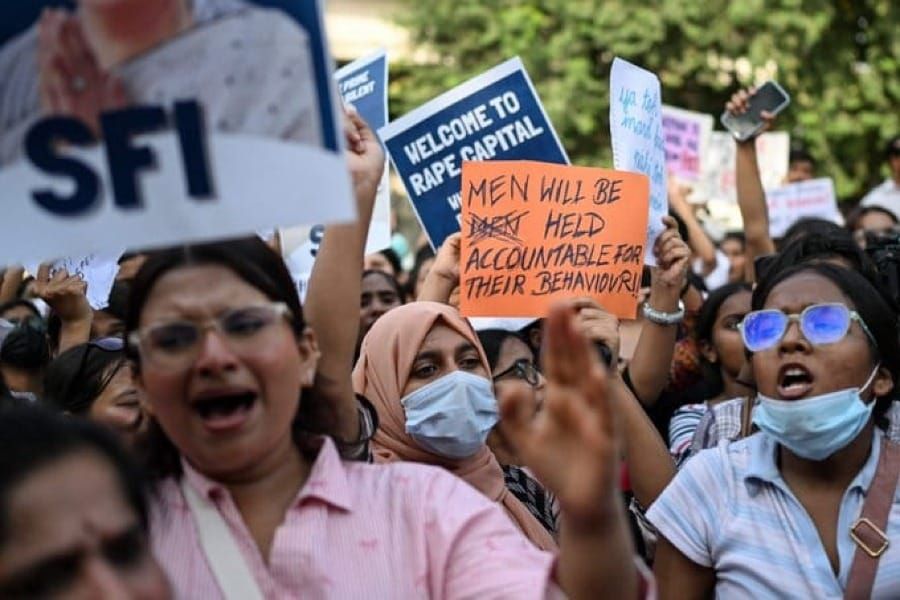
Hundreds of women students marched through Delhi University's North Campus on 28 September behind placards reading "Curfew for Rapists, Not Women" and "Thank you for online classes, we'd prefer safe roads". A week earlier, three men who said they were police officers had raped a 17-year-old girl in Aastha Kunj Park in south-east Delhi, according to police. The park borders Lady Shri Ram College for Women, where students say men have harassed, stalked and exposed themselves to them for years on the dark road to the back gate.
Justices J.B. Pardiwala and K. Vinod Chandran of the Supreme Court wrote on 28 September that the attack "has also brought to light pre-existing complaints of recurrent sexual harassment faced by students of Lady Shri Ram College for Women, situated in the immediate vicinity of Aastha Kunj Park". "Regrettably, these prior grievances failed to serve as a wake-up call for the police or the local administration to rectify institutional security lapses through enhanced patrolling and vigilance before yet another victim fell prey to unscrupulous perpetrators," they wrote.
Delhi has spent more than a decade building a women's safety system since a 23-year-old physiotherapy student was gang-raped on a bus in December 2012. The city received Rs 422.88 crore from the national Nirbhaya Fund by March 2022. A Safe City Project of about 10,000 cameras, sanctioned in 2018, had still not switched on its cameras by November 2025. Pink police booths fell from 135 to about 50. The Delhi Commission for Women had no chair from January 2024 until July 2026.
Lieutenant Governor Taranjit Singh Sandhu ordered a safety audit of every park in Delhi two days after the attack. The Delhi Development Authority (DDA), which manages Aastha Kunj, promised more cameras, lights and guards the day after that, and restricted evening entry to selected gates. Delhi Police sent women officers and patrol vans to the college. Delhi Police also arrested all three accused within hours of the attack, working from footage from more than 300 cameras.
A Lady Shri Ram student told The Federal: "They directly told us, 'It won't happen in the future.' But where were you before that?"
Aastha Kunj Park, 21 September
A 17-year-old girl and a male friend, also 17, left Kalkaji temple at about 7 p.m. on 21 September, bought chips and water outside Kalkaji metro station and entered Aastha Kunj Park through Gate No. 7, according to the first information report (FIR) as reported by The Statesman. They were eating on a bench when three men approached and said they were police.
Police said the men "used legal and police-related language to convince the teenagers that they were in trouble". The men slapped the boy, took both teenagers' phones and separated them. One of them told another, "Asif bhai, take out the gun," according to the FIR. They took the girl to an isolated spot, threatened her with the gun and raped her. Her friend called the police control room at about 8:45 p.m. after she told him what had happened.
Amar Colony police registered the case under sections 70(2), 61(2), 115(2) and 351(3) of the Bharatiya Nyaya Sanhita, covering gang rape of a minor, criminal conspiracy, hurt and intimidation. Police also applied sections 6 and 17 of the Protection of Children from Sexual Offences (POCSO) Act. Police arrested Asif (30) at about 6 a.m. on 22 September and Hemant Singh (31) and Mukesh Singh (24) at their home in Sri Niwaspuri about an hour later. Police said Asif fired at officers near the district magistrate's office road and was shot in the right leg, about 50 metres from Lady Shri Ram College's back gate. Officers say they recovered an unlicensed firearm, a knife and condoms from Asif, found pornographic material on his phone and found that search histories had been deleted from the other two men's phones. Police have recorded 12 witness statements. The father of Hemant and Mukesh said his sons had been framed. None of the three has been tried.
What was known before
Lady Shri Ram students describe years of harassment on the stretch between the college's front and back gates. The route has "three or four regular street lights", students told The Federal, and the back gate closes at 7:30 p.m. "They come and continuously masturbate and provoke the girls who are coming and going," one student said. Divya, an LSR student, told the Sunday Guardian that the area around the back gate "is actually a very unsafe area" and that a 500-metre stretch outside it is poorly lit after sunset. Newslaundry found stretches of darkness and street lights that did not work when it walked the route after the attack.
The Supreme Court order does not say who received the earlier complaints, when they were made or what was done with them. No dated complaint by Lady Shri Ram College, its students' union, its administration or a residents' association to Delhi Police, the DDA or the Municipal Corporation of Delhi (MCD) has been published. The students' accounts, the court's finding and the absence of a documented paper trail are all that is on the record; which office was told, and when, remains unknown.
Two men robbed a 28-year-old US citizen and a woman friend at knifepoint inside "DDA Astha Kunj Park near Nehru Place" on the night of 25 June 2025, cutting him on both hands, The Statesman reported. Police arrested two 20-year-olds after an encounter four days later.
Unnamed senior officers told NewsX that people had verbally complained that Asif was often seen in the park carrying a knife and harassing couples, and that those complaints "were never officially reported to police". Brut reported that Hemant Singh had been removed from a gym about a month before the attack after the gym received complaints from women. None of the three men has a published criminal record. The claims about Asif come from unnamed police sources and have not been tested.
Delhi Police posts on X, seen only in search listings, say Commissioner Anurag Kumar opened pink booths, police help points for women, at Lady Shri Ram College and PGDAV College; a separate post dates his visit to the southern range, where two pink booths were opened, to 16 September, five days before the attack. Students at a march on 23 September complained that the booth did not work, The Logical Indian reported.
The Students' Federation of India led a night march of Delhi University women on 2 September, after the Greater Noida bus case became public, and demanded "regular independent safety audits across DU campuses" and women police on campuses, Deccan Chronicle reported.
A 142-acre park with seven gates
The DDA manages Aastha Kunj, a 142-acre park between Kalkaji temple, Nehru Place and the college. Outlook reporters who inspected the park on 23 September found seven gates, several of them unmanned, no CCTV cameras at the entry and exit gates, collapsed sections of boundary wall and poor lighting near Gate No. 3. Between 6:30 p.m. and 8 p.m. one guard stood at Gate No. 1, one at Gate No. 3 and one patrolled on a motorcycle. The park's official hours are 4 a.m. to 9 p.m.
A guard told Outlook: "The park is huge and it's impossible to keep a vigil in each area." A police officer told the magazine: "Gates remain open all night. If we close them, people will start jumping over barriers." The Tribune reported gaps in CCTV coverage and several cameras that did not work. The DDA has said 27 guards work in the park across three shifts, OneWorldNews reported.
No safety audit of Aastha Kunj before 21 September has been published or reported. Ruby Makhija, secretary of the Navjiwan residents' welfare association, told ThePrint: "These are huge parks, which are under DDA, but there is no proper ownership."
Taranjit Singh Sandhu, the Lieutenant Governor, met the police commissioner, the MCD commissioner and the DDA vice-chairman on 23 September and ordered a safety audit of all Delhi parks within a week, more beat patrols and pink police around parks. On 24 September the DDA vice-chairman ordered extra CCTV cameras at entry points, floodlights in dark stretches, more guards, night bike patrols and safety boards within seven days. "After sunset and until closing time, visitors will be allowed to enter through selected gates," the DDA order said. The DDA said it would work with police and residents to ensure "that its parks remain accessible to women, children, senior citizens and other visitors". The audit's findings had not been published by 30 September.
Sent home
Lady Shri Ram College suspended in-person classes at about noon on 22 September, after the police shooting near its back gate, and taught online on 22 and 23 September. "Some students were panicking after the shooting so we decided to suspend classes around noon," a college official told CP24. Principal Kanika K. Ahuja said the college placed "the highest priority" on its students' safety and well-being. A strike by the Delhi University Teachers' Association on 23 September also kept most staff away, a faculty member told CNN-News18. The college returned to "regular offline mode" on 24 September.
Students who marched afterwards treated the closure, the DDA's evening gate restrictions and calls from parents to landlords as part of one pattern. "We should not empty the streets of women," a student told The Federal. "While your idea is to protect women, this is not how you can protect women." A Miranda House student told The Business Standard her parents had called the owner of her paying-guest lodging, and another said such owners demand extra money from female students.
Yaksha Sharma, a Delhi University graduate, told ANI: "This is exactly that patriarchal mindset, that when it comes to a girl, then just lock the girl up." Another student said: "Why shouldn't the restrictions be on men? Why don't you educate them?" A protester told The Statesman: "If girls were safe here, a gang rape would not have happened in Kalkaji. Till when will we stay indoors?"
Students from Kamala Nehru and Gargi colleges marched to Arun Jaitley Park on 25 September and issued a declaration, "Hum Auratein Azaad Hai" ("We women are free"), demanding lighting, transport, toilets and hostels and opposing restrictions after sunset, DU Beat reported. Careers360 reported that Delhi Police stopped an earlier march near the sub-divisional magistrate's office on 24 September and questioned students about why they were protesting. The 28 September march from Miranda House to the Faculty of Arts lasted nearly two hours. Samridhi Sharma, a 2018 graduate of Swami Shraddhanand College, said: "Street lights are bare minimum."
Rekha Gupta, Delhi's chief minister, said at Maitreyi College on 30 September: "Families and society often talk about imposing restrictions. But why only on girls? What about the boys?" She said cases "must be expedited to deliver justice swiftly". She did not announce new measures.
Where the money went
The Union government allocated Rs 7,712.85 crore to the Nirbhaya Fund from 2013-14 to 2024-25, and the women and child development ministry told the Rajya Sabha on 12 March 2025 that Rs 5,846.08 crore, about 76 per cent, had been "released/utilised". The government reports release and use as one figure, so the share actually spent is not published. A parliamentary committee on home affairs reported in March 2018 that the fund was "severely under-utilised".
Delhi was allocated Rs 393.4 crore by mid-2019, more than any other state or territory, and had used Rs 19.4 crore of it, or 4.9 per cent, according to Lok Sabha answers compiled by Factly. By March 2022 Delhi had been allocated Rs 422.88 crore and had used Rs 413.07 crore, the government told the Lok Sabha in December 2022. Most of the jump came from a single central release of Rs 268.60 crore to the Delhi Safe City Project in 2019-20. No figures for Delhi after March 2022 have been found.
The Union home ministry sanctioned the Delhi Safe City Project in 2018 at about Rs 798 crore, fully centrally funded, for about 10,000 cameras with video analytics, a command centre and women's patrol vans. The ministry released Rs 333.27 crore by 2020-21 and told the Lok Sabha in July 2021 that details of spending were "not maintained in the Ministry". The project missed a deadline of August 2023 set by the Lieutenant Governor. Officials said in November 2025 that its cameras had "still not started operating" because staff needed training, The Patriot reported, and Swarajya reported in December 2025 that a launch was expected in 2026. No launch has been reported.
Delhi's Public Works Department installed about 264,000 street cameras under a Rs 571 crore contract begun in 2018-19. Parvesh Verma, the public works minister, said in July 2025 that a technical audit had found more than 32,000 of them not working and more than 15,000 never installed. A PWD audit report placed before the Delhi Assembly in January 2026 counted 7,535 cameras offline. The two figures come from the same department six months apart and have not been reconciled. Delhi Police's own network of 19,431 cameras included 971 in South-East district, 941 of them working, according to police data reported by The Patriot in November 2025 without a year for the count.
An audit by the safety mapping firm Safetipin identified 1,406 dark spots in Delhi; 1,158 had been lit by September 2024, when the Lieutenant Governor ordered the MCD to finish the rest within a month, The Tribune reported. The result of that drive is unknown. Delhi Police had 135 pink booths and 115 integrated booths at the scheme's peak; about 50 were left by June 2025, none open around the clock, according to police data reported by The Patriot.
The Delhi Commission for Women, which operated the 181 women's helpline and a rape crisis cell, had no chair from January 2024. About 223 contract staff were removed in May 2024 and its office was closed for about 18 months. "There cannot be any reason whatsoever for not filling up the vacancies," the Delhi High Court said on 18 February 2026. Lata Gupta took over as chair on 27 July 2026 with more than 200,000 complaints pending and the crisis cells not working, The Wire reported. The 181 helpline had been moved to the Delhi government's women and child development department.
Delhi's 11 one-stop centres for survivors of violence had assisted 18,490 women by September 2024. A NITI Aayog study cited by The Reporters' Collective found that 0.8 per cent of Delhi respondents knew of them and that none had a police facilitation officer. The Union budget's Sambal line, the safety arm of the Mission Shakti programme, was cut from Rs 629 crore to Rs 322.35 crore at revised estimate in 2025-26; Rs 202.40 crore was spent in 2024-25.
Delhi's 10,000 civil defence volunteers who worked as bus marshals were removed in October 2023. None of the Home Guard marshals flagged for reinstatement had returned by November 2025, and the Delhi Transport Corporation said "there is no requirement", ETV Bharat reported.
Two more cases, two different failures
A 16-year-old Class 11 student boarded an empty sleeper bus at Pari Chowk in Greater Noida at about 9 p.m. on 4 August, believing it was going to Noida Sector 63. She told police the driver and conductor raped her during a journey of about 47 kilometres and left her near the Kashmere Gate inter-state bus terminus in Delhi. "The girl accused the (bus) driver and the conductor of gang raping her," said Niharika Bhatt, deputy commissioner of police for North Delhi. Police traced the bus to a Timarpur parking lot "within a few hours" using CCTV footage, Bhatt said, and arrested the driver, Kuldeep (39), and the conductor, Sandeep (26). They face charges of gang rape, kidnapping and wrongful confinement under the Bharatiya Nyaya Sanhita and the POCSO Act. The case became public on 31 August.
Bus UP 83 ET 3789 was registered in Firozabad on 28 April 2026 and was fined 12 times in three months, for a total of Rs 63,000, Additional Superintendent of Police Suresh Chandra Rawat said. A transport officer fined it Rs 26,000 on 8 July for operating without a permit. It was still carrying passengers four weeks later. The operator had done no background check on the two men, police told The Tribune. Reports conflict on whether the bus's cameras worked. An unnamed officer told ThePrint that barricading the Ring Road and highway to stop a bus "can lead to severe traffic congestion". The National Human Rights Commission asked police in Delhi, Gautam Budh Nagar and Mainpuri for reports on 2 September, and Delhi's transport department ordered on 1 and 2 September that buses keep trackers and panic buttons working and remove curtains and window film.
India notified rules in October 2018 requiring vehicle trackers and panic buttons in public service vehicles. The Supreme Court said on 14 May 2026 that fewer than 1 per cent of such vehicles had them and barred fitness certificates without the devices, ThePrint reported. A private sleeper bus with tinted windows was used in the gang rape of a 30-year-old woman in Mangolpuri, Delhi, in May 2026, more than 13 years after Delhi cracked down on buses with tinted glass in December 2012.
A teenage girl was stabbed to death near Kushak Road in outer north Delhi, in the Swaroop Nagar area, on 10 September. "When the girl threatened to file a police complaint, the accused allegedly stabbed her to death and dumped her body," an investigating officer told The Week. Her body was found in an open field on 13 September, so decomposed that police first thought it was a man's; a tattoo identified her. "The deceased initially could not be identified," said Lokeshwaran R, additional deputy commissioner of police for Outer North. Darkness made the number plate of the accused's tempo unreadable on CCTV, and police went through footage from more than 50 cameras. Police had arrested a 19-year-old and three boys aged 16, 17 and 17 by 18 September on charges including rape and murder. No one had reported her missing; her family said she often left home for days.
The Greater Noida case exposes gaps in the regulation of private buses that cross state lines: a bus fined for having no permit kept operating, its crew was unvetted and no agency stopped it on a 47-kilometre drive. The Swaroop Nagar case turns on child protection and missing-person reporting. Police identified suspects quickly in both, and neither involves a documented refusal to register a complaint. The two cases share an unlit or unwatched setting and young victims; the records do not show one common institutional failure.
What the numbers measure
India's National Crime Records Bureau (NCRB) recorded 29,536 rapes in 2024, a rate of 4.3 per 100,000 women, and 67,809 cases under the POCSO Act. In 96.8 per cent of recorded rapes the accused was known to the survivor. Police filed charge sheets in 81.3 per cent of rape cases; courts completed 20,587 rape trials out of 206,777 before them, convicting in 24.4 per cent.
Delhi recorded 1,212 rapes in 2022, 1,088 in 2023 and 1,058 in 2024, and 13,396 crimes against women in 2024. Its rate of crimes against women, 176.8 per 100,000 women, was the fourth highest of India's 19 largest cities, behind Jaipur, Lucknow and Indore. Delhi Police's own figures count 2,076 rapes in 2024 and 1,901 in 2025. NCRB counts only the most serious offence in each FIR and records many rapes of children under POCSO, which may explain much of the gap; neither agency has published a reconciliation.
NCRB counts only cases that police register. The National Family Health Survey of 2019 to 2021 found that 14.2 per cent of women who had experienced physical or sexual violence from a partner sought any help, according to an analysis in BMC Global and Public Health. NCRB has said part of the fall in recorded crime in 2024 reflects the switch from the Indian Penal Code to the Bharatiya Nyaya Sanhita on 1 July 2024.
Lovely Professional University
A post on Reddit on 26 September alleged that a female student at Lovely Professional University (LPU), a private university in Phagwara, Punjab, had been raped in Girls' Hostel 3 three or four days earlier by a plumber or other worker, the Punjab and Haryana High Court was told. Versions on WhatsApp and elsewhere added that the student, or two students, had died. A 21-year-old agriculture student had died after a fall from a girls' hostel on 10 September; police say they are investigating that death separately and have found no link to a rape.
Students began protesting outside Girls' Hostel 3 at about 1 a.m. on 27 September and blocked National Highway 44 by 2 a.m., police said. Students said a warden had been told and had done nothing, Onmanorama and NewsGram reported; no one has verified that, and no complaint to the university's internal complaints committee has been reported. Sorabh Lakhanpal, a dean, told ANI: "When the students brought this matter to our attention, we decided it needed to be treated seriously." He did not say when that was. Vice-chancellor Jaspal Singh Sandhu said the university did not know of any such incident. No report shows the university contacting police before the protest.
Registrar Monica Gulati issued a statement on the morning of 27 September: "The University categorically clarifies that there is no truth in the rumours presently being circulated." The statement said "anti-social elements" were spreading the claim in "a deliberate and concerted attempt to malign the reputation of the University". The statement cited no evidence, WION reported. Gulati also posted a video of three students living in Room 504 of Girls' Hostel 3 with the caption "The false narrative ends here". "Nothing of that sort happened in our room; we have been living here for the past two months," one said.
Students from Room 504 released a second video on 28 September. "Half of our video was trimmed and posted on Instagram, about which we had no idea," they said, according to WION, and said they had been "instructed to say that students and others are bothering us". "Our consent was not taken," they said. WION wrote that the authenticity of the second video "is not known". Neither the university nor police has commented on it. Neither video, as reported, contains a statement by the students that an assault took place.
Police registered FIR No. 162 at Satnampura police station on 27 September against an unknown person on the students' complaint and formed a special investigation team. "The students could not provide us with any victim's name," Naveen Singla, deputy inspector general for the Jalandhar range, told the BBC. "As of now, it can't be verified that rape has happened or not." Gaurav Toora, senior superintendent of police for Kapurthala, said: "So far, we have found no substantiating evidence." By 29 September police had reviewed more than 100 hours of CCTV footage and Singla said cameras on every floor of the hostel showed no man entering, ThePrint reported. No plumber has been reported questioned.
Protesters threw stones, burned vehicles and damaged police cars on 27 September until police used batons in the evening; five students were detained and three FIRs have been registered over the violence. "A force of over 2,000 personnel is currently deployed here," said M.F. Farooqui, additional director general of police. Director General of Police Gaurav Yadav said: "We have also found the role of outsiders." LPU suspended classes for 10 days from 28 September and postponed midterm exams, and students left the hostels within hours, the BBC reported. Punjab's women's commission sought the FIR and safety reports from district officials on 28 September.
Ashok Mittal, LPU's chancellor and a Rajya Sabha member of the Bharatiya Janata Party, said at a rally in Jalandhar on 30 September: "Someone posts just two lines on Reddit and then starts provoking others." "These are not 100 per cent but 100 crore per cent lies," he said. He said the unrest was a conspiracy "to damage Punjab, dent Hindu-Sikh unity". The Punjab and Haryana High Court on 30 September asked police for a status report on whether a rape took place and listed a public interest petition for 8 October.
14 years after Nirbhaya
The Justice J.S. Verma Committee reported on 23 January 2013, five weeks after the December 2012 bus attack. It recommended police reform, criminalising marital rape and opposed the death penalty for rape. Parliament passed the Criminal Law (Amendment) Act 2013, which widened the definition of rape, created offences of stalking, voyeurism and sexual harassment, and under section 166A made a public servant who fails to record an FIR for these offences liable to up to two years in prison. Marital rape remains exempt under section 63 of the Bharatiya Nyaya Sanhita. No national count of prosecutions under section 166A has been found.
Parliament added the death penalty for the rape of girls under 12 in 2018 and raised POCSO sentences in 2019; since 1 July 2024 section 70(2) of the Bharatiya Nyaya Sanhita has punished gang rape of a girl under 18 with life for the rest of natural life or death. The Nirbhaya Fund has paid for 991 one-stop centres nationally, which had assisted 1.52 million women by August 2026; the 181 helpline in every state and territory except West Bengal; the 112 emergency system in all 36; and 14,658 police women's help desks.
Fast-track special courts for rape and POCSO cases numbered 775 in April 2026, including 16 in Delhi. They disposed of 85,595 cases in 2024 and 66,500 in 2025, while pending cases rose to 245,579 in 2025, the law ministry told the Lok Sabha. The central scheme that funds them was extended until 30 September 2026. No further extension had been announced by that date.
The Supreme Court steps in
Pardiwala and Chandran opened In Re: Recent Rape Incidents in Delhi NCR on their own motion on 28 September. They wrote that they were acting on "a series of deeply disturbing news reports over the past few weeks". The order cites the Aastha Kunj attack, "the alleged gang rape and murder of a teenage girl in the Swaroop Nagar area of Delhi" and "the alleged sexual assault of a minor girl inside a moving sleeper bus, which law enforcement agencies failed to intercept while it traversed a distance of over 47 Km from Greater Noida to Delhi". It gives no count of cases.
Paragraph 5 of the order reads: "These incidents, considered alongside other recent reports of sexual offences across Delhi-NCR, starkly underline a systemic failure on the part of law enforcement and civil administrative authorities to guarantee basic public safety." Public spaces "cannot be permitted to become zones of high risk due to grossly inadequate illumination, poor surveillance, lax patrolling" and other "preventable administrative deficiencies", they wrote, and the right to live free from the fear of violence is part of the guarantee of life and liberty in Article 21 of the constitution. "One cannot help but draw painful parallels to the 2012 Nirbhaya case, calling into question whether systemic law enforcement mechanisms have made any meaningful progress in the decade since then," they wrote.
Paragraph 8 limits the case to "the broader institutional failures that transcend any single case" and leaves individual guilt to the trial courts. "Expressions of concern, devoid of accountability, fall short of answering the larger institutional question. Expressing solidarity is not the solution to this social evil," they wrote.
The Commissioner of Police must set up teams in each police district, led by an officer of at least deputy superintendent rank, to survey vulnerable places using "past and present complaints received, previous incidents and other objective indicators", draw vulnerability maps and post a named officer at each park and vulnerable area. Lighting and CCTV in parks, metro stations, bus stops and railway stations must be audited and broken equipment repaired. Complaints on the chief minister's Jan Sunwai portal must be geo-tagged and tracked, and police must impound vehicles with illegal window film. All of that is due within four weeks.
Status reports must cover the use of the national sexual offenders database by Delhi Police over five years, the home ministry's system for tracking sexual offence investigations, Mission Shakti, the 112 and 181 helplines, the Safe City Project, women's help desks and one-stop centres. For each scheme the authorities must say whether it is working, the area it covers, "the officer or authority responsible for its implementation", the cases it handled over three years and its average response time. "A mechanism intended to protect women and children can serve its purpose only if it is accessible, functional, adequately staffed, capable of responding promptly and subject to continuing institutional oversight," the judges wrote.
The Registrar General of the Delhi High Court must report within four weeks on the number of fast-track and POCSO courts, their pending cases and disposal times, and assign the cases named in the order to a fast-track court with trials finished "preferably within a period of one year from the commencement of trial". The court issued notice to three officials: the Chief Secretary of the Delhi government, the Commissioner of Police and the Registrar General. It appointed senior advocate Liz Mathew as amicus curiae and listed the case for 5 October.
Who answers for what
- Delhi Police, under Commissioner Anurag Kumar and answerable to the Union home ministry: patrolling around Aastha Kunj and Lady Shri Ram College, the pink booth opened there on 16 September, the national sexual offenders database and the Safe City cameras. Police arrested the Aastha Kunj, Greater Noida and Swaroop Nagar accused within hours or days and have increased patrols since 22 September. No record shows what police did with earlier harassment complaints from the area.
- Delhi Development Authority, under the Lieutenant Governor: Aastha Kunj's gates, guards, lighting, cameras and boundary wall. The DDA ordered new cameras, lights, guards and gate controls on 24 September. No DDA statement addressing conditions in the park before 21 September has been published, and no earlier audit of the park has been found.
- Municipal Corporation of Delhi and Public Works Department: street lighting and the 264,000-camera network outside the park. Their audits disagree on how many cameras work, and the result of the September 2024 dark-spot drive is unknown.
- Delhi government, whose Chief Secretary is a respondent in the Supreme Court case: the Delhi Commission for Women, left without a chair from January 2024 to July 2026, the 181 helpline and one-stop centres. Chief Minister Rekha Gupta has said restrictions should not fall only on girls and has announced no new measures.
- Union home ministry: the Safe City Project, sanctioned in 2018, and the investigation tracking system. The ministry told Parliament in 2021 that it did not keep figures on Safe City spending.
- Lady Shri Ram College and Delhi University: the back gate that closes at 7:30 p.m., the two days of online classes and the handling of students' complaints. The college has not published what complaints it received or passed on before 21 September.
- Uttar Pradesh transport authorities: the permit and fitness of bus UP 83 ET 3789, which kept carrying passengers after a no-permit fine on 8 July.
- Lovely Professional University: its statement of 27 September that the allegation had "no truth", issued without published evidence, and the video of three students that the students later said was trimmed and posted without their consent. The High Court will hear the public interest petition on 8 October.
What comes next
The central scheme that funds India's 775 fast-track special courts for rape and POCSO cases expired on 30 September 2026 unless renewed; no renewal had been announced by the end of that day. The National Commission for Women had asked Delhi Police for an action-taken report on the Aastha Kunj case within seven days of 23 September, and Punjab's women's commission had asked Kapurthala officials for the LPU FIR and safety reports by 30 September. Neither report had been published.
The DDA's week-long audit of Delhi's parks, ordered by the Lieutenant Governor on 23 September, is due to finish in the first days of October. The Supreme Court hears In Re: Recent Rape Incidents in Delhi NCR again on 5 October, when the Chief Secretary, the Commissioner of Police and the Registrar General of the Delhi High Court are due to begin answering its questions. LPU's 10-day suspension of classes ends on 7 October, and the Punjab and Haryana High Court hears the petition over the university's handling of the allegation on 8 October.
Delhi Police's district teams must finish mapping vulnerable areas, post named officers at parks and complete the lighting and CCTV audits ordered by the Supreme Court by 26 October, four weeks from the order. The Delhi High Court's report on fast-track courts falls due the same day.