President Volodymyr Zelenskyy awarded Elon Musk the Order of Freedom on 26 August 2026, 18 days after Musk had reportedly refused a Ukrainian request to lift the Starlink limits blocking strikes inside Russia.
For outstanding personal merits in protecting human lives and freedom and in developing relations between the peoples of Ukraine and the United States of America, I hereby decree: to award the Order of Freedom to Elon Musk, entrepreneur, engineer, and head of SpaceX and Tesla, United States of America
– Decree of the President of Ukraine No. 835/2026
Decree No. 835/2026, published on the presidential website, cites outstanding personal merits in protecting human lives and freedom and in developing relations between the peoples of Ukraine and the United States. It names Musk as an entrepreneur, engineer and head of SpaceX and Tesla. The same order went to Polish president Andrzej Duda in June 2025, and Zelenskyy has used it through the war as a diplomatic instrument rather than a battlefield decoration.
Musk revived America PAC in late July 2026 and committed up to $120 million to Republican turnout work before the midterm elections, on 29 July, after saying he had got a little too involved in politics. He gave $5 million to a Trump-aligned super PAC earlier in the year.
Musk sets the geographic boundaries of the satellite network Ukrainian units use to fly drones, direct artillery and hold communications along the front. Ukrainian officials have spent months asking him to move those boundaries outward, and he has refused.
The current restriction
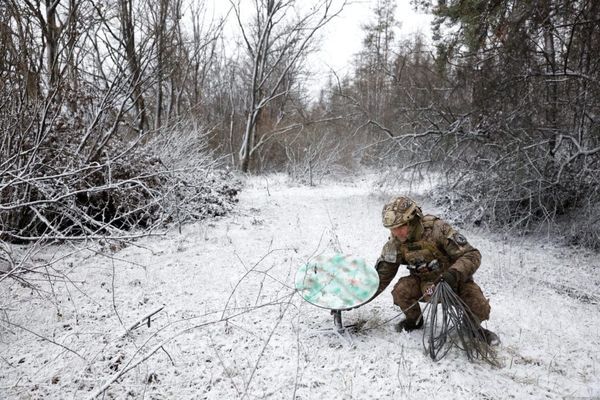
Ukrainian forces may use Starlink only inside Ukraine's internationally recognised borders, Crimea and the occupied regions included. Drones flown beyond that line lose the link and fall back on inertial and satellite navigation, which strips the operator of the live video feed needed to find and hit a vehicle that moves.
Zelenskyy asked Donald Trump at a White House meeting on 28 July 2026 to arrange talks with Musk on extending coverage over Russian territory so Ukrainian drones could hunt ballistic missile launchers, The Atlantic reported on 8 August. Trump said he would consider the request and gave no commitment, and Musk refused it, according to that reporting.
Kyiv wanted the boundary pushed out far enough to reach mobile launchers up to 200 kilometres beyond the border, the Financial Times reported on 21 August, and wanted the launchers destroyed before winter, when Russia concentrates its missile campaign on Ukraine's power grid. The Financial Times reported that Trump did not back the proposal.
Ukraine sought the change as its stock of Patriot interceptors fell during the conflict with Iran, The Atlantic reported. Ukrainian planners argued that each launcher destroyed on the ground removes an interceptor from the defence budget.
Denys Shtilerman, co-founder of the drone manufacturer Fire Point, told United24 that fitting long-range drones with Starlink modules would expand the strike zone to 500 kilometres and put targets as far as Siberia within reach of a guided attack.
Matthew Whitaker, the U.S. ambassador to NATO, said Washington would not permit Ukraine to build Patriot interceptors on its own soil, reversing an earlier Trump administration undertaking.
Mykhailo Fedorov, appointed defence minister on 14 January 2026 and dismissed on 15 July after his mobilisation reform failed and after months of friction with commander-in-chief Oleksandr Syrskyi, pursued back-channel talks with Musk without result. A person close to Fedorov told The Atlantic there was no positive decision, and said Musk answers Ukrainian officials by telling them it is time to make a deal. Fedorov's removal brought hundreds onto Independence Square; Zelenskyy dismissed Syrskyi six days later, on 21 July, and named Mykhailo Drapatyi in his place.
Zelenskyy told reporters on 22 August, in a transcript released two days later, that Trump had accused him of deception after Ukraine's defence ministry relayed a conditional approval Musk had never given. "He said that I had supposedly deceived him because Musk had denied Ukraine the use of Starlink on Russian territory," Zelenskyy said. He went back to the ministry, which conceded the error, and he linked the episode to the changes in his government without naming Fedorov. Zelenskyy said Musk may change his mind once he sees further arguments.
Musk told The Economist in July 2026 that Starlink is not decisive in the war, that Russia would not withdraw its troops and that the fighting can end only through concessions.
Kherson, autumn 2022
Musk ordered a SpaceX engineer to switch off Starlink coverage near Beryslav in Kherson region during Ukraine's autumn 2022 counteroffensive, Reuters reported on 25 July 2025, citing three people familiar with the matter.
Front-line units lost connectivity, drones stopped flying and artillery coordination broke down, according to that account. A Ukrainian military source told Reuters the blackout contributed directly to the failure of an encirclement operation.
Musk acted on a fear that a Ukrainian breakthrough would provoke a Russian nuclear response, the same sources told Reuters. SpaceX and Musk have not confirmed the episode.
Ukrainian soldiers described catastrophic losses of communication in contested areas of the south in October 2022, with the service failing near and beyond the front line. Kherson city was retaken on 11 November 2022, weeks after the geofence came down around Beryslav.
Sevastopol
Ukraine asked SpaceX in September 2022 to extend Starlink coverage to Sevastopol for a naval drone attack on the Russian Black Sea Fleet. Musk refused, saying he did not want SpaceX to become complicit in a major act of war, and cited U.S. sanctions on occupied territory.
Walter Isaacson wrote in his 2023 biography that Musk had secretly switched off coverage already running over Crimea. Isaacson corrected the account: the coverage had never been enabled there, and what Musk did was decline to switch it on. Ukraine struck the Sevastopol naval base in late October 2022 using other communications.
Gwynne Shotwell, president of SpaceX, said in February 2023 the company had taken steps to stop Starlink being used to control combat drones, and said the terminals were sent for humanitarian purposes rather than weapons guidance. The Pentagon signed a contract for Ukraine's Starlink service in June 2023 that gave it control over coverage areas. Musk retained authority over which areas were switched on.
Funding threats and the peace poll
SpaceX wrote to the Pentagon in September 2022 that it was not in a position to keep donating terminals to Ukraine or to fund the existing ones indefinitely. Musk said on 14 October 2022 that the service cost SpaceX $20 million a month and could not go on indefinitely, then reversed himself the following day and said SpaceX would keep funding it.
Musk published a four-point plan on 3 October 2022 as a Twitter poll: fresh votes under UN supervision in the annexed regions, Crimea formally recognised as Russian, a guaranteed water supply to Crimea and neutrality for Ukraine.
Zelenskyy answered with a poll of his own asking which Musk his followers preferred, the one who supports Ukraine or the one who supports Russia. Andriy Melnyk, then Ukraine's ambassador to Germany, told Musk to f*** off. Dmitry Medvedev praised the plan.
Attacks on Zelenskyy
Musk wrote on X on 3 March 2025 that Zelenskyy "wants a forever war, a never-ending graft meat grinder", and called it evil. Two days later he wrote that Zelenskyy should be offered amnesty in a neutral country in exchange for a transition back to democracy in Ukraine.
Musk has called repeatedly for elections in Ukraine during martial law, a position Zelenskyy rejected on 23 August 2026, saying wartime elections would split the country. Ukrainian law suspends elections while martial law is in force, and martial law has been extended without interruption since February 2022.
Musk wrote in March 2025 that Ukraine's entire front line would collapse if he switched Starlink off, and described the service as the backbone of the Ukrainian army. Radosław Sikorski, Poland's foreign minister, replied that Poland pays roughly $50 million a year for Ukraine's terminals and would seek other suppliers if access were threatened. Musk called him a small man. Marco Rubio said no one had made any threats about cutting Ukraine off.
Reuters reported in February 2025 that U.S. negotiators had raised shutting off Starlink in Ukraine during talks on a minerals agreement. Musk denied it.
What the award is for
A Russian BM-35 attack drone carrying a Starlink terminal came down near the Presidential Office in Kyiv's government district in late January 2026, causing minor damage and no casualties. Ukrainian officials appealed to Musk directly after the crash.
SpaceX and Ukraine's defence ministry announced on 2 February 2026 that they would block Russian units using stolen and grey-market terminals to guide drones. Terminals in Russian hands began going dark on 5 February, disrupting coordination, logistics and drone flights, and Ukraine moved its own units onto a whitelist of authorised terminals. Musk said that month the measures had worked.
SpaceX sent the first terminals to Ukraine in February 2022, two days after Fedorov, then digital transformation minister, asked Musk for them publicly on Twitter.
The Order of Freedom is awarded for services in strengthening Ukraine's sovereignty and independence, consolidating society and advancing democracy.
Ukrainian units remain barred from using Starlink beyond Ukraine's recognised borders.
Russia is building a satellite internet system of its own, Rassvet, developed by the private company Bureau 1440, which launched its first batch of 16 satellites in March 2026 and lost one of them in June. Vadym Skibitskyi, deputy head of Ukraine's military intelligence, said on 10 August 2026 that Moscow was launching the constellation faster than planned, that the system passes over Ukraine only intermittently and that 292 satellites are planned by 2027 and 924 by 2035.