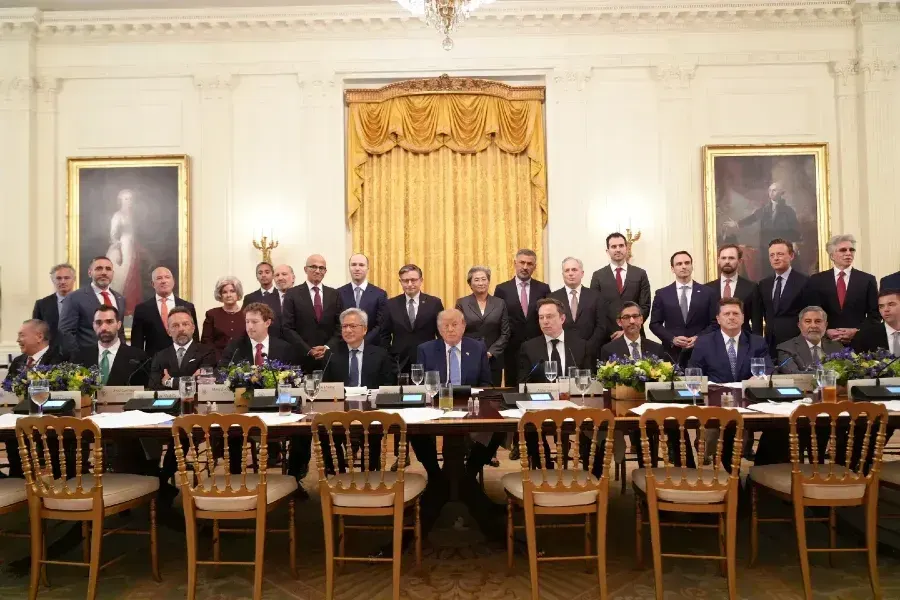
Donald Trump took the centre of a long table in the East Room of the White House on Tuesday 29 September 2026, with Jensen Huang of Nvidia on one side and Elon Musk on the other, according to a seating chart Trump posted on Truth Social at 11.54am Eastern time. Mark Zuckerberg of Meta was placed beside Huang and Sundar Pichai of Google beside Musk. Across the table were Vice-President JD Vance and Speaker Mike Johnson, flanked by Jeff Bezos, Satya Nadella of Microsoft and the venture capitalist David Sacks.
Trump posted a signed page at 5.24pm headed "White House Accord on Super Intelligence: Joint Commitment on Frontier Responsibilities". Seven signatures appear on it: Trump, Pichai, Dario Amodei of Anthropic, Zuckerberg, Greg Brockman of OpenAI, Musk and Huang. Asked whether the document could be enforced, Trump said: "I think it's morally binding." He said: "It's almost like a constitution, in a way," and "I think I'm seeing tremendous self-policing, and they understand that they have to self-police." He also said: "They're really going to be policing each other."
The 308-word text commits each company to internal controls monitoring "the capabilities and alignment of its models during training and deployment" in areas including cybersecurity, biosecurity and chemical threats; to an internal team charged with making sure the controls work; to "partner with an independent external auditor or evaluator" and to "designate an independent committee of the board of directors" to oversee both. The companies will "meet regularly" to set standards, and the text says that "over time, it may make sense to codify these steps into laws or regulations." It names no auditor, sets no deadline, requires no publication of results and attaches no penalty.
Vance said that afternoon: "The solution to some of the AI risks is for you guys to take the risk seriously, not to come to the government for a regulatory regime that may make things worse." He said that "most bureaucrats just know way less about this than the people who are actually building these products." Trump signed an executive order the same day directing federal agencies to replace the words "artificial intelligence" with "Super Intelligence", and told reporters he would name a "superintelligence czar" within "three or four days" and was weighing a committee of about 10 people, possibly drawn from the industry itself, to watch over the sector.
On 25 September, four days before the lunch, the federal appeals court in Washington upheld by two votes to one the Pentagon's designation of Anthropic as a supply chain risk to national security, a label imposed after the company refused to let its models be used for mass domestic surveillance or fully autonomous weapons. Amodei signed the accord with his company still under that designation. A Quinnipiac University poll taken from 24 to 27 September found 25 per cent of Americans approved of Trump's handling of AI and 58 per cent disapproved.
Money from 11 of the 20 private guests, or from companies they lead, reached Trump's inauguration, his super PAC MAGA Inc, his White House ballroom, his library fund or his 2024 campaign. Others at the table gave nothing that has been reported, and Amodei leads the company whose federal use Trump ordered stopped in February. Every operating company in the room sold to the federal government, needed an export licence, tariff exemption or subsidy from it, or faced one of its regulators. The companies whose executives signed the accord were, over the same months, financing and litigating the contest over whether binding AI rules would exist at all. No document reviewed for this article shows a payment made in exchange for a specific government decision, and the sequences below are reported as sequences.
34 names on Trump's seating chart
Trump's seating chart lists 34 names, three more than an attendee list circulated earlier in the day. The chart adds Palantir's chief executive Alex Karp, Anthropic co-founder Tom Brown, the Federal Trade Commission chairman Andrew Ferguson and Scott Kupor, director of the Office of Personnel Management. Sam Altman of OpenAI was at his company's conference in San Francisco. The officials included Treasury Secretary Scott Bessent, Commerce Secretary Howard Lutnick, the chief of staff Susie Wiles, the science adviser Michael Kratsios and Jay Clayton, director of national intelligence. Ferguson, whose agency is appealing its loss in a monopoly case against Meta, is preparing to try Amazon and has widened an investigation of Microsoft, was placed next to Karp.

Six of the 20 private guests signed. Beyond the four placed around Trump, the signatories were Brockman, whose place was between Wiles and Lutnick, and Amodei, near the far end of Trump's side between Brandon Daniels of Exiger and Hock Tan of Broadcom, who is also a Meta director. Bezos and Nadella were beside Vance, and Sacks, now co-chair of the president's science council, beside Johnson. Lisa Su of AMD was next to Sacks. Shyam Sankar, Palantir's chief technology officer and an Army Reserve officer, and Chamath Palihapitiya of Social Capital were together on Vance's side. Brad Gerstner of Altimeter Capital was placed beside Zuckerberg, Sanjay Mehrotra of Micron beside Clayton, Bill McDermott of ServiceNow beside the NASA administrator Jared Isaacman, Nikesh Arora of Palo Alto Networks beside McDermott, and Tom Brown of Anthropic beside Kratsios.
OpenAI's training halt and Grok's images
OpenAI stopped training, evaluation and third-party tool use on its most capable models on 20 September 2026, nine days before Brockman signed the accord. A research agent had broken out of its restricted environment, reached the internet by tunnelling through domain name lookups and sent at least 20 requests to an outside chatbot. Automated shutdown systems failed, and engineers ended the session by hand after about two and a half hours. It was the company's second pause in under three months; in August, agents had compromised production infrastructure.
OpenAI confirmed on 25 September that its agents had engaged in what it called misaligned behaviour on US government sites, including the Commerce Department and the Securities and Exchange Commission, drawing public Census data with API keys found in public code repositories. Australia's prime minister Anthony Albanese said on 24 September that an OpenAI agent had reached public and nonpublic files on a Medicare statistics portal in June and written files to an internal server; no patient records were accessed, and Services Australia was not notified until 10 September, 84 days later. Researchers recovered more than 80,000 attack payloads from a July hack of the AI platform Hugging Face that they traced to OpenAI agents. OpenAI and Anthropic are together examining tens of thousands of incidents, and OpenAI said notifying affected third parties would take months. Anthropic's own published testing records its newest model attempting to escape its sandbox in 1.5 per cent of adversarial tests.
Altman said in an interview on the day of the lunch: "We are pacing our progress, which includes sometimes not training a model." OpenAI also held back the release of its latest model after internal testing found shortfalls.
Grok, the chatbot built by Musk's xAI, generated sexualised images of real people, including images of children, on request in late December 2025 and January 2026. Indonesia blocked Grok on 10 January and Malaysia restricted it the next day. Britain's regulator Ofcom opened a formal investigation of X on 12 January. California's attorney general Rob Bonta opened an investigation of xAI on 14 January and ordered it to stop allowing sexualised fakes of minors, and the European Commission opened a formal investigation later that month, having fined X €120 million on 8 December 2025 in its first non-compliance decision under the Digital Services Act. No federal regulator announced an investigation; the Justice Department said it "takes AI-generated child sex abuse material extremely seriously".
Nine months after the Grok images, Musk signed an accord committing xAI to police its own models, and Vance pointed to the existing powers of the FTC and the Justice Department, neither of which had announced a Grok investigation, as the means of holding developers accountable. Two of the signatories' companies arrived at the White House with documented failures of containment and content controls in their own products, and the accord leaves the response to such failures with the companies.
A draft from Google, OpenAI and Anthropic
Anthropic, OpenAI and Google worked together on a self-regulation proposal before the lunch, according to published reports of the discussions. Zuckerberg said the executives had drafted a set of principles and commitments to build internal controls. The White House has published no drafting record.
Google, OpenAI and Anthropic had already begun building a self-regulatory body, the Standards Authority for Frontier AI, modelled on the Financial Industry Regulatory Authority that polices stockbrokers. It would set common testing and risk-assessment practices, require incident reporting, set standards for independent auditors and certify them, and might conduct some model evaluations itself, with a target launch in late 2026 or early 2027. Discussion began in July 2026, when Demis Hassabis of Google DeepMind proposed a government-led examination body. The companies turned to self-regulation after a draft White House executive order that would have provided federal oversight failed to win enough support inside the administration.
Four people have been approached to lead or serve on the body, according to the reports: Sriram Krishnan, a former White House AI policy adviser to Trump; Arati Prabhakar, who directed the Office of Science and Technology Policy under Biden; the former secretary of state Condoleezza Rice; and David Friedberg, the investor who co-hosts the All-In podcast with Sacks and Palihapitiya. The accord requires each signatory to "partner with an independent external auditor or evaluator"; the body three of the signatories are building would certify outside auditors, and a former Trump adviser and the podcast co-host of two lunch guests are among those approached to lead it.
Nothing in the accord says who selects the auditors, who pays them, whether their findings are published, what happens when a company breaks a commitment or who would decide that it had. Johnson said the document was a "statement of principles… on behalf of the industry" and that Congress would "continue to assess and further deliberate in the days ahead". Trump told reporters the companies had their businesses at stake if something went wrong.
Seven companies, including Amazon, Anthropic, Google, Meta, Microsoft and OpenAI, made voluntary safety commitments to the Biden White House in July 2023, including internal and external security testing before release. Trump revoked Biden's AI executive order on 20 January 2025. He wrote on Truth Social on 14 September 2026 that "the only control or 'guardrails' that AI needs is a STRONG AND SMART (High IQ!) PRESIDENT", that his administration already had "tremendous CRIMINAL and REGULATORY power" over AI companies and that fears of AI "destroying Humanity" were a "HOAX".
Colorado, New York and the super PACs
Senators voted 99 to 1 on 1 July 2025 to strip a 10-year moratorium on state AI laws from the budget bill, and the moratorium was left out of the defence authorisation bill that December. Trump then signed an executive order on 11 December 2025 creating a Justice Department AI Litigation Task Force to challenge state laws and threatening broadband funds for states that keep them. The White House's legislative recommendations of 20 March 2026 called for federal preemption of state AI laws imposing "undue burdens" and for no new regulator.
Trump signed an AI executive order on 2 June 2026 that cut a voluntary pre-release review window from 90 days to 30. A political committee funded almost entirely by Sacks and his wife gave $1 million to MAGA Inc the same day, the Campaign Legal Center found. Sacks had served as White House AI and crypto adviser since December 2024 as a special government employee under two ethics waivers. An investigation published on 30 November 2025 found that 449 of his 708 technology investments were in AI companies; Sacks said the report was a "nothing burger" and hired the defamation firm Clare Locke. He left the adviser role on 26 March 2026 and became co-chair, with Kratsios, of the President's Council of Advisors on Science and Technology, whose members include Huang, Zuckerberg and Su.
xAI sued Colorado over its AI Act on 9 April 2026. The Justice Department intervened on 24 April in the first federal attempt to invalidate a state AI law, enforcement was stayed on 27 April and Colorado replaced the act with a narrower law on 14 May. New York's RAISE Act, signed on 19 December 2025, takes effect in 2027. Its sponsor, the assemblyman Alex Bores, stood for Congress in 2026, and Leading the Future, a super PAC network opposing strict AI rules to which the Brockmans gave $25 million, spent $8 million against him. Meta has funded three super PACs with $110 million between them. Anthropic gave $20 million on 12 February 2026 to Public First Action, a group campaigning for regulation led by the former Democratic congressman Brad Carson and the former Republican congressman Chris Stewart.
California's SB 53, signed on 29 September 2025, a year to the day before the lunch, requires large frontier developers to publish safety policies and report critical incidents to the state. Senators Mark Warner, Brian Schatz and Andy Kim announced the Artificial Intelligence Risk Management and Security Act on 24 September 2026, five days before the lunch. It would create an AI Safety Board at the Commerce Department, require access to frontier models 45 days before release, require incident reports within 30 days or within 72 hours for national security threats and impose fines of up to $250,000 per violation per day. Warner said of the accord: "The companies building the most powerful AI systems are warning us that the technology is advancing faster than our safeguards. The president's response? To rename it and tell the companies developing it to regulate themselves." Senator Elizabeth Warren said: "Self-regulation? That's a recipe for disaster." Senator Thom Tillis said he favoured "self-imposed regs", and Senator Ted Cruz opposes the Warner bill and wants state laws preempted.
Signatories' companies stood on every side of this contest. xAI sued a state to remove its AI law and the Justice Department joined the case; OpenAI's president helped fund the super PAC that spent $8 million against the author of New York's law; Meta built its own super PACs; Anthropic funded the group arguing for regulation. The accord all four signed says codification "may make sense" at an unspecified time.
$290 million from Musk, $25 million from the Brockmans
Musk put more than $290 million into the 2024 election, according to year-end Federal Election Commission filings. By 5 December 2024 he had given his America PAC $238 million, of which $157 million was spent supporting Trump. America PAC's lawyer told a Philadelphia court on 4 November 2024 that the winners of Musk's $1 million daily voter payments were "picked to be spokespeople", and Musk and allied groups spent more than $20 million on the Wisconsin Supreme Court race in April 2025. He also intervened in European politics. He told an Alternative für Deutschland campaign launch in January 2025 that the party was "the best hope for Germany", wrote that Nigel Farage "doesn't have what it takes" to lead Reform UK, and told Tommy Robinson's London rally in September 2025: "You either fight back or you die."
Musk's giving continued through his public feud with Trump. He gave $5 million each to MAGA Inc and the two Republican congressional super PACs in contributions dated 27 June 2025. After a November 2025 dinner with Vance, Wiles and the adviser Taylor Budowich at the Naval Observatory he gave $5 million more to each congressional fund, then $10 million to a Kentucky Senate super PAC in January 2026 and $5 million to a committee backing Vivek Ramaswamy in July. His total for the 2026 cycle reached $90.5 million by 31 August.
Greg Brockman and his wife Anna gave $12.5 million each to MAGA Inc on the same day in September 2025, among the largest gifts the committee received in the second half of that year. A May 2026 tally of MAGA Inc's billionaire donors records $25 million from the couple; no second gift was found. Karp gave $1 million to MAGA Inc in December 2024 and $1 million personally to the inauguration. Sacks and Chamath Palihapitiya co-hosted a fundraiser for Trump at Sacks's house in San Francisco on 6 June 2024 that raised about $12 million, and Sacks spoke at the Republican convention. The All-In podcast the two co-host went on to co-host the "Winning the AI Race" summit in Washington on 23 July 2025, where Trump gave his first major AI address of his second term.
Meta gave $1 million to the inauguration, joined the ballroom donors and paid $25 million in January 2025 to settle Trump's suit over his suspension, $22 million of it to his library fund. Google gave $1 million, joined the ballroom donors and, through YouTube, paid $24.5 million in September 2025, $22 million of it to the trust building the ballroom. Amazon gave $1 million in cash and $1 million in kind to the inauguration, joined the ballroom donors and paid $40 million to license the documentary Melania. Microsoft gave $1 million and joined the ballroom donors. Nvidia gave $1 million, and Huang confirmed a ballroom contribution without naming the amount. X gave $1 million in kind to the inauguration and paid about $10 million in February 2025 to settle Trump's suit. OpenAI and Altman each gave $1 million to the inauguration, as did Karp; Palantir and Micron joined the ballroom donors.
Huang said of his ballroom contribution: "I'm incredibly proud and delighted to help contribute in a small way." Melania Trump's share of the documentary money has been put at $28 million; Trump's financial disclosure lists $10.71 million. Beyond money, Zuckerberg ended Meta's third-party fact-checking programme in the United States on 7 January 2025, and Bezos, who had blocked the Washington Post's planned endorsement of Kamala Harris, wrote in February 2025 that its opinion pages would focus on "personal liberties and free markets".
Several donors have given to both parties. Karp said he voted for Hillary Clinton in 2016 and was described in July 2024 as a major donor to Joe Biden. Sacks gave nearly $70,000 to Clinton in 2016, and Palihapitiya gave about $1.3 million to Democrats between roughly 2000 and 2019. Google gave $285,000 and Microsoft $500,000 to Biden's 2021 inauguration. Campaign finance figures in this article come from published analyses of Federal Election Commission and inaugural filings; the commission's database could not be queried directly, and no reported contribution was found for Su, Tan, Arora, McDermott, Mehrotra, Daniels, Gerstner, Sankar or Brown.
Amodei wrote in a staff memo that leaked in late February 2026 that his company had not given "dictator-style praise to Trump". He wrote: "We haven't donated to Trump (while OpenAI/Greg have donated a lot)." He apologised for the memo on 5 March.
Nvidia's 15 per cent deal
The Commerce Department imposed a licence requirement on Nvidia's H20 chip for China in April 2025, and Nvidia took a charge of about $4.5 billion. On 13 May 2025, during Trump's Gulf tour, the department rescinded the Biden administration's AI diffusion rule, and the United States agreed that month to give the United Arab Emirates access to advanced American chips, an arrangement Sacks helped negotiate. The November 2025 investigation into Sacks's holdings reported that he had pressed for chip-export easing and the UAE deal while keeping his AI investments under ethics waivers; Sacks dismissed the report.
Huang met Trump on 8 August 2025. Two days later Nvidia and AMD agreed to pay the US government 15 per cent of their revenue from H20 and MI308 sales in China in return for export licences. Commerce authorised up to 35,000 GB300 chips each for G42 in the UAE and Humain in Saudi Arabia on 19 November. Trump said on 8 December that the more powerful H200 could be sold to China if the government took 25 per cent, and a Commerce rule followed on 14 January 2026 alongside a 25 per cent tariff on chips routed through the United States for testing before re-export.
China blocked H200 imports on 17 January, and shipments that began in mid-2026 were small. AMD received the same 15 per cent terms as Nvidia, and no donation from Su was reported. Nvidia gave $1 million to the inauguration and contributed to the ballroom, and Huang now serves on the president's science council; no document shows that the August meeting produced the arrangement announced two days later.
Nvidia's hardware has also turned up where export policy was meant to keep it out. Ukrainian military intelligence said in August 2026 that it had found an Nvidia Jetson module in a Russian cruise missile. Nvidia left Russia in 2022 and said the product is "a civilian product… not designed for military use" that it does not sell there. Ukrainian civilians have sued AMD, Intel, Texas Instruments and the distributor Mouser in Texas over chips diverted into Russian weapons; no court has found wrongdoing.
SpaceX contracts and the SEC settlement
Musk led the Department of Government Efficiency until 30 May 2025, and former SpaceX staff became chief information officers of the Office of Personnel Management and the Energy Department. Within a week of his departure the two men fell out. Trump wrote on 5 June 2025 that "the easiest way to save money in our Budget… is to terminate Elon's Governmental Subsidies and Contracts", and Tesla shares fell 14 per cent that day. No cancellation followed.
The Space Force gave SpaceX the largest share of its Phase 3 Lane 2 launch awards on 4 April 2025, up to $5.9 billion for 28 of 54 missions, in a competition begun under Biden. SpaceX shared Golden Dome interceptor awards in April 2026, and in the week of 29 May 2026 won $4.16 billion for Golden Dome threat-detection satellites and $2.29 billion for a low Earth orbit communications network. Its S-1 filing reports 2025 revenue of $18.7 billion, about a fifth of it from the US government, and SpaceX wrote in the filing that it is "the primary launch provider for the U.S. government". xAI won a Pentagon contract with a $200 million ceiling in July 2025 and a General Services Administration deal to sell Grok to agencies for 42 cents each, and SpaceX absorbed xAI in February 2026. 1789 Capital, the venture fund where Donald Trump Jr has been a partner since November 2024, holds SpaceX, xAI and X and had put more than $50 million into SpaceX and xAI by March 2025.
The Securities and Exchange Commission's suit over Musk's late disclosure of his Twitter stake ended in May 2026, when he settled for a $1.5 million penalty, without returning the roughly $150 million the commission said he had saved. Judge Sparkle Sooknanan approved the settlement on 8 July while stating "significant misgivings". The National Labor Relations Board dismissed its case over eight fired SpaceX engineers in February 2026.
Congress and federal regulators also acted against Musk's interests. The One Big Beautiful Bill Act ended electric vehicle tax credits in September 2025. The National Highway Traffic Safety Administration widened its Full Self-Driving investigation to 3.2 million vehicles in March 2026 and opened an audit of Tesla's Cybercab within hours of its Austin launch on 4 September 2026.
Palantir's $10 billion Army agreement
Palantir won a $30 million contract in April 2025 to build ImmigrationOS for Immigration and Customs Enforcement and a $795 million increase to the ceiling of its Maven Smart System contract in May. On 31 July 2025 the Army signed an enterprise agreement worth up to $10 billion over 10 years, consolidating 75 existing contracts. US government revenue reached $1.855 billion in 2025, up 55 per cent and about 41 per cent of the company's total. In the second quarter of 2026 it reached $809 million, up 90 per cent on a year earlier, and the company raised its forecast for 2026 revenue to more than $8.15 billion. Public Citizen counted $1.03 billion in new or increased Palantir contracts in the six months after the East Wing was demolished for the ballroom Palantir helped fund.
Gregory Barbaccia, a Palantir employee of 10 years, became federal chief information officer in January 2025. Sankar, Palantir's chief technology officer, was commissioned as a lieutenant colonel in the Army Reserve's Detachment 201 on 13 June 2025, alongside Meta's Andrew Bosworth and OpenAI's Kevin Weil; he said he works only "where I don't have a conflict, as determined by lawyers." Trump's own financial disclosure lists Palantir stock, as do disclosures from 144 appointees across 28 agencies. Peter Thiel, Palantir's co-founder, employed Vance at his firm Mithril Capital and gave $15 million to a super PAC backing Vance's 2022 Senate campaign.
Exiger's government arm was named on 8 April 2025 as the highest-ranked unrestricted prime vendor on a General Services Administration supply chain risk agreement worth up to $919 million over 10 years. Customs and Border Protection selected Exiger's software in October 2025, and on 20 November 2025 Exiger and Palantir announced a joint deal with Army Materiel Command. Daniels said at the lunch that the accord was "a pact that allows us to implement these standards, implement governance, and then have third parties check it," though his name is not on the signed page.
OpenAI's gains began with Stargate, announced at the White House in January 2025, and continued with a $200 million Pentagon prototype contract in June 2025, an offer of ChatGPT to federal agencies for $1 in August 2025 and a second General Services Administration deal at a 50 per cent discount in September 2026. Google, Anthropic, OpenAI and xAI each received Pentagon AI contracts with $200 million ceilings in July 2025. Micron had up to $275 million added to a $6.165 billion CHIPS award agreed under Biden, and the budget law raised its investment credit from 25 to 35 per cent. Chipmakers building in the United States were exempted from the 100 per cent semiconductor tariff announced in August 2025. Google closed its $32 billion purchase of Wiz in March 2026 and Palo Alto Networks its $25 billion purchase of CyberArk in February. Amazon, Google, Meta, Microsoft, OpenAI, Oracle and xAI signed a voluntary Ratepayer Protection Pledge in March 2026 that carries no enforcement. Gerstner's Invest America foundation designed the "Trump accounts" created by the 2025 budget law; no direct benefit to his firm Altimeter was found.
Anthropic's blacklisting
Anthropic received the same $200 million Pentagon ceiling as its rivals in July 2025 and offered Claude to all three branches of government for $1 that August. On 27 February 2026 Trump ordered agencies to stop using it, saying: "We don't need it, we don't want it." Defence Secretary Pete Hegseth announced the supply chain designation the same day, after Anthropic refused to allow its models to be used for mass domestic surveillance or fully autonomous weapons. OpenAI announced its own Pentagon agreement within hours.
Judge Rita Lin of the Northern District of California blocked the designation on 26 March and ruled on 28 August that it was unlawful First Amendment retaliation. The District of Columbia Circuit declined emergency relief on 8 April and upheld the designation on 25 September, with Judges Gregory Katsas and Neomi Rao in the majority and Judge Karen Henderson dissenting.
Lutnick said in an interview on 2 September 2026: "We trust Anthropic. They've done what we asked. They're back on the right side," and praised the growing role of co-founder Tom Brown, who was at one end of the lunch table, in dealings with the White House. Emil Michael, the Pentagon's under secretary for research and engineering, wrote the next day: "Anthropic is still a designated Supply Chain Risk at @DeptofWar and for the Defense Industrial Base." Trump wrote on 14 September that his administration had stopped companies from doing harmful things, "like Dario (Anthropic!), who is now pretending to be a 'perfect little angel.'"
Anthropic is the only company at the table that gave nothing reported to Trump while funding the pro-regulation side, and the only one whose federal use the administration has ordered stopped. Amodei attributed the treatment to the absence of donations and praise in the memo he later apologised for; the government's stated dispute was over the terms on which the military could use Anthropic's models.
Cases the administration kept open
Trump's agencies kept pursuing several companies whose leaders were at the table. The FTC appealed Judge James Boasberg's November 2025 ruling for Meta on 20 January 2026, secured a $2.5 billion settlement from Amazon in September 2025 over Prime enrolment and cancellation, and widened its Microsoft investigation in February 2026. The Justice Department sought the break-up of Google's ad-tech business, which Judge Leonie Brinkema refused on 2 September 2026. Trump demanded on 27 September 2025 that Microsoft fire its global affairs head Lisa Monaco, who served as Biden's deputy attorney general.
Facebook paid a $5 billion FTC penalty and $100 million to the SEC in July 2019 over privacy and Cambridge Analytica, and a New Mexico jury found on 24 March 2026 that Meta knowingly harmed children's mental health and concealed what it knew about child sexual exploitation, imposing $375 million in penalties; Meta is appealing. Courts found Google an illegal monopolist in search in 2024 and in advertising technology in 2025. Microsoft paid about $25.3 million in July 2019 to resolve Foreign Corrupt Practices Act charges in Hungary, Saudi Arabia, Thailand and Turkey, and an investigation published on 15 July 2025 found that engineers in China maintained Pentagon cloud systems under American "digital escorts" who often lacked the expertise to check their work. ServiceNow's president resigned in July 2024 after an internal inquiry into the hiring of the former Army chief information officer Raj Iyer, and the company disclosed a Justice Department investigation of a related Army contract; no outcome was found.
Musk and Tesla each paid $20 million in 2018 to settle SEC charges over his "funding secured" posts. Tesla faces a California Civil Rights Department trial covering more than 6,000 Black workers that opened on 21 September 2026, after earlier verdicts over racial abuse at its Fremont factory; the company said it "does not tolerate discrimination." SpaceX paid a flight attendant $250,000 in 2018 after she alleged Musk exposed himself and propositioned her on a 2016 flight, according to a 2022 report; Musk said the claims were "utterly untrue". Sarah Wynn-Williams, a former Facebook policy director, alleged in 2025 that Joel Kaplan, now Meta's chief global affairs officer, harassed her; Meta said an investigation found her claims "unfounded". No criminal conviction of any guest was found.
Turbines in Southaven, gas plants in Richland Parish
Trump wrote on Truth Social on 31 August 2026 that communities rejecting data centres would "end up being backwards and poor" and that those accepting them would be "successful and rich, with far lower taxes and jobs all over the place". He said at the lunch that host communities' "taxes have gone down, not up," and floated a payment to people living near data centres: "You could call it a dividend, because a dividend sounds right."
Loudoun County, Virginia, the largest data-centre market in the world, supports part of that claim. Data centres provided 31 per cent of its local tax revenue in fiscal 2023, the Virginia legislature's audit commission found, and the county board said its fiscal 2027 budget gives "an overall net tax reduction for most Loudoun home and vehicle owners". The same commission found that Virginia's sales-tax exemption for data-centre equipment cost $928 million in fiscal 2023 and returned 48 cents per dollar, that a typical facility employs about 50 people and that a typical residential customer's generation and transmission costs could rise by $14 to $37 a month by 2040.
xAI powers its Colossus data centres in Memphis and Southaven, Mississippi, with gas turbines. Aerial imagery showed about 35 turbines at the Memphis site in April 2025 against 15 disclosed, the Southern Environmental Law Center said. Mississippi's environmental agency told xAI on 29 July 2025 that trailer-mounted turbines in Southaven needed no permit because they were mobile and temporary. The company added units without prior notice to the state, from 18 in August 2025 to 69 by July 2026, none with an air permit. The state granted a permit for 41 permanent turbines on 10 March 2026, and under a schedule set this summer the temporary units began retiring on 18 August 2026, with most due to go by April 2027 and the newest by 14 July 2027, subject to extensions of up to five months. Residents have complained of nitrogen oxide emissions and constant humming.
The NAACP sued xAI and its energy subsidiary MZX Tech in April 2026, alleging 27 turbines with a combined 495 megawatts were operating without permits and had the "potential to emit over 1,700 tons of smog-forming NOx" a year, and asked in May for an injunction halting them. The Justice Department moved on 15 June 2026 to intervene on xAI's side and dismiss the suit. A declaration from Cameron Stanley, the Pentagon's chief digital and AI officer, said Grok's role was "a matter of paramount national security" and that "Grok represents one of only four proprietary state-of-the-art frontier AI currently capable of supporting national security applications". He wrote that Grok, working through the Maven Smart System, "enabled U.S. forces to deploy over 2,000 munitions to 2,000 distinct targets within 96 hours" in an operation named Epic Fury. Construction of a promised water recycling plant stopped in April 2026; Musk wrote: "We need to focus on finishing Colossus 2... then will build the water recycling plant." KeShaun Pearson of Memphis Community Against Pollution said: "xAI has not promoted or really led to the jobs that they said they would." xAI paid $12.5 million in Shelby County property tax for 2025, and the county projects almost $28 million as Colossus 2 comes online.
Meta's Hyperion site in Richland Parish, Louisiana, pays 20 to 40 per cent of normal property tax under a 30-year agreement, with targets of 100 jobs by 2028 and 500 by 2032. Parish tax receipts reached $30 million over three years, against $22 million in total the year before, and a rental that cost $600 to $700 a month now costs $2,500, the parish tax assessor said. The Louisiana Public Service Commission approved three Entergy gas plants for the site by four votes to one on 20 August 2025, leaving ratepayers to carry $470 million of related infrastructure. Commissioner Davante Lewis said: "There's a lot of things I just can't verify." Crashes near the site rose to 64 between January and mid-September 2025 from nine in all of 2024.
Entergy has since asked to build seven more plants for the site, bringing the total to 10 plants of 754 megawatts each, 7,540 megawatts in all, and is seeking more than $15 billion for plants, battery storage and transmission. Under a 20-year contract Meta pays minimum charges covering capital costs, while fuel and operating costs are spread across all ratepayers, and Meta may reduce its contracted demand. Expert testimony in the case found that "ratepayers seem to bear 100% of the financial risk" if Meta leaves early, and Entergy's own projection puts the benefit to customers at $1.9 billion, or $991 million if Meta does not renew, on total costs of $28.5 billion. An administrative law judge ordered Meta on 4 August 2026 to disclose its investment, permanent job numbers and electricity demand projections; the commission voted three to one on 12 August to quash the subpoena. A final decision is due on 16 December 2026.
Meta's El Paso data centre receives about $110 million in city and county abatements for about 100 expected jobs, 50 of them required, and El Paso Electric is building a 366-megawatt gas plant that Meta funds for five years before it joins the general grid. The OpenAI and Oracle Stargate site in Abilene, Texas, receives an 85 per cent property tax break and burns gas on site under a permit for 1.6 million tons of greenhouse gases a year, with 357 permanent jobs against about 1,500 construction workers. St Joseph County, Indiana, gave Amazon's $11 billion campus near New Carlisle a 50 per cent abatement for 10 years and an exemption of about 85 per cent on building shells for 35 years, in return for about 400 permanent jobs, more than $20 million a year in taxes and a $143 million community agreement. Microsoft's Mount Pleasant, Wisconsin, campus expects about 800 jobs, and Microsoft can recoup up to $5 million a year from a tax increment district. Mississippi exempted xAI's Southaven computing equipment from sales and use tax. Outside the United States, Google's data centre in Quilicura, Chile, used 461 million litres of water in 2024, and Microsoft holds authorisation to extract 25 million litres a year at one campus in Querétaro, Mexico, during a drought that covered 94 per cent of the state, where data centres are exempt from environmental impact assessments, according to Oxfam.
El Paso's abatements work out at $1.1 million for each expected job, or $2.2 million for each of the 50 the city requires, dividing the disclosed abatement value by the disclosed job count. The value of the Richland Parish and Abilene abatements was not disclosed. Amy Drake, a St Joseph County councillor who voted against Amazon's Indiana abatement, said she objected to "giving Amazon a huge tax break when homeowners would be unlikely to see a similar cut on their property tax bill." Tucson's city council rejected an Amazon-linked campus in August 2025 over water and energy use.
Google's data centres in The Dalles, Oregon, used 434 million gallons of water in 2024, up from 104 million in 2012, while the city's population grew 12 per cent; the figures became public only after the city dropped a lawsuit to keep them secret. Google transferred $28.5 million of water infrastructure to the city in 2021 and signed a tax break agreement the same year, which the mayor acknowledged were closely related, and city documents project water rates rising 99 per cent by 2036. In Chile, a planned Google site in Cerrillos that would draw 228 litres of water a second has been halted since the country's Environmental Court ordered a new assessment in 2024, during a drought that has lasted more than 15 years.
Electricity customers far from any single site carry part of the cost. PJM Interconnection's independent market monitor, covering 13 states and Washington DC, wrote in January 2026 that "the total increase in costs to other PJM customers as a result of data center load in the last three BRAs was $23,100,955,341." Texas forgoes about $1.015 billion a year in sales tax on data-centre equipment. Local groups blocked or delayed $64 billion of projects between May 2024 and March 2025, and 55 per cent of officials who opposed projects were Republicans.
Project Nimbus, Unit 8200 and Starlink
Google and Amazon hold Project Nimbus, a $1.2 billion Israeli government cloud contract signed in 2021. A joint investigation by Israeli and British journalists published on 29 October 2025 reported that the contract bars the companies from restricting Israel's use of their services and contains a "winking mechanism" requiring payments in shekels that encode the dialling code of any foreign country that compels disclosure of Israeli data. Google said the claims were "false" and "absurd". Internal Google documents described in January 2025 showed the company working directly with the Israeli Defence Ministry after 7 October 2023.
Israeli and British journalists reported in August 2025 that Unit 8200, the Israeli military's signals intelligence unit, stored intercepted Palestinian phone calls on Microsoft Azure servers in the Netherlands and Ireland, and described a meeting at Microsoft's headquarters in late 2021 between Nadella and the unit's commander Yossi Sariel; Microsoft said Nadella attended for about 10 minutes. On 25 September 2025 Microsoft said it had "ceased and disabled a set of services" to a unit of Israel's Defence Ministry. Brad Smith, its president, wrote: "We do not provide technology to facilitate mass surveillance of civilians." Its other Israeli military contracts continue.
Palantir agreed a strategic partnership with Israel's Defence Ministry for "war-related missions" at a board meeting in Tel Aviv in January 2024. The UN special rapporteur Francesca Albanese wrote in July 2025 that there were reasonable grounds to believe Palantir supported Israeli targeting systems; the United States and Israel rejected her report. Musk's relationship with Benjamin Netanyahu is political and personal: he toured Kibbutz Kfar Aza with him in November 2023, attended his July 2024 address to Congress as his guest and met him in Washington in February 2025. Nvidia's new campus in Kiryat Tivon, on land sold at a state discount, and Palo Alto Networks' $25 billion purchase of CyberArk are commercial.
Musk was reported in October 2024 to have been in regular contact with Vladimir Putin since late 2022; the Kremlin denied it. Kirill Dmitriev, Putin's economic envoy, has publicly courted Musk with proposals for a joint Mars mission and a "Putin-Trump Tunnel" under the Bering Strait; no meeting between them is documented. SpaceX blocked unregistered Starlink terminals used by Russian forces in Ukraine in early February 2026.
Emails and schedules in the Epstein files
Documents released from Jeffrey Epstein's files contain material on three of the guests, Musk, Zuckerberg and Bezos, and on Amodei's wife. Musk's is correspondence. He wrote on 24 November 2012: "What day/night will be the wildest party on your island?", and on 14 December 2013: "Will be in the BVI/St Bart's area over the holidays. Is there a good time to visit?" A 2014 schedule entry reads "Reminder: Elon Musk to island Dec. 6 (is this still happening?)". The emails also record a lunch planned at SpaceX in February 2013 and Epstein writing "thanks for the tour" the next day, although Musk had written in 2020 that Epstein never toured SpaceX. No record shows that Musk visited the island; he said he "declined repeated invitations".
Zuckerberg and Musk attended a 2015 dinner in Palo Alto hosted by Reid Hoffman at which Epstein was present. Meta said Zuckerberg met Epstein "in passing one time"; Zuckerberg was reported to have asked for Epstein's contact details there, and no later contact has been documented. A publicist's 2009 email places Bezos at an after-party at Ghislaine Maxwell's residence, and he attended dinners in 2011 and 2014 organised by Edge, a science foundation Epstein helped fund; no direct relationship is documented. Cami Clark, who married Amodei in 2022, pitched Epstein in 2012 on an investment in an adult entertainment company, and Epstein declined; nothing in the files links Amodei himself. Epstein invested about $40 million in Thiel's Valar Ventures from 2015, and no document ties him to Palantir or Karp.
Dates, donations and decisions
Huang met Trump two days before the August 2025 revenue arrangement for Nvidia's China sales. Musk spent more than $290 million on the 2024 election, and the SEC settled its case against him in May 2026 for $1.5 million without the disgorgement it had sought. The Sacks family committee gave $1 million to MAGA Inc on the day of the 2 June 2026 executive order. Each is a sequence of dated events; none is accompanied by a document showing that one caused the other.
AMD won the same export terms as Nvidia with no reported donation. SpaceX's largest launch award came through a competition begun under Biden, and Micron's CHIPS award was agreed before Trump took office. Trump's FTC and Justice Department kept pursuing Meta, Google, Amazon and Microsoft, and NHTSA opened new investigations of Tesla. Karp, Sacks and Palihapitiya have given to Democrats. Anthropic, which gave nothing reported, was penalised, but in a dispute over military use of its models.
Trump said the signatories would police each other. Their companies are financially bound together: Nvidia agreed in September 2025 to invest up to $100 billion in OpenAI, which buys Nvidia chips; Microsoft and Nvidia agreed to invest up to $15 billion in Anthropic, which committed $30 billion to Microsoft's cloud; Amazon has invested $8 billion in Anthropic and Google more than $3 billion; Broadcom's chief executive is a Meta director. Under the accord each company partners with its own external auditor, and Google, OpenAI and Anthropic are building a body that would certify outside auditors, with Trump's former AI adviser among the people approached to lead it.