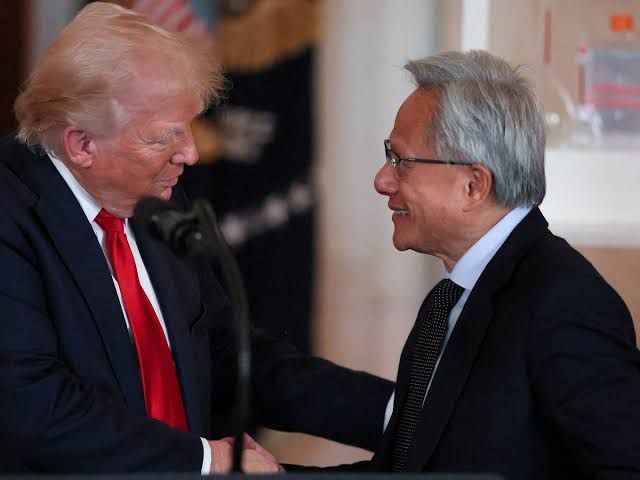
President Donald Trump's accounts bought up to US$1 million of Nvidia shares on 6 January 2026, a week before his administration published the rule letting Nvidia sell its H200 chip in China.
The purchase came at the end of a sequence that began in 2025. Nvidia committed US$25 million to Trump's White House ballroom in October 2025, about three months after Trump lifted a ban on its H20 chip following meetings with Jensen Huang, its chief executive. Nvidia had agreed in August to pay the government 15 per cent of H20 revenue from China. In October officials also briefed Trump that a businesswoman close to Jensen Huang was a suspected Chinese intelligence asset, and he chose not to act. On 8 December he approved H200 sales to China in return for 25 per cent.
Public filings, official statements and Trump's own remarks record each of those steps. Democratic lawmakers and former export officials have asked whether Nvidia's money and access, or the president's own holdings, shaped decisions that the government treats as matters of national security. The available documents establish the payments, the meetings and the approvals. They do not establish an agreement linking them, and no official has alleged one.
Trump's representatives said independent managers with sole authority over trading made the share purchases. An Nvidia spokesperson said the ballroom donation was independent of any business interests. Kush Desai, a White House spokesman, said in December 2025 that licensed exports to vetted customers differed from smuggled chips sold to unknown buyers. Trump said on 9 November 2026 that he believed Jensen Huang had not known the woman was a spy.
Huang's meetings with Trump
Before 2025 Jensen Huang rarely visited Washington. As the incoming administration weighed banning Nvidia's chip sales to China, he and his wife attended a donors' dinner at Mar-a-Lago, Trump's club in Palm Beach, Florida, where he argued for allowing them.
The Commerce Department told Nvidia on 9 April 2025 that it needed a licence to sell the H20, a chip designed to meet earlier export limits for China. Nvidia disclosed the requirement on 15 April and later recorded a US$4.5 billion charge on unsold H20 inventory and purchase commitments. The day before that disclosure it announced plans to produce up to US$500 billion of AI infrastructure in the U.S. over four years with its manufacturing partners.
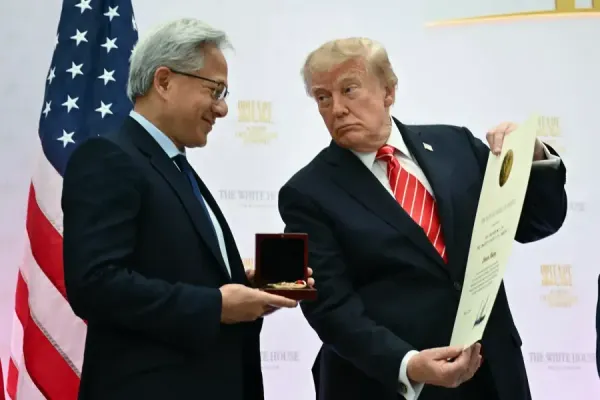
Jensen Huang met Trump at the White House in July 2025, and the administration reversed the H20 restriction that month. The Commerce Department began issuing H20 licences in August, two days after another meeting between the two men. Trump said that summer that he had once wanted to break Nvidia up before he learned more about the company and its chief executive.
On 3 December 2025 Jensen Huang met Trump again and then met Republican senators behind closed doors on Capitol Hill. Five days later Trump approved the H200. Trump appointed him to the President's Council of Advisors on Science and Technology in March 2026. In May, after Jensen Huang was left off the list of executives travelling to Beijing, Trump called him and he boarded Air Force One in Alaska. He and his wife sat at the head table of the White House state dinner for Xi Jinping, China's president, on 24 September 2026.
Jensen Huang made his case in public as well as in private. He said in May 2025 that export controls had failed because Chinese researchers would turn to their own chips, and told reporters that month that there was no evidence of AI chip diversion. In November 2025 he said at a London conference that China was going to win the AI race, then said hours later that China was nanoseconds behind the U.S.
A US$25 million ballroom gift
Nvidia's US$25 million to the ballroom equalled the largest gifts on a donor spreadsheet disclosed in October 2026, alongside Apple's. The money passed through the Trust for the National Mall, a nonprofit not generally required to name its donors, and Nvidia asked that its gift be kept anonymous. It was not among the 37 donors the White House named in October 2025. Jensen Huang told reporters that month that he was delighted to contribute.
Nvidia also built a lobbying operation from almost nothing. It reported US$4.97 million of federal lobbying in 2025 and a quarterly high of about US$2.2 million in the third quarter of 2026, with export controls among the listed issues. In December 2025 it lobbied successfully to keep the GAIN AI Act, which would have required chipmakers to supply U.S. customers before selling to China, out of the annual defence bill. Jensen Huang called the decision to drop it wise.
Lobbying reports record spending and subjects but not which officials were approached or what they were told. The ballroom donation does not appear in them, because gifts to the trust are not lobbying expenditure.
Trump's 15 per cent
Trump told reporters on 11 August 2025 that he had negotiated the H20 terms with Jensen Huang personally. He said he asked for 20 per cent of the revenue and settled on 15, and that he wanted something for the country because he was giving Nvidia a release. Advanced Micro Devices agreed to the same terms for its MI308 chip. Trump said a reduced version of Nvidia's newer Blackwell chip might be possible for a larger cut.
No U.S. company had previously paid a share of its revenue for an export licence. Officials at the Bureau of Industry and Security, which issues the licences, were caught off guard, and one said the payment was not written into the licences granted. Christopher Padilla, a former head of the Commerce Department's International Trade Administration, called the arrangement astonishing. Peter Harrell, a nonresident fellow at the Carnegie Endowment for International Peace, wrote that charging a fee to relax national-security controls set "a terrible precedent".
The Constitution bars taxes on exports, and trade lawyers questioned the legal basis for the 15 per cent. Raja Krishnamoorthi, the senior Democrat on the House select committee on China, asked the administration what authority it relied on. Twenty former officials and security specialists, among them Matt Pottinger, a former deputy national security adviser, urged Lutnick not to license the H20 at all. Nvidia said it followed the rules the U.S. government set.
Lutnick gave a different rationale from Trump's. He said in July 2025 that resuming H20 sales was tied to talks on China's supply of rare earth minerals and that the H20 was only Nvidia's fourth-best chip. The Commerce Department had also been told not to impose new export controls on China for the time being, to avoid upsetting talks with the Chinese government, according to people familiar with the instruction. China had accounted for 26 per cent of Nvidia's revenue in 2022 and 17 per cent in 2024.
The H200 payment took a different legal form. On 13 January 2026 the bureau published a rule moving H200-class exports to China from a presumption of denial to case-by-case review. A presidential proclamation imposed a 25 per cent tariff on such chips when imported into the U.S. for testing before export. Lawyers at Mayer Brown wrote that the tariff in practice carried out Trump's December promise that 25 per cent of H200 sales to China would be paid to the U.S.
The October 2025 briefing
Officials briefed Trump in October 2025 that Alice Huang, a Chinese businesswoman and former executive of Megaspeed, one of Nvidia's largest Southeast Asian customers, was passing information to the Chinese government and had a close relationship with Jensen Huang. Trump chose not to act. The officials did not believe Jensen Huang knew what she was doing, and a warning might have alerted her to the surveillance.
Before meeting Xi in Busan, South Korea, on 30 October 2025, Trump considered raising Jensen Huang's request to sell China Blackwell chips and dropped it after nearly all his senior advisers objected, current and former officials said. Marco Rubio, the secretary of state and national security adviser, later oversaw a memo identifying Alice Huang as having been recruited by China's Ministry of State Security. It circulated in spring 2026 before Trump's visit to Beijing, and Lutnick received it.
Trump said on 8 November 2026 that he did not regret not acting on the briefing and called Jensen Huang an honourable man. On 9 November he said he had been reading about the matter over a period of time, but not for long, an account that differs from the reported briefing about a year earlier.
Ten Chinese buyers
Senator Elizabeth Warren of Massachusetts, a Democrat, said on 3 December 2025 that Jensen Huang had spent the previous year lobbying the president to approve advanced chip sales to China. Trump announced the H200 decision on 8 December, excluding Nvidia's newer Blackwell and Rubin chips. Nvidia said the administration's critics and the country's foreign competitors were pushing for the same result.
The Commerce Department, led by Howard Lutnick, carried out the decision. Its January rule required exporters to certify sufficient U.S. supply, third-party testing and safeguards on remote access. By 14 May the department had approved about 10 Chinese companies, among them Alibaba, Tencent, ByteDance and JD.com, to buy up to 75,000 H200 chips each.
Brian Mast, the Republican chairman of the House Foreign Affairs Committee, introduced a bill after the decision that would let Congress block such licences. The committee advanced it 42 to 2 on 21 January 2026 over objections from Nvidia and from David Sacks, the White House adviser on AI.
Trump's 6 January purchase
Trump's periodic transaction report for the first quarter of 2026, signed on 8 May and released by the Office of Government Ethics, records Nvidia purchases on 6 January and 10 February. The second was between US$1 million and US$5 million. Representative Don Beyer of Virginia, a Democrat, wrote that the filing listed 15 separate Nvidia transactions.
The report covers more than 3,000 trades in many companies. It gives values only in bands and does not show who placed each trade or why. A Trump Organization spokesperson said the accounts were managed by third-party financial institutions with sole authority over trades. Eric Trump, the president's son, said the family's exposure to Nvidia came through broad index funds, although the filing lists Nvidia shares by name.
A federal criminal statute, 18 U.S.C. 208, bars executive branch employees from taking part in matters in which they have a financial interest, but section 202(c) exempts the president. The president must still report securities trades under the STOCK Act. Warren wrote to Trump on 12 August 2026 about the timing of the Nvidia purchase on 6 January. Trump's representatives have not said whether the account managers knew of any pending export decision.
No H200 sales by April
Nvidia gained licences to sell in China but little revenue from them. The Chinese government told its companies not to buy the H20 after accusing it of security risks in July 2025, and to hold back from the H200. Lutnick told senators on 22 April 2026 that no H200 chips had been sold to China. Jensen Huang said on 30 April that Nvidia's share of China's market for its data centre products had fallen to zero.
The U.S. Treasury's share therefore depended on sales that had not taken place by the spring of 2026. Trump's holdings rose and fell with Nvidia's shares. The ballroom, which Trump has made a personal project, received Nvidia's US$25 million.
Lutnick's own interests have also been questioned. Representative Madeleine Dean of Pennsylvania, Warren and other Democrats asked the Commerce Department's inspector general in December 2025 to investigate whether investments by Lutnick's family in AI data centres conflicted with his official decisions.
Kessler, Bessent and the Entity List
Lutnick did not always side with Nvidia. In October 2025 he held up a multibillion-dollar deal to supply Nvidia chips to the United Arab Emirates until the Emiratis completed promised U.S. investments. Jensen Huang and other Nvidia executives complained privately about his tactics, people familiar with the matter said, and an Nvidia executive later said they had not.
Officials inside the government objected at several points. Bureau officials were caught off guard by the H20 payment. Trump's senior advisers opposed raising Blackwell sales with Xi. Officials who were not named said Jensen Huang's closeness to Trump had stalled investigations and proposed sanctions at the Commerce Department, where leaders had required approval for any investigation of Nvidia or any outreach to the company.
Bureau staff were later told to route all Nvidia requests through Jeffrey Kessler, the under secretary for industry and security, after Nvidia's general counsel contacted him. The department has not said who issued that instruction. A bureau spokesman said enforcement was at an all-time high.
The department has added no company to its Entity List since 9 October 2025, when it published its last additions, and Megaspeed is not on it. Scott Bessent, the Treasury secretary, pressed Lutnick on 5 November 2026 on why Megaspeed had not been listed, people familiar with the exchange said. Kristen Eichamer, a Commerce Department spokesperson, said the conversation did not happen.
The H200 licence files
Commerce Department licence files for the H20 and H200 would show what officials weighed before approving Nvidia's China sales, and the administration has not released them. Nor has it released the department's internal rules on Nvidia matters or its records of communications with Nvidia. The names of the managers of Trump's accounts, any instructions they received and any White House correspondence about Nvidia's ballroom gift are also unpublished.
Warren and Senator Jim Banks of Indiana, a Republican, asked Lutnick in March 2026 to determine whether Jensen Huang's 2025 statements that there was no evidence of chip diversion had misled officials and influenced licensing decisions. They wrote after the Justice Department charged three people tied to Super Micro Computer, an Nvidia customer, with smuggling servers to China. Nvidia said strict compliance was a top priority and that the administration's critics were helping foreign competitors.
Senator Chris Coons of Delaware, a Democrat, asked Lutnick on 30 April 2026 to reconcile his testimony with Jensen Huang's account and to say how many H200 chips had been licensed for China. The department has not published an answer.
Three Republican House committee chairs have asked Jensen Huang to brief them in closed session on 18 November, and two of them said this week that he could face a subpoena if he did not agree. Democrats take control of both chambers in January, and Democratic lawmakers have said they will investigate.