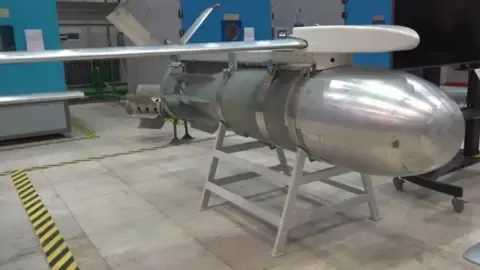
A Russian arms procurement company obtained nearly 278,000 servo drives in 2025, enough to build 139,000 guided glide bombs, according to research by the Kyiv-based Center for Defense Reforms shared with the Kyiv Independent.
Russian forces dropped almost 44,000 glide bombs on Ukraine in the first 11 months of 2025, about 130 a day, according to Ukraine's Defence Ministry. In the week to 25 October 2026 they dropped about 1,600, President Volodymyr Zelenskyy said.
Vadym Skibitskyi, deputy head of Ukraine's military intelligence agency, the HUR, told Reuters in November 2025 that Russia planned to make at least 120,000 guided bombs that year. The servo purchases the think tank found would cover 139,000.
The supply chain
The company is TRV-Engineering JSC, which the research describes as the central buyer for glide-bomb components. Its servo drives move the control surfaces on the UMPK and UMPB kits that turn unguided bombs into guided ones.
TRV-Engineering is on the U.S. Treasury's list of blocked persons under Executive Order 14024 and on the U.S. Commerce Department's Entity List, and has faced EU export restrictions since June 2022. CED Sail LLC, which the research names as its main servo supplier, faces no Western sanctions, and the report singles it out as a priority for designation.
Eight of the 20 companies the researchers identified in glide-bomb production face any Western sanctions or export restrictions. Four Chinese companies are critical to the chain, one of them under U.S. export restrictions and none sanctioned by the EU or UK, the research found.
The report names one of the four, Shenzhen Fire Power Control Technology Limited. Neither it nor CED Sail appears on the U.S. Treasury's sanctions list or the U.S. Consolidated Screening List as of 27 October.
"These are not the actions of a country preparing for lasting peace," said Oleksandr Danylyuk, chairman of the Center for Defense Reforms and a former chief adviser to Ukraine's defence minister.
The bombs
Five glide bombs struck Zaporizhzhia earlier in October, killing 20 people, three of them children, and injuring 32, according to the Kyiv Independent. Ukraine's military intelligence has found U.S., Japanese, Chinese, Swiss and Taiwanese components in Russian glide bombs.
The Norinco transfers
Russian state institutes and arms makers supplied China North Industries Group, known as Norinco, with design documents and wind-tunnel test data before and after Russia's full-scale invasion of Ukraine in February 2022, according to a report by C4ADS, a Washington nonprofit.
The report, by senior analyst Allen Maggard, was released on 22 October. It draws on Russian trade and customs records from 2010 to March 2025, Russian and Chinese corporate filings, academic papers, patents, Russian procurement and court records, and financial records obtained by Ukraine's Economic Security Council.
TsAGI, Russia's Central Aerohydrodynamic Institute, gave Norinco Chinese-origin scale aircraft models it had tested in its wind tunnels, with the test data, at least nine times between 2022 and 2024, the trade records show. Rosoboronexport, Russia's state arms exporter, is listed as the payee for documentation on a flying-wing model.
TsAGI made 19 such transfers to Chinese state arms makers between 2014 and 2022, including Norinco, the Aviation Industry Corporation of China and China Precision Machinery Import-Export Corporation, according to the report.
The rocket drone
SPLAV, the Russian maker of the Smerch multiple rocket launcher, sent Norinco technical documents on a reconnaissance rocket called the KR-30RRS from February 2014 to December 2015, the trade records show. SPLAV probably sent another batch on 12 April 2022, seven weeks after the invasion, C4ADS found.
C4ADS assessed that the KR-30RRS is probably a code name for the 9M534, a Smerch rocket that carries a reconnaissance drone. In March 2025 Norinco unveiled the Feilong 60A, a drone launched from its SR-5 rocket system, and in June 2025 it tested a cannon-launched drone called Sky Eye, according to the South China Morning Post.
C4ADS called it possible, even likely, that Norinco drew on the Russian design, and wrote that its assessment "rests primarily on the functional equivalence between the systems". The report does not document a transfer of the drone design itself.
Russian and Chinese researchers co-authored 86 academic papers on drones from 2022 to 2026, against 36 from 2009 to 2021, the report found. The Chinese government approved a joint institute of the Moscow Aviation Institute and Northwestern Polytechnical University in June 2025.
The designations
TsAGI is on the U.S. Treasury's blocked list and the Entity List, and faces EU export restrictions without an EU asset freeze. SPLAV is under U.S. sectoral sanctions and on the Entity List, though not on the blocked list, and the EU froze its assets in October 2022.
Norinco is on the U.S. Treasury's list of Chinese military-industrial companies, which bars U.S. investment in its securities, and on the U.S. Department of Defense's list of Chinese military companies. It is not on the U.S. blocked list or the Entity List, and EU sanctions databases list no measures against it.
Northwestern Polytechnical University has been on the Entity List since 2001. Rosoboronexport is under U.S. blocking sanctions and an EU asset freeze.
The Ukrainian measures
Ukraine's military intelligence said on 22 October that the new Russian Filin cruise missile contains 35 U.S. and 22 Chinese electronic components and a Chinese-made inertial navigation unit. Its developer is NPO Molniya, part of Russia's Tactical Missiles Corporation.
Zelenskyy imposed sanctions on 24 October on 51 people and 44 companies, 42 of them Russian and two registered in China, that Ukraine links to production of Iskander, Kalibr, Kh-101 and Kinzhal missiles. A second decree that day listed 32 Russian citizens and 35 Russian companies.
The HUR published details on 26 October of 30 pieces of foreign production equipment at Russian missile plants. They include a Chinese-made five-axis machining centre at the Votkinsk Plant, which makes Iskander-M and Kinzhal missiles.
The sanctions gap
EU export restrictions under Regulation 833/2014 bar EU firms from supplying listed Russian end users, while an asset freeze under Regulation 269/2014 blocks a company's funds and bars all dealings with it. U.S. blocking under Executive Order 14024 freezes a company's U.S. assets and bars U.S. persons from dealing with it.
The Center for Defense Reforms' full list of the 20 companies and four Chinese suppliers, and the customs declarations behind TRV-Engineering's 278,000 servo drives, would show which of them EU and UK designations could reach. Russian trade records after March 2025, beyond the data C4ADS held, would show whether TsAGI's transfers to Norinco continued.