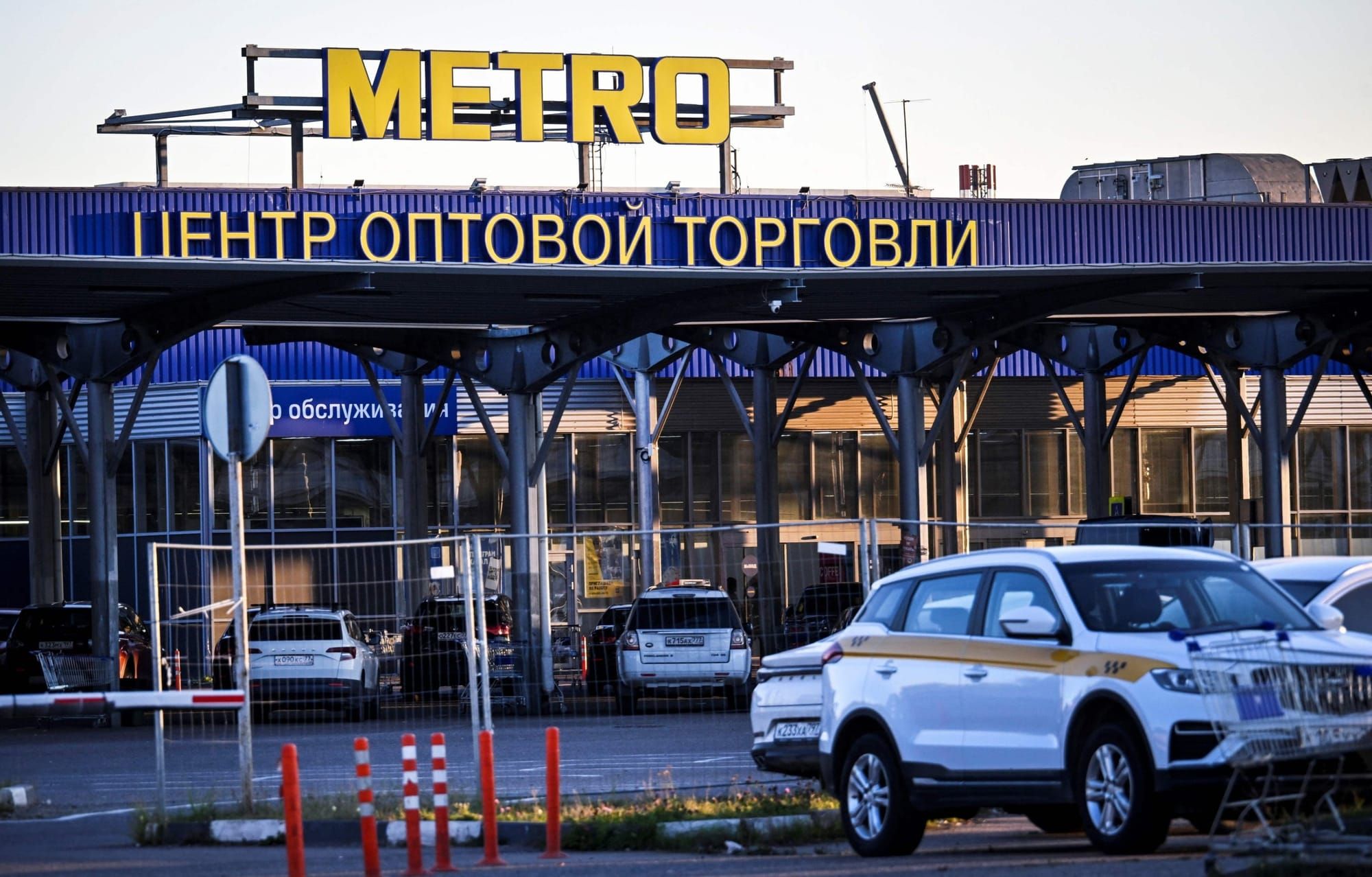
Metro AG's Russian chain gave 1 billion rubles (€11.1 million) to a fund equipping Russian troops in Ukraine, it said on 23 October, 25 days after a Vladimir Putin decree put it under state management.
Metro AG said the same day that the donation was neither coordinated with nor authorised or approved by the parent company, and that it has had no control over the chain's operations since 28 September. The Düsseldorf group still formally owns the Russian business, which runs 91 wholesale stores with about 9,000 staff.
People's Front. Everything for Victory!, the fund that received the money, is managed by the All-Russia People's Front, Putin's political coalition. The Council of the EU added the movement to its sanctions list in February 2023, and Sergei Gorbunov, first deputy head of its executive committee, said Metro's money would buy off-road vehicles, communications and reconnaissance systems and equipment to counter drones.
The decree
Putin's decree of 28 September transferred to temporary management the 54.45 per cent and 45.55 per cent stakes that two Dutch holding companies of Metro AG, Metro Cash & Carry International Holding B.V. and Metro Cash & Carry Russia B.V., held in OOO Metro Cash & Carry, the main Russian operating company. It also took in OOO Metro Warehouse Noginsk and OOO Retail Property 5, the property company that two German Metro subsidiaries own 90 per cent and 10 per cent respectively.
The manager the decree appointed, AO UK Torg Rus, was registered in Moscow on 8 September with share capital of 10,000 rubles at the same Leningradskoye Shosse address as Metro's Russian head office. Its founder, sole owner and general director is Johannes Tholey, who has run OOO Metro Cash & Carry since March 2023, and Radio Svoboda reported that he is its only employee.
The order rests on Decree No. 302 of April 2023, which lets the Russian state take over the property of companies from countries it lists as unfriendly, and under which a temporary manager holds an owner's powers but may not sell the assets, The Bell reported. Putin can end the arrangement by a separate decision.
Putin's decree of 17 September handed the Russian businesses of Auchan, Nestlé, FM Logistic and Lemana PRO, formerly Leroy Merlin, to L.E.V. Management, a company with no link to their former managers. Metro's chain stayed with the local team that ran it before the decree, the trade publication Malls.ru reported.
The transfer
Tholey announced the donation in a company press release and said that, as part of Russia's economic system, Metro considered it "important to participate in the state's strategic initiatives". The fund said the billion rubles had reached its accounts, and Metro's Russian press office told Vedomosti that part of the sum would go to humanitarian and social causes, without giving the split.
OOO Metro Cash & Carry reported revenue of 260.3 billion rubles for 2025 and net profit of 4.4 billion rubles, down 32.1 per cent on the year before, in its Russian statutory accounts. The donation equals about 23 per cent of that profit.
Metro AG told Deutsche Welle that it distances itself from any support for Russia's war against Ukraine and that financing military action runs against its position and its business principles.
Le Monde
Le Monde reported on 7 October, citing a source close to Moscow business circles, that Metro had asked the Russian authorities to place the chain under temporary management in the hope of keeping more control over its fate. The source said Metro's chief executive had travelled to meet Putin's economic adviser about the request, after Metro's managers concluded that Auchan, Nestlé and the others had been caught unprepared on 17 September.
A senior Russian government official told Reuters the takeovers were meant to make European governments reconsider their sanctions, and said of the companies that might follow: "Let them be scared." Dmitry Peskov, Putin's spokesman, said on 29 September that Russia saw no grounds for returning businesses under temporary management to their foreign owners.
Metro AG in Russia
Metro AG has traded in Russia since 2001, and its board decided after the full-scale invasion in February 2022 to keep the Russian subsidiary running, and Ukraine's National Agency on Corruption Prevention added Metro Cash & Carry to its list of international sponsors of war in February 2023 over that decision.
Metro AG reported Russian sales of €2.14 billion for the first nine months of its 2025/26 financial year. Its statement on the decree said it had taken a range of measures since February 2022 to reduce the links between the Russian business and the parent company, and that it was analysing the decree's further effects on Metro AG.
The other donors
Russian units of at least three other foreign companies under temporary management have paid the same fund in 2026, Vedomosti reported. AkzoNobel's Russian business, from the Netherlands, gave 1 billion rubles in August, and the Polish can maker Can-Pack gave 500 million rubles in February and 1 billion in March.
The Russian unit of Rockwool, the Danish insulation maker, gave 600 million rubles. With Metro's billion, the four companies' Russian units have given the fund 4.1 billion rubles this year.
The sanctions
The EU asset freeze on the All-Russia People's Front forbids EU citizens and companies from making funds available to it. Companies outside the bloc must comply with EU sanctions only for business done in whole or in part within the EU, and OOO Metro Cash & Carry is a Russian company.
Article 8a of the EU's Russia regulation 833/2014, in force since June 2024, requires EU companies to use their best efforts to stop entities they own or control outside the bloc from undermining the sectoral sanctions in that regulation. The European Commission's guidance says a parent that loses control of a subsidiary under another country's law may face reduced liability where the loss was not caused by its own negligence, assessed case by case.
Metro AG's correspondence with Putin's economic adviser would show whether the group sought the administration, as Le Monde's source said. The bank record of the 1 billion ruble payment would name the paying company and its date, and the fund's quarterly report to donors would show how much of Metro's money went to vehicles, reconnaissance systems and counter-drone equipment.