Russian aircraft bombed a school in Komyshuvakha, Zaporizhzhia region, as residents gathered there for humanitarian aid on 2 November, then bombed the shelter they fled to, killing at least 33 people.
Overnight into 3 November Russia launched 289 attack drones, 17 ballistic missiles and 59 cruise missiles at Ukraine, President Volodymyr Zelenskyy said. A guided bomb landed between the buildings of a city clinical hospital in Kharkiv and injured 73 people. A missile tore through a hospice in Dnipro that housed nearly 50 terminally ill patients.
Russian attacks killed at least 38 civilians across Ukraine in the 24 hours to the morning of 3 November. Danielle Bell, head of the UN Human Rights Monitoring Mission in Ukraine, said the village had publicised the distribution and that Russian forces either knew about it or failed to take basic steps to find out. In either case, she said in a statement, "this attack seems to have violated the most fundamental principles of international humanitarian law".
The Komyshuvakha strike came about 11 hours after a six-day local ceasefire around occupied Oleshky expired at 22:59 on 1 November, Ukrainian negotiators had said. U.S. first lady Melania Trump's office had mediated that truce. U.S. special envoy Steve Witkoff has scheduled talks between U.S., Russian and Ukrainian officials in Abu Dhabi for 10 and 11 November.
Latvia, which chairs the UN Security Council this month, called an emergency meeting of the council over the strike. Rescuers had recovered 31 bodies by the morning of 4 November and 59 people were still missing, regional officials said, as Russia sent 310 more drones against Ukraine's energy system overnight.
The aid distribution
Local authorities in Komyshuvakha posted on 1 November, on a social media channel with nearly 5,000 subscribers, that aid would be handed out at the school between 10:00 and noon the next day, UN human rights monitors said in a statement. The monitors said multiple powerful glide bombs struck the school building in the morning as civilians gathered to receive the aid.
The school had stopped holding classes because the village lies too close to the front line. It housed one of the Zaporizhzhia region's resilience centres, where residents who stayed near the front collected food and supplies.
Residents came to the school every Monday for aid packages, Zelenskyy said. The strike fell on a Monday.
Zelenskyy said in his evening video address that Russian forces first dropped aerial bombs on the school, which also served as a shelter. Rescue workers and police officers arrived after the first strike and took cover from a threatened follow-up attack. Russian aircraft then dropped nine more aerial bombs on the shelter where people had taken refuge, Zelenskyy said.
Zelenskyy put the number of dead at 18 on the evening of 2 November. By late that night the count stood at 24. The State Emergency Service gave 26.
Mykhailo Semikin, acting head of the Zaporizhzhia Regional Military Administration, said on national television on 3 November that 31 people had been killed, five injured and almost 50 were missing. Zelenskyy said later that day that 33 people had been killed and that more than 50 could still be under the rubble.
Semikin said on the evening of 3 November that 20 of the 31 recovered dead had not yet been identified and that 58 people were missing. He called it the deadliest Russian strike on Zaporizhzhia region since February 2022 and said Russian drones attacking the site kept forcing rescuers to stop the search.
Rescuers had pulled 31 bodies from the rubble by the morning of 4 November and 12 had been identified, Ivan Fedorov, co-chair of the regional defence council, wrote on Telegram. He listed 59 people as still missing, wrote that some of them would probably be identified among the bodies already recovered and estimated that 38 people could remain under the debris.
The regional count of 31 recovered bodies is two lower than the toll of 33 Zelenskyy gave on 3 November.
The State Emergency Service said two rescue workers and four police officers were among the dead. The rescuers were Denys Konovalenko and Oleksii Sushchevskyi, both 44.
Denys Konovalenko had served in civil protection for almost 12 years and Sushchevskyi had worked in fire and rescue in Zaporizhzhia since 2013. Both held state awards and between them they leave two widows and four children.
Ukraine's National Police named its four dead officers in a statement on 3 November. Major Mykhailo Buzhenko was a senior precinct officer with 21 years of service. Major Mykola Balanda was a senior criminal police operative with 23 years of service.
Captains Mykhailo Romanov and Dmytro Besedin were community police officers who had each served more than 10 years in the region.
Buzhenko, Balanda, Romanov and Besedin were helping residents into the underground school that served as the village shelter when the repeat strike trapped everyone trying to get out, the police said. Three of the four had been driven from their own homes by Russia's occupation of part of Zaporizhzhia region and had kept working in other front-line communities. The police said the bomb that killed them was a three-tonne FAB.
Several dozen people died under the rubble, among them staff of the local administrative services centre and members of the community, the police said. Andrii Danyk, head of the State Emergency Service, said the two rescuers had gone out every day to help people and risked their lives in dangerous conditions.
Two more rescuers were among the five people injured, the service said. The bombs destroyed the school's sports hall, an outbuilding and a fire engine and damaged the main school building, according to the service. Crews were still digging through the shelter on the morning of 3 November.
Many of the dead and wounded were civilians who had come for aid or hurried back to help after the first blast. Semikin set 3 November as a day of mourning across the region. The Zaporizhzhia city defence council extended it to three days, from 3 to 5 November.
Semikin said every number in the toll stood for a family waiting for news. Zelenskyy called it an exceptionally horrific strike and one of the deadliest Russian attacks of the war. He said Russian forces could not have been unaware that the residents who remained in Komyshuvakha received aid at the school every week.
Zelenskyy said the bombing was further proof that Russia wanted neither de-escalation nor real justice.
Russia had passed up the chance to build on the Oleshky humanitarian operation even though Ukraine had proposed further steps, Zelenskyy said. He said the strike showed the Russian government was intent on killing people rather than easing the war.
The Russian account
Russia's Defence Ministry said in a statement on 3 November that its forces had targeted Ukrainian military units in areas around Komyshuvakha and two other settlements in Zaporizhzhia region. The ministry said up to 25 Ukrainian servicemen had been killed and that 15 vehicles and an electronic warfare station had been destroyed. The Russian government says its forces strike only military targets and denies attacking civilians.
The dead named so far are two State Emergency Service rescuers and four police officers sent to the school after the first strike. Under international humanitarian law police officers and civil defence rescuers are civilians unless they take a direct part in hostilities. Articles 61 to 63 of Additional Protocol I to the Geneva Conventions give civil defence personnel specific protection while they carry out rescue work.
The Institute for the Study of War, a U.S. research group, assessed on 2 November that the airstrike reportedly killed at least 18 civilians and placed it within a Russian long-range strike campaign that intensified through October. ISW said Russia was using jet-powered drones and quasi-cruise missiles to maximise civilian harm, in service of a theory of victory under which Vladimir Putin aims to make civilian life in Ukraine untenable and to cut the Ukrainian economy off from Europe.
ISW assessed on 16 October that Russian forces had seized about 100 square kilometres of Ukrainian territory since 1 January 2026 and had suffered a net loss of 122 square kilometres since 1 September, in its daily assessment. Russian forces seized or consolidated about 90 square kilometres across the whole front in August 2026, against 505 square kilometres in August 2025, ISW found.
Ukrainian prosecutors have documented repeat strikes on the same site throughout the war, timed to hit rescuers and neighbours who run to the wounded. Russian forces used the same sequence in Komyshuvakha on 18 November 2023, when a second barrage hit police and rescuers who had arrived after an earlier missile strike and killed two State Emergency Service employees, Ukraine's National Police said at the time.
The UN response
Latvia, which holds the UN Security Council presidency for the first time in its history this November, called an emergency meeting of the council over the Komyshuvakha strike on 3 November, Foreign Minister Baiba Braže wrote on X. Her post gave the toll as at least 26.
Ukrainian Foreign Minister Andrii Sybiha thanked Latvia and said Russia was using the permanent seat that had belonged to the Soviet Union to evade accountability. He said he expected the council to oppose Russian atrocities rather than only discuss them.
Matthias Schmale, the UN Resident and Humanitarian Coordinator in Ukraine, said most of the victims were residents who had come to the school for aid and employees of the local administration. Later strikes on the same spot killed the two rescuers and four police officers who responded to the first, he said.
UNICEF said on 3 November that Ukraine had sustained almost 2,000 attacks on education since the full-scale invasion in 2022, about 270 of them this year. Ukrainian children had spent an average of 34 hours of school time under air raid alerts between the start of the academic year and 20 October, more than 13 per cent of scheduled lessons, the UN said.
The village
Komyshuvakha lies about 20 kilometres from the front line and has been treated as a front-line settlement since November 2025 because of repeated guided bomb attacks, the Zaporizhzhia Investigation Center told the Kyiv Independent. Children were evacuated from the settlement under a compulsory order in June because of its closeness to the front. The school building stayed in use as a shelter and an aid point.
Guided aerial bombs can glide tens of kilometres after release, which lets Russian aircraft drop them from beyond the reach of Ukrainian air defences. Russia's Defence Ministry has published footage of its aircraft dropping FAB-250, FAB-500 and FAB-3000 bombs fitted with the universal planning and correction module. The FAB-3000 carries a nominal weight of three tonnes.
Zaporizhzhia region opened its first underground school in Zaporizhzhia city in December 2024, built 7 metres below ground with a reinforced concrete roof for 1,000 pupils. A further 10 were then under construction across the region. The government allocated UAH 500 million in subventions and UAH 545 million in grants for the programme.
Russian missiles hit a specialist school in the town on the morning of 20 October 2022. Ivan Fedorov, then head of the regional military administration, said a guided bomb killed a man in Komyshuvakha on 4 May 2026.
Russian drones struck Komyshuvakha on the afternoon of 15 June 2026 while humanitarian aid was being handed out to residents, wounding four people, Fedorov said.
The Kharkiv hospital
A guided bomb struck the grounds of a city clinical hospital in Kharkiv's Nemyshlianskyi district at about 03:20 on 3 November and landed in the passageway connecting two of its buildings. Investigators believe the weapon was a FAB-250 aerial bomb fitted with a UMPK-5R guidance kit.
Kharkiv Mayor Ihor Terekhov said that at about 03:00 the city was under a combined attack of ballistic missiles and guided aerial bombs. The Prosecutor General's Office said 73 people had been injured, among them hospital patients, medical staff and residents of nearby buildings.
The blast damaged the hospital's facade and wards, another medical facility and a laboratory. It broke windows in 10 apartment blocks. Terekhov said more than 1,000 windows were shattered across the hospital and the surrounding blocks.
Zelenskyy wrote on X that the cardiology department, where people were receiving treatment, had been damaged.
Oleh Synehubov, head of the Kharkiv Regional Military Administration, reported 18 injured at 05:02, 25 at 05:35 and 62 at 06:18. The regional prosecutor's office raised the figure to 73 at 08:57. Most of the injured were diagnosed with acute stress reactions, the office said, at a hospital that treats patients with acute heart attacks.
Investigators recovered fragments of a FAB-250 bomb with a UMPK guidance kit from the site. Valeriia Chyrina, spokesperson for the regional prosecutor's office, said preliminary findings pointed to a guided aerial bomb fitted with a jet engine. Russian forces shelled Kharkiv and 15 other settlements in the region over the previous day, Synehubov said.
Synehubov said 226 patients were being moved to other hospitals. The same night Russian strikes hit energy facilities in Kharkiv, Zelenskyy said.
Russian attacks across Kharkiv region killed two people and injured 114 in the 24 hours to the morning of 3 November, including the city of Kharkiv. In Izium a 44-year-old man was killed and 34 people were injured, among them girls aged 10 and 14. A 51-year-old man died in Cherkaska Lozova, outside the city.
Russian forces struck a medical facility in Kharkiv's Slobidskyi district on 10 October, injuring five people including an emergency worker, the State Emergency Service and Synehubov said.
The Dnipro hospice
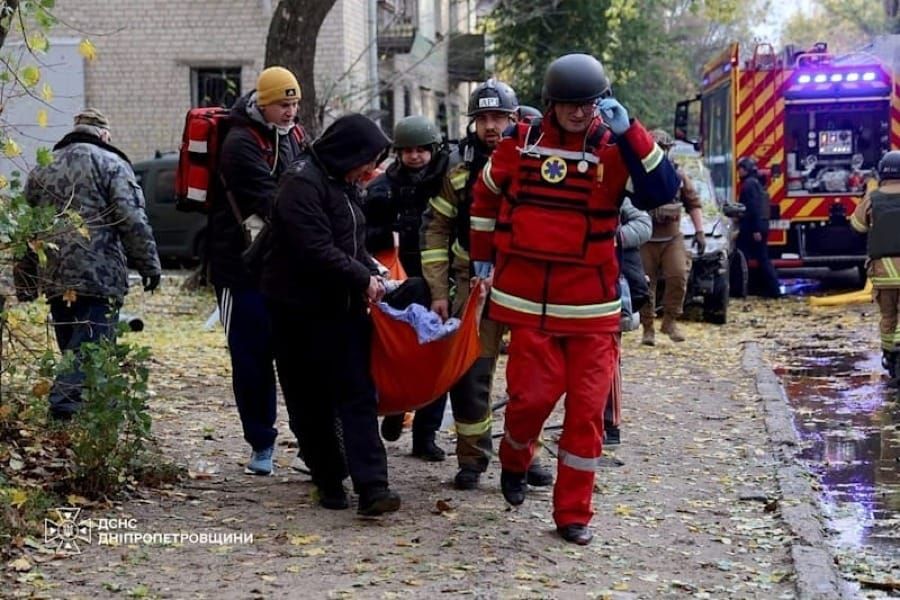
Russian missiles struck Dnipro at dawn on 3 November. Oleksandr Hanzha, head of the Dnipropetrovsk Regional Military Administration, said one person had been killed and 17 injured, three of them seriously. He said several apartment buildings, an administrative building, a hospital and a medical clinic had been destroyed.
Rescuers working under the threat of further strikes recovered a body from the rubble and pulled a woman out alive.
Two law enforcement officers were among the injured. Reuters, citing regional officials later in the day, put the toll in Dnipro at two dead and about 20 wounded, in a report published that afternoon.
Dnipro Mayor Borys Filatov published photographs of the city hospice, its wards strewn with debris across the beds. "These are elderly, terminally ill people. This is a Russian missile," he wrote.
Filatov wrote that he knew he was breaching ethics by publishing the images and that he wanted people abroad in particular to see them.
Nearly 50 terminally ill patients were being transferred from the hospice to other city hospitals, the oldest of them 90, Filatov said. The city had recently renovated the wards. The hospice was one of the few places offering that kind of care to Dnipro residents and to people displaced from occupied and front-line areas, he said.
Filatov said 20 residential buildings in Dnipro had been damaged or partly destroyed. A grammar school, a kindergarten, a music school, a library, the Enerhetyk palace of culture and an outpatient clinic built with World Bank support were also hit.
A city hospital treating nearly 100 people was damaged along with an outpatient clinic, Hanzha said. Patients were being moved. Hanzha said no patients or medical staff were hurt at the hospital.
Prime Minister Sergii Koretskyi said the strikes on Dnipro also hit a railway station, passenger carriages and locomotives. Olha Hyria, a 49-year-old Dnipro resident, told Reuters that "this winter is going to be very hard". Residents said they had stocked up on water, power banks and warm clothes.
Elsewhere in Dnipropetrovsk region, Russian attacks overnight injured four people in Nikopol district, among them boys aged four and 10. One man was hurt in Kryvyi Rih district. A 61-year-old man was killed in Synelnykove district on 2 November, Hanzha said.
Russian missiles and drones killed 12 people in Dnipro on the night of 1 to 2 June 2026. A Russian missile strike on 20 May destroyed about 900 pallets of aid and housing repair materials worth more than US$1 million in a UN refugee agency warehouse in the city.
Five days before the hospice strike, on 29 October, a Russian drone hit a platform at Dnipro's main railway station where an electric train and train No 866 to Zaporizhzhia stood with passengers aboard and nearby, killing 13 people, Hanzha said. Ukrzaliznytsia, the state railway, said it had announced an evacuation more than 10 minutes before the blast but that many people stayed beside the train. The company opened an internal investigation into the strike.
The grid
Energy facilities were the main targets of the 3 November attack: power plants, substations and the systems that carry electricity across the country, said Denys Shmyhal, first deputy prime minister and energy minister. Zelenskyy said Russia struck generation and substations in nine regions: Odesa, Cherkasy, Zhytomyr, Vinnytsia, Kharkiv, Dnipropetrovsk, Chernivtsi, Chernihiv and Rivne.
Ukraine's Air Force said its air defences shot down 49 cruise missiles, three ballistic missiles and 257 drones. Russia also fired Zircon missiles in the attack. The Air Force recorded Kh-101 cruise missiles for the first time since 7 October.
Kh-101 cruise missiles are launched from Tu-95MS and Tu-160 strategic bombers of Russia's Long-Range Aviation, the command Lieutenant General Sergei Kobylash led during the 2022 to 2023 strikes on the grid for which the International Criminal Court issued a warrant for his arrest. Ukrainian officials called the 3 November attack one of the largest of the war.
DTEK, Ukraine's largest private power producer, said three of its five thermal power plants had been knocked offline. The company said dozens of missiles and drones hit the three plants and that all three stopped generating.
A DTEK facility in southern Odesa region was hit at midnight, after several strikes on the same site in two months. Odesa introduced scheduled power cuts.
More than 180,000 customers in about 130 settlements lost electricity in Zhytomyr region, said Governor Vitalii Bunechko. Most towns and villages in Vinnytsia region lost power, the regional distributor Vinnytsiaoblenergo said.
An Ukrenergo substation was damaged in Rivne region, Governor Oleksandr Koval said. Ukrenergo ordered emergency blackouts in Cherkasy region.
Kyiv and the surrounding region faced emergency power cuts after Russian strikes hit facilities of the regional distribution network, Mayor Vitali Klitschko said on 3 November. Water supplies failed in the Pecherskyi, Podilskyi and Holosiivskyi districts of the capital and in Sofiivska Borshchahivka, west of the city, after the city military administration warned that outages at Kyivvodokanal's pumping sites could cut water across Kyiv. Public transport was also disrupted in the capital, while elsewhere water supplies were cut as pumping stations and treatment facilities lost power.
Russia's Defence Ministry said its forces had struck electricity facilities in Vinnytsia, Dnipropetrovsk and Kharkiv regions that supply power to the Ukrainian army and to military factories. The Kyiv Independent described the attack as Russia's largest on Ukraine's energy system this year.
The energy ceasefire
Trump announced on his Truth Social platform on 11 October that Russia and Ukraine had agreed to stop attacking each other's energy systems. "Effective immediately, there is an ENERGY CEASEFIRE in the War between Russia and Ukraine," he wrote, giving no terms.
Trump had written on 14 September that both countries had agreed not to hit each other's energy infrastructure. Neither government confirmed that agreement.
Zelenskyy told Axios that the announcement was news to him and that Ukraine would agree if Russia did. Trump had said the day before that he had agreed with Putin that Russia would immediately supply more than 300,000 tonnes of diesel to the U.S. and world markets. Zelenskyy called that deal a gift to Putin.
Russian forces struck Kharkiv's CHP-5 combined heat and power plant within hours of Trump's 11 October post, Zelenskyy said. His office confirmed the strike came after the announcement. A Russian missile then hit a grocery store in the Kharkiv suburbs, killing three people and injuring nine, among them two children, Synehubov said.
Zelenskyy said Russia had carried out more than 200 strikes on Ukraine's electricity generation and transmission in the preceding week and 17 on gas and oil facilities.
Trump's war with Iran has been blamed for high diesel prices weighing on Republican prospects in the 3 November midterm elections, Reuters reported. Zelenskyy had told ABC News on 11 October that Ukraine would stop striking Russian oil refineries if Russia halted its attacks on Ukraine's power system.
Dmitry Peskov, Putin's spokesperson, said on 14 October that the terms of the energy ceasefire Trump had mentioned had never been clarified and that work on them was continuing. Russia's Defence Ministry had announced strikes that week on three of the largest thermal power plants near Kyiv and two near Kharkiv.
Russia had already struck Kyiv's energy system more times in 2026 than in all previous years of the full-scale war combined, Telegraf reported on 14 October.
Russia's 3 November strikes on power plants and substations in nine regions came 23 days after Trump's announcement.
The nuclear substation
Russia aimed three drones at a substation critical to the stable operation of the Khmelnytskyi nuclear power plant during the attack, Shmyhal said. He called it a serious escalation that threatened nuclear safety across Europe, said Ukraine had informed the International Atomic Energy Agency and asked international partners to respond.
Russian strikes over four winters have damaged or destroyed much of Ukraine's coal, gas and hydroelectric generation, leaving its nuclear plants carrying a greater share of the country's electricity. Reactors depend on outside power to run their cooling systems, which makes the substations that feed the plants a nuclear safety concern.
Russian attacks on 30 October 2025 damaged substations essential to the safety of Ukraine's nuclear plants, the IAEA said at the time. Its team at the Khmelnytskyi plant had to shelter for several hours and two of the four units at the Rivne plant cut output.
Russia's attack on substations connected to nuclear plants on 7 February 2026 cut the volume of electricity Ukraine generated from nuclear power by about half, Vitaliy Zaichenko, chief executive of Ukrenergo, told the Kyiv Independent. He described the plants as constant targets that needed stronger protection.
Ukraine operates the Rivne, Khmelnytskyi and South Ukraine plants. Russian forces have held the Zaporizhzhia plant, Europe's largest, since March 2022.
The warning
Zelenskyy said on the evening of 2 November that intelligence showed Russia was preparing a new mass strike on energy and logistics targets. Russia had launched 193 drones against Ukraine on the night of 1 to 2 November and 332 drones and loitering munitions during the day on 1 November, ISW said. ISW assessed that Ukrainian forces likely struck Russian oil infrastructure in Samara region the same night and that neither side advanced on the ground on 2 November.
Zelenskyy linked the timing of the 3 November attack to the U.S. midterm elections held that day. He said "all of this is happening on the day of the US congressional elections" as he appealed to allies for more air defences.
Russia fired more than 100 ballistic missiles at Kyiv and the surrounding region in the second half of October, Zelenskyy has said. The U.S. is delaying deliveries of the PAC-3 interceptors Ukraine needs against ballistic missiles. Al Jazeera correspondent Audrey MacAlpine said the Trump administration has approved no significant military aid package for Ukraine since it took office.
Zelenskyy said on 26 October that Ukraine had received 24 Patriot interceptors from the U.S. over 90 days against a need of about 350 a month. Ukraine had waited nearly a month for Pete Hegseth, head of the U.S. Department of Defense, to approve missiles for its Patriot and NASAMS systems, he said.
Zelenskyy wrote on 27 October that the prolonged delays in interceptor deliveries were directly helping Russia's strike campaign. Russian forces had fired 21 ballistic missiles at Kyiv in three waves overnight on 21 to 22 October, damaging metro infrastructure on the Pivdennyi Bridge and splitting the city's green line in two. Ballistic missiles struck the campus of the State University of Trade and Economics in Kyiv on the night of 26 October, injuring five students and staff, Zelenskyy said.
Russia's Defence Ministry announced on 30 August that its forces had begun preparing massive strikes on Ukraine's energy system on instructions it had received. The ministry described the coming strikes as a response to Ukrainian attacks on Russian civilian infrastructure and its fuel and energy industry. Putin had said on 22 August that Russian strikes on Ukrainian infrastructure were effective and timely.
The Defence Ministry posted "In winter you will freeze" on its Telegram channel on 14 August. Putin said on 1 September that Russian forces had been instructed to prepare and carry out massive strikes on the energy system, according to the UN Commission of Inquiry's report to the General Assembly, published by OHCHR.
Yaroslavl Governor Mikhail Yevrayev said two employees were injured at a refinery in the region when a Ukrainian drone attack started a fire overnight into 3 November. Russian authorities said in the last days of October that their air defences had downed most of more than 850 drones flying towards Moscow region.
The ceasefire
Russian and Ukrainian forces stopped firing around occupied Oleshky, across the Dnipro River from Kherson, at 03:00 Kyiv time on 27 October under a truce that ran until 22:59 on 1 November. Davyd Arakhamia, head of the Servant of the People faction in parliament and a member of Ukraine's negotiating team, called it the biggest de-escalation since 2022.
Evacuated residents travelled by bus to the Russian city of Anapa, then flew to Belarus and crossed into northern Ukraine, Arakhamia said. The humanitarian convoy assembled in Armiansk in occupied Crimea, about 85 kilometres south of Oleshky, said Dmytro Lubinets, Ukraine's human rights ombudsman and chief negotiator for the operation.
About 24,000 people lived in Oleshky before the full-scale invasion. The first lady's office estimated that 1,700 to 2,000 remained, mostly older people. Neither government had disclosed how many people left during the truce.
Prime Minister Koretskyi said 527 residents were expected to return to Ukrainian-controlled territory. The operation had 25 buses with provision for bedridden residents and 50 medical staff.
Lantratova said two people were killed during the demining of the road out of the town. Ukrainian soldiers told the broadcaster that drone footage showed Russian forces preparing an offensive against Kherson for the moment the truce ended.
The UN Human Rights Monitoring Mission documented at least 29 civilians killed and 54 injured in Oleshky and Hola Prystan in 2026 up to 25 June, most of them by short-range drones.
Russian forces struck a hospital building in central Kherson with a drone at about 07:40 on 2 November, within nine hours of the truce ending, said Yaroslav Shanko, head of the Kherson City Military Administration. Several rooms were damaged and windows and internal doors were blown out, he said, with nobody reported hurt.
Ukraine's General Staff said on 2 November that Russian forces had used the humanitarian pause to rotate troops, reinforce defensive positions, restore artillery and replenish ammunition. Sky News drone footage from 1 November showed Russian equipment and personnel moving during the pause. Kherson city officials said Russian fibre-optic FPV, Mavic reconnaissance and Molniya attack drones were again hunting vehicles in the city.
Lubinets and Yana Lantratova, Russia's human rights commissioner, who is under sanctions, were invited to a White House event at which the first lady was to speak about the Oleshky operation, a source told the Kyiv Independent. Pages of the Oleshky agreement obtained by Fox News carry the signatures of both commissioners and are dated 23 October.
The following night
Russia launched 310 drones at Ukraine from 18:00 on 3 November, 81 of them jet-powered Shaheds, along with Gerbera drones and Parodiya decoys, Ukraine's Air Force said. Air defences had downed or suppressed 272 by 08:00 on 4 November, including 64 of the jet-powered drones. Drones struck 19 locations and debris fell at 15 more.
A strike on an industrial site in Dnipro injured two men aged 38 and 57 and started a fire. A shopping centre in Odesa burned after a strike on the evening of 3 November. The blast shattered windows in nearby buildings.
Kovel mayor Ihor Chaika said a strike on an infrastructure facility left most of the city without power. Zhytomyr lost electricity after an attack on its energy infrastructure, drones hit an energy facility in Ternopil region and Rivne governor Oleksandr Koval said Russia had tried to strike energy sites in his region.
Russia's Defence Ministry said its drones had hit the 750 kV Nalyvaikivka substation in Kyiv region and the 110 kV Chyzhivka substation in Zhytomyr region overnight, along with vessels it said were serving the Ukrainian armed forces.
The other strikes
Russian attacks killed four people and injured six in Donetsk region in the 24 hours to the morning of 3 November, said Vadym Filashkin, head of the regional military administration. Russian drones killed a 63-year-old man and injured a 61-year-old woman in the Mykolaivka community of Sumy region.
A 15-year-old boy was wounded in Bucha district of Kyiv region, two people were injured in Cherkasy region and seven were hurt across Kherson region over the same period. Zelenskyy said Russian forces in the overnight attack aimed mainly at Kyiv, Kharkiv, Dnipropetrovsk and Vinnytsia regions.
The talks
Witkoff wrote on X on 2 November that the Abu Dhabi talks would cover post-war security arrangements, de-escalation, humanitarian efforts and next steps toward peace. U.S. negotiators would meet France, Germany, the United Kingdom, the EU and NATO in Brussels during the week to discuss security guarantees, Europe's post-war security structure and investment in reconstruction, he wrote.
The European Commission is hosting a meeting on 4 November with the U.S., NATO, European allies and Ukraine. NATO will hold further consultations on 5 November. Zelenskyy said the Brussels meeting would discuss a prosperity plan and security guarantees.
Yuri Ushakov, Putin's foreign policy aide, told Russian state television on 25 October that Russia would be ready to resume talks after 4 November, Russia's National Unity Day. National Unity Day falls the day after the U.S. midterm elections.
Dmitry Peskov, Putin's spokesperson, confirmed on 3 November that a Russian delegation would attend the Abu Dhabi talks on 10 and 11 November and that presidential aide Vladimir Medinsky would remain Russia's chief negotiator. Medinsky also led Russia's delegation at the Istanbul talks in May 2025.
The Abu Dhabi meeting will be the fourth three-way round between Russia, Ukraine and the U.S. in 2026 and the first since 18 February. European governments have not been invited.
Zelenskyy said on 24 October that negotiators from Ukraine, Russia and the U.S. had agreed to technical-level meetings in Abu Dhabi in the first half of November.
Zelenskyy flew to Berlin on 3 November, the opening day of the Berlin Security Conference, to meet German Chancellor Friedrich Merz on air defence and the energy sector. Merz called the planned talks the right step, said Europe had to be part of the process and urged the Russian government to negotiate a ceasefire seriously. "I have not seen any sign of this so far," he said.
Zelenskyy said in Berlin that Ukraine had offered to extend the Oleshky ceasefire and that Russia had answered with new strikes. He said a ceasefire should begin with a halt to strikes on energy infrastructure and could be agreed without a meeting between the Ukrainian and Russian leaders.
Germany has become Ukraine's largest backer since the U.S. withdrew financial support.
The civilian toll
The UN Human Rights Monitoring Mission recorded 328 civilians killed and 2,105 injured in Ukraine in September 2026, 85 per cent more casualties than in September 2025, in a report published on 16 October. The highest tolls were in Kyiv, Kherson, Kharkiv, Sumy and Zaporizhzhia regions. Civilians were killed or injured in Kyiv on 22 of September's 30 days, more often than in any month since the full-scale invasion began, the mission said.
Bell said the first two weeks of October were among the deadliest for civilians in recent years, with mass-casualty attacks in Kharkiv, Zaporizhzhia, Kramatorsk and Kyiv within a few days of one another. The mission verified 18 civilians killed and 44 injured in Russian-occupied territory in September and said the true figure there was likely considerably higher because its access is limited.
The energy campaign
Russian attacks have damaged more than 9 gigawatts of thermal and hydroelectric generating capacity since October 2025, of which 3.5 gigawatts had been partly restored by March 2026, Ukraine's energy ministry said. The State Inspectorate for Energy Supervision has examined more than 11,600 damaged or destroyed electricity facilities since February 2022, more than 1,800 of them in the first half of 2026.
The UN Independent International Commission of Inquiry on Ukraine told the UN General Assembly on 26 October that Russia's attacks on Ukraine's energy system were war crimes and crimes against humanity, in a statement. It found that Russian authorities intentionally directed attacks against civilian objects and committed the crime against humanity of other inhumane acts under a state policy of depriving civilians of essential energy services. Erik Møse, its chair, said the attacks were "widespread and systematic, carried out with intent".
The commission's report draws on accounts from 255 people in Kyiv and eight other regions who lived through the winter of 2025 to 2026. Older people stayed in unheated flats during air raid alerts because a power cut could trap them in a lift. Hospital patients lost life-support devices, the commission found.
Thermal generation fell by 70 per cent in the worst-hit areas and temperatures dropped to minus 21 degrees Celsius, according to Ukrainian authorities cited in the report.
The report cites Putin's statement of 10 October 2022, the day of the first large-scale attack on the grid, that the strikes were launched on the Defence Ministry's proposal under a General Staff plan. The commission also examined Ukrainian attacks on energy facilities in Russia and in occupied Ukraine, including a drone campaign against Crimea's power system from July to September 2026. It made no legal finding on them after the Russian government denied it access, the report states.
Russia's mission to the UN said the Russian government does not recognise the commission's mandate and called its findings based on falsified data. The commission had found in November 2025 that Russian forces carried out indiscriminate and disproportionate attacks with explosive weapons and used short-range drones to spread terror among civilians, the UN said.
Agnès Callamard, secretary general of Amnesty International, said in February 2026 that the scale and intensity of Russia's attacks on vital energy infrastructure showed a strategy to spread despair among Ukrainian civilians and break their morale, Amnesty said. Russia had carried out hundreds of intense long-range aerial attacks since October 2025. They hit the energy system daily in January 2026, the organisation found.
A Russian Iskander missile destroyed a World Food Programme warehouse in Dnipro in May 2026 holding more than US$1.4 million of aid meant for 130,000 people, Foreign Minister Andrii Sybiha said. WFP has recorded more than 84 cases of damage to its warehouses, vehicles and distribution points in Ukraine over 18 months.
The law
Russia is a party to the four Geneva Conventions and to Additional Protocol I. Article 57 of the protocol requires those who plan or decide on an attack to do everything feasible to verify that the target is a military objective and to cancel or suspend an attack once it becomes apparent that the target is civilian or that the expected civilian harm would be excessive.
Article 52 provides that where there is doubt about whether a school is being used to make an effective contribution to military action, it is to be presumed that it is not. Article 51 prohibits acts or threats of violence whose primary purpose is to spread terror among the civilian population.
Article 18 of the Fourth Geneva Convention protects civilian hospitals from attack. Under Article 19, that protection ends only if a hospital is used to commit acts harmful to the enemy. Even then it ends only after a warning setting a reasonable time limit has gone unheeded.
Article 8 of the Rome Statute of the International Criminal Court lists as war crimes intentionally directing attacks against civilians, against personnel and objects involved in humanitarian assistance and against buildings dedicated to education and hospitals.
Judges at the International Criminal Court issued arrest warrants on 5 March 2024 for two Russian commanders: Lieutenant General Sergei Kobylash of Russia's Long-Range Aviation and Admiral Viktor Sokolov, then commander of the Black Sea Fleet, the court said. Pre-Trial Chamber II found reasonable grounds to believe they bore responsibility for missile strikes by forces under their command on Ukrainian power plants and substations from at least 10 October 2022 until at least 9 March 2023.
The court issued further warrants on 25 June 2024 for former defence minister Sergei Shoigu and for Valery Gerasimov, chief of the General Staff, over the same campaign of strikes on the energy system. Gerasimov, who still heads the General Staff, announced the Russian side of the Oleshky ceasefire on 23 October.