Human rights defenders released from Israeli detention after the interception of the Global Sumud Flotilla on 19 May have arrived in Turkey and across Europe with injuries and accounts of abuse that would constitute torture and crimes against humanity under international law.
The Global Sumud Flotilla's organisers said on Friday they have documented at least 15 cases of rape and sexual violence during the detention of roughly 430 people seized in international waters approximately 250 nautical miles from Gaza. Several participants had broken ribs. Others had fractured vertebrae. Dozens arrived at Istanbul's airport in wheelchairs.
Luca Poggi, an Italian economist who was among those detained, told Reuters on his arrival in Rome:
"We were stripped, thrown to the ground, kicked. Many of us were tasered, some were sexually assaulted, and some were denied access to a lawyer."
Sabrina Charik, who coordinated the return of 37 French nationals, told Reuters five French participants had been hospitalised in Turkey, some with broken ribs or fractured vertebrae, and that several had made detailed accusations of sexual violence including rape.
Israel's prison service denied the allegations outright, calling them "false and entirely without factual basis" and stating that all detainees were "held in accordance with the law, with full regard for their basic rights." Reuters said it was not immediately able to independently verify the accounts.
What lawyers found at Ashdod port
Adalah, the Palestinian legal aid organisation, sent a team of lawyers to Ashdod port while detainees were still being processed there. Their team collected testimony from hundreds of participants on the night of 20-21 May. The lawyers documented dozens of participants with suspected rib fractures, many reporting difficulty breathing. They documented widespread use of tasers and evidence that rubber bullets had been fired at close range. They recorded allegations of sexual abuse and psychological torment. They noted that detainees had been required to hold stress positions throughout the transfer process between vessels and the port.
Adalah's lawyers had been refused access to their clients while the detainees were still at Ashdod. They were told they could not see them until they reached Ketziot prison in the Negev desert, more than 80 kilometres inland.
The abuse in detail
Ilaria Mancosu, an Italian human rights defender, provided the most detailed account of what happened between interception and arrival at Ashdod. Israeli naval forces transferred detainees from their own vessels to two ships that had been converted into makeshift prisons. Those put on one of the two ships suffered significantly more violence than those on the other. They were locked in metal containers and beaten by groups of soldiers, suffering fractures to ribs and arms. Some had serious injuries to their eyes and ears from taser use at close range.
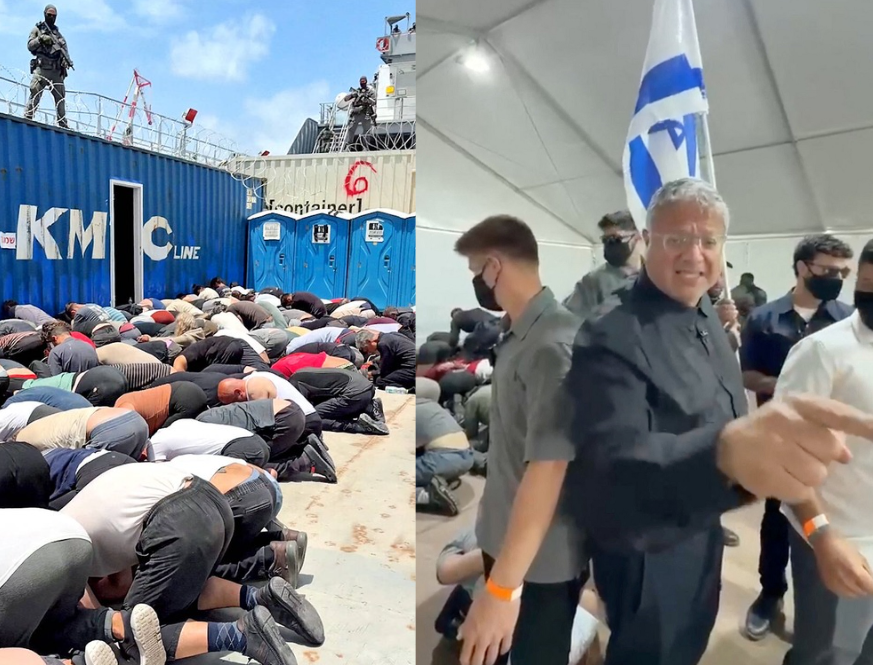
Detainees spent two days on the prison ships with no running water. They had been stripped of most of their clothing and given no blankets, using cardboard and plastic to keep warm at night. Once transferred to land at Ashdod, they were made to kneel for several hours and were kicked and shoved if they moved or spoke. At the prison they were moved periodically between rooms to prevent sleep.
Luca Poggi, an Italian economist, told Reuters on his arrival in Rome:
"We were stripped, thrown to the ground, kicked. Many of us were tasered, some were sexually assaulted, and some were denied access to a lawyer."
Sabrina Charik, who coordinated the return of 37 French nationals, told Reuters five French participants had been hospitalised in Turkey, some with broken ribs or fractured vertebrae, and that several had made detailed accusations of sexual violence including rape. French national Adrien Jouan posted photographs to Instagram showing bruises across his back and both forearms.

A German Foreign Ministry spokesperson confirmed that consular officials who met German nationals on their arrival in Istanbul found a number with injuries undergoing medical checks.
"Some of the allegations that have been made are serious," the spokesperson said.
Spanish Foreign Minister José Manuel Albares confirmed 44 Spanish participants were expected to arrive in Madrid and Barcelona throughout Friday, four of whom had received medical treatment for injuries.
Organisers said the worst abuse occurred on the second prison ship, the one converted with barbed wire and shipping containers. About 50 human rights defenders arrived at Istanbul airport requiring medical attention on arrival, according to flotilla organisers, including multiple Italians. Flotilla spokeswoman Maria Elena Delia said many had suffered serious injuries and some were in shock.
The Ben-Gvir footage
The abuse allegations arrived on top of an existing crisis that had already hardened European government positions toward Israel before the torture claims even surfaced.
On 20 May, National Security Minister Itamar Ben-Gvir visited Ashdod port while human rights defenders were being processed and posted a video of himself waving an Israeli flag while dozens of participants knelt, zip-tied, as Israel's national anthem played. EU Council President António Costa called the footage "appalling" and demanded the human rights defenders' immediate release. Prime Minister Benjamin Netanyahu rebuked Ben-Gvir's conduct as "not in line with Israel's values and norms," while defending the interception itself.
Ben-Gvir, a key ally of Trump & Israel’s Minister of National Security, as well as leader of the far-right ultranationalist Otzma Yehudit party, posted a video of himself verbally abusing international human rights defenders while they were chained, forced to kneel, and abused. https://t.co/T1NipdGnFo pic.twitter.com/5mM0gOvcnM
— Anonymous (@YourAnonCentral) May 20, 2026
Ben-Gvir called the warrant application announced the previous day against Finance Minister Bezalel Smotrich a "declaration of war." He said he was "neither afraid nor deterred" by the prospect of a similar application against himself.
Article 7
The allegations carry specific weight in international law. Rape used as a method of detention or as an act of coercion by state actors constitutes torture under the UN Convention Against Torture, to which Israel is a party. Under Article 7 of the Rome Statute, rape and other forms of sexual violence constitute crimes against humanity when committed as part of a widespread or systematic attack against a civilian population. Although Israel is not a party to the Rome Statute, the ICC has an existing investigation into the situation in Palestine, extending to conduct in territory over which the court has claimed jurisdiction. Conduct occurring in Israeli custody during the processing of detainees seized in international waters could fall within that investigation's scope.
Rome prosecutors have opened a criminal investigation covering possible crimes of abduction, torture, and sexual violence. Their investigation also covers the two prior Global Sumud Flotilla interceptions, in April 2026 and autumn 2025. Italian MP Dario Carotenuto, who was among the detained, told Italian news agency ANSA that he and other participants were beaten "savagely" by Israeli officials after their arrest.
The earlier interception in April 2026, which this article has previously documented, resulted in Spanish-Swedish Palestinian activist Saif Abu Keshek and Brazilian Thiago Ávila being separated from the group and taken to Shikma Prison in Ashkelon, where Ávila was beaten so severely he lost consciousness twice, with injuries later confirmed by the Brazilian embassy.
The European response
The European response hardened through a sequence that began with Ben-Gvir's video on 20 May and accelerated sharply on 22 May as abuse allegations emerged. Eleven countries, eight of them European, summoned Israeli ambassadors. The diplomatic pressure was the broadest coordinated European rebuke of Israel since the October 2023 war began.
Italian Foreign Minister Antonio Tajani formally asked EU foreign policy chief Kaja Kallas to place Ben-Gvir sanctions on the agenda of the next meeting of EU foreign ministers, calling the seizure of human rights defenders in international waters and their treatment in custody "unacceptable acts." Spain, the Netherlands, and Belgium moved unilaterally, banning both Ben-Gvir and Smotrich from their territory without waiting for EU consensus. Polish Foreign Minister Radosław Sikorski said Warsaw would seek its own entry ban. Swedish Foreign Minister Maria Malmer Steenergaard called urgent sanctions necessary. Luxembourg's Foreign Minister Xavier Bettel said Ben-Gvir's conduct reflected "a profound lack of respect, dignity and humanity." Germany confirmed injured nationals and said some accusations were "serious."
Ireland went furthest, Taoiseach Micheál Martin wrote to EU Council President António Costa calling explicitly for a ban on products from Israeli settlements and the full or partial suspension of the EU-Israel Association Agreement. His letter, dated 20 May, asked for an urgent discussion at the next European Council summit on 18-19 June. "The EU cannot continue with a business as usual approach to Israel," Martin wrote. Ireland's Tánaiste Simon Harris called Israel's actions "despicable and cannot be consequence-free" and called for a "strong, unambiguous EU response." Among the approximately 15 Irish nationals detained was Dr Margaret Connolly, sister of Irish President Catherine Connolly. The president said she was "very proud" of her sister.
A leaked letter from Martin to Costa went further than previously reported. Beyond condemning Ben-Gvir, it cited Israel's introduction of the death penalty, its incursion into southern Lebanon, and widespread bombing of Beirut as context for why business as usual was no longer defensible.
The Czech Republic opposed Ben-Gvir sanctions, according to Politico's sources, citing concerns that Ben-Gvir could use European sanctions for domestic political advantage ahead of Israel's October elections. EU foreign policy spokesperson Anouar El Anouni noted at the European Commission's Friday press briefing that EU sanctions require unanimity from all 27 member states and declined to comment on confidential discussions.
Netanyahu himself condemned Ben-Gvir's conduct, as did Israeli Foreign Minister Gideon Sa'ar, an unusual public split within the Israeli government.
Ben-Gvir posted a second video in which he taunted the detained participants directly: "They came here all full of pride like big heroes. Look at them now." He then addressed Netanyahu directly, saying: "Give them to me for a long, long time, give them to us for the terrorist prisons, that's what it should look like."
EU High Representative and European Commission Vice-President Kaja Kallas proposed last year imposing sanctions on Ben-Gvir; they failed due to a lack of unanimous support. The current momentum, accelerated by the abuse allegations and the Ben-Gvir video, represents the strongest push yet, but the Czech position means the outcome at the June summit is not guaranteed.
Canada
Canada had 12 nationals aboard the flotilla. All 12 arrived in Turkey and are receiving urgent medical care, Foreign Affairs Minister Anita Anand confirmed on Friday.
Anand said Canada "unequivocally condemns the grave mistreatment of Canadians in Israel" and that "those responsible for this egregious abuse must be held accountable."
Canada summoned Israel's ambassador, joining France, Italy, and the Netherlands in formal diplomatic protests.
Ontario Liberal MP Salma Zahid called on Ottawa to go further, demanding "strong, broad-based sanctions on the Netanyahu government" and arguing that Netanyahu's continued inclusion of Ben-Gvir in cabinet amounts to endorsement of his conduct. As of the time of publication, the Canadian government had announced no sanctions. Under the Special Economic Measures Act and the Justice for Victims of Corrupt Foreign Officials Act, Ottawa has the legal architecture to impose targeted sanctions on Israeli officials. Anand has declined to say whether it will use them.
The US Treasury response
On 19 May, the same day as the interception, the USian Treasury's Office of Foreign Assets Control sanctioned four people it described as associated with the flotilla: two from the Popular Conference for Palestinians Abroad and two from the Belgian-based Samidoun network, a Palestinian prisoners solidarity organisation. Their USian assets were frozen. None of the four were among the 430 human rights defenders detained at sea.
Treasury Secretary Scott Bessent described the flotilla as "a ludicrous attempt to undermine President Trump's successful progress toward lasting peace in the region" and called it "pro-terror."
The US did not publicly provide evidence to support the Hamas-affiliation allegations against the named individuals. Every other nation whose citizens were detained, most of them NATO allies, made no such designation.
To understand why the USian government responded to an Israeli naval detention of 430 people from 40 countries by sanctioning the victims' organisers, the financial record helps. Pro-Israel interest groups spent more than $230 million benefiting Donald Trump since 2020, with the bulk concentrated in the 2024 election cycle. The single largest contributor was Miriam Adelson, an Israeli-born physician and billionaire widow of casino magnate Sheldon Adelson. She donated $100 million to Trump's 2024 campaign through her Preserve America super PAC, paid in four monthly instalments of $25 million from July to September 2024 and a final $20 million instalment in late September. Her contribution was the largest individual donation to any presidential candidate that cycle, eclipsing Elon Musk's $75 million. She and Trump dined together at least six times across 2023 and 2024, with discussions centring on Israel policy.
Trump later recounted one exchange publicly: "I actually asked her once. I said, 'So Miriam, I know you love Israel. What do you love more, the United States or Israel?' She refused to answer. That means it might mean Israel."
The Adelson family's total documented contributions to Trump across the 2016, 2020, and 2024 cycles exceed $220 million.
At AIPAC's 2025 Congressional Summit, the organisation's CEO Elliott Brandt stated publicly that AIPAC had cultivated influence with three top national security officials in the Trump administration. Secretary of State Marco Rubio collected more than $1 million in AIPAC and Israel lobby contributions since his first Senate election. He had been described as a protege of Sheldon Adelson, who funded his 2016 presidential campaign before switching to Trump. Miriam Adelson subsequently contributed $120 million to Trump's 2024 campaign in part to secure Rubio's appointment as Secretary of State, according to Track AIPAC's analysis. AIPAC's PAC and its super PAC, the United Democracy Project, spent nearly $126.9 million combined during the 2023-2024 election cycle, according to FEC filings, including more than $55.2 million in direct donations to federal candidates. Sixty-five percent of Congress received AIPAC or affiliated super PAC money in that cycle.
The international law question
Israel's Foreign Ministry framed the interception as lawful enforcement of a naval blockade. Foreign governments argued Israel has no jurisdiction in international waters. Under the UN Convention on the Law of the Sea, boarding a foreign vessel on the high seas without the consent of its flag state constitutes a violation except in narrowly defined circumstances: piracy, slave trading, unauthorised broadcasting, and statelessness. Israel has alleged none of those. The vessels were flying the flags of multiple states, including EU member states.
Turkey and Spain have described the interceptions as piracy. The distinction matters for the criminal jurisdiction of the states whose nationals were detained. If the interceptions occurred in international waters without legal basis, the detention itself was unlawful, meaning any coercion applied to detainees was applied to people being held illegally. Rome prosecutors appear to be proceeding on that basis.
The flotilla's statement
The Global Sumud Flotilla issued a statement on Telegram on Friday framing the abuse of its participants in explicit relation to Gaza's detained population.
"While the world's eye is trained on the suffering of our participants, we cannot emphasise enough that this is a mere glimpse of the brutality Israel imposes daily on Palestinian hostages."
The flotilla said it would continue its mission.