The United States brokered a ten-day cessation of hostilities between Israel and Lebanon on 16 April, the first direct diplomatic engagement between the two governments since the failure of the May 17 Agreement in 1983. The truce took effect at 17:00 EST, with Beirut celebrating the news under celebratory gunfire. The Israeli military's first response to the announcement was to confirm it was staying inside Lebanon throughout the pause. IDF commanders said civilians would not be permitted to return to 55 Lebanese villages inside its operational zone. Five Israeli brigades remain on Lebanese soil.
Trump called the agreement "a very nice little package for about a week" and said Lebanon would "take care of Hezbollah." Asked what made this initiative different from every failed predecessor, he answered: "Me. I'm the difference." The State Department's published agreement is shorter than his claim. It reads as a gesture of goodwill by Israel, an invitation to Lebanon to negotiate, and an explicit reservation of the Israeli right to strike.
Hezbollah was not a signatory. The group's Secretary-General Naim Qassem called the deal a "free concession" to Israel and the US, and on day one told fighters their "hands will remain on the trigger." On day two he described the truce as "useless in practical terms" and demanded Israel halt attacks "in the air, on land, and at sea." By the weekend, Hezbollah said it had ambushed Israeli soldiers near Taybeh in southern Lebanon.
The terms
The State Department text commits Israel to a cessation of hostilities for an initial ten-day period "as a gesture of goodwill by the Government of Israel", intended to enable good-faith negotiations toward a permanent security and peace agreement. It preserves Israel's right to act in self-defence "at any time, against planned, imminent, or ongoing attacks." An Israeli official told Ynet that "our forces will remain deep inside Lebanese territory" and that the IDF would "act against any threat, similar to the arrangement in the November 2024 ceasefire."
Lebanon's obligations include taking "meaningful steps to prevent Hezbollah and all other rogue non-state armed groups in the territory of Lebanon from carrying out any attacks." The text also states that Lebanon's security forces are the exclusive guarantors of the country's sovereignty, a formulation designed to exclude Hezbollah's claim to a parallel defence role, and that "no other country or group" holds that status. The qualifying phrase the Lebanese government agreed to, "with international support", is where the gap between the government's formal commitment and its actual capacity to compel Hezbollah compliance is located on the page.
Both sides asked the US to facilitate further direct negotiations covering demarcation of the international land boundary and a comprehensive agreement. If realised, the resulting treaty would be the first peace treaty between Israel and Lebanon in history. The 1983 May 17 Agreement was signed but never ratified and was abrogated by Lebanon under Syrian pressure weeks later. Prime Minister Nawaf Salam said on Friday that the Lebanese government's decision to disarm Hezbollah was "irreversible". He is scheduled to meet President Emmanuel Macron in Paris on Tuesday.
The UNIFIL killing
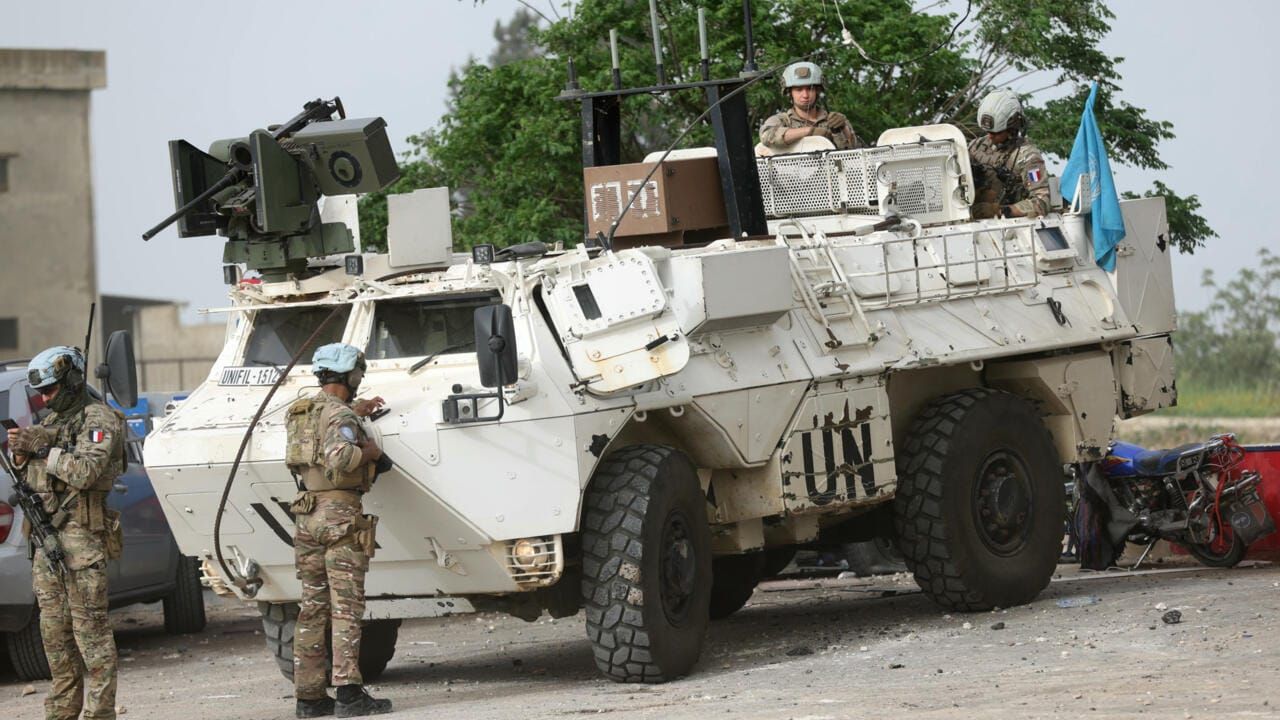
On Saturday 18 April, two days into the ceasefire, a UNIFIL patrol clearing explosive ordnance along a road near the village of Ghandouriyeh in southern Lebanon came under small-arms fire. The patrol was working to reopen access to a UN post that had been isolated by weeks of fighting between Hezbollah and Israeli forces. Staff Sergeant Florian Montorio of the French 17th Parachute Engineer Regiment, based in Montauban, was killed. Three other French peacekeepers were wounded, two seriously.
UNIFIL's initial assessment identified the fire as coming from non-state actors, "allegedly Hezbollah". UN Secretary-General António Guterres said it was presumed Hezbollah militants were responsible. French President Emmanuel Macron spoke with Lebanese President Joseph Aoun and Prime Minister Nawaf Salam, and said in a statement that "everything suggests that responsibility for this attack lies with Hezbollah". French Armed Forces Minister Catherine Vautrin said Montorio had been killed in an ambush by direct small-arms fire. The IDF also attributed the attack to Hezbollah. UNIFIL said deliberate attacks on peacekeepers are grave violations of international humanitarian law and of UN Security Council Resolution 1701, and may amount to war crimes.
Hezbollah denied the attack. In a statement it expressed surprise at what it called hasty accusations, pointing to the silence of the same parties "when the Israeli enemy attacks UNIFIL forces." The group called for a full Lebanese investigation. Lebanon's army condemned the shooting and opened an investigation. Salam ordered a separate inquiry. Aoun and Parliament Speaker Nabih Berri condemned the attack.
The killing was the third UNIFIL fatality in recent weeks. Two peacekeepers had been killed in March when an explosion of unknown origin destroyed their vehicle. On 12 April, separately, UNIFIL reported that an Israeli Merkava tank had rammed its vehicles, damaging monitoring equipment, which it characterised as a violation of Resolution 1701. Both Hezbollah and Israeli forces have fired on UNIFIL positions during the 2024 escalation and the 2026 resumption. The mission was first deployed in 1978 and now fields around 10,000 troops.
What Hezbollah's absence means
The structural problem with the agreement is precisely what Hezbollah's absence from it represents. The Lebanese government does not control Hezbollah militarily. Hezbollah fighters who fired more than 2,000 rockets and drones at Israel during the six weeks of renewed fighting since 2 March are still present and armed in southern Lebanon. The group's parliamentary bloc retains political power in Beirut. Prime Minister Salam said in March that Hezbollah's military operations were directly commanded by Islamic Revolutionary Guard Corps officers.
A ceasefire to which Hezbollah is not a party creates a predictable dynamic. Israel can declare any Hezbollah action a violation justifying military response. Hezbollah can declare any Israeli military presence on Lebanese soil a justification for what it calls resistance. The Montorio killing fits inside that dynamic: it happened three days into a ceasefire Hezbollah had rejected, on a mission made necessary by the fact that Israeli and Hezbollah operations had cut off a UNIFIL post. The November 2024 ceasefire that preceded this conflict was undermined by the same pattern. Israel continued striking what it called Hezbollah infrastructure almost daily, killing roughly 500 people by late 2025 according to the Lebanese Health Ministry. Hezbollah rebuilt its capabilities. Neither side implemented the withdrawal terms of Resolution 1701.
Former Israeli diplomat Alon Pinkas dismissed the Israeli government's framing of the new deal. "Netanyahu says a lot of things," he told Al Jazeera. "I wouldn't take him at face value." Leaders of regional councils in northern Israel, the communities worst hit by Hezbollah rocket fire, expressed unhappiness. Moshe Davidovich of the Mateh Asher Regional Council called the security zone "not a diplomatic achievement" and said it risked further violence.
Silver Plough, the security zone, and the demolitions
The Israeli policy on the ground has been explicit and public. On 12 April, during a visit to southern Lebanon with Defence Minister Israel Katz and IDF Chief of Staff Lieutenant General Eyal Zamir, Prime Minister Benjamin Netanyahu told troops that the war continued "including inside the security zone in Lebanon". Katz announced Operation Silver Plough, a campaign to demolish homes in Lebanese border villages. Channel 12 reported the Israeli army had identified more than 20 villages for demolition and was reinforcing the operation with heavy engineering equipment. Katz said residents south of the Litani River would not be allowed to return until Hezbollah was disarmed. Israel separately destroyed the Qasmiyeh Bridge, the main crossing over the Litani, after a warning.
On 19 April, Katz made the posture explicit. "Prime Minister Benjamin Netanyahu and I have instructed the Israeli army to act with full force, both on the ground and from the air, including during the ceasefire, in order to protect our soldiers in Lebanon from any threat." The Lebanese military has reported ceasefire violations by Israeli forces in Khiam, Bint Jbeil, and Dibbin. Israeli strikes on 17 and 18 April killed several individuals Israel described as Hezbollah members.
UN human rights experts, in a statement issued before the ceasefire, described Israel's campaign in Lebanon as "unprecedented" and said the combination of blanket evacuation orders with destruction of homes was "consistent with the pattern of domicide that was initiated during the genocide in Gaza". They called the deliberate destruction of homes a weapon of war and a form of collective punishment.
Black Wednesday, and the context the ceasefire inherits
The war the truce interrupted ran for 46 days. It began on 2 March, when Hezbollah fired projectiles into northern Israel in response to the US-Israeli assassination of Iranian Supreme Leader Ali Khamenei on 28 February. Israel answered with 3am strikes on Beirut and evacuation orders across 50 southern Lebanese villages and the Beqaa Valley. Hezbollah said the move was a defensive act unrelated to the Iran war, citing over a year of Israeli violations of the November 2024 truce.
Six weeks of fighting killed 2,294 Lebanese and wounded 7,544 between 2 March and 16 April, according to Lebanese Health Ministry figures cited by the Christian Science Monitor on 20 April. Over 1.2 million people were displaced, around one in five of Lebanon's population. The single worst day came on 8 April. Hours after the US and Iran announced their two-week ceasefire, which Pakistan had said included Lebanon and which Netanyahu immediately denied included Lebanon, Israel launched what it called Operation Eternal Darkness. Over 100 targets were hit in a ten-minute window. The IDF said it killed 250 Hezbollah militants. Lebanese Health Ministry figures and OHCHR reporting put the death toll at between 303 and 357, with more than 1,150 wounded. Many strikes hit central Beirut. Associated Press journalists reported seeing charred bodies in vehicles and on the ground at the Corniche al-Mazraa intersection, a mixed residential and commercial neighbourhood. Lebanon calls the day Black Wednesday.
The IDF said the strikes killed Ali Yusuf Harshi, Naim Qassem's personal secretary and nephew. Iran paused Hormuz shipping in response. Iranian President Masoud Pezeshkian warned that the strikes rendered negotiations with Washington meaningless. French Foreign Minister Jean-Noël Barrot called the strikes "unacceptable". EU foreign policy chief Kaja Kallas and UK Foreign Secretary Yvette Cooper called for Lebanon to be included in the Iran ceasefire. Over twenty governments and the United Nations condemned the Israeli attacks. Lebanese President Aoun called them barbaric. The Lebanese government announced a plan to demilitarise Beirut.
That is the war the 16 April ceasefire paused. Its durability depends on the broader Iran crisis. The same week the Israel-Lebanon truce took effect, the US Navy seized the Touska in the Gulf of Oman, Iran cancelled the second round of Islamabad talks, and the ceasefire between Iran and the United States, originally due to expire on 21 April and extended by Trump to Wednesday evening Washington time, edged toward the precipice. If the Iran ceasefire collapses, Lebanon's will likely collapse with it. Qassem's threshold for calling off the pause is Israeli military action on Lebanese soil, which Katz has publicly ordered to continue. The killing of a French peacekeeper on day two, attributed to Hezbollah and denied by Hezbollah, is what the ten days look like on paper.