On Wednesday morning, human rights defenders from the Global Sumud Flotilla arrived at Ashdod port in Israel, their hands in the air, having been transferred from their own boats to Israeli naval vessels in the eastern Mediterranean. Lawyers from the Israeli rights organisation Adalah, who had driven to Ashdod to meet them, were told they would not be permitted access until their clients reached Ketziot prison in the Negev desert, more than 80 kilometres inland. Israel's foreign ministry had declared on Monday it "will not allow any breach of the lawful naval blockade on Gaza." The flotilla's 430 human rights defenders, from more than 40 countries, aboard 50 vessels, were the latest proof of that policy.
This is the third time Israel has stopped the Global Sumud Flotilla at sea. The distance from Gaza where it has done so has grown with each attempt.
The flotilla set out from Marmaris in southern Turkey on 14 May, the eve of Nakba Day, with 54 ships and nearly 500 participants from 45 countries. It was, by any measure, the largest civilian-led maritime convoy of its kind in history. Participants included doctors, journalists, lawmakers, and human rights advocates. South Korea, Italy, Malaysia, Australia, Brazil, and Spain were among the countries represented. The mission's stated aim was to break Israel's blockade of Gaza and deliver humanitarian assistance that aid organisations say remains critically short even under the US-brokered ceasefire between Israel and Hamas that has been nominally in force since October 2025.
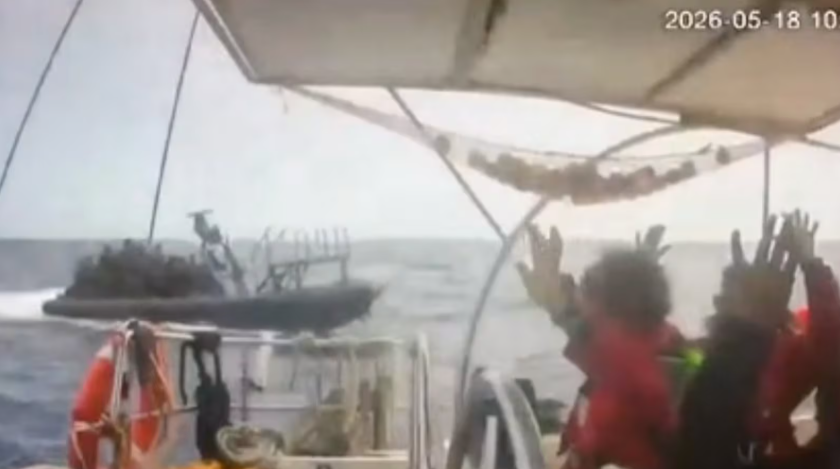
On 18 May, Israeli naval warships encircled the fleet in international waters, approximately 250 nautical miles from Gaza's coast. Video footage released by the flotilla showed human rights defenders raising their hands as Israeli forces boarded their vessels. Soldiers then destroyed cameras mounted on the boats. Israel said it fired warning shots at two vessels; flotilla organisers said rubber bullets were used on five boats. Italy's Foreign Minister Antonio Tajani called for an urgent review of the use of force after Italian human rights defenders reported being shot at. "What is the legal basis for the arrests?" asked South Korean President Lee Jae Myung. "Is that Israeli land? Detaining our citizens for reasons not justified under international law is too excessive and inhumane." A South Korean citizen, an Italian MP, and an Italian journalist were among those detained.
Israel transferred all 430 human rights defenders to Israeli vessels and brought them to Ashdod. The flotilla's organisers said participants would be taken to Ketziot prison. Italy's foreign ministry said its nationals were "expected to be transferred to a facility for identification and then allowed to depart," the standard procedure from previous interceptions: brief detention, deportation. For two of the human rights defenders taken during the April interception, the procedure was rather different.
On 30 April, Israeli forces stopped 22 boats from the flotilla in international waters approximately 600 nautical miles from Gaza, near the Greek island of Crete. One hundred and eighty-one human rights defenders were detained and taken to Crete. Two were separated from the group and taken to Israel: Saif Abu Keshek, a Spanish-Swedish Palestinian activist who had been on an observer boat with no intention of sailing to Gaza, and Brazilian Thiago Ávila. Both were taken to Shikma Prison in Ashkelon. Ávila later said he was beaten so severely he lost consciousness twice. The Brazilian embassy confirmed visible injuries on his face during a consular visit under glass. Both were charged under terrorism statutes. Both were released after diplomatic pressure from Spain and Brazil, going on hunger strike in the interim. The Al Jazeera article by a flotilla participant published on 11 May, written while at sea between interceptions, described Abu Keshek as having "been forced to lie face-down from the moment of his seizure, kept hand-tied and blindfolded, his face and hands bruised."
The first flotilla attempt in autumn 2025 was stopped approximately 120 nautical miles from Gaza. The April 2026 interception occurred near Crete, more than 600 nautical miles away. The current interception took place 250 nautical miles out. International maritime lawyers and the flotilla's own legal team have argued that each of these interceptions constitutes a violation of freedom of navigation under the United Nations Convention on the Law of the Sea, which guarantees the right of innocent passage on the high seas to vessels of all states. Turkey called the April interception piracy. Spain called it illegal. Germany and Italy expressed "grave concern." Israel has maintained the interceptions are lawful enforcement of a naval blockade it describes as legal.
Israel declared the illegal Gaza blockade in 2007. The UN Human Rights Council found in 2009, following the Mavi Marmara incident in 2010, that the blockade constitutes collective punishment of the civilian population of Gaza in violation of international humanitarian law. Israel and the United States dispute that finding. The International Court of Justice, where South Africa's genocide case against Israel is proceeding toward oral hearings expected in 2027, has issued multiple provisional orders requiring Israel to ensure humanitarian access to Gaza. None of those orders has been enforced. The flotilla is, among other things, a civil society attempt to accomplish materially what the court has ordered formally and what has not happened.
Israel describes the flotilla as a provocation with no genuine humanitarian intent, noting that the boats carry only a symbolic amount of aid. That framing is accurate in the narrow sense: the 50 boats could not move meaningful quantities of supplies. It misses the point the flotilla has explicitly stated: breaking the siege, not stocking it. A single successful arrival in Gaza would establish that civilian vessels can reach Gaza without Israeli interdiction, a different claim than any tonnage calculation captures. Israel has, consistently, understood this, which is why it has intercepted every attempt regardless of cargo size.
The October 2025 Israel-Hamas agreement includes written guarantees of increased humanitarian aid access to Gaza. UNRWA, the UN agency for Palestinian refugees, has been blocked by Israeli authorities from bringing humanitarian assistance into Gaza since 2 March 2025, a period now exceeding fourteen months. Aid organisations describe supply levels as critically short across food, medicine, and clean water. The flotilla, organised partly in response to that gap, is being stopped by the same state whose ceasefire commitments promised to close it.
The three Italians, the South Korean citizen, the Australian human rights defenders, the Malaysian participants, the Brazilian doctors, all being driven to a desert prison while their lawyers wait outside, are the human content of that contradiction. The ceasefire says aid will flow. The naval forces say the ships carrying it will not pass. Both things are Israeli policy, operating simultaneously, and only one of them is enforced.
South Korea's president Lee put the jurisdictional question plainly: is that Israeli land? The answer is no. The eastern Mediterranean, 250 nautical miles from Gaza's coast, is international water under UNCLOS. The Israeli navy operates there with impunity because no state has been willing to physically contest it, and because the diplomatic consequences of each interception have so far been calibrated at a level Israel has found acceptable: statements of "grave concern," calls for urgent review, demands for consular access.
What has not happened is any government sending its own vessels to accompany the flotilla. The human rights defenders on those 50 boats were aware of this when they departed Marmaris. They set out anyway, determined to break the illegal blockade that world governments continue to ignore.
What you can do
The 430 people now in Ketziot need two things immediately: legal access and diplomatic pressure. Here is what both require.
If you have a detained national.
Citizens of South Korea, Italy, Australia, Malaysia, Brazil, Spain, and at least 35 other countries are among those detained. Contact your foreign ministry directly, by phone and by written message, and demand three specific things: immediate consular access without conditions, a formal statement naming the interception as a violation of international maritime law, and a public call for release before deportation proceedings begin. The previous pattern is that governments accept deportation as resolution. Deportation is not resolution for someone who has been detained in international waters without legal basis. Demand more than that.
If you are in a country with nationals detained.
Whether or not you personally know someone on the flotilla, your elected representative can raise this. Find your MP, your senator, your MEP, and ask them by name to make a public statement demanding release. The April interception produced releases partly because Spain and Brazil made enough diplomatic noise that silence became more costly than action for Israel. Volume matters.
Support Adalah.
Adalah, the Legal Center for Arab Minority Rights in Israel, is the organisation physically present at Ashdod right now, being denied access to its clients. It will be providing legal representation throughout what happens next, including any court proceedings. Its work on the April interception contributed directly to securing Abu Keshek and Avila's release. Donate at adalah.org.
Support the Global Sumud Flotilla directly.
The flotilla has survived three interceptions and is explicitly planning to sail again. Its legal team has placed governments on formal notice of UNCLOS violations. Its documentation of each interception, including livestreams, testimony, and medical evidence, is the primary public record of what Israel is doing in these waters. That documentation work costs money. Donate and follow at globalsumudflotilla.org.
If you are a journalist or work in media.
The Committee to Protect Journalists has called for the immediate release of journalists and media workers detained on the flotilla and demanded transparency on their whereabouts and legal status. Contact CPJ at cpj.org if you have information. Amplify their demands. An Italian journalist is in Ketziot tonight. Their organisation should be raising this loudly.
If you are in the EU.
The EU-Israel Association Agreement requires both parties to respect human rights as an essential element. The agreement has a human rights clause that has never been invoked. Your MEP can push for a European Parliament vote on whether Israel's conduct since October 2025, including this interception, constitutes compliance with that clause. That is a formal mechanism with a formal address. Use it. Contact your MEP through europarl.europa.eu.
If you are in Canada.
Amnesty Canada has called on the Canadian government to formally urge Israel to allow safe passage for humanitarian vessels, publicly affirm the right to freedom of navigation for civilian ships, ensure consular protection plans are in place for Canadian nationals, and refrain from exercising any form of pressure or delegitimisation of the people on those boats. Contact your MP and your senator through parl.ca and ask them to raise this with the Minister of Foreign Affairs.
The longer pressure track.
The UN Human Rights Office has called for the immediate release of all those detained and for independent investigations into torture allegations from the April interception. Those investigations will not happen without sustained public pressure. The OHCHR's statement is at ohchr.org. Share it. The ICJ provisional orders requiring Israel to ensure humanitarian access to Gaza are not being enforced. That enforcement gap is what the flotilla is responding to, and it will not close through silence.
The people now in Ketziot made a calculation that the risk was worth it. They sailed knowing what happened in April. The minimum the rest of us can do is make the cost of holding them higher than the cost of releasing them.