The mechanism is almost elegant in its compounding. Israel collects taxes on goods imported into Palestinian territories on behalf of the Palestinian Authority, as it has been obligated to do since the 1994 Paris Protocol on Economic Relations. It is supposed to transfer that revenue monthly to the PA. Finance Minister Bezalel Smotrich stopped doing so in May 2025. The accumulated total now stands at $5 billion, per PA figures. That is well over half the PA's annual budget. Al-Shabaka, Carnegie, and the PA's own government describe it as theft. Israel has offered no credible legal justification for refusing to transfer it.
Reuters reported on 15 May that the US is now considering asking Israel to redirect an undetermined portion of that stolen money not to the PA but to Trump's Board of Peace, the body overseeing postwar reconstruction in Gaza. The PA was not invited to join the Board of Peace. Israel was. The body is chaired by Donald Trump, who holds that position for life and cannot be removed except by unanimous vote of its executive members. The executive board also includes Jared Kushner, Steve Witkoff, and Marco Rubio.
Smotrich has already rejected a US request to transfer even a portion of the withheld funds to the Board of Peace, according to the Times of Israel. The PA has separately offered to contribute to the Board of Peace but has conditioned any contribution on Israel's first releasing the clearance revenues owed to it. Israel has refused. The current situation, therefore, has stolen Palestinian tax money sitting in Israeli hands, with the possibility that it is eventually released not to the Palestinian Authority it was collected for, but to a reconstruction fund that excluded the PA from membership and gave Israel a seat at the table.
What clearance revenues are and why they matter
The Paris Protocol was appended to the Oslo Accords to govern the economic relationship between Israel and the Palestinian territories until a final peace settlement. Israel, which controls all borders and entry points into Palestinian territory, collects import duties and value-added taxes on goods destined for Palestinians and is meant to pass that money to the PA. Before October 2023, this transferred approximately $270 million per month, enough to cover the salaries of 147,000 PA civil servants. It represents roughly two-thirds of the PA's total revenues. Palestinian banks and businesses have no independent access to global financial markets: they depend on Israeli intermediaries, and those intermediaries require a letter of indemnity that Smotrich controls and has repeatedly withheld or threatened to withhold for additional coercive effect.
This fiscal architecture was designed as a temporary arrangement pending a final status agreement. It has lasted more than thirty years without that agreement, and has become the primary instrument by which Israel exercises economic control over the PA's ability to function. When Smotrich withholds Palestinian clearance revenues, he is not suspending Israeli aid. He is confiscating Palestinian funds in violation of the Paris Protocol. The agreement is explicit: these revenues must be transferred monthly.
The withholding has escalated in stages. Starting in 2019, Israel began making unilateral monthly deductions from Palestinian funds it was holding in trust, taking the equivalent of the PA's payments to prisoner families and those killed by Israeli forces. Israel took the money unilaterally, without arbitration, in violation of the Protocol. By 2024 it had stolen approximately $1 billion this way. After October 2023, Israel withheld an additional $75 million per month, equivalent to what the PA paid civil servants in Gaza. In May 2025, Smotrich stopped transfers entirely. PA Prime Minister Mohammad Mustafa said in a government meeting that the West Bank is "on the brink, risking an explosion any time." PA salary arrears have reached at least six months. The PA's public debt stands at approximately $8 billion, around 60% of West Bank GDP. Palestinian civil servants have been receiving 70-80% of their salaries at best, and often less.
Al-Shabaka, the Palestinian policy network, described the withholding in a February 2026 analysis as "a reflection of a new, more radical agenda driven by the far-right."
Smotrich has stated his aim explicitly and repeatedly: the elimination of the PA and the annexation of the West Bank. Stealing the clearance revenues is one instrument toward that end. The international community has watched it happen without enforcing the Paris Protocol.
The Board of Peace
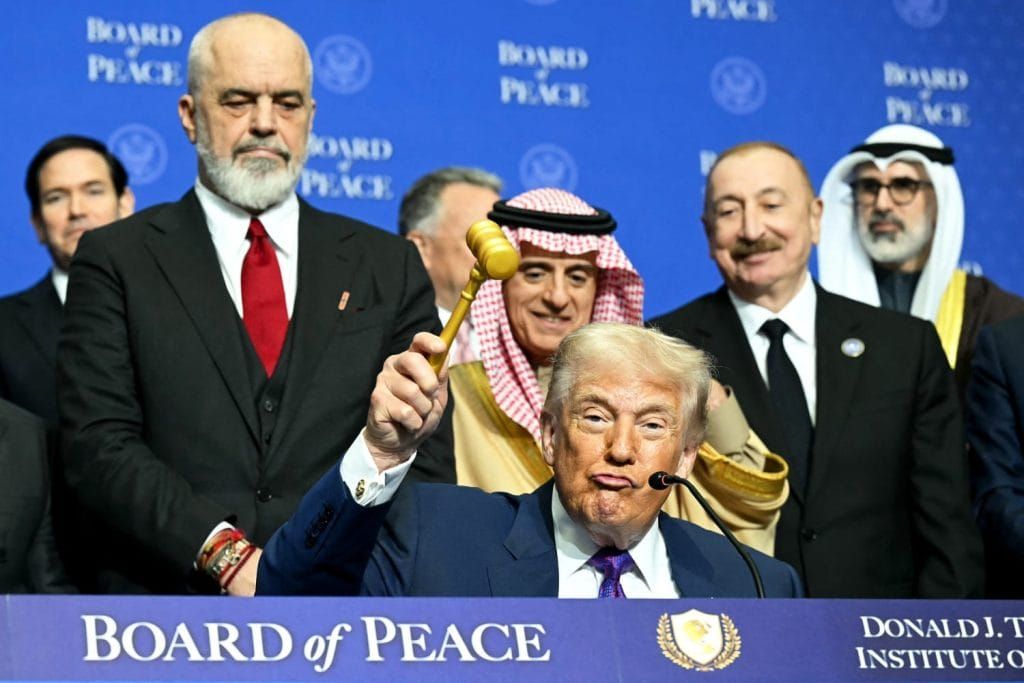
Trump's Board of Peace was established in January 2026, ratified as an official international organisation at Davos, and given formal mandate through a UN Security Council resolution. On paper it exists to oversee Gaza's post-war reconstruction and governance transition. In practice its structure concentrates authority in a way that has alarmed everyone from the Carnegie Endowment to the UN human rights office.
Trump chairs it for life. His veto cannot be overridden. Permanent membership costs $1 billion, payable within the first year. Among those who have accepted membership alongside the US are Israel, Qatar, Turkey, Saudi Arabia, the UAE, and, reportedly at Trump's invitation, Russia's Vladimir Putin. Among those who declined or have not committed are France, Germany, Canada, and Spain. The UK has described the National Committee for the Administration of Gaza, the Palestinian technocratic body under the board, as more important than the board itself, and has expressed concern at the board's broad mandate and decision to invite Putin.
The PA was not invited. UN Special Rapporteur Ben Saul, addressing the UN Palestinian Rights Committee, stated that "Palestinian self-determination cannot be conditional" and that the plan "places political transition under external oversight, lacks representation of Palestinians, and excludes the Palestinian Authority." He called the oversight arrangement reminiscent of colonial models. OHCHR stated the Board is "not under United Nations authority or transparent multilateral control" and that the US "is not an honest broker."
Carnegie noted that the board, as structured, means "Trump's power unchecked" and treatment of Israel's actions "permissive."
The financial situation of the board makes the clearance revenue proposal understandable as desperation, if not as principle. Countries pledged $17 billion at the board's first convening, including $10 billion from the US. The World Bank estimates Gaza's reconstruction will cost $70 billion. The board has acknowledged a gap between pledges and actual donations. The Carnegie analysis of the board's Financial Intermediary Fund for Gaza Reconstruction, the GRAD mechanism set up through the World Bank, noted there is no restriction on how the funds may be spent: unlike the Ukraine fund, which explicitly limits contributions to non-military uses, the GRAD carries no such constraint. The board can spend the money on whatever else the executive board decides.
The proposal now under US consideration would, in effect, use $5 billion in stolen Palestinian tax money to partially fill a $53 billion gap in a reconstruction fund that excluded the Palestinians' representative government and gave their occupier a seat on the executive.
Who profits
The executive board of the Board of Peace is Trump, his son-in-law Jared Kushner, his special envoy Steve Witkoff, Secretary of State Marco Rubio, Apollo Global Management CEO Marc Rowan, Israeli-Cypriot billionaire Yakir Gabay, World Bank President Ajay Banga, and former British Prime Minister Tony Blair. The people directing where tens of billions in reconstruction money goes have disclosed financial interests, ongoing government investigations, and undisclosed conflicts of interest that run directly through the states paying for permanent Board of Peace membership.
Kushner is the most documented. After leaving Trump's first administration, he founded Affinity Partners and raised $2 billion from Saudi Arabia's Public Investment Fund, the sovereign wealth fund controlled by Crown Prince Mohammed bin Salman. The Senate Finance Committee investigation, led by Senator Ron Wyden, found that Affinity has collected at least $87 million in fees from the Saudi government alone since June 2021, pockets a 2% annual management fee from virtually all investors regardless of performance, and as of July 2024 had generated no return on investment and distributed not a penny of earnings to clients.
Sen Wyden's conclusion, stated in a September 2024 letter, was that Affinity "is likely part of a compensation scheme involving U.S. political figures designed to circumvent the Foreign Agents Registration Act."
In late 2024, Wyden referred Kushner to the Department of Justice for possible FARA violations. In March 2026, the New York Times reported that Kushner was simultaneously serving as Trump's Middle East envoy and soliciting billions in additional capital from the same Gulf governments he was negotiating with.
In April 2026, Representative Jamie Raskin opened a formal House Judiciary Committee investigation. His letter to Kushner stated directly: "You cannot faithfully represent the United States with billions of dollars in Saudi and Emirati cash burning a hole in every pocket of every suit you own."
Saudi Arabia, the UAE, and Qatar, whose sovereign wealth funds are Kushner's primary investors, each paid $1 billion or more for permanent Board of Peace membership. They are simultaneously Kushner's clients, Board of Peace members, and the intended primary funders of the reconstruction Kushner co-designed and publicly described as "amazing investment opportunities." When Kushner unveiled his $30 billion "master plan" for Gaza at Davos in January 2026, replacing historic sites with data centres, industrial zones, and seaside resorts, he described it as "real-estate diplomacy." He told the inaugural Board of Peace meeting that board members were "not personally profiting from this."
House Oversight Committee Chairman James Comer, a Republican, previously acknowledged that "what Kushner did crossed the line of ethics."
Republican Senator Thom Tillis argued that Kushner and Witkoff "are not subject to Senate confirmation, and they're not subject to oversight."
Witkoff's conflict runs through cryptocurrency. World Liberty Financial, the Trump family crypto project in which Witkoff holds a stake, saw its stablecoin used in the UAE sovereign wealth fund MGX's $2 billion investment in Binance. The UAE is a Board of Peace member. Witkoff negotiated with the UAE while holding a financial stake in a vehicle whose value depends in part on UAE sovereign capital flows. His net worth has increased approximately 15% since Trump took office, to $2.3 billion, with World Liberty Financial a primary driver.
Rowan, at the Board of Peace's inaugural meeting in February 2026, told the assembled delegates: "The coastline alone? $50 billion in value on a conservative basis. The housing stock, more than $30 billion. The infrastructure, more than $30 billion." He put total Gaza real estate value at approximately $115 billion and said it "just needs to be unlocked and financed." Apollo Global Management, which Rowan runs, has $785 billion in assets under management. Its business model, built around an insurance subsidiary called Athene, operates as what Rowan himself has described as a "permanent capital vehicle": reconstruction would likely be financed through loans and public-private partnerships rather than grants, locking Gaza into decades of debt servicing while guaranteeing investor yields. The Komisar Scoop analysis of Rowan's appointment noted that under this model, "aid money and future revenue streams from tolls, utilities, ports would disappear into a black box, shielded from public oversight."
Yakir Gabay, the Israeli billionaire on the same executive board, told the inaugural meeting that Gaza's coast should be "developed as a new Mediterranean Riviera with 200 hotels and potential islands."
Gabay is an Israeli national, sitting on the body governing reconstruction of territory his country's military destroyed.
Trump himself chairs the board in his personal capacity, not as president. Under the January 22, 2026 charter resolution, executive board members are named without reference to their current office or title. Carnegie flagged this explicitly: it means they retain access to the board's funds after the UN mandate ends and after Trump leaves office. Negotiations are reportedly ongoing between the Trump administration and JPMorgan Chase to establish a private account for the board accessible by the chairman and his designates. Trump simultaneously has a personal lawsuit against JPMorgan and its CEO Jamie Dimon for $5 billion. He is suing the bank being negotiated with to hold the reconstruction fund he will control personally and indefinitely.
The contractor ecosystem
The conflicts do not stop at the executive board. The contracts being issued and sought under the Board of Peace reveal an entirely separate layer of self-dealing with no competitive procurement framework.
The Guardian obtained Board of Peace contracting records showing plans for a 5,000-person, 350-acre military base inside Gaza for the planned International Stabilization Force, ringed by 26 armoured watch towers, bunkers, and a small arms range. The identity of the contractor is not publicly known. The land where it will be built is, per the UN, currently under Israeli military control and home to 1.9 million displaced Palestinians. Diana Buttu, a Palestinian-Canadian lawyer and former peace negotiator, described it as "an act of occupation." No competitive bidding process has been publicly documented.
Gothams LLC, an Austin-based disaster response firm with recent federal contracts at a South Florida migrant detention centre, submitted a plan to the White House for a "fully integrated humanitarian logistics system." Its draft proposal, obtained by the Guardian, guaranteed the company a minimum three-times return on capital expenditure and a seven-year monopoly over trucking and logistics for the Board of Peace, with a three-year renewal option. A separate slide deck promoting the associated "Gaza Supply System," dated January 2026, advertised returns of 46% to 175% to "sovereign investors" in the first year alone. Charles Tiefer, a federal contracting law expert who sat on the Commission on Wartime Contracting in Iraq and Afghanistan, reviewed the Gothams terms and said they were "outrageous." Three people familiar with the process told the Guardian that Board of Peace and White House officials were actively courting investments from sovereign wealth funds, including the UAE's Mubadala, to fund these projects. Former DOGE officials now operating under Kushner's portfolio were involved in the planning.
UG Solutions, a North Carolina security firm, previously guarded aid distribution sites run by the Gaza Humanitarian Foundation, a US and Israel-backed operation whose distribution points were linked to multiple civilian deaths. Palestinian NGOs said UG Solutions would not be welcomed back due to those incidents. The company is seeking new Board of Peace contracts and has been in active discussions with administration officials, according to the Financial Times.
"Everybody and their brother is trying to get a piece of this," one long-time contractor told the Guardian. "People are treating this like another Iraq or Afghanistan. And they're trying to get rich off of it."
There is no binding conflict of interest rule that applies to any executive board member. There is no independent oversight body with authority over the GRAD fund. There is no use restriction on reconstruction money equivalent to what the Ukraine fund carries. The people issuing contracts are the same people with undisclosed financial interests in the states funding the contracts. The people setting reconstruction priorities described Gaza's coastline as $50 billion in unlocked value at the first official meeting of the body they chair. None of this is incidental to the Board of Peace's design. It is the design.
Impunity
Israel has been stealing Palestinian tax revenue in breach of the Paris Protocol for years. There have been no consequences. Abbas stated at a Fatah conference that the withholding "violates the agreements between the Palestinian Authority and Israel, as well as international law." That is accurate. There has been no enforcement. No sanctions against Israel have been imposed in response. No international body has compelled compliance. The US, which spent years pressuring the PA to reform its prisoner payment system as a condition of releasing the funds, has not imposed equivalent pressure on Israel to comply with its own treaty obligations.
Smotrich's position is that the funds are a coercive instrument. In letters to Netanyahu, he has called the PA "an immediate danger to Israel" and pushed for annexation of the West Bank. In June 2024, his office made the release of withheld funds conditional on the Israeli government legalising West Bank settlement outposts, which themselves violate international law. Oslo requires monthly transfers. Smotrich has routinely withheld stolen Palestinian funds to extract unrelated political concessions: settlement legalisations, deportation policy, halting ICC proceedings. This is extortion built on theft, and the stolen funds have become a political weapon.
The proposed US request to redirect stolen Palestinian money to the Board of Peace would, if accepted, ratify theft as policy. It would launder a treaty violation into a financial contribution to a Trump-designed institution, bypass the PA entirely, and establish that an occupying power can steal Palestinian tax revenue and then decide where it goes without the Palestinians' consent. The Board of Peace official's framing, that "money held in a bank does nothing to further the President's 20-Point Plan," treats $5 billion in stolen Palestinian funds as idle capital awaiting deployment. That $5 billion belongs to an institution that is currently unable to pay its civil servants in full.
The Iraq comparison has been made by multiple analysts, the Coalition Provisional Authority held undisputed power over Iraq's reconstruction after 2003 with no effective oversight.
UN special envoy Lakhdar Brahimi called CPA head Paul Bremer "the dictator of Iraq. He has the money. He has the signature."
The Board of Peace, with Trump as lifetime chair holding sole veto, a $70 billion reconstruction mandate, no meaningful independence from its chairman's political interests, and an executive board populated by the same people whose financial interests are intertwined with Gulf states invested in the region's future, represents a closely analogous structure.
What the international failure looks like
The Paris Protocol is a binding treaty. Israel has violated it in a documented, ongoing, publicly acknowledged manner. The main US request to date has been that Israel redirect the improperly withheld funds to a body the US chairs, rather than that Israel comply with its legal obligation to transfer them to the PA. France, Germany, Canada, and Spain declined to join the Board of Peace, citing concerns about its mandate and accountability structure. Having declined, they have no influence over how it operates or how its funds are sourced. The EU-Israel Association Agreement's human rights clause, which requires both parties to respect human rights as an essential element of the relationship, has not been invoked. The ICJ provisional orders requiring Israel to enable humanitarian access to Gaza sit unenforced. The Paris Protocol sits unenforced.
The international failure is not passive; it is complicity. The redirection proposal means the US would be asking Israel to use its ongoing theft as a funding mechanism for a US-controlled institution, normalising the crime by giving it a constructive destination. Stolen Palestinian money would flow into a body with no Palestinian representation, no independent oversight, no use restriction, and a mandate that extends, per its charter, beyond Gaza to other areas of conflict wherever the chairman decides. The Palestinians would have funded, through theft, the very institution built to govern them without their consent.
Smotrich has refused even this. His refusal is itself revealing: he does not want the money to go to Palestinian reconstruction on any terms, including Trump's terms. He wants the PA to collapse. That goal is shared by no credible partner in the international community, and yet it is advancing.
Coordinated economic strangulation
Since October 2023, Israel has cancelled work permits for more than 200,000 Palestinian labourers from the West Bank, eliminating an estimated $4 billion in annual income equivalent to 25% of West Bank GDP. The Bank of Israel has refused to honour the Oslo requirement to convert accumulated Palestinian-held shekels into foreign currency, leaving Palestinian banks unable to accept large deposits. Smotrich has threatened legislation to permanently expropriate the withheld clearance funds into Israel's war deficit. The PA's $8 billion debt is equivalent to 60% of the West Bank's entire annual economic output.
The people who will lose their salaries if the PA collapses are not politicians. They are teachers, nurses, police officers, administrators, and engineers. One hundred and forty-seven thousand civil servants' salaries depend on this revenue. The West Bank's stability depends on the PA's ability to function. Every analyst covering the region, including those with no sympathy for the PA's political positions, has noted that a PA collapse would not produce a vacuum favourable to any peace process. It would produce either direct Israeli military control or the conditions for a third intifada. Both outcomes serve Smotrich's stated objectives. Neither serves Gaza's reconstruction.
The proposal to redirect the funds to the Board of Peace, however it resolves, is a symptom of the core problem: $5 billion in stolen Palestinian money is sitting in Israeli hands in breach of a treaty signed in 1994, and after three decades of precedent for using it as a pressure tool, no state with the power to enforce the treaty is willing to do so. Israel has faced no sanctions, no legal proceedings, and no meaningful diplomatic cost for the theft. The international community's response to repeated treaty violations has been to ask, politely, whether the stolen money might be redirected somewhere useful. The Board of Peace may or may not receive this money. The PA has not received it. That is where the accountability question begins and, so far, ends.