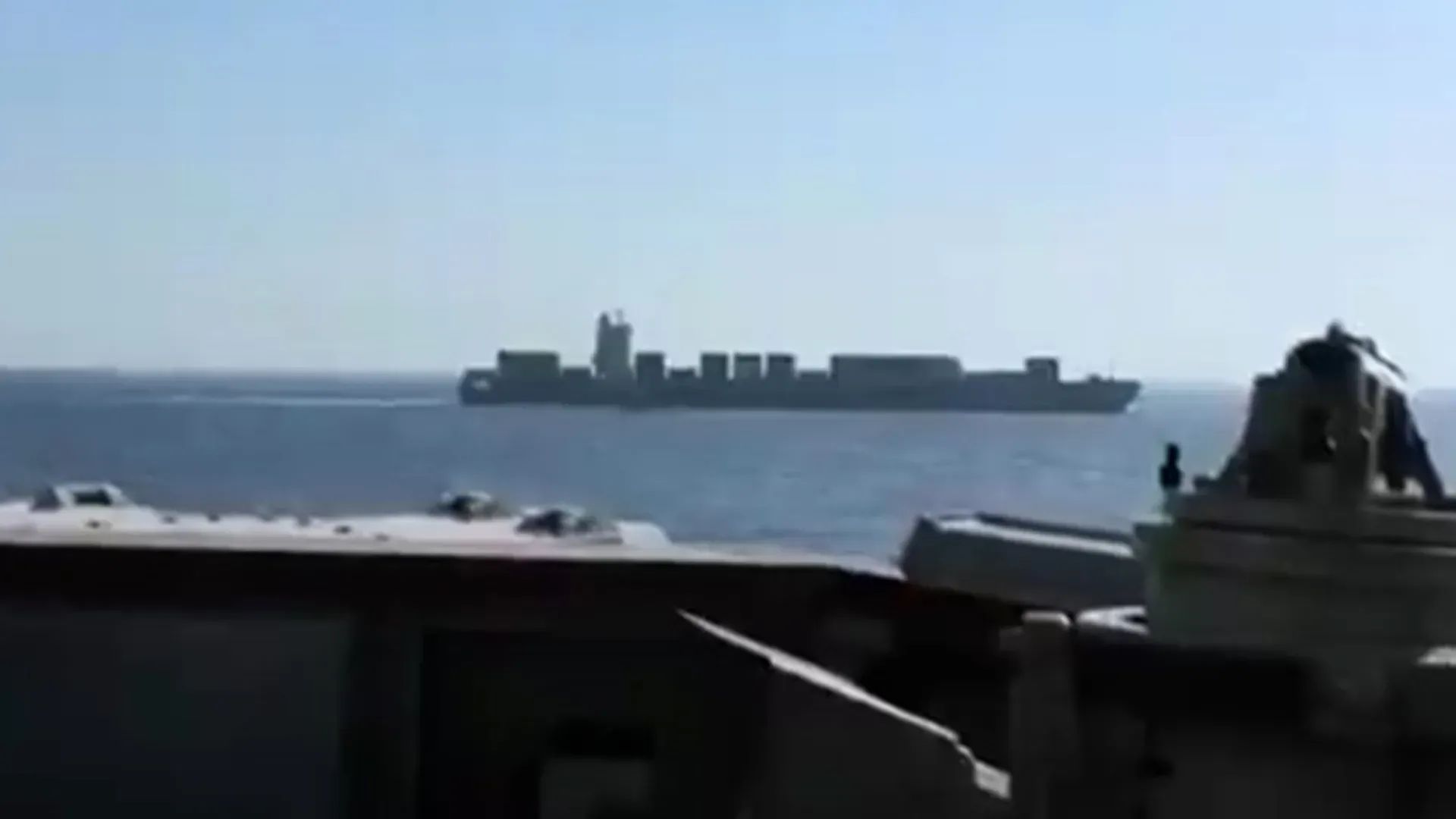
US Marines from the 31st Marine Expeditionary Unit rappelled from helicopters onto the deck of the Iranian-flagged container ship Touska on the evening of Sunday 19 April, after the guided-missile destroyer USS Spruance fired three rounds from its 5-inch Mark 45 gun into the vessel's engine room, disabling it in the northern Arabian Sea after a six-hour standoff. Within hours, Iran cancelled the second round of peace talks scheduled for Islamabad and called the operation an act of piracy. Brent crude opened Asia trade on Monday up more than six percent, at roughly $96 a barrel.
It was the first seizure of a non-military Iranian vessel since the US naval blockade of Iranian ports took effect on 13 April, and the first Iranian cargo ship the American military has captured since the start of what Washington calls Operation Epic Fury on 28 February. The Touska, owned by the Tehran-based Mosakhar Darya Shipping Co, has been under US Treasury sanctions since 2018. All of its owner companies and technical and commercial managers have been sanctioned since 2012. Its last port of call was Port Klang, Malaysia, which it left on 13 April bound for Bandar Abbas in southern Iran, with prior voyages shuttling between the Chinese port of Zhuhai and Iranian ports. It was scheduled to arrive in Bandar Abbas on Monday.
CENTCOM said the ship was steaming at 17 knots when it was intercepted. Its captain, Bakhtiar Hosseinzadeh, is a member of the Islamic Revolutionary Guard Corps, according to Iran Wire, which reports his crew has been described inside the IRGC as the guardian of the corps's shipping interests. CENTCOM head Admiral Brad Cooper said the Touska was one of several vessels of interest US intelligence analysts had been monitoring in recent days, both inside and outside the blockade boundary.
The Touska is 294 metres long (965 feet), 32.25 metres wide, and carries a crew of around two dozen. President Trump, posting on Truth Social, described it as nearly nine hundred feet long and weighing almost as much as an aircraft carrier. It is in fact only around 38 metres shorter than the USS Abraham Lincoln. Trump said the crew had refused to listen, and that US Marines had custody of the vessel. CENTCOM subsequently announced the ship was carrying unknown cargo. Maritime security sources cited in Indian and US reporting said the containers were thought to hold dual-use items with potential military applications, including metals, pipes, and electronic components.
The Touska incident
CENTCOM said the Touska had been informed it was in violation of the US blockade and had been given repeated warnings over a six-hour period to comply and reverse course. A radio transmission released by the Navy captured a Spruance crew member telling the ship: "We're prepared to subject you to disabling fire." When the crew failed to comply, the destroyer directed them to evacuate the engine room before firing. Three rounds from the Mark 45 hit the engine room. The Spruance is a Flight IIA Arleigh Burke-class Aegis guided-missile destroyer with an ODIN anti-drone laser fitted in 2024. Its main gun fires 16 to 20 rounds per minute with an effective range of around 13 nautical miles. The retired US Navy captain Carl Schuster, speaking to CNN, said it would typically take at least two hits to knock out a diesel engine of the Touska's size, and that all three visibly struck. He added the vessel will likely need to be towed.
Marines then flew in from the amphibious assault ship USS Tripoli and rappelled aboard. Grainy night-vision footage released by CENTCOM shows troops descending on ropes onto the container stacks. A US military official told the New York Times two options are under review: towing the Touska to Oman, or allowing it to steam to an Iranian port if its propulsion can be restored.
Earlier on Saturday, before the Touska incident, Iran's Islamic Revolutionary Guard Corps fired on commercial vessels attempting to transit the Strait of Hormuz, including ships affiliated with the French carrier CMA CGM, which confirmed one of its vessels had been subject to warning shots. Its crew was unhurt. Trump accused Iran of firing, in his words, bullets in the Strait of Hormuz, and called it a violation of the ceasefire agreement. Shipping data from Kpler showed more than 20 vessels passed through the strait on Saturday, the highest daily count since 1 March, suggesting a brief resumption of traffic before Saturday's incidents reversed the trend.
Iran's response
Iran's armed forces called the boarding piracy. Iran's top joint military command, Khatam al-Anbiya, accused the US of violating the ceasefire and vowed retaliation through the IRGC-affiliated Tasnim News Agency. Hours later, Iranian state media claimed drone strikes had been launched against multiple US vessels in response. The Pentagon had not confirmed any such strikes by Monday evening. Foreign Ministry spokesperson Esmaeil Baghaei told reporters that Tehran had no plans to send negotiators to Islamabad, and described the blockade as unlawful and criminal, amounting in his words to a war crime and a crime against humanity. Iran's First Vice President Mohammad Reza Aref warned: "Either a free oil market for all, or the risk of high costs for everyone."
Iran's parliament speaker Mohammad Bagher Ghalibaf, writing on X, accused Trump of imposing a siege, violating the ceasefire, and attempting to turn the negotiating table in Islamabad into a table of surrender. He added that in the past two weeks, Tehran had prepared to reveal what he called new cards on the battlefield. The front page of the Tehran daily Jam Jam carried a cartoon of Trump drowning in the Strait of Hormuz under the headline "Marine Bluff". President Masoud Pezeshkian, who succeeded the assassinated Ebrahim Raisi last year and has taken a moderate posture throughout the conflict, refused to engage in diplomacy under the threat of renewed attack.
The Islamabad cancellation matters tactically. The ceasefire between Iran and the United States, the agreement that has kept US-Israeli strikes on Iran paused since 8 April, was originally due to expire on Tuesday 21 April. Trump told Bloomberg on Monday that the deadline had been extended by roughly 24 hours to Wednesday evening Washington time, but that it was highly unlikely he would extend it further. He said on a phone call to a PBS News reporter that "lots of bombs will start going off" if no deal was reached, and that in the absence of a deal the US would knock out every power plant and every bridge in Iran. The first round of Islamabad talks on 11 and 12 April, led by Vice President JD Vance alongside special envoys Steve Witkoff and Jared Kushner, ended after a 21-hour session without agreement, primarily over Iran's nuclear enrichment rights.
By Monday evening, Iranian state TV denied any Iranian delegation had departed for Islamabad. The New York Times, citing two senior Iranian officials, reported that a Tehran delegation was nevertheless making plans to arrive on Tuesday. The Supreme Leader's clearance came through late Monday night, according to mediator sources cited by Al Jazeera. The US team, initially thought to be limited to Witkoff and Kushner because of security concerns, was re-expanded to include Vance on Monday. At least four US government aircraft carrying communications equipment and motorcade support landed at Nur Khan air base in Rawalpindi on Sunday. Pakistani authorities closed roads around the Serena Hotel in Islamabad's Red Zone in preparation for the talks. The mediation is being run by Pakistani army chief General Asim Munir and Prime Minister Shehbaz Sharif.
Two blockades, one strait
The situation in the Strait of Hormuz now involves two overlapping interdiction regimes on the same 21-nautical-mile waterway. Iran has been controlling access since early March, requiring ships to coordinate passage with the IRGC, charging fees the Trump administration has called illegal tolls, and directing vessels along routes it designates, including routes affected by mines it has reportedly laid. Per US intelligence, Iran itself may no longer know where all those mines are. The US blockade, imposed on 13 April after the collapse of initial ceasefire terms, bars vessels bound to or from Iranian ports from passing. In practice, the two regimes produce a near-total chokepoint, with both belligerents asserting control of the same stretch of water.
Al Jazeera's calculations put Iran's pre-blockade oil export revenue at close to five billion dollars in the month before 13 April, now effectively eliminated. The UAE climate envoy Sultan Al Jaber estimated on 19 April that 600 million barrels of oil have been blocked since the start of the conflict, with 50 days of mounting pressure on liquefied natural gas, jet fuel, fertiliser, and downstream costs. Wall Street Journal reporting has described Gulf state unease at the duration of the crisis, with UAE officials privately warning they may move to settle trade in Chinese yuan if dollar-denominated commerce continues to be disrupted.
US intelligence assessments reported by CNN, the New York Times, and the Soufan Center in early and mid-April paint a more restrained picture than the White House's public rhetoric. Iran retains roughly 50 percent of its prewar ballistic missile launchers and approximately 40 percent of its drone stock, according to those assessments. A large portion of its coastal defence cruise missiles, which have not been a primary target of the US air campaign, remain intact. Pre-war, Iran was estimated to hold about 470 launch systems. US strikes have destroyed roughly 200 and rendered a further 80 non-operational. Missile production facilities at Khojir, Shahroud, Parchin, and Hakimiyeh have been heavily damaged. Strikes on deeply buried "missile cities", including a facility outside Yazd that tunnels more than 1,500 feet into granite, have hit 77 percent of visible tunnel entrances according to a CNN investigation, but activity resumed at those sites within hours. That residual capacity has not been used against the US naval presence, and represents the deterrent argument Tehran now uses to push back on Washington's pressure.
The opening strikes of Operation Epic Fury on 28 February killed Supreme Leader Ali Khamenei and Ali Larijani, the head of Iran's National Security Council. Iranian casualties have reached 3,375 as of Monday, according to Abbas Masjedi, the head of Iran's Legal Medicine Organization. Internal Iranian power has effectively transferred to the Islamic Revolutionary Guard Corps, which now dominates governance in the absence of a supreme leader. US intelligence earlier reported that China was preparing to ship air defence systems to Iran. The Touska incident puts that supply route, and any future Iranian vessel attempting to use the strait, firmly within the scope of US interdiction.
European minesweeping, the Macron-Starmer initiative
The quiet story beneath both blockades is European, and it is developing independently of the US. On 17 April, President Emmanuel Macron and Prime Minister Keir Starmer co-chaired an international summit at the Élysée, bringing together 51 countries, including Germany under Chancellor Friedrich Merz and Italy under Prime Minister Giorgia Meloni, to establish a multinational Strait of Hormuz Maritime Freedom of Navigation Initiative. The joint statement was explicit: the mission will be strictly defensive, will operate only after a sustainable ceasefire agreement, and will protect merchant vessels, reassure commercial shipping operators, and conduct mine clearance operations. Washington was deliberately not at the table.
A French presidential official told AFP that the mission would require two preconditions to proceed: an Iranian commitment not to fire on passing ships, and a US commitment not to block ships transiting the strait. Neither exists in the current environment. Starmer, speaking to BBC Radio 5 Live on 13 April, had already ruled out UK participation in the US blockade, noting that Britain has mine-sweeping capability, that it is using it, and that its focus is keeping the strait open rather than shut. The UK has reportedly discussed deploying mine-hunting drones from RFA Lyme Bay. France has sent its nuclear-powered aircraft carrier Charles de Gaulle alongside a helicopter carrier and several frigates to the wider Middle East. Germany has two minesweepers and 10 mine hunters available but has made deployment contingent on a peace agreement, a UN Security Council mandate, and Bundestag approval. The EU's top diplomat Kaja Kallas has floated the possibility of expanding Operation Aspides, the existing EU Red Sea anti-Houthi mission, into the strait, but member states have ruled this out while active fighting continues.
Whether the European initiative can operate safely while both sides are still firing on vessels is the operational question European planners have not publicly answered. France will host further coordination meetings in the coming days; the UK will host the next leaders' meeting.
The Touska seizure is the first direct test of the US blockade's enforcement doctrine, and the answer, delivered at 17 knots in the north Arabian Sea, is that Washington will stop ships with gunfire and Marines rather than interception and warning. Iran's response, so far, has been rhetorical. The ceasefire officially expires Wednesday evening. Brent opened at $97.43 on Tuesday morning.