
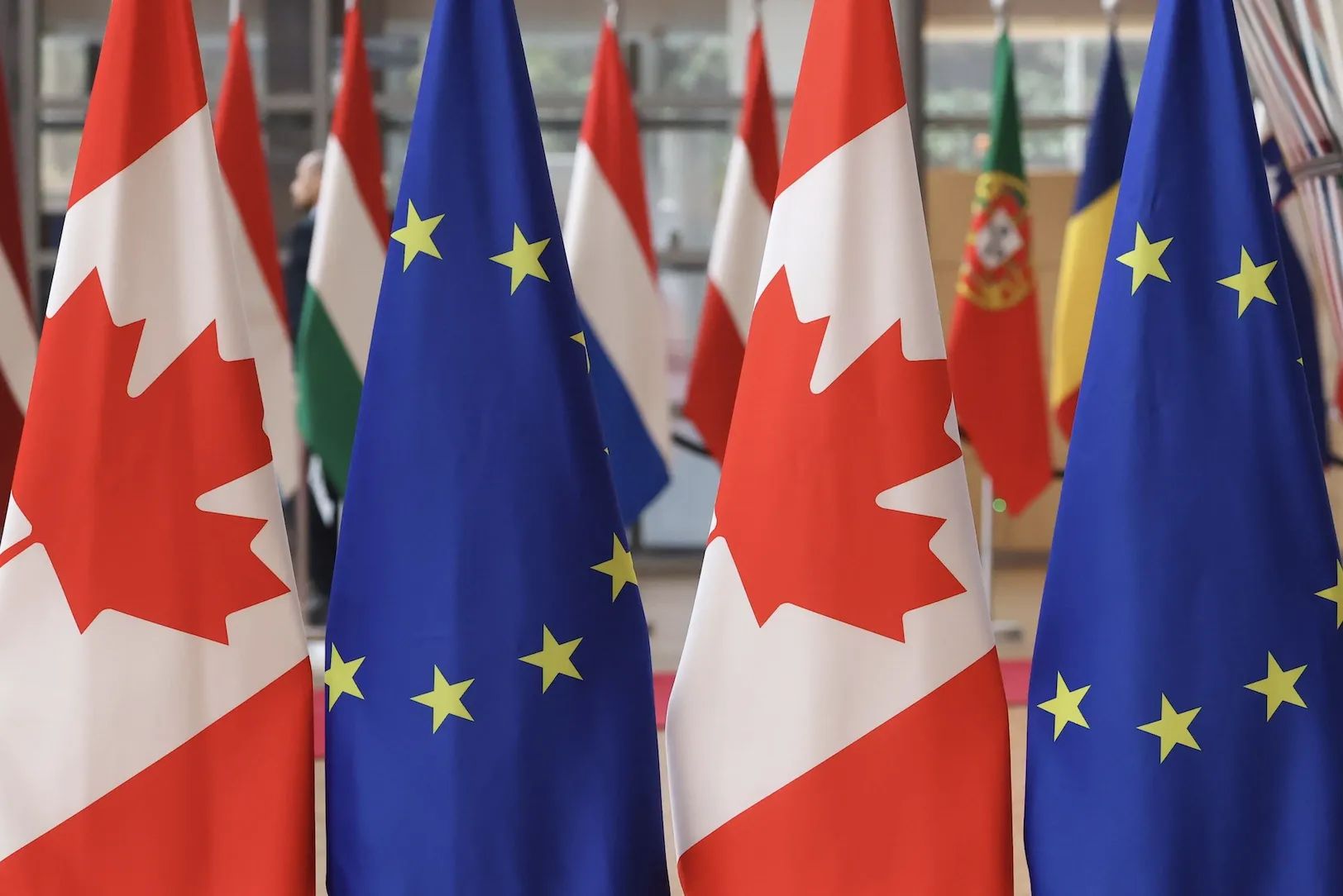
The European Parliament has formally consented to Canada's participation in the EU's Security Action for Europe programme, completing the last institutional step required under EU treaty law and making the bilateral defence agreement fully binding on both sides.
The consent vote closes a ratification sequence that moved faster than most observers expected. The Canada-EU Security and Defence Partnership was signed at the Brussels summit in June 2025. Negotiations on SAFE participation concluded in December. EU member states endorsed the agreement on 19 December. Defence Minister David McGuinty signed the formal text at the Munich Security Conference on 14 February 2026. Under the treaty process, the deal could be provisionally applied from the moment of signature (meaning Canadian companies have been engaging with European procurement cycles since February), but formal legal conclusion required parliamentary consent. It now has it.
Spanish MEP Nicolás Pascual de la Parte, a member of the European People's Party and a former NATO ambassador to Brussels, welcomed the result directly. "Welcome, Canada," he said. "Our reliable security-building partner is the first non-European country to join SAFE and deepen our defence ties."
Polish MEP Borys Budka framed the vote as a statement about the new architecture of transatlantic defence. "Transatlantic cooperation is no longer just a slogan; it is becoming a supply chain," he said. "We do not just share values, we share a common perception of threats. Europe is rearming. Canada is with us. That is the message today's vote sends to the world."
What the agreement does
SAFE is a €150-billion loan programme that forms the first pillar of the EU's Readiness 2030 plan, an €800-billion financial and industrial effort to strengthen European defence capacity by the end of the decade. The programme offers low-interest, long-maturity loans to EU member states for joint procurement of priority military capabilities. Loans are already disbursing. As of March 2026, the Commission had approved the national defence investment plans of 18 member states, including Czechia and France.
Under standard SAFE rules, third-country suppliers face a 35% ceiling on the value of components they can contribute to any procured system. Canada negotiated a specific exemption: Canadian content may comprise up to 80% of the total value of any joint procurement. That threshold positions Canadian firms to compete for contracts on terms effectively equivalent to EU-member companies, rather than as marginal suppliers.
The agreement also includes a clause requiring Canada to make a financial contribution to Ukraine's defence industry proportionate to the value Canadian firms derive from SAFE contracts. That links commercial access directly to collective defence obligations, and is not standard in third-country participation arrangements.
Canada's entry fee is €10 million in total: €2.5 million in administrative costs and €7.5 million in annual participation costs. The EU has indicated this will be reassessed in line with actual contract volumes Canadian companies generate.
Where the contracts go
The agreement's practical effect for Canadian industry depends on which SAFE-eligible procurement categories Canadian firms can credibly supply. The clearest opportunities are in space surveillance and early-warning infrastructure, secure communications networks, and dual-use AI and cyber technology. SAFE regulation explicitly categorises these as eligible defence capabilities, and Canadian firms are competitive in all of them. NorthStar Earth and Space, Telesat, and Kepler Communications are among the companies positioned for contracts in satellite-based surveillance and communications. The hardware categories (ammunition, missiles, drones, artillery systems, infantry weapons) represent the larger volume, and Canadian manufacturing capacity in several of these has expanded under the Carney government's defence industrial push.
McGuinty described the opportunities as "enormous" and said the deal would "catalyse massive private investment" in the Canadian defence industry. Those are claims about future state rather than current fact, and industry analysts have consistently noted a one-to-two year lag between agreement entry and meaningful contract flow. Formal ratification removes the last legal uncertainty from that timeline. The question for Canadian companies now is positioning, not legality.
The main street benefits
The most direct benefit is jobs. The February 2026 Defence Industrial Strategy commits 70% of federal defence contracts to Canadian firms within a decade. SAFE adds a second market for the companies that win those contracts. A manufacturer building artillery shells or communications satellites for the Canadian Armed Forces can now bid for European contracts using the same facilities and workforce. That means more sustained production runs, more hiring, and less exposure to a single buyer. The previous situation, where Canadian firms were heavily dependent on US defence contracts now subject to tariff disruption and procurement nationalism under the Trump administration, made the European diversification strategically urgent.
The downstream effects are real but diffuse. A Telesat or Kepler Communications winning European satellite contracts employs engineers in Ottawa, Waterloo, and Calgary. A Magellan Aerospace supplying engine components to a Eurofighter upgrade program keeps machining lines running in Mississauga and Winnipeg. CAE, which already operates simulation and training centres across Europe, gains preferential access to SAFE-funded contracts for pilot and operator training. None of these are overnight transformation. The analyst consensus is a one-to-two year lag before contract flow begins
For European citizens, the benefit is simpler to describe: more supply, lower unit costs, faster delivery. European defence procurement has been constrained by the limited production capacity of a small number of domestic primes. Adding Canadian industrial capacity to SAFE-eligible procurement means governments competing for artillery systems, drones, or communications equipment have more qualified bidders, which applies downward pressure on contract prices and reduces the delays that have been endemic since the Ukraine war began. It also reduces dependence on US suppliers whose terms are now subject to political and security unpredictability.
The diplomacy around it
The European Parliament consent vote is arriving in the middle of the densest week of Canada-EU engagement since the partnership began. On 11 May, Foreign Affairs Minister Anita Anand was in Brussels to co-chair, alongside EU High Representative Kaja Kallas, the high-level meeting of the International Coalition for the Return of Ukrainian Children. Canada announced CAD 3.4 million in new support for the UN Human Rights Monitoring Mission in Ukraine, bringing Canada's total contribution to that mission to CAD 4.8 million. Anand also signed the Convention establishing an International Claims Commission for Ukraine, making Canada the first country outside Europe to join. Canada, Ukraine, and Norway will host a follow-on ministerial conference in Toronto on 28-29 September 2026, focused on the return of deported children, detained civilians, and prisoners of war.
Anand told Euronews what the accumulation of activity represents. "Over the last year, we've signed over 20 security, defence and economic agreements around the world, and we're just getting started," she said. "The reason is that it's not just a policy response. The policy response is based on like-mindedness, on shared values, and on the belief that territorial integrity, state sovereignty, and multilateral trade are important values that we will continue to collectively work for."
Kallas has made the same point with less elaboration. She described Canada as "the most European of all the non-European countries in the world" and said Canada and the EU "can be a stabilising force for foreign policy and trade."
At the European Political Community summit this month, Prime Minister Mark Carney told European leaders that Europe would not submit to an "insular and brutal world" and could serve as a foundation from which a new international order could be rebuilt.
These statements are coming from multiple capitals simultaneously and are consistent enough in their framing to constitute a coordinated message, not a sequence of coincidental remarks. The SAFE ratification is part of that message, but only part.
Why CETA ratification now matters
The March 2026 European Parliament resolution on EU-Canada cooperation, adopted 482 to 108, called specifically on the 10 EU member states that have not yet ratified CETA to do so ahead of CETA's 10th anniversary in 2027. That is a political call, not a legal one, but it reflects the same momentum the SAFE consent vote formalises. CETA has been provisionally applied since 2017, so the absence of full ratification has limited practical effect to date. But full ratification would remove the last legal vulnerability to a member state withdrawal, and in the current environment that matters. Investment Chapter provisions that currently fall outside provisional application would also enter force.
The March resolution and the May consent vote are distinct instruments with distinct legal effects. One was political. This is legal. But they are products of the same set of decisions being made in Brussels about where Europe's partnerships are going.
In March 2026, the EP voted 482-108 in favour of deeper EU-Canada cooperation. The SAFE consent vote, arriving two months later with broad cross-party support, reflects the same parliamentary direction. Canada is now the only non-European country with preferential access to SAFE. SAFE loans are already being disbursed, the agreement is fully in force, and Canadian companies are now eligible to bid on projects.