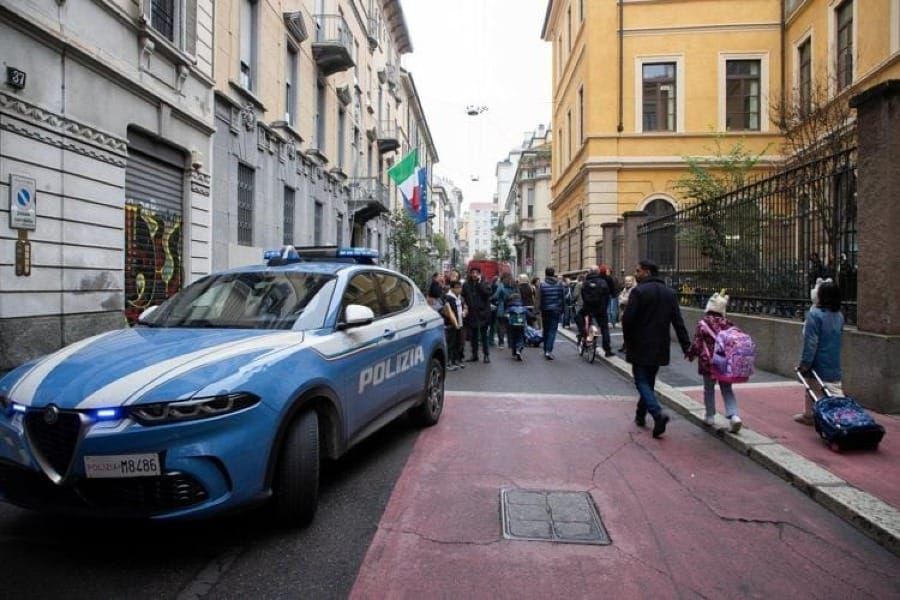
About 6,300 Italian state schools received emailed bomb threats on the morning of 11 November signed "Mikhail Andropov", the name used a week earlier to claim hoax threats against dozens of European flights.
Education Minister Giuseppe Valditara said the email reached about 6,300 of Italy's 7,476 state schools and 312 were evacuated. Another 3,778 Italian schools received threats under the same name on 12 November and 77 were evacuated. More than 300 schools in Northern Ireland received a threatening email on 11 November, as did schools in Scotland and the Republic of Ireland.
Prime Minister Giorgia Meloni said in a video message after meeting ministers, intelligence chiefs and cyber security specialists on 11 November that whoever sent the threats "wants our fear, lost days, suspicion and chaos". She said Italian police were working with their European counterparts to find the source.
Ireland's government said on 6 November that the threats against Irish media and aircraft were likely to be a co-ordinated campaign of disruption. Ivano Gabrielli, who heads cyber security at Italy's Postal Police, said in an interview on 7 November that the threats against aircraft had no single direction and were "more likely different actors whose only aim is to destabilise". Valditara told reporters there was always a risk of "someone else behind the madman". Interior Minister Matteo Piantedosi said the incidents could be linked by imitation.
The Russian government has denied involvement. Some flight threats were signed in the name of Male State, a banned Russian movement, and its founder, Vladislav Pozdnyakov, said it no longer existed and had no part in them.
From airliners to newsrooms
A Wizz Air flight from London to Sofia diverted to Budapest after a bomb threat on 2 November, Hungarian Defence Minister Romulusz Ruszin-Szendi said. The next morning a LOT Polish Airlines flight from Heathrow to Warsaw landed at Warsaw-Modlin after a threat was announced on board, according to the airport. Modlin closed for about two hours while bomb technicians checked the Boeing 737 MAX and the 181 people aboard were taken to the terminal. An SAS flight from Copenhagen was searched at Warsaw Chopin the same morning.
Eurocontrol, which manages Europe's air traffic network, counted seven threatened flights on 3 November, 14 on 5 November and 35 over the week. The 14 were about 0.05 per cent of the nearly 26,300 flights it handled that day. National authorities reported at least 27 passenger flights affected on 5 November alone, in at least 10 countries.
Spain's Guardia Civil said three emailed threats naming Air Europa and Iberia flights arrived within 20 minutes on 5 November. An email in Italian reached a logistics company working with Rome's Fiumicino airport. It named a Finnair flight from Helsinki and an Aer Lingus flight from Dublin, both bound for Rome, and was signed by "Fighters of the Male State". Václav Havel Airport in Prague said an anonymous email named four of its flights, and Czech police said similar emails had gone to other European airports.
Austria's defence ministry said Eurofighters escorted every threatened flight in Austrian airspace on 5 November. Bulgaria scrambled MiG-29s for three Ryanair flights bound for Sofia, and Italian jets escorted a Finnair flight from Helsinki to Rome. An Aer Lingus flight from Dublin to Rome diverted to the French air base at Évreux, and a Wizz Air flight from Milan to Warsaw diverted to Vienna. On 6 November Hungarian jets escorted airliners through Hungarian airspace and NATO ordered air patrols near the Hungarian-Romanian border, Ruszin-Szendi said.
RTÉ, Ireland's public broadcaster, received an emailed threat on the morning of 6 November, Director-General Kevin Bakhurst said. Bulgaria's Nova TV received the same message. Both were headed "Message to the West", signed "Mikhail Andropov" and said an operative had planted a device in the building that would explode within 45 minutes. The sender said he led the group behind the flight threats.
Staff left RTÉ's Donnybrook campus in Dublin, and the broadcaster replaced live television with music and recorded programmes for up to three hours. Police evacuated and searched Nova's newsroom in Sofia, and the channel stayed on air. Virgin Media, Newstalk and the Irish Independent also received threats, the Irish government said, and Sky in Britain said it had reported a threat to the authorities.
Prague airport said nine of its flights were searched on 6 November, four arrivals and five departures, and the French prime minister's office said four aircraft landed safely at Orly after threats. A Wizz Air flight from Prague to Rome diverted to Venice. That afternoon about 20 international news outlets received an email calling the week's threats only the beginning. It listed aircraft, cruise ships, metro stations and trains as targets.
The schools
The Italian school email began "We have come to annihilate you", said a remote-detonated device had been left in a plastic bag inside the building and said a bomb had been planted in the engine of the prime minister's car. The signature read "Mikhail Andropov, leader of the Vilayat of Misoginistan".
The message went only to state schools and skipped South Tyrol, which runs a separate school email system. More than 50 schools in Lazio were evacuated within hours, and schools in Rome, Milan, Naples, Palermo and Bologna suspended lessons while police and bomb disposal teams searched them. Students at the Mamiani high school in Rome left the building thinking the alarm was the break bell and learned of the threat outside.
Italian schools had received earlier waves of emailed threats on 19 October and 2 November, when about 280 schools were affected. The 19 October emails praised sharia law and the 2 November emails were signed by a fictitious Islamic Revolutionary Guard corps. Northern Ireland's schools were also targeted on 19 October, when up to 300 received an email that originated outside the U.K. and was signed off with an Islamist phrase, Education Minister Paul Givan said. The Police Service of Northern Ireland said the 11 November message also came from outside the U.K., and the Education Authority said it resembled the October email.
The 12 November email said the building had been mined that day, told recipients a bomb had been placed at Palazzo Chigi, the prime minister's office, and demanded Meloni's resignation. The government treated the email as a repeat hoax and told prefects and head teachers that classes should continue unless there were specific and well-founded grounds for alarm.
What the emails share
The 6 November messages to RTÉ and Nova TV carried the same heading, signature, 45-minute deadline and wording. The emails took responsibility for the flight threats, and a message under the Andropov name and group reached Rome airport authorities on 5 November threatening two flights. Other 5 November emails to Italian airports carried the Male State signature.
The flight emails came from anonymous accounts in several locations, one of them traced to Colombia, and many were written in the recipient's own language, the Financial Times reported, citing intelligence officials. Preliminary checks found that the 11 November school email was sent from a compromised account at Dayeh University, a private university in Taiwan, which belonged to a former student whose account had been breached. The 12 November emails came from several addresses on Philippine domains, among them hijacked accounts.
Gabrielli said in a separate interview that some attackers in this field want to be taken for someone else. The 6 November email to Irish media said its authors had recruited residents of European countries and gained access to compromised devices, servers and accounts.
The Andropov signature
"Mikhail Andropov, leader of Vilayat Mizoginistan", in the Bulgarian spelling, signed an emailed bomb threat to the district court in Blagoevgrad, in south-western Bulgaria, on 9 October, the regional news site Struma reported. The first flight threat came almost four weeks later. The email, headed "Death is already near", gave a 60-minute deadline, said a bomb would be sent to the car of Interior Minister Ivan Demerdzhiev and went to more than 100 official addresses, including government ministries. Bulgaria's organised crime directorate investigated the threats.
The same court had earlier received an email headed "Hatred", signed "Vilayat Mizoginistan" without the Andropov name, which said its recipients would answer for crimes against men, and one signed in the name of Islamic State. The 11 November Italian school email repeated content sent nine days earlier under a different signature.
"Message to the West", the heading of the newsroom emails, echoes the title of the 1983 biography Andropov: New Challenge to the West, and the first name may refer to the book's co-author, Mikhail Bernstam. Yuri Andropov ran the KGB from 1967 to 1982 and led the Soviet Union until his death in 1984. A school head who analysed the email read the alias as Mikhail Gorbachev's first name joined to Andropov's surname.
Islamic State used "vilayat", the Arabic word for province, for its regional branches, and a close form, vilayet, named the provinces of the late Ottoman empire. "Misoginistan" joins misogyny to the suffix of Central Asian country names. Fanpage.it searched Telegram and the channels used by known pro-Russian hacker groups for the name and concluded that the group had probably been invented recently.
Panu Moilanen, a lecturer in security and strategic analysis at the University of Jyväskylä in Finland, said that the name was chosen to suggest a Russian connection whether or not one exists. He judged the chance of a single sender relatively high and said copycats were well documented in such cases.
Russia and Male State
Pozdnyakov, a Russian blogger, founded Male State in 2016 as a closed group on the social network VKontakte. A court in Nizhny Novgorod ruled it extremist and banned it in October 2021. In 2022, when bomb threats in Montenegro carried the Male State name, he said someone was using it without his involvement. Vidas Ksanas, head of security at Lithuania's airports, said the group or someone claiming to represent it had previously sent several bomb threats to Lithuanian airports. "Misoginistan" appears to echo Male State, whose signature appeared on the 5 November airport emails.
Some of the same intelligence officials regard Russia as the most likely origin of the flight threats on grounds of motive, method, previous incidents and early evidence. Their working hypothesis was that pro-Kremlin activists or hacker groups sent the emails. The officials said attribution would take a long time.
The investigations
Nicola Piacente, the chief prosecutor in Genoa, opened an inquiry into causing false alarm, interrupting a public service and making serious threats, with a possible terrorism aggravation. Prosecutors in Milan have opened files of their own. The antiterrorism unit of the Rome prosecutor's office under Francesco Lo Voi is investigating false alarm and aggravated threats. The Postal Police and the Digos special operations police are tracing the routes the emails took and the accounts used. A technical meeting of the Interministerial Committee for the Security of the Republic was scheduled for the afternoon of 12 November.
Italian investigators asked foreign police to help identify the servers behind the messages, and Europol was expected to meet police from the affected countries. Europol said it could help national authorities exchange information and identify connections between incidents in different countries. The European Commission convened representatives of EU member states, Norway, Switzerland and Iceland on 11 November to review the aviation threats.
Czech police handed the Prague threats to the National Centre against Terrorism, Extremism and Cybercrime, and French prosecutors opened an investigation into whether foreign powers were connected. An Garda Síochána said the threats to Irish media would be investigated and judged the 11 November school email not credible. The PSNI rated the risk to the public as low, and Police Scotland said it was treating the messages to Scottish schools as hoaxes.