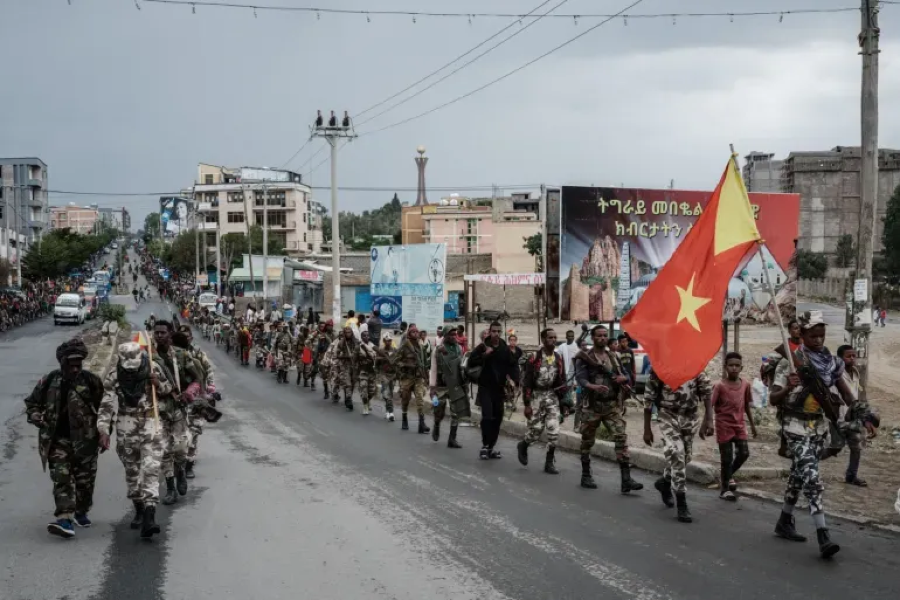
Residents of Mekelle, the capital of Ethiopia's Tigray region, were stockpiling food and withdrawing cash on 24 September as fighting between Tigrayan and federal forces spread into the neighbouring Afar and Amhara regions. "We are buying almost everything we think could become necessary," a Mekelle resident said. "Almost all basic necessities are becoming more difficult to obtain or afford. There is also a growing fear that the situation could deteriorate into siege conditions similar to those experienced during the previous war." Tigrayan forces patrolled the city's streets and drones flew overhead, residents said.
A resident of Adigrat, near the Eritrean border, said market shelves were empty and food shortages worsening: "Essential medicines remain scarce and astronomically expensive. Daily survival has become a constant calculation."
Tigrayan forces took the airports at Mekelle, Axum and Shire on 23 September, and Ethiopian Airlines suspended all flights to the region. On 24 September flights to Lalibela, the Amhara town of medieval rock-hewn churches, were also suspended because of fighting nearby, according to seven sources. "There is fighting around the town but not inside it yet," a diplomatic source told the agency. People in Lalibela were rushing to withdraw cash, a resident said.
Ethiopia's 2020 to 2022 war with the Tigray People's Liberation Front (TPLF) killed about 600,000 people, according to African Union estimates, and left Tigray cut off from telephone networks, with food, cash and medicine restricted. About one million people displaced by that war have still not gone home.
Strikes on towns
Alamata, a town in southern Tigray held by TPLF-aligned forces since early this year, was hit by 21 drone and MiG airstrikes on 23 September that killed 14 civilians and wounded 22, according to the Europe External Programme with Africa (EEPA), a Brussels-based organisation whose daily reports draw heavily on Tigrayan sources. EEPA said the wounded were treated at Alamata General Hospital. It also reported two drone strikes on 22 September in Tahtay Adiyabo district near Sheraro, with no casualties, and drone strikes in western Tigray. The federal government has not commented on the reports, and no independent source had confirmed them by 24 September.
A drone strike at about 2am on 8 September in the MyShumet area near Freweyni, in Hintalo district of southeastern Tigray, killed three people, among them a two-year-old child, and wounded four, according to Tigray Television and the district administrator, Goytom Tesfay. Goytom accused the government of "deliberately targeting civilians". The account has not been independently verified, and the government did not respond. The Soufan Center, a New York research group, recorded a drone strike on Mekelle on 21 August.
A drone strike at about midnight on 27 September 2025 killed four people at the Sanka health post in Gubalafto district of North Wollo, about 20 kilometres from Woldiya in Amhara, according to eyewitnesses and health workers. The dead included a pregnant woman who was giving birth and parents caring for sick children. Federal forces have fought Fano militias in Amhara since 2023. "I have seen in my own eyes the deaths of four patients and caregivers," a health worker at the post said. Staff said at least 10 Fano fighters were being treated there at the time.
Volker Türk, the UN human rights chief, said in February, after an earlier round of fighting on the Tigray-Amhara border, that "drones, artillery and other powerful weapons were used by both sides."
Afar
Fighting broke out overnight on 22 September in Abala and Erebti in Afar, two humanitarian sources said. "We are expecting it to expand. We just sent (a) truck with food to help the people displaced," an aid worker in northeastern Afar said. Abala lies in the mountains along the Afar-Tigray border; Erebti is about 100 kilometres away by road. A former senior TPLF official said Tigrayan forces had taken Berhale, Erebti, Abala, Megale, Dalul and Konoba. No independent source confirmed the list, and no count of newly displaced people was available on 24 September.
About 18,000 people fled Tonsa and surrounding areas of Megale district after Tigrayan forces moved into six Afar villages in November 2025, and about 11,000 of them had received no aid by 20 November, according to local officials. Families sheltered under trees and in school buildings at Arora and Elakelo. "Half of Tonsa kebele is controlled by Tigray forces, while the other half remains under the Afar regional government," said Abdu Mohammed, a Megale district official. The kebele chairman said "heavy weapons are occasionally being fired by Tigray forces." Afar authorities accused the TPLF of shelling civilians with mortars; the TPLF called the accusation groundless.
Mortar fire on two kebeles in Megale district on 21 June killed at least two people and wounded others, said Siraj Sadik, the local administrator, who blamed the TPLF. On 31 May, the day before Ethiopia's national election, two 12-year-old boys herding cattle in the district were killed and their livestock taken, according to the same report.
Amhara
Lieutenant General Assefa Chekol of the Ethiopian National Defence Force (ENDF) said on 24 September that the TPLF offensive in Amhara had been "repelled, with 272 attackers killed and a further 260 wounded." The army said it had inflicted "heavy personnel and equipment losses" on the TPLF. No independent source has confirmed the figures. ACLED, the US-based conflict monitor, recorded clashes in Gazgibela district of Wag Hemra zone and in the Gidan, Lasta and Raya Kobo districts of North Wollo zone.
EEPA reported fighting along the Kobo-Tumuga line near Hagere Maryam and Weldiya, where TPLF forces and the Amhara Fano National Movement fought federal troops, and along the Zata, Dinqa and Sekota line further west. Thomas van Linge, a Dutch analyst who maps conflicts on X, wrote on 24 September that a joint TPLF and Fano push toward Sekota had failed and that the attackers had pulled back to Alamata. He wrote that Fano fighters had reported capturing an ENDF officer, Lieutenant Colonel Meles Ashagre, in Wollo, and that Amhara sources said an ambush near the village of Injafat had destroyed or captured 10 military vehicles, of which video "so far confirms the destruction of one." No news agency had confirmed any of these accounts by 24 September.
Tens of thousands of civilians fled Alamata, Korem, Raya Bala, Wefla and Zata toward Kobo and Woldiya in late January, when TPLF-aligned forces took Alamata, according to local officials and residents. About 500 people were arrested in Alamata and held in school compounds, and families were asked for 200,000 birr to secure a detainee's release, according to the paper.
Forced recruitment
Young people were being recruited by force, the Mekelle and Adigrat residents said. "I know an 18-year-old boy who lost his father in the last war and they took him by force," the Adigrat resident said.
Human Rights Watch documented Tigrayan authorities abducting men and boys as young as 15 from streets, markets, offices, homes and gold-mining sites from at least April 2026. "Three armed men came to my house," a man from Northwestern Zone who escaped recruitment told the group. "About 17 others were taken with me to the town's police station. Four or five youth around 16 or 17 [were] with us." A miner detained at a gold site in Kola Tembien on 25 May said: "All of us opposed the decision … they had their guns, and began pushing everyone onto trucks." A day labourer said: "We can't sleep. We have to change locations every night."
A proclamation issued by the TPLF administration in early June makes military service compulsory, allows the death penalty for loosely defined offences, sets prison terms of up to 25 years for criticising the mobilisation and fines of up to 50,000 birr, about US$315, for evasion or desertion, Human Rights Watch reported on 23 June. Families of those who avoid the draft have been punished. "Tigrayans are still reeling from a devastating two-year conflict and its aftermath," said Laetitia Bader, the group's deputy Africa director. "Authorities in the region should not respond to ongoing political tensions by forcing civilians into military service while simultaneously punishing criticism of such forced conscription."
A young man in Tigray said in early September: "The fear of being drafted is what's making many youth lose hope." Another resident told the network: "The people of Tigray want peace; we don't want a second war."
Arrests
Uniformed security forces detained ethnic Tigrayans in the Ayat 49 and Semit neighbourhoods of Addis Ababa this week and released them only after ransom payments, EEPA reported. During the 2020 to 2022 war, Tigrayans in the capital were detained in mass arrests under a state of emergency. Türk said in February that both Tigrayan and federal forces were "reportedly carrying out arrests for perceived affiliation with the opposing side. This must stop."
Inside Tigray, armed men detained four veteran military leaders who had voiced doubts about the war overnight into 24 September, among them Lieutenant General Tadesse Werede, who commanded Tigrayan forces in the last war and headed the interim administration until May, a member of his family said. EEPA named two of the others as Colonel Tewelde Gebretensay, a military intelligence chief, and Isaias Tadesse, and said they were held for opposing military action. The Ethiopian Media Authority suspended the licence of Tigray TV indefinitely, citing content that "threatens national and public security."
Hunger in the camps
About 80 per cent of Tigray's population needed emergency support before the fighting resumed, the World Food Programme estimated, and US aid to the region was cut in 2025. "It's not conflicts that will ultimately kill us, but famine," Nireayo Wubet, an 88-year-old farmer living in the Hitsats displacement camp, said in January. "It's a matter of time before I am gone." Abraha Mebrathu, the camp's coordinator, said: "While little support is starting to come to Hitsats … it's like pouring a glass of water in a lake."
More than 300 people had died in Hitsats since 2022, according to camp residents and officials, and surveys in Kola Tembien found acute malnutrition in 62 per cent of children under five. "Everything is bad. We are dying daily and burying almost every day," an elderly man in the camp said. "The foreign donors ignore us and give us their back. The party, to which we dedicated our lives, has given us its back." Yonas Hagos, a deacon at a village church, said residents were "dying constantly, mostly as a result of hunger". Joshua Eckley, head of mission in Ethiopia for Médecins Sans Frontières, said donor cuts had "placed additional strain on an already fragile public health system."
The warring parties
Seven armed groups announced the Ethiopian Peoples' Forces Alliance for Survival on 21 September: the TPLF, the Amhara Fano National Movement, the Oromo Liberation Army, the Ogaden National Liberation Front, the Afar Revolutionary Democratic Unity Front, the Benishangul Peoples' Liberation Movement and the Gumuz Peoples' Democratic Movement. Their statement called for "an inclusive transitional government". Fano fought alongside federal troops and Eritrea against the TPLF in the last war, and Amhara and Tigrayan claims to Welkait, Tsegede, Humera and Raya remain unresolved.
Abdisalam Balema, a TPLF central committee member, said federal forces had "begun an offensive around southern Tigray". Amanuel Assefa, the TPLF vice-president, said on 24 September: "We are in the situation of full-blown war now." Getachew Reda, a former TPLF leader who now advises Prime Minister Abiy Ahmed, said the TPLF had "launched an all-out offensive against government positions in Afar and Amhara". A government official said the TPLF had carried out "a premeditated assault on civilian infrastructure" and that "the door to dialogue remained open for any groups that laid down their arms". Billene Seyoum, Abiy's spokesperson, said the alliance had been collaborating "for a while with the financial backing" of Eritrea.
The Oromo Liberation Front, a legal opposition party whose former armed wing became the Oromo Liberation Army, said in a statement dated 24 September that a "northern coalition" aimed to turn Oromia "into a battleground for an unnecessary war" and called on the government to "embark on genuine peaceful negotiations with all concerned parties to end the war". Eritrea called Ethiopian accusations that it backs armed groups inside Ethiopia "false and fabricated" in February.
International response
António Guterres, the UN secretary-general, said this week he was "gravely concerned by the rapidly deteriorating situation in northern Ethiopia" and called on all sides to protect civilians and allow safe and unhindered humanitarian access. The European Union said "immediate de-escalation is needed" and that "differences can only be resolved through dialogue and not military action." Ervin Massinga, the US ambassador, said on 23 September that "rejecting dialogue sponsored by the African Union under President Olusegun Obasanjo and engaging in an unwinnable fight does nothing for the people" and that the US government "has the tools to impose additional sanctions".
Lindsey Green, deputy director of research at Physicians for Human Rights, said in February that reported attacks in four regions and "escalation of threats between Ethiopia and Eritrea, put civilians back in the crosshairs with dire consequences for their health and human rights."
Tigere Chagutah, Amnesty International's regional director for East and Southern Africa, said in August that "the resumption of violence in Tigray region puts residents at renewed risk of human rights violations." Amnesty called for unhindered access for independent monitors, aid agencies and journalists. The UN International Commission of Human Rights Experts on Ethiopia and the African Commission on Human and Peoples' Rights inquiry into Tigray, the two international bodies that investigated abuses in the last war, have both been shut down.