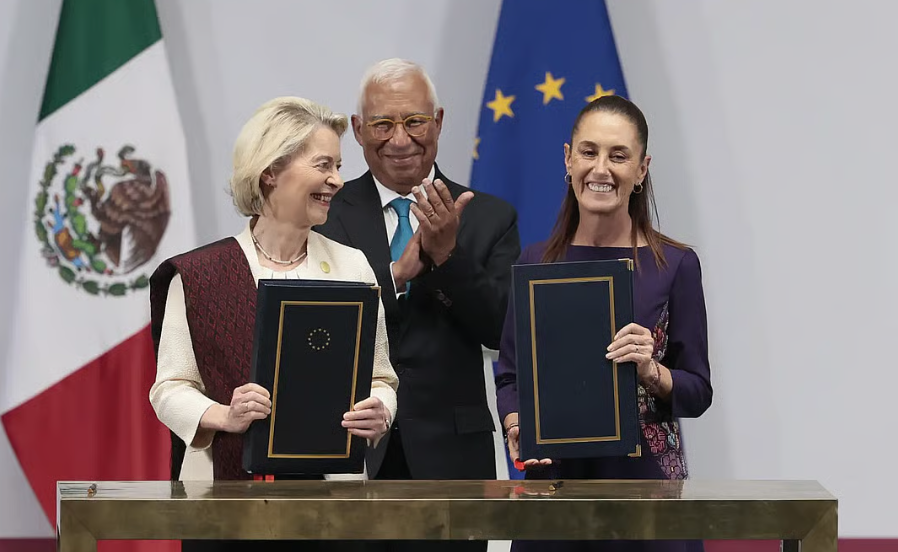
The European Commission President, the European Council President, the EU's High Representative for Foreign Affairs, and the EU's Commissioner for Trade all flew to Mexico City on Thursday for a summit that had been a decade in the making. On Friday, 22 May, Ursula von der Leyen, António Costa, Kaja Kallas, Maroš Šefčovič, and Claudia Sheinbaum signed two agreements: the Modernised Global Agreement and the Interim Trade Agreement, replacing an arrangement that had governed EU-Mexico relations since 2000.
"This is about more than just trade," Kallas told reporters at a press conference with Mexican Foreign Minister Roberto Velasco on 21 May. "It is a geopolitical statement."
She added that EU-Mexico trade had grown 75% over the past decade and that the deal would remove remaining barriers in "strategic sectors such as raw materials, agriculture, and services" while helping "both economies compete globally." Both sides spent nine years negotiating a deal that gives Mexico a credible alternative to its economic dependence on the US, gives Europe access to Latin American markets and critical minerals, and gives both parties a coordinated position on the rules-based international order that neither of them, at this moment, can take for granted.
Von der Leyen, opening the summit on 22 May, framed the deal as an answer to a changed world.
"Economic coercion, territorial aggression, growing pressure on our shared values and interests," she said, listing the forces reshaping the international order. "Our response must be to adapt and to work even more closely together."
She invoked Diego Rivera, whose fourteen years in Europe studying Spanish masters and building friendships with Picasso and Modigliani before returning to Mexico she described as "a constant dialogue across the Atlantic that enriches both sides."
Sheinbaum, asked at a press conference whether the EU deal was aimed against the US, gave a carefully crafted diplomatic response that the EU and US trade agreements were "not contradictory."
"On the contrary, they strengthen Mexico, strengthen Europe and strengthen the United States," she said.
Both sides spent nine years negotiating an agreement that gives Mexico a credible alternative to its economic dependence on the US, gives Europe access to Latin American markets and critical minerals, and gives both parties a coordinated position on the rules-based international order that neither of them, at this moment, can take for granted.
The money
Total EU-Mexico trade in goods reached €87 billion in 2025, with EU exports of €53 billion and Mexican exports to the EU of €34 billion. Services add approximately €22 billion, bringing the combined figure to roughly €109 billion. EU investment stocks in Mexico reached €207 billion in 2024. More than 45,000 EU businesses export to Mexico, the majority of them small and medium enterprises.
The modernised deal is projected to expand bilateral commerce by 35% over five years, reaching approximately €148 billion in goods trade alone by 2030. Mexico has separately targeted a 50% increase in its own exports to the EU by the same date. At current volumes, a 35% expansion represents roughly €30 billion in new annual trade, split across agriculture, manufacturing, pharmaceuticals, and digital services.
For Europe, the tariffs were eliminated on pork, dairy, cereals, fruit, and pasta entering Mexico. A total of 568 European and 26 Mexican geographical indications protected, covering products like Spanish Rioja, Italian Parmigiano-Reggiano, and French Champagne that had previously faced unprotected competition. EU firms gain access to Mexican state-level government contracts for the first time, opening a public procurement market that had been entirely closed. The Investment Court System replaces the existing investor-state dispute settlement mechanism, removing a mechanism that had allowed corporations to sue governments over regulatory decisions and replacing it with a bilateral court structure offering more predictable protections.
For Mexico, the EU markets are open to coffee, fruit, chocolate, and agave syrup. The pact provides legal certainty for Mexican exporters entering the EU, a market of 450 million people, under rules that do not change based on an election result in one country. EU investment rules give Mexican industries access to European capital that comes with governance standards and technology transfer provisions rather than resource extraction terms.
What it means for ordinary people
The effects on daily life will not arrive all at once. The Interim Trade Agreement applies provisionally from the date of signature, meaning businesses can begin accessing benefits immediately. The full Modernised Global Agreement requires ratification by the European Parliament and all 27 EU member states along with Mexico's domestic consent process. Under normal circumstances, that can take years; however, the Canada EU deal of 2026 demonstrated that the process can be accelerated to just a few months.
Mexicans
For Mexicans, the most immediate material benefit is job security in export industries. Mexico's manufacturing sector, particularly automotive, electronics, and agrifood, has been whipsawed by US tariff volatility since 2025. The OECD cut Mexico's growth forecast to 0.7% in 2025 partly because of USian trade uncertainty weighing on investment and employment. The EU agreement provides a second major market for Mexican manufacturers operating under stable, rules-based terms that cannot be altered by a single executive order. For a factory worker in Monterrey or Guadalajara whose employment depends on export demand, that diversification is the difference between having one buyer who can cut them off and having two.
The binding labour rights chapter matters for Mexican workers specifically. The 2000 agreement had no enforceable labour provisions. The Modernised Global Agreement includes labour rights commitments enforceable through independent dispute settlement panels with real consequences for non-compliance. Mexican labour unions have been pushing for exactly this kind of external accountability mechanism for years, as a counterweight to employer pressure in export processing zones, it now exists.
The agrifood gains benefit Mexican farmers and agricultural workers directly. EU market access for coffee, fruit, chocolate, and agave syrup opens new export channels for producers who have historically sold either domestically or to the US. Agave and tequila producers, concentrated in Jalisco, face no EU tariff under the new agreement. Mexican coffee growers in Chiapas and Veracruz gain access to European premium markets on the same terms as their Colombian and Ethiopian competitors, which they previously did not have.
Europeans
For Europeans, the most visible near-term impact is in food prices and product availability. Reduced tariffs on Mexican coffee, chocolate, and agave products will over time feed through to retail pricing. Protected geographical indications mean that European products in Mexican supermarkets will be the genuine article rather than local imitations carrying the same name. That matters commercially for producers in Spain, Italy, France, and Germany who have watched their products undercut for years. It also matters for Mexican consumers who will gain access to authentic European products at more competitive prices.
EU firms gaining access to Mexican state-level government contracts for the first time creates procurement opportunities that did not exist before Friday. For European SMEs, the 45,000 of which already export to Mexico, expanded market access under clearer legal protections reduces the cost and risk of doing business there.
Canadians
For Canadians, the benefit is more direct than it appears. Canadian capital is already deeply embedded in Mexico, cumulative Canadian FDI has exceeded $56 billion since 1999, more than 1,500 Canadian companies operate there, Scotiabank is the sixth-largest bank in Mexico, Bombardier's Querétaro aerospace facility employs 5,000 people, and more than half of all foreign mining concessions in Mexico are registered to Canadian companies.
Every one of those operations just gained preferential access to European markets under the new agreement, provided the goods qualify as Mexican-origin under the rules of origin. For mining that is straightforward: zinc or lead extracted from Mexican soil is Mexican-origin regardless of who owns the mine, and it now exports to EU buyers tariff-free. Canadian firms with Mexican operations do not need a separate agreement with Brussels. They are already there.
Canada holds major reserves of lithium, cobalt, nickel, and rare earths. Mexico holds fluorspar, antimony, copper, zinc, and lead. Both countries are now inside the EU's formal critical minerals architecture. That means European capital, European technology partnerships, and European procurement contracts flowing to North American resource industries that are currently underutilised relative to their strategic value. The mining towns of northern Ontario and the manufacturing corridors of Monterrey are both, in different ways, positioned to benefit from Europe's need to build supply chains outside China.
Securing those supply chains reduces European dependence on Chinese-controlled inputs, which is the precondition for the green transition being affordable at scale. If the green transition gets cheaper, energy bills over the next decade look different for households across Europe, Mexico, and Canada simultaneously.
How this challenges China
China has spent twenty years building infrastructure, investment, and resource extraction relationships across Latin America, largely on terms that prioritise Chinese access to resources over governance standards or recipient-country development. The EU-Mexico deal, backed by Global Gateway investment commitments across energy transition, transport, pharmaceuticals, water, agriculture, and digital transition, offers a direct alternative.
The China challenge is most visible in the minerals chapter. Mexico supplies approximately 33% of the EU's fluorspar and holds reserves of antimony, copper, zinc, and lead. Before this agreement, those supply relationships had no formal legal architecture protecting EU access. The deal eliminates export restrictions and import duties, prohibits export monopolies and dual pricing, and establishes secure supply mechanisms under the EU's Critical Raw Materials Act. The explicit goal is to reduce dependence on supply chains currently concentrated in China.
The EU now has formal agreements covering the two largest Latin American economic blocs simultaneously: EU-Mercosur, which entered force on 1 May, and the EU-Mexico agreement signed today. Add Canada, which joined the EU's SAFE defence procurement programme in February 2026, signed a Security and Defence Partnership with the EU in June 2025, and has concluded more than 20 security, defence, and economic agreements with the EU in the past twelve months, and the picture is a formal EU institutional presence across the entire western hemisphere that did not exist two years ago.
EU-Mercosur covers Brazil, Argentina, Uruguay, and Paraguay. EU-Mexico covers the continent's second-largest economy. EU-Canada covers the country with the largest sovereign access to the Arctic and the longest land border with the US. Combined, these cover more than half of Latin American GDP and the two largest economies that share a land border with the United States. Where Chinese investment in the region has proceeded through bilateral relationships with individual governments, often structured around resource access with limited governance requirements, the EU is building a regional structure with binding standards that apply across the network. For American governments weighing Chinese versus European capital and partnership, the EU-Mexico agreement is the latest and most visible expression of which way that arrangement is tilting.
How this challenges the US
Mexico, as it stands right now, cannot afford to alienate the US. Approximately 80% of Mexico's exports go north. The tariff shocks of 2025, which the OECD cited as a primary driver of Mexico's GDP growth slowing to 0.7% that year, demonstrated how quickly the US can weaponise that dependence. The EU-Mexico agreement does not change that overnight, but it changes Mexico's position at the negotiation table, making it stronger.
Mexico now has an alternative relationship with a 27-member bloc covering 450 million people, with its own market access, investment financing, law enforcement cooperation, critical minerals frameworks, and political alignment. The US cannot simply threaten Mexico with trade consequences without Mexico having somewhere else to direct a growing portion of its output. That changes the bilateral dynamic, not by ending dependence but by making it less absolute.
The Trump administration has invoked hemispheric primacy explicitly, describing Canada and Mexico as subjugated and US dependant nations ripe for US absorption and applying tariffs as political blackmail. The Monroe Doctrine, the 19th-century principle asserting US primacy in the Americas, has never been formally abandoned. The EU-Mexico agreement, signed alongside EU-Mercosur and alongside ongoing negotiations with Chile and the Andean Community, is the most direct European challenge to that doctrine in the modern era. Europe is not significantly militarily present in the Western Hemisphere as of yet. But it is now economically, legally, and institutionally embedded in a way it was not six months ago.
The USMCA review, scheduled for July 2026, runs directly alongside this. The US has subjected various Canadian and Mexican products to new duties since early 2025, upending North American integration in ways that have alarmed economists and security officials in Ottawa and Mexico City. Canada and Mexico launched a new bilateral action plan to deepen economic integration and coordinate on strategic sectors, including critical minerals and energy ahead of the USMCA review. The EU-Mexico agreement strengthens Mexico's position in those negotiations by demonstrating that it has credible alternatives. A Mexico that can redirect exports to Europe is a different negotiating partner than a Mexico that cannot.
Does this open the door to a military or intelligence alliance?
While the Modernised Global Agreement is a trade and cooperation agreement, not a defence pact and Mexico has a long-standing constitutional tradition of non-intervention and non-alliance in foreign conflicts, and Sheinbaum has not deviated from it. What the agreement does contain is an Europol cooperation provision.
Europol is the EU's law enforcement cooperation agency. Its inclusion means EU-Mexico cooperation on joint investigations, operational coordination, and intelligence sharing against transnational organised crime can now proceed under a formal legal basis rather than ad hoc bilateral arrangements. For Mexico, which faces sustained pressure from the US, the world’s largest consumer of narcotics, a major source of illicit weapons trafficking, and a country that periodically threatens unilateral and illegal action against Mexican sovereignty, having a formal law enforcement partner backed by the collective weight of 27 EU member states, and with no domestic political interest in weaponizing the drug war for bilateral leverage, is a significant operational asset.
The summit also explicitly addressed cooperation on security and migration as a joint agenda item. The joint summit statement names both as areas of deepened cooperation. These are soft security provisions, not hard security commitments. But they establish the institutional infrastructure on which a deeper security relationship could eventually be built, if both parties chose to develop it.
There is one area where Mexico has already moved closer to the EU's position than its non-alliance tradition might suggest, and that is Ukraine. The joint summit statement signed on 22 May explicitly states that both parties "exchanged views on current international and regional developments, including the war against Ukraine" and "reaffirmed our support for efforts aimed at achieving a just and lasting peace, in accordance with United Nations General Assembly Resolution ES-11/10." That is Mexico formally co-signing the EU's position on Russia's war, on the record, in an internationally binding summit statement. Mexico has historically been cautious about multilateral alignment on the Ukraine conflict, citing its tradition of non-intervention. Its inclusion of the UN General Assembly resolution language in a joint statement with EU heads of state represents a major shift. It does not make Mexico a military ally of Ukraine. But it places it, in the same camp as the EU's position on the war.
The question of whether this opens the door to a wider alliance is really a question about trajectory. A formal trade and cooperation agreement is step one. Europol cooperation is step two. A security and defence partnership of the kind the EU signed with Canada in June 2025 would be step three. Mexico has not taken that step and has not signalled it intends to as of yet. Whether the trajectory leads there depends on how the USMCA review resolves, how aggressively the US responds to the EU-Mexico agreement's geopolitical implications, and whether Sheinbaum concludes that a strategic alignment with Europe is worth the domestic and bilateral cost of breaking with Mexico's non-alliance tradition in exchange for expanded international security from invasion or sovereignty violations.
Where Canada fits
Canada is the third leg of the North American triangle, and its position in this picture is the most interesting. Canada joined the EU's SAFE defence procurement programme in February 2026, the first non-European country to do so and the only non-European country with preferential access to the €150-billion defence procurement fund. Canada signed a Security and Defence Partnership with the EU in June 2025. Canada is the first non-European country to join the International Claims Commission for Ukraine. Canada has signed more than 20 security, defence, and economic agreements with the EU and its member states in the past twelve months.
Canada and Mexico launched a bilateral action plan in September 2025 to deepen economic integration ahead of the USMCA review, coordinating specifically on critical minerals and energy. Carney cited a "rupture" with the US at Davos in early 2026, signalling that Canada's historically close alignment with the US was under formal review.
What this means in practice is that Canada is already inside the EU's strategic network in a way Mexico is not yet. Canada has a defence partnership with the EU. Mexico has a trade and cooperation agreement. Canada has SAFE procurement access. Mexico has an Europol cooperation provision. The distance between the two positions is significant. But the direction of travel is the same for both countries: away from exclusive dependence on the US and toward stronger and more beneficial relationships with Europe.
The EU-Mexico deal creates, for the first time, a situation where the US's two largest bilateral trade partners, Canada and Mexico, are both formally aligned with the EU through agreements covering trade, investment, security cooperation, and strategic minerals. The US-Canada-Mexico relationship is no longer a closed triangle. Europe is inside it now, on both sides.
What the joint statement says about the future
The summit statement, published in full on 22 May, describes both parties as committed to multilateralism, international law, and a reformed World Trade Organization at its core. It explicitly commits both to a Joint Declaration on Trade and Gender Equality as an integral part of the MGA, advancing gender equality, women's economic empowerment, and the Women, Peace and Security agenda. It covers climate, digital regulation, health, circular economy, and energy. It addresses Cuba, a signal that the political coordination extends into territory where EU and Mexican positions diverge from the US.
Kallas called it a geopolitical statement. It is also a bet. The bet is that the rules-based international order is durable enough to anchor a network of agreements that give its participants alternatives to dependence on any single power. The EU-Mexico agreement is one more node in that network.Whether this network can withstand the pressure of the alternative remains to be seen. The battlefield is being set; who wins the war for our collective future is still uncertain.