Volodymyr Zelenskyy has approved a 40-day operation to push Russia towards ending the war, timed to a stalled negotiation and directed at the oil revenue that funds the fighting. The Western price cap on Russian crude, the financial side of that pressure, faces a 15 July review that could loosen it.
Volodymyr Zelenskyy said on 25 June that he had approved a 40-day operation by Ukraine's Security Service aimed at compelling Russia to end its war, timed to a stalled peace negotiation. He gave no detail on how the campaign would run, or whether it would be military, intelligence-led or an information effort. The decision followed a briefing by the Security Service chief, Major General Yevhenii Khmara, on Ukraine's long-range and medium-range strike plans, which Ukrainian officials call "sanctions".
Zelenskyy said the operation was meant to influence Russia and press for an end to the war rather than force a capitulation. Ukraine cannot dictate terms to a larger power that still believes it is winning, but it can raise the cost of continuing and time that pressure to a negotiation stuck for months.
The strikes began within a day. Drones from the Security Service's Alpha unit hit the Zaliv shipyard in occupied Kerch on 26 June, setting fire to the cable-laying ships Volga and Vyatka, the nearly finished ferry Petropavlovsk and an S-400 air defence system covering the Kerch Strait. The Security Service said the two vessels were being built for Russia's defence ministry to carry an underwater acoustic surveillance system. Russian-installed authorities in Crimea imposed a regional state of emergency the same day, a week after Ukrainian forces struck a railway bridge over the North Crimean Canal and as attacks on fuel depots and power stations left much of the peninsula short of electricity.
Russia's refining chain
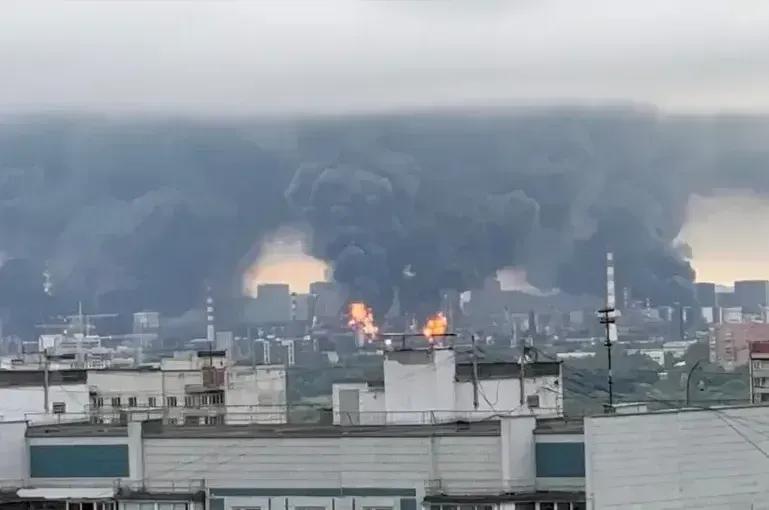
Over recent weeks Ukraine has concentrated long-range fire on Russia's energy infrastructure. Repeated drone strikes shut down the Moscow Oil Refinery, which is unlikely to restart before the end of the year. The Lukoil-Nizhegorodnefteorgsintez refinery in Kstovo, Russia's fourth-largest and its second-largest producer of petrol, went offline on 24 June after a drone strike damaged a primary refining unit, two industry sources told Reuters. Drones also hit the Vtorovo oil pumping station in the Vladimir region, part of the network that feeds fuel to the Moscow area and to Baltic export ports.
"Hell is beginning," Ukraine's defence minister, Mykhailo Fedo
Authorities in more than 20 regions have imposed restrictions on petrol sales. Crimea has suspended civilian fuel sales entirely, and Russian tourists have left the peninsula. "Hell is beginning," Ukraine's defence minister, Mykhailo Fedorov, said in an interview on 17 June, as Ukrainian strikes cut logistics and isolated the peninsula.
Refineries are harder to repair than oil fields and easier to hit with cheap drones, and the damage falls on both the war economy and domestic morale. Oil and gas are Russia's largest source of war revenue, about a quarter of the federal budget. Strikes on the refining and export chain squeeze that budget while reaching a population long insulated from the war.
The 40-day window
Ukraine timed the campaign to a diplomatic deadline. The Trump administration spent the first half of 2026 pushing both sides towards a settlement. The first trilateral talks were held in Abu Dhabi and a further round in Geneva on 17 and 18 February, around a US-drafted plan that Ukraine and its European partners judged to tilt heavily towards Russia. Trump set a mid-2026 deadline for a deal and pressed both sides to reach it.
The talks stalled on the two issues that have blocked every round since 2022. Russia wants recognition of its annexations and full control of the Donbas, including the roughly one-fifth of Donetsk province that Ukraine still holds. Ukraine refuses to cede that territory without a national referendum and demands Western security guarantees that Russia rejects. Putin has said the strategic initiative lies with Russian forces, and few expect him to soften terms voluntarily.
By intensifying strikes as that deadline nears, Ukraine is trying to raise the cost to Russia of holding out and to show European governments and the Trump administration that it can still inflict damage and should not be pushed into a deal on Russia's terms.
Zelenskyy disclosed nothing about how the operation will run, leaving its true scope unknown. No evidence yet shows that drone strikes, however damaging, will move a Russian negotiating position built on the belief that time favours Russia. Ukraine's General Staff puts Russian losses since February 2022 at more than 1.39 million, a figure that cannot be independently verified and should be read as a Ukrainian military claim.
Europe, Canada and the price cap
Ukraine's strikes and Western sanctions target the same revenue. The strikes cut Russia's refining capacity, while the sanctions are meant to cap what Russia earns on the crude it still exports.
The G7-led coalition that runs that cap, which includes the European Union and Canada, set a ceiling on the price at which Russian crude can be sold using Western shipping, insurance and finance. The EU and UK lowered their cap to $44.10 a barrel in mid-January, and Canada matched it on 19 February under the Special Economic Measures Act. The closure of the Strait of Hormuz during the Iran war then sent oil prices up, lifting Russian Urals crude into the $80s.
The cap is governed by a formula tied to market prices, with a scheduled review on 15 July. If the review proceeds, the higher prices could lift the ceiling above $60, by some estimates towards $75 a barrel, handing Russia the revenue relief the cap was built to deny. Commission President Ursula von der Leyen has proposed pausing the adjustment until January 2027 as part of the EU's 21st sanctions package, presented on 9 June. "Russia has clearly failed to subjugate Ukraine," von der Leyen said. Member states aim to approve the package before 15 July.
The sanctions track is moving in parallel. By early June the EU had sanctioned 632 shadow fleet vessels; the 21st package would add 30 more, target vessels that service the fleet for the first time and bar anyone who has served in the Russian armed forces since 2022 from entering the bloc. Canada has sanctioned more than 3,400 individuals and entities since 2014 and keeps adding shadow fleet tankers, with a tranche on 12 June that listed 121 vessels and hit energy, nuclear and financial enablers. European navies have begun boarding and detaining suspected shadow fleet tankers at sea, raising live questions under the international law of the sea about how far enforcement can reach in international waters.
Canada's listings on 8 May named 23 individuals and five entities involved in the unlawful deportation and forced transfer of Ukrainian children, the same conduct behind the ICC arrest warrants issued in March 2023 against Putin and Russia's children's rights commissioner, Maria Lvova-Belova. The child deportations remain one of the clearest documented legal cases against the Russian leadership.
The next month
The price cap coalition decides on 15 July whether to freeze the cap or let the formula float it upward, the most consequential choice on the calendar for Russia's oil revenue. Other developments to watch over the same period are whether the EU package clears, Canada's next listings under the Special Economic Measures Act and the unresolved fight over whether frozen Russian sovereign assets can be channelled to Ukraine, a debate Belgium continues to slow over legal-risk concerns about the funds held at Euroclear.
Belarus appears to have accepted a Ukrainian ultimatum to remove communications equipment Ukraine said was aiding Russian drone strikes, even as Zelenskyy said military storage and road infrastructure along the Belarusian border was nearing completion. The European Commission proposed on 26 June to extend protection for Ukrainian refugees to March 2028 while excluding newly arriving men of military age, a restriction the Ukrainian government itself requested and one Denmark announced a day earlier, with consequences for the diaspora across the bloc.
A 40-day campaign cannot end the war on its own. Ukraine is aiming narrower, degrading the refining chain while the sanctions coalition decides whether to hold the revenue cap down, to make continuing more expensive for Russia while a negotiated outcome is on the table. The coalition votes on the cap on 15 July.