
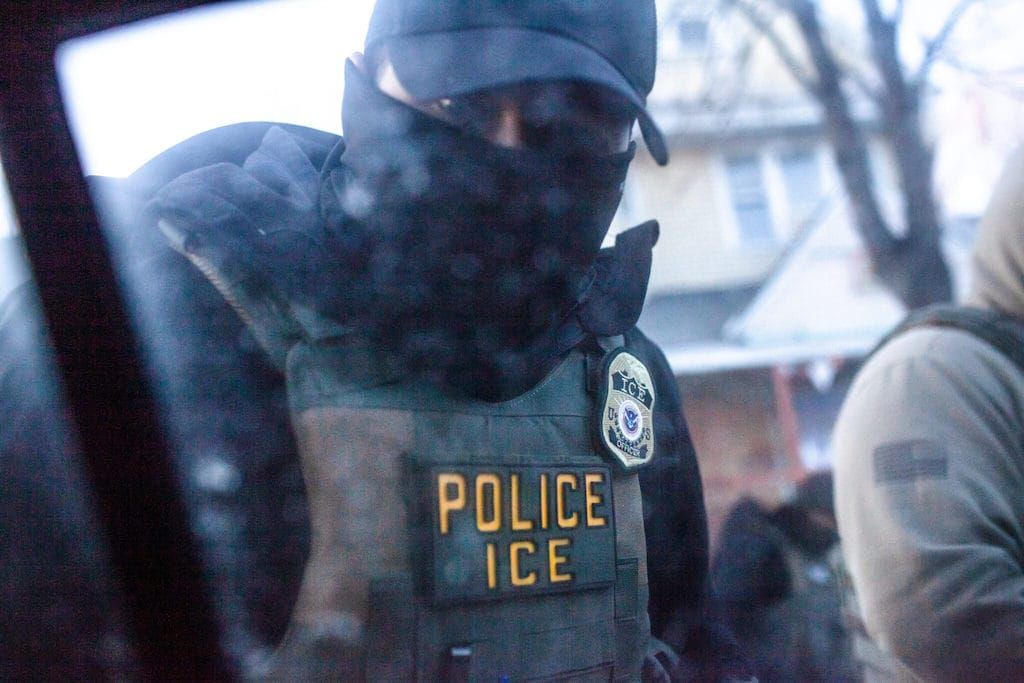
ICE raiders rounded up more than 10,000 people across the United States in the five days to 2 July, a surge ordered by the Trump administration and carried out largely away from public view.
The raids ran on while the men's football World Cup, co-hosted by the U.S., filled stadiums from Atlanta to the New Jersey suburbs. On 24 June, the day before the Supreme Court stripped deportation protection from hundreds of thousands of Haitians, Haiti had played Morocco in Atlanta in its first World Cup since the 1970s, red and blue jerseys filling the downtown while more than 2,300 people were killed in gang violence in Haiti this year and 1.5 million displaced, according to the United Nations. The crackdown drew a fraction of that attention.
Immigration and Customs Enforcement now holds more than 63,000 people, up by roughly 4,000 in recent days, according to figures obtained by the New York Times. The count had reached a record of more than 71,000 in January 2026, and the UN human rights office put the number above 60,000 in late June against about 40,000 in early 2025. The surge sits on top of a detention system that Congress has funded to run through 2029, that is delivering record profits to the private companies paid to run it and that is on course for the deadliest year in ICE custody in more than two decades.
The five-day surge
ICE leaders ordered senior officials in late June to move most of their agents onto arrests, according to documents obtained by the New York Times, which first published the figures. The instruction set a new target of 2,000 arrests a day, double the rate of about 1,000 earlier in the year.
Agents were told to work seven days a week, with the large majority assigned to arrest work. About 80 per cent of officers were directed to arrests, according to the New York Times, and one officer said a mandatory weekend surge had been pushed through at short notice.
The people taken in the five days were picked up at check-ins, at traffic stops, in the street and outside their homes. On 28 June, officers briefly detained a 56-year-old nun from Nigeria, a trained nurse, as she walked to church in McAllen, Texas. The pattern matched what human rights defense groups have reported for months, that people with no criminal record were being swept up alongside the murderers and traffickers the department names in its daily press releases, and near-zero releases at the border.
The quiet game
The surge carried none of the announced city sweeps that drew mass protest earlier in the year. Homeland Security Secretary Markwayne Mullin, sworn in on 24 March 2026 after President Donald Trump removed Kristi Noem and reassigned her to a Western Hemisphere security post, had promised a quieter enforcement campaign and pledged to keep the department out of the news cycle. Mullin, a former senator from Oklahoma and a member of the Cherokee Nation, took over an agency with a far larger workforce and budget than the one Noem had inherited.
That shift followed Operation Metro Surge, a month-long deployment of more than 3,000 federal officers to the Minneapolis area that began in December 2025 and targeted the city's Somali community. During that operation federal officers killed two US citizens. Representative Jamie Raskin told Noem at a hearing that there had been three homicides in Minneapolis in 2026 and that her agents had committed two of them. The approach changed after Mullin arrived, but the scale did not.
ICE raids and round-ups have continued at pace. Mullin said in late June that ICE was removing more than 3,000 people a day, though he also put the arrest rate at closer to 1,200 a day, well short of the 2,000 target set for the five-day surge.
The Supreme Court rulings
The Supreme Court cleared the way for the surge on 25 June, ending Temporary Protected Status for about 350,000 Haitians and roughly 6,000 Syrians in a 6-3 ruling written by Justice Samuel Alito. The decision, in the consolidated cases Mullin v. Doe and Trump v. Miot, paused orders from federal courts in Washington and New York that had kept the protections in place. The court held that the TPS statute bars judicial review of the homeland security secretary's decision to end the programme, reading the phrase that bars review of any "determination" broadly enough to cover every step leading to the decision as well as the decision itself. It rejected the claim that ending the designation for Haitians rested on racial bias, with Alito writing that the statements cited by the challengers were not overtly racial and could rest on race-neutral grounds.
Chief Justice John Roberts and Justices Clarence Thomas and Brett Kavanaugh joined the opinion in full. Justices Neil Gorsuch and Amy Coney Barrett joined all of it except the section addressing the discrimination claim. Justice Thomas, concurring, went further than the majority, writing that people who are not citizens have no equal protection rights against the federal government at all, because that guarantee binds only the states.
Justice Elena Kagan, joined by Justices Sonia Sotomayor and Ketanji Brown Jackson, dissented. She read the review bar narrowly, arguing it reached only the secretary's substantive determination about country conditions and not the procedural steps she was required to take first, including consultation with other agencies. On the discrimination claim she wrote that the record showed race had entered the decision, and she reproduced the presidential statements the majority had declined to print, including the 2018 description of Haiti and the 2024 campaign claim that Haitians in Ohio were eating pets. The majority, she wrote, had declined to print statements "so repellent and racially inflected" that quoting them made the point.
The ruling reaches far beyond the two countries before the court. TPS holders keep legal status and work permits while their home countries are judged unsafe, and the Congressional Research Service counted nearly 1.3 million people from 17 countries enrolled as of early 2026. Because the decision holds that courts cannot review most terminations, it places every one of those designations at the discretion of the secretary. The State Department still warns against travel to both Haiti and Syria, listing gang violence, kidnapping and armed conflict.
The same day the court revived a border policy known as metering, letting officials turn away asylum seekers when they judge crossings too crowded to process. Justice Sotomayor read part of her dissent from the bench, and Alito responded in open court by describing the asylum policy as orderly and humane, a public exchange that drew notice for breaking the court's usual restraint. A further order concerning border agents' authority over some lawful permanent residents has been reported as part of the term's immigration rulings.
Supreme corruption
Two of the justices in the majority, Clarence Thomas and Samuel Alito, have been the subject of documented ethics controversies over undisclosed gifts. Ethics experts, members of Congress and the court's own critics have questioned their independence for three years.
Justice Thomas has, for more than two decades, accepted luxury travel from the Texas billionaire and Republican donor Harlan Crow that he did not report, the gifts he received included yacht cruises, private jet flights and annual stays at Crow's Adirondacks resort. Crow also bought the house where Thomas's mother lived, paid private-school tuition for a relative Thomas was raising and, roughly 15 years ago, funded much of the budget of a political group founded by Thomas's wife that paid her a salary. Seven ethics-law experts told ProPublica the failures to disclose appeared to violate a post-Watergate gifts law. Thomas later amended filings, writing that he had "inadvertently omitted" some of the trips, and Crow said he had extended hospitality to old friends and never discussed a case. Thomas's wife, Virginia Thomas, took part in efforts to overturn the 2020 election result, and Thomas declined to recuse from related cases.
Justice Alito failed to disclose a 2008 Alaska fishing trip on the private jet of the hedge-fund billionaire Paul Singer. Singer's firm repeatedly had business before the court, and Alito later joined a ruling that handed it a multibillion-dollar victory in a dispute over Argentine bonds. Alito said he had no obligation to recuse and pre-empted the story with a Wall Street Journal essay. In 2024 the New York Times reported that an upside-down US flag, a symbol carried by "Stop the Steal" supporters, flew at his Virginia home days before President Joe Biden's inauguration, and that an "Appeal to Heaven" flag associated with the same movement and with Christian nationalism flew at his New Jersey house in 2023. Alito attributed both to his wife and refused to step aside from cases tied to the 6 January attack, telling members of Congress in a letter that he had no part in flying the flags.
Both judges intersect with Leonard Leo, the co-chairman of the Federalist Society and the chief architect of the Supreme Court's regressive supermajority. Who gained control over a $1.6 billion dark money network donated by pro-Israel billionaire Barre Seid in 2021. Leo helped organise Justice Alito's fishing trip and joined at least one of Justice Thomas's trips with Crow, and was subpoenaed by Senate Democrats investigating the gifts. The Senate Judiciary Committee's inquiry documented further undisclosed flights. The inquiries drove the court to adopt its first written code of conduct in November 2023, a code that has no enforcement mechanism.
In 2021 the Illinois businessman Barre Seid gave $1.6 billion to the Marble Freedom Trust, which Leo controls, the largest known donation to a political advocacy group in US history. Leo moves that money through a network of tax-exempt groups, among them the 85 Fund, the Concord Fund and the donor-advised fund DonorsTrust, whose backers can stay anonymous. According to the Jerusalem Post, in 2010, Bar-Ilan University gave Seid an honorary degree for “supporting those organizations which will fortify Israel’s position in the world.” Seid is believed to have funded the Clarion Fund’s distribution of an Islamophobic DVD titled “Obsession Radical Islam’s War With the West” to US voters ahead of the 2008 presidential elections. The Clarion Fund, now the Clarion Project, is a group that claims to expose extremism, but has been reported to promote false anti-Muslim propaganda. Brian Schwalb, the attorney general for the District of Columbia, has investigated the network since 2023 over whether Leo turned the charities to personal enrichment. Leo has denied wrongdoing.
Leo curated the shortlist Trump drew on for his first-term Supreme Court picks, and six of the nine sitting justices hold Federalist Society ties built through the years he ran its judicial work. He helped steer Justice Thomas through his 1991 confirmation and is close to both Justice Thomas and Justice Alito.
Leo-linked groups are among the largest funders of DonorsTrust, which has passed tens of millions of dollars to organisations advising Project 2025, the Heritage Foundation blueprint for the second Trump term, according to NBC News and the watchdog Accountable.US. Those organisations include America First Legal, the group run by Stephen Miller, the White House aide behind the deportation drive. Trump has since turned on Leo, calling him a "sleazebag" in 2025 after a trade court blocked his tariffs in a case brought by a group in Leo's orbit.
Justice Neil Gorsuch sold a Colorado property shortly after his confirmation to the head of a law firm with frequent business before the court, though the sums involved fall well below those in the disclosures concerning Justice Thomas and Justice Alito.
Funding through 2029
Congress had already funded the system the court freed to run. The One Big Beautiful Bill Act, signed in July 2025, set aside more than $170 billion over four years for immigration enforcement, more than every state and local police budget in the country combined, according to the Brennan Center for Justice. Of that, $45 billion went to detention and $29.9 billion to arrests and deportations, with money for 10,000 new ICE officers.
ICE's budget rose from about $10 billion to roughly $85 billion, making it the highest-funded law enforcement agency in the country. The agency says it more than doubled its officers and agents from 10,000 to 22,000 in a single year.
A second bill, the Secure America Act passed in mid-2026, added about $70 billion more for ICE and Customs and Border Protection, with roughly $39 billion for ICE, spendable through September 2029. The law bars ICE from using the money on cheaper alternatives to detention such as parole, check-in apps or ankle monitors. Combined ICE and CBP funding is now heading above $200 billion.
The corporate concentration camp business
GEO Group reported total revenue of $2.63 billion and net income of $254.3 million for 2025, a company record, according to its annual report filed with the Securities and Exchange Commission. Net income had stood near $32 million the year before, the same filing shows. The firm won about $520 million in new or expanded contracts that year.
Founder and executive chairman George Zoley told investors it was "the most successful year for new business wins in our company's history".
GEO holds about one in three individuals captured by ICE and runs close to two dozen immigration facilities, and about half its revenue comes from its ICE contracts. Its subsidiary BI Incorporated provides electronic monitoring and, in December 2025, won a two-year ICE contract for location tracking worth up to $60 million a year. GEO also holds a $1 billion, 15-year contract to run Delaney Hall in Newark. GEO and CoreCivic each gave $500,000 to the president's inaugural committee in December 2024, and a GEO subsidiary gave three separate $1 million contributions to the pro-Trump super PAC Make America Great Again Inc between October 2025 and April 2026, according to the Project on Government Oversight. GEO privately asked ICE to weaken national detention standards, according to the Washington Post, and the version the agency posted in June 2026 dropped a requirement that facilities follow some state and local laws and added wording that captured individuals who work for about a dollar a day are not employees entitled to wages, a point at issue in labour lawsuits in three states.
CoreCivic, the other large operator, reported 2025 profit of $116.5 million, up nearly 70 per cent, on revenue of $2.2 billion. The company detained just over 16,000 people by the end of the year and told ICE it could supply nearly 13,000 more beds. Its Dilley facility in Texas held families through a measles outbreak.
On CoreCivic's February earnings call, some investors complained that ICE was not detaining enough people to lift revenue further, noting the population sat at about 70,000 rather than the 100,000 they had expected. Lauren-Brooke Eisen of the Brennan Center said the network of public and private interests built around detention will be hard to dismantle even if a later administration tries to wind it down.
Working for a dollar a day
Detainees who work inside ICE facilities are paid about a dollar a day, a rate set in 1950 and never raised. A detainee must work 58 days to earn what a worker on the federal minimum wage makes in one, according to Public Citizen. About 70 per cent of people in ICE custody have no criminal record, according to the Transactional Records Access Clearinghouse, so most are held in civil custody without any conviction.
Detainees have sued GEO and CoreCivic for years under the Trafficking Victims Protection Act, the federal forced-labour statute, saying the companies made them work under threat of solitary confinement or the withholding of food, soap and sanitary pads. In February the Supreme Court refused to let GEO dismiss a class action brought by tens of thousands of detainees held at its Aurora facility in Colorado. Some of the suits allege what the plaintiffs call slavery. Dalila Yeend, a former detainee at a Buffalo facility, said the pay was "bordering on slavery".
Legal scholars and advocates argue the constitutional bar on slavery does not shield the companies. The 13th Amendment forbids involuntary servitude except as punishment for a crime, and immigration detainees are held in civil custody and convicted of nothing, so that exception does not reach them, according to a March 2026 analysis by Freedom Network USA. The American Civil Liberties Union found some detainees worked in the kitchen only to be allowed more food, one of them losing 68 pounds.
The wording ICE added to its June 2026 standards, that detainees in the work programme are not employees entitled to wages, matches the defence GEO has run in those cases.
The Venturella appointment
David Venturella became acting director of ICE on 1 June, replacing Todd Lyons, who resigned after roughly a year running the agency's rapid expansion and who was never confirmed by the Senate. Venturella served as an executive vice president at GEO Group from 2012 until 2023 and stayed on as a paid consultant until 31 January 2025, according to a Securities and Exchange Commission filing. He joined DHS as a senior adviser less than two weeks later, received a waiver from the federal ethics rule that normally bars officials from working on contracts involving a recent employer, and took charge of the division that awards detention contracts before moving into the top job.
Tom Homan, the White House border czar, worked as a paid consultant to GEO before returning to government, and his office was reported to have played a role in Venturella's hiring. Senator Elizabeth Warren wrote to Venturella asking whether he would recuse himself from matters that could benefit GEO and pressing him to make his ethics arrangements public. House Judiciary Democrats had earlier flagged his return as a conflict of interest, and more than 50 members of Congress raised corruption concerns about the secretive, uncompetitive nature of ICE's facility contracting. Advocates at the Detention Watch Network described a revolving door in which senior staff move between the agency and the companies it pays.
The homeland security department said Venturella abides by all ethics requirements and pointed to more than 30 years in federal law enforcement.
Scott Shuchart, a former senior ICE official, said the closeness is plain, telling reporters that "when GEO comes in for a meeting, it feels like a fraternity reunion".
Conditions inside
Detainees at Delaney Hall staged a hunger strike in May over spoiled and mouldy food, medical neglect and denial of medication, according to advocates and attorneys. New Jersey's attorney general and governor sued GEO after state health inspectors were blocked from parts of the building. More than 80 people were arrested at protests outside, where federal officers at times used pepper spray and tear gas.
In late June, with the region under a heat wave, part of a housing unit at Delaney Hall lost air conditioning. ICE confirmed the failure and said it added portable units and ice water.
A man from Nicaragua held there said the heat had been constant, telling reporters that "we used our T-shirts to blow air due to the extreme heat".
Mullin has rejected the accounts of poor conditions, saying "this isn't Holiday Inn".
An investigation by Senator Jon Ossoff logged 1,037 credible reports of human rights abuse in immigration custody between January 2025 and January 2026, including 206 reports of medical neglect, 139 of denial of adequate food or water and 88 of physical and sexual abuse. Public reports cited in the findings describe emergency calls referencing sexual assault at the Adelanto and South Texas processing centres.
The American Civil Liberties Union interviewed 45 people held at Fort Bliss in Texas, the largest detention site in the country, and documented accounts of physical and sexual abuse, medical neglect and pressure to self-deport. The facility passed an ICE inspection. The homeland security department has denied the abuse findings and accused Ossoff of scoring political points.
Deaths in custody
Geraldo Lunas Campos, a 55-year-old man from Cuba, died on 3 January at Camp East Montana, a tent facility at Fort Bliss in El Paso. The El Paso County Medical Examiner ruled the death a homicide by asphyxia. Witnesses said guards choked him as he said he could not breathe. ICE first called the death a suicide attempt, then changed its account. A man held at the same site told the Associated Press he overheard a guard describe a staff betting pool on which detainee would die by suicide next.
Mohammad Nazeer Paktiawal, 41, served more than a decade in Afghanistan's army alongside US forces and entered the U.S. on humanitarian parole in 2021. He died on 14 March, less than a day after ICE detained him, with no known underlying illness.
The individual deaths sit within a sharp statistical rise. Human Rights Watch and Physicians for Human Rights, in a report on 25 June, counted 52 deaths in ICE custody in the 500 days to 4 June, ranging in age from 19 to 75 and drawn from 20 nationalities. The mortality rate, the groups found, is the highest in more than a decade, more than double the rate when the second term began, close to four times the rate under President Biden and higher than during the Covid-19 pandemic. Of the 39 deaths in the first 12 months, seven were recorded as apparent suicides, against one in 2024. The groups said the government had systematically failed to report deaths in a timely and complete way.
Citing US government data, UN High Commissioner for Human Rights Volker Türk counted 33 deaths in custody in 2025 and 18 in the first five months of 2026, with a further death reported that month, against 11 in all of 2024. Five of the 2026 deaths were classified as suicides. A CBS News analysis put the 2025 rate at 5.6 deaths for every 10,000 people detained, the highest since 2020. A 2024 study by the ACLU and other groups found most deaths in ICE custody between 2017 and 2021 would have been prevented by adequate medical care.
The rights at stake
The United States ratified the International Covenant on Civil and Political Rights in 1992 and the Convention against Torture in 1994. Both bar arbitrary detention and prohibit cruel, inhuman or degrading treatment, and both require humane conditions for anyone the state holds. The U.S. is also party to the 1967 Refugee Protocol, which forbids sending people back to countries where they face persecution.
Türk said on 26 June that conditions in ICE custody fell short of those obligations. He pointed to inadequate food and healthcare, disease in overcrowded facilities and allegations over the use of force, and said prolonged solitary confinement could amount to cruel, inhuman or degrading treatment, a threshold the UN sets at 15 days. He called for prompt and independent investigations into every death in ICE custody and said those who broke the law must answer for it. He had warned in January that the enforcement drive was producing arbitrary and unlawful arrests and that officers had at times used force that appeared disproportionate, and he stressed that Congress holds the power to condition ICE's funding on compliance.
Human Rights Watch and Physicians for Human Rights said the U.S. should bring its facilities into line with the UN Standard Minimum Rules for the Treatment of Prisoners. The Supreme Court held in 2001 that the government may not detain people awaiting deportation indefinitely, reading a time limit into the statute because constitutional due process protects everyone in the country, citizen or not.
Resistance
Renée Nicole Macklin Good, a 37-year-old US citizen and mother of three, was shot and killed by an ICE agent on 7 January as she sat in her car. Officials said the agent, named by the Associated Press as Jonathan Ross, acted in self-defence and that Good drove at him. Witness video contradicted that account. Alex Pretti, a 37-year-old nurse, was shot and killed by Customs and Border Protection officers on 24 January while filming and protesting. Deputy Attorney General Todd Blanche said the justice department would not open a criminal investigation into Good's killing. An FBI supervisor resigned rather than drop a civil rights inquiry, and federal prosecutors quit in protest.
On 23 June, US District Judge P. Casey Pitts vacated the policy that let ICE arrest people at immigration courthouses and restored a 12-hour limit on short-term holding. Within days, ICE arrested three men at New York courts, an Ecuadorian and a Dominican man on one day and a Guatemalan man the next, in what lawyers with Make the Road New York said was open defiance of the order. Murad Awawdeh of the New York Immigration Coalition said the agency continued to "operate in a lawless and rogue fashion".
Senator Warren and Senator Ossoff have pressed for records and recusals. Newark's mayor is fighting in court to close Delaney Hall. Detainees across several states have refused food. The pattern that emerges is of courts striking down discrete policies and the agency proceeding until stopped again.
Routes to redress
Federal courts have struck down parts of the enforcement campaign this year, from third-country deportations to the courthouse-arrest policy, and ICE has at times carried on regardless. Each ruling holds only until the government finds another route or wins on appeal.
Türk pressed USian lawmakers twice in 2026 to use Congress's control of ICE's budget to force compliance with international law. Congress instead funded detention through September 2029 and, in the Secure America Act, barred ICE from spending the money on cheaper alternatives to detention.
Refugees International and other immigrant-rights groups asked the Inter-American Commission on Human Rights in October 2025 to monitor ICE's conduct and to call on the U.S. to halt it. The commission can investigate and recommend but cannot compel a government that treats its findings as advisory. The U.S. never joined the procedure that lets individuals bring complaints under the civil and political rights covenant, and it treats that covenant and the torture convention as unenforceable in its own courts without further legislation.
A divided panel of the Fifth Circuit Court of Appeals ruled on 6 February that millions of non-citizens could be held without a bond hearing, widening the pool subject to mandatory detention. Other appeals courts are weighing the same question, and a split among them would push the issue back to the same Supreme Court that decided the TPS cases.
The funding runs through September 2029. The eight large facilities and 16 smaller centres planned under the warehouse-conversion programme are being built now, and the companies that will run them have told investors 2026 will be their most profitable year yet.