Fuel rationing reached dozens of Russian regions by 24 June 2026, from coupon-only sales in occupied Crimea to purchase caps in Moscow and eastern Siberia, after a Ukrainian drone campaign cut the country's refinery output.
The shortages trace to sustained Ukrainian strikes on the refineries, depots and fuel logistics that supply the army Russia sent into Ukraine on 24 February 2022. For years the Russian state exported the war while shielding its own drivers from the cost of it. That gap is now quickly being closed by Ukraine's armed forces.
Ukraine's president, Volodymyr Zelenskyy, said on 24 June, citing Ukrainian intelligence, that fuel shortages had reached more than 60 Russian regions, and that Russian security services had proposed postponing or cancelling the parliamentary elections set for September. This indicates that the squeeze is expanding and its political repercussions are impacting the Kremlin.
Regional governors have brought in the limits while insisting there is no crisis. In the Leningrad region, Governor Alexander Drozdenko said "supplies are being delivered according to plan, there are no shortages."
Fuel limits across dozens of regions
The count varies with method, according to The Moscow Times, about 22 regions had official sales limits by 24 June, close to a quarter of Russia's federal subjects. The exiled outlet Novaya Gazeta Europe counted at least 13 with formal limits and another eight admitting shortages, queues or supply breaks. The independent outlet The Bell put the figure at 53, and Banki.ru above 50, once private chain restrictions are counted.
The largest networks moved first, as Tatneft capped sales across its stations nationwide and switched several to cash only, while Rosneft, Bashneft and TNK banned the filling of portable canisters across Russia, restricting buyers to the vehicle tank. Omsk limited purchases to 40 litres a car; its governor, Vitaly Khotsenko, said the curbs were a stand against "artificial hype." Saratov set a 30-litre limit from 23 to 30 June, which its governor, Roman Busargin, said was meant to "reduce unjustified panic and possible speculation on the fuel market." Lukoil stations in Voronezh restricted city sales to 30 litres of petrol, St Petersburg capped purchases at 100 litres from 16 June, Karelia held buyers to 20 litres and the Kamchatka settlement of Palana moved to monthly quotas.
Occupied Crimea has fared worst, where authorities there put petrol on a coupon system from 31 May, run through a smartphone application that issues a QR code with no guarantee of fuel at the end of it. On 21 June the peninsula's authorities suspended free sales altogether, reserving supplies for state bodies and emergency services, after roughly half of its filling stations ran dry. In occupied Luhansk and Donetsk, limits of 20 and 30 litres were imposed; further caps followed in occupied Zaporizhzhia and Kherson.
According to the St Petersburg International Mercantile Exchange, wholesale petrol rose about 30 per cent for AI-92 and 33 per cent for AI-95 since the start of the year, with diesel up 40 per cent to a record 75,900 roubles a tonne. A station in the Novosibirsk region reached 99 roubles a litre by 20 June. Russia's competition regulator opened a case against three firms suspected of price collusion, and the marketplaces Avito, Ozon and Wildberries began blocking advertisements for fuel resale.
Ukraine's long-range strike campaign
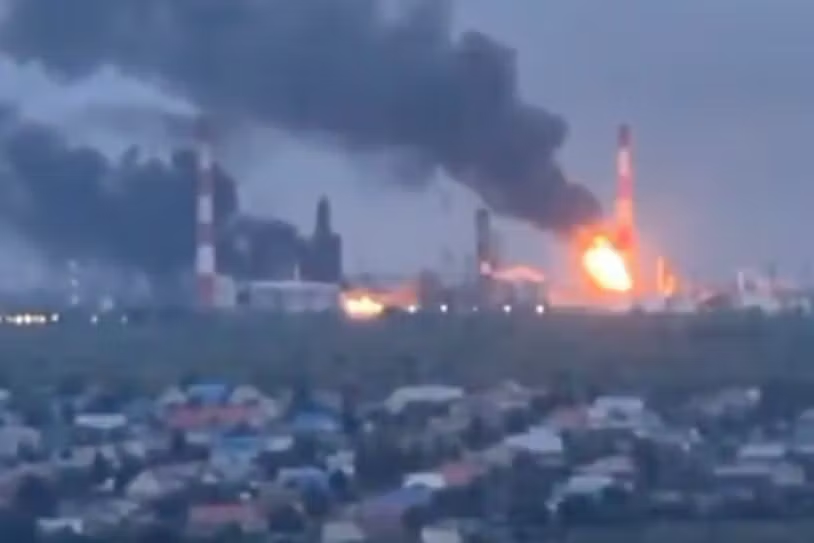
President Volodymyr Zelenskyy said in May that Ukraine had hit at least 15 Russian refineries since January. The Kirishi plant, with a capacity of 20 million tonnes a year, has been shut since 5 May. The Ryazan refinery suspended operations after a 15 May strike. The Moscow refinery went offline in mid-May before being struck again on 16 and 18 June; the first of those strikes damaged a primary unit accounting for about 53 per cent of the plant's capacity and halted operations, and the second hit its Euro+ unit. According to Reuters, citing two industry sources, the plant is unlikely to restart before 2027. Plants at Syzran, Saratov, Novokuybyshevsk, Kstovo, Volgograd and Novoshakhtinsk were also hit. The Taneko refinery at Nizhnekamsk, the largest plant operated by Tatneft, halted processing after a strike on the night of 12 June, and the Kuibyshev refinery in the Samara region stopped after a strike on 10 June.
On 20 June Ukraine struck the Antipinsky refinery in the Tyumen region, about 2,000 kilometres from the border, in what Zelenskyy said was a strike by a new domestic drone with a range of up to 3,000 kilometres. The Tyumen governor first said the attack had been repelled, then that debris had fallen on the site and staff had been evacuated; Ukraine's General Staff said the results were still being verified.
The strikes have gone beyond refineries to oil depots, the Ust-Luga gas processing plant, pumping stations, the Kerch fuel terminal and Port Kavkaz, Crimean rail bridges and air defence positions on the Crimean Bridge.
Ukraine calls the campaign its "long-range sanctions."
Oil and gas taxes account for about a quarter of Russia's federal budget. The same refineries that fuel civilian cars also fuel military transport, and the revenue they generate pays for the war they help wage.
The invasion and the target set
Russia launched its full-scale invasion of Ukraine on 24 February 2022 and has since struck Ukrainian power stations, cities, ports, homes and hospitals, returning to the electricity grid each winter. Ukraine is defending against that invasion. Its strikes hit fixed infrastructure tied to Russia's war economy and military logistics, not the territory of a neutral state.
The logic Ukrainian officials state is direct: while Russia keeps striking Ukrainian civilian infrastructure, Ukraine will strike the economic base that lets Russia keep fighting. Russia built the dependence on militarised energy infrastructure over decades. Ukraine did not create it. It found a way to reach it.
Refineries, sanctions and the domestic market
The research firm Energy Intelligence calculated that Russian refining fell below 4 million barrels a day in the first week of June, a 21-year low, with close to a third of capacity idle, around 2.14 million barrels a day.
It said the result was the country's "worst fuel crisis in its history."
Output of petroleum products in April was down 9.2 per cent on a year earlier, according to figures cited from the state statistics service.
How much capacity is actually offline is genuinely contested, and the range is the honest answer. Reuters put it at roughly a quarter of total refining capacity and more than 30 per cent of gasoline output. Zelenskyy said in May that nearly 40 per cent of primary refining capacity was down. The independent energy analyst Sergei Vakulenko estimated the real reduction nearer 30 per cent, below the headline figures, while Capital Economics put the hit at 10 to 20 per cent and said global crude prices had barely moved. The state statistics service stopped publishing gasoline production data in May, leaving an information gap that the wider estimates have filled.
Every major Russian refinery uses some Western technology, and restrictions on parts and equipment complicate the work; Russian industry sources said some plants could not restart for that reason. With gasoline production down about a quarter from a year earlier, according to Reuters, Russia has turned to imports. Belarus has agreed to supply fuel, Russia has approached Kazakhstan about roughly 50,000 tonnes of AI-92 petrol, and at least one seaborne cargo was due at a western port in June, which industry sources said was likely to come from Asia, a rare step for one of the world's largest fuel exporters. Kazakhstan's energy minister, Erlan Akkenzhenov, said no formal request had arrived from Russia. Russia has also allowed refineries to produce lower-quality fuel to stretch supply.
A ban on petrol exports runs to 31 July, a ban on aviation fuel exports from 1 June to 30 November and limits on diesel and jet fuel are under review. Crude shipments from the western ports of Primorsk, Ust-Luga and Novorossiysk were set to fall to about 1.7 million barrels a day in June, down from 2.5 million in May. Deputy Prime Minister Alexander Novak made the Russian government's first public admission that crude output was falling, citing refineries under "unscheduled repairs."
In the zone within about 250 kilometres of the front, including Crimea, analysts say the acute shortages owe more to drone strikes on fuel trucks, depots and ferries than to the nationwide fall in production. The logistics into the peninsula have been cut, not just the output feeding it.
China and the war economy
According to the US-China Economic and Security Review Commission, China is the top buyer of Russian fossil fuels and the main supplier of the dual-use components that sustain Russia's military, the two roles most relevant as the refineries burn. As the strikes force Russia to divert crude from damaged refineries to export, China is the buyer that absorbs much of it, softening the loss of refining revenue.
On the supply side, China provides about 90 per cent of the sanctioned technology Russia can no longer source in the West, according to Bloomberg, and the research institute MERICS put Chinese dual-use shipments to Russia above $4 billion in 2024, among them microelectronics, machine tools, navigation gear and drone components. China says it is a neutral party that supplies no lethal weapons and that the accusations are groundless.
Official messaging on the shortages
The Institute for the Study of War said the shortages were intensifying while the Russian government tried to conceal them and reassure the public. Pro-government channels circulated a video by a motoring blogger who said there were no queues; viewers pointed out that most pumps in the shot were blocked off with cones and the price board showed only zeros.
Governors and regulators have blamed seasonal demand, logistics, repairs, speculation and panic buying, while avoiding any mention of Ukrainian strikes. The Russian government acknowledged that production had fallen in some areas but said it saw no risk of nationwide shortages, and the energy ministry said domestic supply remained stable.
For a state whose forces have spent years striking Ukraine's electricity grid through winter, official complaints that frame fuel queues as speculation carry a hard irony. For many Russians the war has been something happening elsewhere, to other people; the queue at the pump is where it becomes local. This is not equivalence. Ukrainian civilians are killed in Russian strikes; Russian drivers wait in line for petrol. The people now queuing include many who never chose this war and cannot safely say so, in a country where independent reporting on it has been driven into exile.
What the crisis means for the war
This is not yet a national collapse, and the most sober reading inside the independent Russian press says so. According to an analysis in The Moscow Times, media coverage has run ahead of what ordinary Russians experience, state subsidies have held pump prices far below inflation, with petrol up about 36 to 37 per cent against cumulative inflation near 42 per cent since 2022, and summer fuel crunches predate the war, recurring in 2011, 2018 and 2021. The same analysis estimated gasoline output across 2026 at roughly 10 per cent below 2025, a more conservative figure than the current run-rate drop, and expected shortages to worsen through this summer and into 2027 as the strikes continue and grow more frequent.
Seaborne crude export volumes fell about 24 per cent month on month after the strikes hit export infrastructure, according to the Centre for Research on Energy and Clean Air, and oil-product exports from the Tuapse refinery were down 65 per cent year on year for January to April. The government is raising value-added tax from 20 to 22 per cent to cover widening budget gaps. The drones that cause this damage cost a small fraction of what they destroy. Analysts note that in a genuine shortage the Russian military can simply requisition fuel from civilians, farmers and businesses, which would push the cost of the campaign further onto the home front rather than lift it. The fuel that reaches the front will be taken from the queue, not added to it.
The queues in Russian cities do not equal the cemeteries, the blackouts and the ruined towns Russia has inflicted on Ukraine, and they are not the point. The war Russia chose to carry out, can no longer be kept wholly outside its own borders, and the infrastructure Ukraine is striking was built by the Russian state to wage that war. By late June 2026 the petrol export ban ran to 31 July, the aviation fuel ban to 30 November and the lines at the pumps were still forming.