Serbian President Aleksandar Vučić told a party rally in Belgrade on 27 June 2026 that he will resign within weeks and call early presidential and parliamentary elections, a year before his mandate expires.
"I will be president for only a couple more weeks, and then I will resign," he told supporters of his Serbian Progressive Party.
He gave no date for the resignation or for dissolving parliament, the step required before a parliamentary vote.
Vučić proposed that the party contest the elections under a new list named United Serbia, an echo of the United Russia party that anchors Vladimir Putin's rule, and said it would win more convincingly than ever. Under the Serbian constitution a presidential election must follow within 90 days of a resignation, and the speaker of parliament serves as acting head of state in the interim. His second and final term, due to expire in mid-2027, bars him from running again for president. He framed the announcement as help for his party rather than a departure, promising higher pensions, more money for the poor and better state health services, and pledging that the party would end corruption.
The announcement followed 18 months of student-led protests, the largest in Serbia since the demonstrations that brought down Slobodan Milošević in 2000, set off by the collapse of a railway station canopy in Novi Sad that killed 16 people.
Resignation without departure
The presidency in Serbia is largely ceremonial, and the prime minister holds the greater executive power. Vučić has held one office or the other since 2014, and his party has governed since 2012. The current prime minister, Đuro Macut, a doctor with no prior political career whom Vučić installed in April 2025, has limited independent standing, and Vučić has floated a return to the prime minister's office he held from 2014 to 2017. Several of his allies have publicly called for it. Radivoje Grujic, a Warsaw-based analyst, said the move was "not at all the end of Vučić", and analysts expect Vučić to place an ally in the presidency while keeping the levers of power. Opposition and student figures call the early vote an attempt to set the terms of a contest before the movement can organise against him. Savo Manojlović, who leads the Move-Change movement, said Vučić was trying to "preempt his inevitable fall".
The prime minister's fall
Two ministers, Vesić and Momirović, had already given up their posts in November 2024. Prime Minister Miloš Vučević followed on 28 January 2025, the most senior casualty of the protests, resigning alongside the mayor of Novi Sad, Milan Đurić.
His departure came hours after he, Vučić and the speaker had jointly invited students to talks and promised to meet their demands. In the early hours of 28 January, four men with baseball bats came out of the party's Novi Sad offices on the Boulevard of Liberation and set upon students who were putting up stickers for a blockade of three city bridges planned for 1 February, three months to the day after the collapse. They broke the jaw of a 23-year-old art student, who was operated on that night, and injured several others. One of the four was reported to have been seen in the company of Vučević's son. The men were charged with grievous bodily harm and violent conduct, and denied the charges.
Parliament did not formally acknowledge the resignation for about 50 days, until 19 March, a delay opponents read as an effort to ride out the protests, and Vučić then nominated Macut, who took office on 16 April. In July 2025 Vučić pardoned the four before their trial concluded, along with others accused of attacking demonstrators, among them a woman who drove her car into a crowd, a move the European Parliament called interference with justice. Vučević kept the SNS presidency and became an adviser to Vučić on regional matters.
The Novi Sad collapse
The 48-metre concrete canopy at Novi Sad railway station fell onto the pavement at 11:52 on 1 November 2024, as people sat and walked beneath it. Fourteen died at the scene and three more were hurt, two of them women pulled from the rubble hours later by rescue crews drawn from across Serbia. The toll reached 16 as two of the injured died over the following months, among them a 19-year-old man who died on 21 March 2025, while one woman remained gravely injured. The dead, who ranged in age from six to 74, were Serbian save for one citizen of North Macedonia. The government declared 2 November a day of mourning.
The station sat at the centre of one of the government's flagship works, the high-speed line from Belgrade to Budapest, a centrepiece of Chinese investment in Serbia under the Belt and Road Initiative. The renovation was designed by the state institute CIP and carried out under a 2018 intergovernmental contract, awarded without a public tender, by a consortium of two Chinese state firms, China Railway International and China Communications Construction, known together as CRIC-CCCC. Professional supervision was assigned to the French firm Egis and the Hungarian firm Utiber. The station was first reopened with a ceremony in 2022, before that year's general election, and again on 5 July 2024, four months before the canopy gave way. The full contract, covering the line from Novi Sad to the Hungarian border at Kelebija, has never been made public.
Cost has been central to the corruption allegations. A 2020 CIP estimate put the designed works on the station building at about three million euros, while Vesić said almost 16 million euros had been paid. The government released only part of the renovation file, and Transparency Serbia said the 195 documents it posted online left out key financing and contracting papers.
Within hours of the collapse the government said the canopy had not been part of the renovation, describing it as an original 1964 structure given only conservation treatment, an account CRIC-CCCC and the state rail operator repeated. Photographs and video of workers on the canopy and accounts from engineers who had worked on the project contradicted that, and the government later conceded the structure had been worked on. Zoran Đajić, an engineer on the reconstruction until 2022, said work had been done on the canopy and that he had foreseen a possible collapse. The day before it fell, CIP had photographed visible damage to the canopy, and there were later reports that staff had been told material was coming loose from it.
More than a year on, no official cause or responsibility for the collapse has been established, and the question of who is to blame remains before the courts. Pro-government figures floated sabotage, but forensic testing of more than 20 samples by the interior ministry found no explosives, which the authorities said ruled out terrorism.
Accountability
Three separate prosecutions have grown out of the collapse, and none has produced a settled verdict. Prosecutors in Novi Sad indicted former construction minister Goran Vesić and 12 others on 30 December 2024 for a serious offence against public safety. A court returned the indictment in April 2025 for further work, an amended version was filed in September, and on 24 December 2025 the Higher Court in Novi Sad dropped the charges against Vesić and five other defendants, finding "insufficient evidence to support reasonable suspicion" while confirming charges against seven others. The court faulted prosecutors for carrying out the extra investigation mechanically without weighing what it produced. The prosecution said it would appeal, and the Court of Appeal in Novi Sad was reviewing the decision in 2026. The co-accused include Vesić's former assistant Anita Dimoski and two former heads of the state rail-infrastructure company, Jelena Tanasković and Nebojša Šurlan, none of whom are in custody. More than a year and a half after the collapse, no charge over the deaths has been settled by a final court ruling.
A second case, brought by the Higher Public Prosecutor's Office in Belgrade against three officials accused of clearing the station to reopen while knowing the work was unfinished, was confirmed by the court in April 2025 but overturned on appeal in February 2026 and sent back over a question of whether an authorised prosecutor had filed it.
The corruption track has gone furthest. On 1 August 2025, nine months after the collapse, the Public Prosecutor's Office for Organised Crime charged Vesić and another former infrastructure minister, Tomislav Momirović, over alleged graft in the Belgrade-to-Budapest railway upgrade that took in the Novi Sad station. Prosecutors say the scheme cost the state budget at least 115 million US dollars and secured at least 18 million for the Chinese contractor. Momirović spent six months in detention and Vesić was released to defend himself at liberty; both deny wrongdoing. Vučić has said there was no corruption in the case, only professional error.
Scale of the protests
The protests began with faculty blockades, the first on 22 November 2024 at the Faculty of Dramatic Arts in Belgrade after students were attacked during a silent tribute, and with daily road blockades held in silence for the dead, their hands often painted red to signify blood. About 100,000 people filled Slavija Square in Belgrade on 22 December 2024, and a general strike followed on 24 January 2025.
The movement reached its peak on 15 March 2025, when crowds filled central Belgrade for a rally held in memory of the dead. The Serbian interior ministry put the turnout at 107,000. The Archive of Public Gatherings, an NGO that counts crowds, estimated 275,000 to 325,000, which would make it the largest protest in modern Serbian history. The students set four demands, led by the release of all documents on the station's renovation, the prosecution of those who had attacked protesters and a 20 per cent rise in the higher-education budget. The European Parliament counted more than 10,700 protests across more than 630 communities between February and September 2025. By July 2025 demonstrations had spread to more than 500 towns and cities, with solidarity rallies in Croatia, Bosnia and Montenegro. Students walked, ran and cycled hundreds of kilometres between cities to reach the rallies, and groups cycled from Novi Sad to the European Parliament in Strasbourg and ran a relay to Brussels.
The sonic-weapon allegation
During a silence for the dead at the 15 March rally, a sudden noise sent part of the crowd into a stampede, and protesters accused the security services of using a long-range acoustic device, a weapon whose use on crowds is illegal in Serbia. The government first denied owning such devices, then said it held Genasys LRAD 450XL units that remained in storage, before acknowledging that an LRAD had been mounted on a Gendarmerie vehicle parked by the National Assembly on the day, while denying it was turned on the crowd. The European Court of Human Rights issued an interim measure on 29 April 2025 instructing the Serbian state to refrain from using sonic devices for crowd control. Earshot, a group that specialises in audio forensics, said in June 2025 that protesters were "very likely" targeted by a directed acoustic weapon, a finding the manufacturer Genasys disputed.
The investigation has since turned towards the people who raised the allegation. On 19 June 2026 the Higher Public Prosecutor's Office in Belgrade, led by Nenad Stefanović, tasked counter-terrorism police with examining whether protesters had staged a simulation of a sonic-weapon attack, a theory that recasts the demonstrators rather than the security services as the subject of inquiry. On 22 June police searched the home and office of the military analyst Aleksandar Radić, who had publicly said an acoustic device was used, and seized his phones and computers; a judge had ordered the search over his statements on the case. Officers handed a summons to Vojkan Kostić, editor-in-chief of the BETA news agency, while he reported from the scene, citing a suspected offence against the constitutional order. Marinika Tepić of the opposition Freedom and Justice Party called the search "personal revenge" by Vučić. Parliamentary speaker Ana Brnabić said the false-attack claim had been meant to provoke a civil war, while interior minister Ivica Dačić accused the European Union of seeking to destabilise Serbia.
Arrests and police violence
The European Parliament, in a resolution passed on 22 October 2025 by 457 votes to 103, recorded more than 1,028 arrests and at least 340 violent incidents since late 2024, some causing serious injury and some involving school pupils, and said the true count was higher. It found that violence had intensified from August 2025, citing police brutality, torture and sexual violence against students, threats by the police protection service known as the JZO, politically motivated prosecutions and pro-government smear campaigns, among them the broadcast of intimate images of a female student. Student organisers running the faculty blockades say more than 3,000 people have been arrested, beaten, detained or dismissed from jobs since November 2024.
Much of the legal pressure has run through two charges, preparing acts against the constitutional order and calling for its violent overthrow. Pro-government media aired leaked recordings of suspects' conversations before arrests were made ahead of the rallies of 15 March and 28 June 2025, and several activists and members of the opposition Free Citizens Movement were detained on those grounds, some later placed under house arrest or driven into exile. The ruling party set up a tent camp in a Belgrade park outside the presidency that later spread to the square facing the National Assembly, and the resolution recorded people with criminal records being mobilised against protesters and attacking them with pyrotechnics.
Reporters Without Borders recorded at least 89 physical assaults on media workers, the highest figure since 2008, with 82 in 2025 and nearly half attributed to police. The European Parliament shortlisted the Serbian students for its 2025 Sakharov Prize for freedom of thought.
Foreign-agent accusations
Vučić has repeatedly called the demonstrators foreign agents and cast the protests as a Western-funded colour revolution aimed at toppling him, without producing evidence. The European Parliament rejected the claim that the EU or its member states had organised the protests, and condemned the arrest and expulsion of EU citizens who voiced support for the students, the publication of their personal data by convicted war criminals and a rising number of EU nationals held at Serbia's borders. Vučić singled out and attacked Green-group members of the European Parliament in September 2025, and the civilian security service detained and questioned activists on the theory of an attempted coup.
The Russian security services have echoed the government's account. The Serbian government invited Russia's FSB to help investigate the 15 March stampede, and analysts say Serbia has amplified a Kremlin line that casts the EU as the hidden hand behind the unrest. At the 27 June rally Vučić again tied the protests to foreign interference while offering the movement dialogue. The students rejected dialogue with the presidency early in the protests, arguing that the office had no power to meet their demands and pointing instead to the courts and prosecutors.
Elections demand and the latest clashes
The student movement, which began without a party programme, converged by May 2025 on a single political demand, a snap parliamentary election, after an earlier opposition push for a transitional government came to nothing. Vučić withheld a date for more than a year, at times saying no vote would come before late 2026 and accusing the students of trying to overthrow the government. In December 2025 the movement ran a signature drive at hundreds of stands across the country to test its support, and it has since moved to field its own electoral list and to contest both the parliamentary and presidential votes. In June 2026 three opposition parties formed a Platform for a European Serbia and said they would work with that student list.
Police fired teargas and clashed with protesters in Belgrade on 23 May 2026, where the Archive of Public Gatherings counted 180,000 to 190,000 people and student speakers set out a policy programme spanning the courts, health, education and agriculture, while Vučić, travelling to China, again blamed foreign powers. At local elections in Bor on 29 March 2026 a student-backed list took most of the city's urban polling stations while the ruling coalition prevailed in the villages, and monitors recorded obstruction and attacks on journalists and students. In May 2026 his government pushed through changes to several election laws that it said answered recommendations from the OSCE's election-monitoring office, ODIHR; opposition parties and watchdogs said the core recommendations went unaddressed, while the European Commission welcomed the package. Days before his resignation announcement Vučić said the parliamentary vote could be held between September and November 2026.
The foreign-policy balance
Serbia has been an EU candidate since 2012, with accession talks open since 2014, but the process has stalled. Of 35 negotiating chapters, 22 have been opened and only two provisionally closed, and none has moved since 2021. Progress is conditional on the rule of law, free and fair elections, normalising relations with Kosovo and aligning foreign policy with the bloc, including the sanctions on Russia that the Serbian government has refused to impose.
The enlargement commissioner, Marta Kos, said in April 2026 that the Commission was weighing whether to withhold about 1.5 billion euros in conditional funding, pointing to a January 2026 judicial overhaul that the EU and the Council of Europe's Venice Commission judged a threat to the courts' independence, the crackdown on protests and the pressure on independent media. European Council President António Costa, visiting Belgrade in June 2026, named the rule of law, electoral reform and media freedom as the areas that had to improve. Vučić skipped an EU-Western Balkans summit in December 2025 and, with the Albanian prime minister, floated a looser model that would trade market access for full membership, which Kos rebuffed.
China rebuilt the Novi Sad station, holds billions of dollars in Serbian infrastructure loans and hosted Vučić for a state investment drive in June 2026, weeks before the resignation announcement. The EU has faulted Serbia for steering large projects, among them Expo 2027 in Belgrade, through special laws that bypass procurement rules. Russia keeps its own hold through the gas supply on which Serbia depends and its majority stake in the country's only oil refiner.
The Trump tower that fell through
Jared Kushner's investment firm Affinity Partners signed a deal in 2024 to build a 500 million US dollar, Trump-branded tower complex on the site of the former Yugoslav defence headquarters in central Belgrade, a building left in ruins by NATO's 1999 bombing. The plans, drawn up with the Emirati developer Mohamed Alabbar, set out two towers of about 30 floors, 175 hotel rooms and roughly 1,500 luxury flats, with a memorial on the site to the victims of the bombing. Kushner, son-in-law of US President Donald Trump and a senior foreign-policy adviser in his administration, presented the project to Vučić in June 2024, and in January 2025 his firm agreed with the Trump Organization to carry the Trump name. The reported terms gave Affinity a 99-year lease at no cost, an option to buy the site outright and 78 per cent of the profits, with 22 per cent for the Serbian state. The arrangement traced to a memorandum signed in December 2022, and Affinity had drawn most of its capital from the Saudi Public Investment Fund and the Emirati and Qatari sovereign funds. Wesley Clark, who commanded NATO during the 1999 war, and US senator Ron Wyden criticised the plan to build on the bombed ministry.
The site was legally protected as a cultural monument, and the project could not proceed until that status was lifted. Serbian organised-crime prosecutors said in May 2025 that Goran Vasić, acting director of the state institute charged with protecting cultural monuments, had admitted forging a document to strip the building of its protection. Serbia's parliament voted in November 2025 to fast-track the redevelopment. On 15 December 2025 prosecutors indicted four officials, among them culture minister Nikola Selaković, for abuse of office and falsifying documents tied to the project. Hours later Affinity withdrew, saying it was stepping aside "because meaningful projects should unite rather than divide". The firm denied any role in document falsification and said it would still build a memorial to the bombing's victims. Vučić said he was proud of those who had tried to bring in the investor, blamed the campaign against the project for its collapse and vowed to pardon any officials charged over it. The towers were never built.
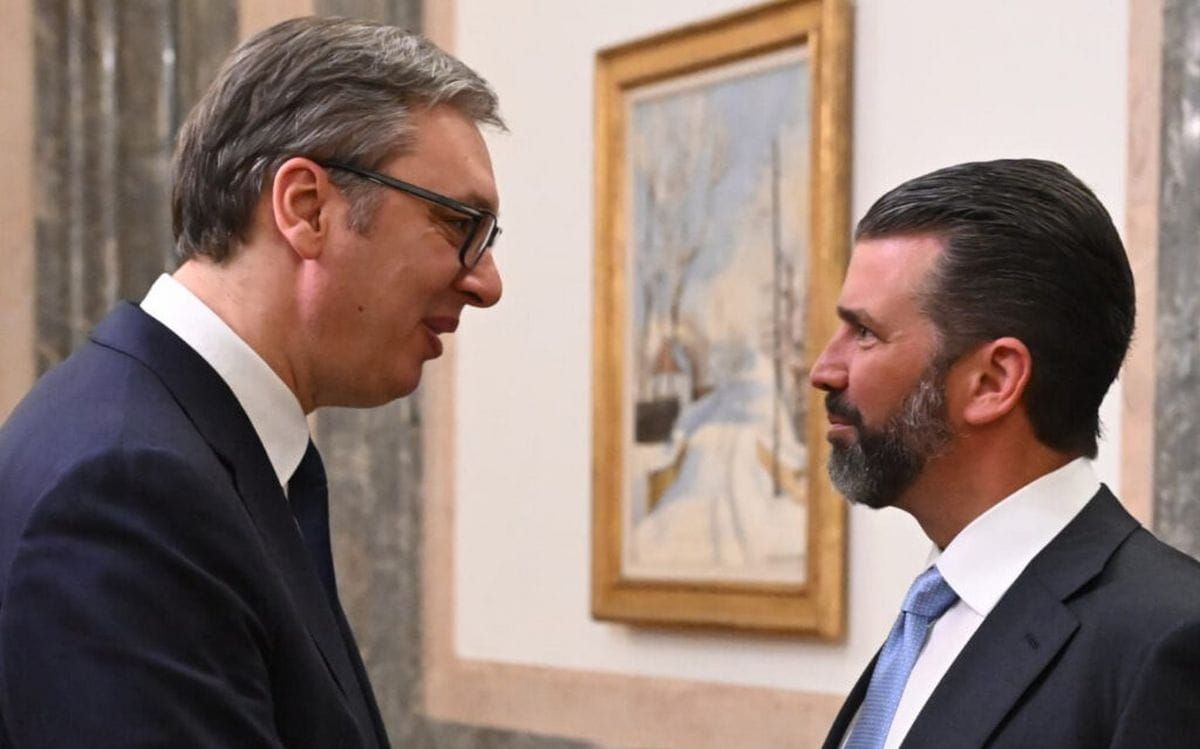
Donald Trump Jr. met Vučić in Belgrade on 11 March 2025, his second visit in six months, and the two discussed what Vučić called strategic cooperation and joint projects. Richard Grenell, the US president's envoy for the Serbia-Kosovo dialogue, has met Vučić repeatedly on the economy and the status of Kosovo. Vučić has sought the Trump administration's help with the economic pressures bearing on Serbia, the heaviest of them over Russian oil.
Arms to Israel
Serbia's arms exports to Israel reached a record 114 million euros, about 131 million US dollars, in 2025, a rise of about 140 per cent on the previous year, according to the Serbian statistics office, with figures reported by the Belgrade weekly Radar, the Balkan Investigative Reporting Network and the Israeli newspaper Haaretz. The exports, mostly large-calibre ammunition, climbed from about three million euros in 2023 and continued through Israel's war in Gaza. Flight-tracking data showed 38 cargo flights carrying weapons to Israel's Nevatim air base in 2025, double the 2024 figure, with at least 17 more in the first quarter of 2026. Most shipments ran through the state arms trader Yugoimport-SDPR, with private firms including Edepro and Romax Trade supplying IMI Systems, an Elbit Systems subsidiary. Vučić said Serbia was the only country in Europe still supplying Israel with ammunition after the Hamas-led attack of 7 October 2023, and that his government had assembled the first shipment within four days of an Israeli request.
The trade sits on a deal struck by the first Trump administration. Under the 2020 Washington Agreement on Serbia-Kosovo normalisation, negotiated by Grenell, Serbia pledged to move its embassy to Jerusalem and Kosovo and Israel agreed to recognise each other. Serbia never moved the embassy and downgraded its representation after Israel recognised Kosovo, which opened an embassy in Jerusalem. Analysts say Vučić has used the relationship with Israel as a route to influence in the US. Serbia in turn signed contracts with Elbit reported at 335 million US dollars in late 2024, for PULS rocket launchers and Hermes 900 drones, and at about 1.64 billion US dollars in August 2025, for drones, long-range missiles and electronic-warfare systems. In April 2026 BIRN and Haaretz reported that Elbit and Yugoimport-SDPR planned a drone factory at Šimanovci, west of Belgrade, with the Israeli firm holding 51 per cent.
Vučić said on 23 June 2025 that Serbia had halted all arms exports to Israel after Israel attacked Iran, redirecting the stock to its own army, though deliveries continued. Haaretz reported that a plane carrying military equipment flew from Belgrade to an Israeli airbase the next day, and that exports in the first half of 2025, at 55.5 million euros, had already passed the full-year record set in 2024. A joint investigation by Haaretz and BIRN reported in April 2025 that Israel Einhorn, a former adviser to Israeli Prime Minister Benjamin Netanyahu who had relocated to Serbia, worked to improve Vučić's image and to facilitate the ammunition shipments. Israeli police declared Einhorn a fugitive on 12 January 2026 over a leak inquiry, and he remains in Belgrade. Francesca Albanese, the UN special rapporteur on the occupied Palestinian territories, told an audience in Belgrade that states which keep arming Israel risk complicity in violations of international humanitarian law.
The Russian bind
Vučić attended Russia's Victory Day parade in Moscow on 9 May 2025, one of only two sitting European leaders to do so alongside the Slovak prime minister. He met Vladimir Putin and Xi Jinping there and said the main reason for the trip was Serbia's gas-supply deal with Russia. Putin had given Vučić a Russian state honour in 2019.
Serbia has refused EU demands to sanction Russia more than three years into the war in Ukraine, citing its dependence on Russian gas and its own experience of sanctions in the 1990s. That dependence runs through NIS, the Petroleum Industry of Serbia, which supplies about 80 per cent of the country's fuel, accounts for roughly nine per cent of GDP, employs about 13,000 people and runs the only refinery, at Pančevo. Russia's Gazprom Neft and an affiliated Gazprom holding own about 56 per cent of NIS, the Serbian state 29.9 per cent. Serbia had sold the majority stake to Gazprom in 2008 for about 400 million euros.
US sanctions designated NIS in January 2025 over its Russian ownership and, after eight postponements, took effect in October. Croatia's pipeline operator stopped delivering crude, and the Pančevo refinery suspended production in late November 2025 before restarting under a temporary licence at the end of December. Vučić said he had refused a US request to nationalise the company and take the Russian stake. The US has pressed for full Russian divestment, Gazprom agreed to sell, and Hungary's MOL emerged as the main bidder, signing a shareholders' agreement with the Serbian government that would lift the state's holding by about five points and keep the refinery running for at least a decade; Abu Dhabi's ADNOC also expressed interest. The Treasury's sanctions office extended NIS's operating licence to 1 July 2026 for the sale to be completed; as of late June the deal had not closed, and Gazprom Neft's chief executive said the talks were complex and would take time. Vučić said American patience was running out.
The arms industry that supplies Israel has also strained Serbia's ties with Russia. The Financial Times reported in June 2024 that about 800 million euros of Serbian ammunition had reached Ukraine through intermediaries since Russia's 2022 invasion. Vučić acknowledged the exports, saying the trade mattered to Serbia's economy even though the country could not sell directly to either side in the war.
A few thousand people rallied in Kraljevo, in central Serbia, on 28 June, a day after the resignation announcement and on Vidovdan, the date that anchors much of the protest calendar. Gathered under the slogan "Students are winning" in a heatwave the public health institute rated dangerous, they did not address the resignation directly and said the fight would go on. Students collected donations for children in Kosovo and signed people up as election monitors, and a two-day march had walked from Kragujevac to reach the city. Marko Djokic, an IT worker who returned home for the rally, said he could not picture Vučić ceding power to anyone else.
At the same Vidovdan rally a year earlier, in Belgrade, police fired teargas for the first time in the protests, and nine students were later charged with preparing acts against the constitutional order, the offence now cited against people who alleged the sonic-weapon attack.
Vučić set no date for his resignation or for the vote, leaving his opponents to guess at the timetable. The European Union has condemned the use of force against peaceful protesters and raised concerns over press freedom and the independence of the courts. The movement and opposition parties say they will contest whatever election he calls, whenever he sets a date.