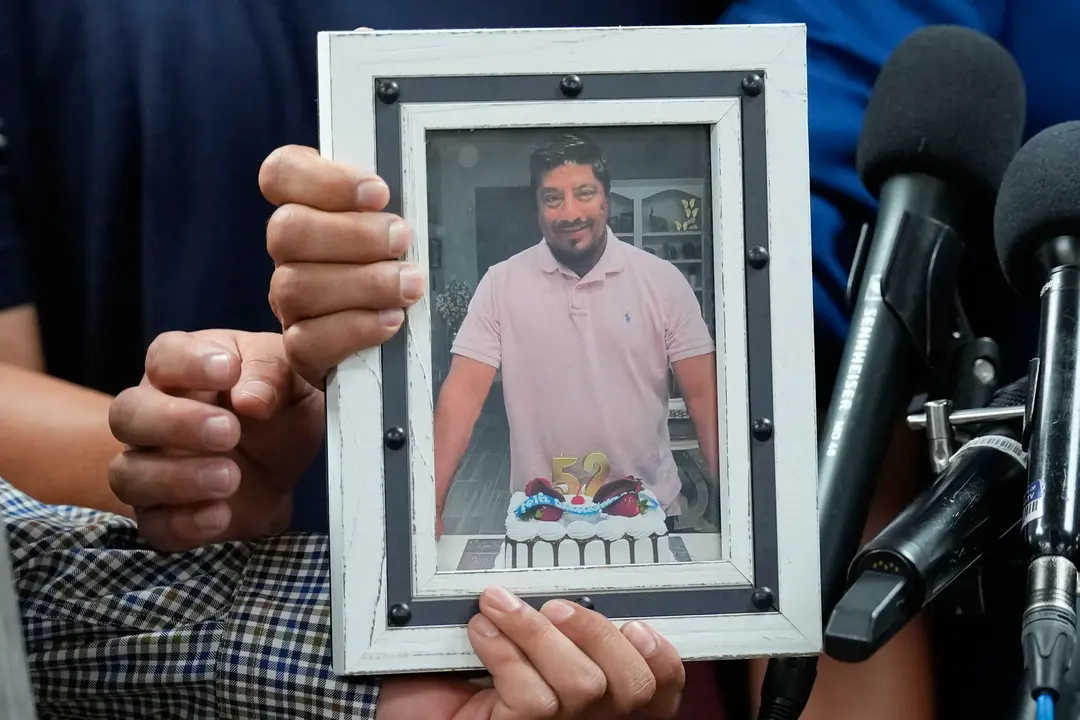
Lorenzo Salgado Araujo left his house around 6 a.m. on Tuesday, 7 July, the way he did most mornings. He was 52, a construction crew leader, and he had a routine, he'd wake up at dawn, say goodbye to his family, pick up his workers, drive out to a homebuilding site in North Houston, put in the day. He had lived in the United States for roughly 35 years. He had three sons, all U.S. citizens, and a wife he had known since they were teenagers in Mexico. By about 6:50 am that morning he was bleeding on a public street, crying in agony, begging for help in Magnolia Park, shot once in the abdomen by an ICE agent who stood over his body as he bled out. He died at Ben Taub Hospital, the same hospital where three of his sons were born.
Araujo was not a wanted man. Rep. Sylvia Garcia, who represents the area, confirmed he had no criminal convictions. He was in the process of obtaining a work permit, having completed his biometric scans and fingerprinting earlier in the year, and he was working toward legal status through official channels. His son says he knew exactly what to do if immigration agents ever stopped him.
Two versions of the same 30 seconds
The Department of Homeland Security version of events is that ICE agents were running a "targeted enforcement operation," They stopped Salgado Araujo's vehicle, he ignored their commands, and he tried to run over an officer. His car struck an ICE vehicle, the agency says, and the officer fired in self-defense.
His family and witnesses' version of events is that the agents were in unmarked vehicles and wore no visible law enforcement insignia. Lorenzo carried thousands of dollars in tools in his van, in a city where work crews are robbed for exactly that, and his relatives believe he may have thought he was being ambushed by thieves.
His eldest son, Ronaldo Salgado, a schoolteacher, put it plainly: "Had my father seen an emblem of ICE, or an emblem that says anything about a law enforcement agency, my father would have complied."
ICE has released no body-camera or dashcam footage. There is bystander video, filmed by a witness named Juliet Martinez, but it begins after the shooting: it shows Salgado Araujo handcuffed and bleeding on the ground between two vehicles, with officers standing over him, watching him beg for help.
The reason many people in Houston and across the US are unwilling to accept the agency's account at face value is that ICE has faced repeatedtly provided misleading or inaccurate public statements following excessive uses of force and civilian killings. ICE and Border Patrol have invoked self-defense in a number of recent shootings, and in several cases, video evidence later contradicted or raised serious questions about the official account. Legal scholars point to those incidents, including the aftermath of the killings of Renee Nicole Good and Alex Jeffrey Pretti in Minnesota, as reasons to demand independent evidence rather than relying solely on the agency's version of events.
What ICE claims, and why each claim invites doubt
The claim that this was a "targeted" operation.
The "targeted" word is meant to suggest a dangerous man, a name on a list. The man they stopped had lived in Houston for 35 years with no criminal convictions and was working through the government's own legal process, biometrics already submitted. ICE has not produced a warrant, a charge, or any stated reason he was singled out. On the available record, "targeted" describes a working father driving to a job at dawn, not a fugitive.
The claim that he ignored commands.
This assumes he understood he was being stopped by law enforcement. His family says the agents were unmarked and unidentifiable, and that Lorenzo, boxed in by strangers with guns before 7 a.m., had reason to fear a robbery of his tools rather than an arrest. A command only carries legal weight if the person can recognize the authority giving it. No footage has been released showing that any command was given, or that Salgado Araujo could have known who was giving it.
The claim that he tried to run over an agent.
This is the exact justification ICE and Border Patrol have offered in a series of recent killings that later fell apart. In January 2026, an ICE agent killed Renee Good, a 37-year-old U.S. citizen and mother of three, in Minneapolis; DHS said her vehicle justified the shooting, and local officials and witnesses said the video did not support that. In the same city, Border Patrol agents killed Alex Pretti, a 37-year-old ICU nurse, whom video showed holding only a phone after agents had already removed the firearm he legally carried. In 2025, agents killed Ruben Ray Martinez, a 23-year-old U.S. citizen, with the same "he tried to ram us" account, even though the video never clearly showed the vehicle contact they described, and a grand jury still declined to charge the agent. In Houston, ICE has released no body-camera or dashcam footage. The only video is a bystander's phone, filmed by a witness named Juliet Martinez, and it begins after the shooting: it shows Salgado Araujo handcuffed and bleeding on the pavement between two vehicles. It confirms he was shot and restrained. It shows nothing of the alleged ramming.
When an agency has given the identical vehicle-ramming justification in multiple shootings that video later contradicted, its use of that justification a fourth time is not evidence of innocence. It is a reason to demand the footage before accepting a word of it. Across the 14 people DHS immigration officers shot between September 2025 and February 2026, officers fired into vehicles in seven incidents, a tactic police departments across the country have spent decades restricting precisely because it converts "the car moved toward me" into grounds to open fire.
How his family found out
No one from the US government called the Salgado family to notify them that Lorenzo was in the hospital, dying for 7 hours, robbing them of the opportunity to say goodbye. Around 7 a.m., Lorenzo's wife told her son Ronaldo something had happened involving ICE. By 8:35 a.m. he had driven to the scene, where he found his father's van but no sign of his father. Then he came across a Facebook video of the incident, posted about an hour after the shooting. He knew it was his father from the voice alone.
"I recognized him immediately, not from his appearance, but from his voice, crying for help as he lay on the street, bleeding out," Ronaldo said.
He went to Ben Taub Hospital and asked for information. According to Ronaldo, no one there could tell him anything, and he ultimately learned his father had died from a news report circulating on social media, not from a doctor, a nurse, or any official. Three other men were detained at the scene, one of them Lorenzo's uncle, and the family had no contact with them afterward.
The investigation, and who is watching it
The FBI's Houston field office is leading the case and processed the scene at DHS's request, but it has framed the inquiry as a "potential assault on a federal officer." In other words, the current federal investigation is oriented around the alleged threat to the agent rather than the killing of the civilian, a framing that treats the dead man as the suspect. The DHS Office of Inspector General is separately investigating the shooting. When the agency being questioned and the agency asking the questions share the same chain of command, independent scrutiny is not a courtesy. It is the only thing that makes the result credible.
That is what nearly everyone responding has demanded. Mexico's president, Claudia Sheinbaum, condemned the killing as "another tragic death" of people whose only "offense" is "not yet having proper documentation," and said her government is weighing legal action and possible involvement of the United Nations over the violence against Mexican nationals.
Rep. Sylvia Garcia demanded "a complete and transparent accounting" and the preservation of "all available footage, communications, and other evidence." State Rep. Christina Morales tied the death to the stalled fight over immigration reform. Harris County Commissioner Rodney Ellis called for a full independent investigation.
The immigrant rights response was immediate. The League of United Latin American Citizens said ICE's "pattern has been one of inaccuracies and prejudicial leaks before the facts are known," and its CEO, Juan Proaño, said, "We don't take DHS at their word at all." The group posted a $5,000 reward for information or video "leading to the arrest, indictment, conviction, or exoneration of any person involved in this potential murder." Cesar Espinosa of FIEL Houston called for accountability and an independent probe.
Neighbors turned the spot where he fell into a small memorial of candles and flowers; one resident, Gina Danielsen, said, "ICE needs to leave us alone. People are here to work."
Texas DPS said it had no role in the operation and referred questions to ICE.
Not the first, and not an outlier
Salgado Araujo's death is part of a growing pattern of abuse, criminality, and street killings by ICE that human rights watchdogs and reporters have been tracking for more than a year.
Between September 2025 and February 2026, DHS immigration officers from ICE and Border Patrol shot 14 people, according to an NBC News tally. Four of them died. Four were U.S. citizens. In seven of the incidents, officers fired into moving vehicles, a tactic that police departments across the country have spent decades trying to ban precisely because it so often ends like this.
Two of the fatal cases involved similar allegations by ICE, which claimed self defense, where none existed. Renee Good, 37, a U.S. citizen and mother of three, was shot and killed by an ICE agent in Minneapolis in January 2026. DHS said her vehicle justified the shooting; local officials and witnesses said the video did not support that. Alex Pretti, 37, an ICU nurse, was killed by Border Patrol agents in the same city. The video showed him holding only a phone, and agents had already taken away the firearm he had legally carried before they shot him. An earlier case involved Ruben Ray Martinez, a 23-year-old U.S. citizen, who was killed during a 2025 traffic stop, and a grand jury declined to charge the ICE agent even though the video never clearly showed the vehicle contact agents had described. The Houston shooting is at least the eighth death tied to a federal immigration enforcement encounter since the Trump deportation campaign, described by some human rights observers as ethnic cleansing, intensified.
The deaths inside ICE internment centers are a larger and separate crisis. Human Rights Watch, in a June 2026 report titled "Dying in Detention," counted 52 deaths in ICE custody between January 20, 2025 and June 4, 2026, the highest annual toll since ICE was established in 2003. The death rate climbed to about 8.4 per 10,000 detainees, more than double the rate at the start of the current administration, nearly four times the Biden-era rate, and more than two and a half times the rate under the first Trump administration. People were dying roughly once every nine days. The report documented seven apparent suicides in a single year, up from one in 2024.
KFF's tracking lines up with that trajectory with at least 33 deaths in ICE custody in 2025, up from 11 in 2024, and 46 total between January 2025 and mid-March 2026. Of those 46, 32 were people with pre-existing medical conditions that got worse behind the wire, 36 died within three months of being detained, and 21 were under 45. The detained population had swelled past 68,000 by early February 2026, a 70 percent jump from about 39,000 at the end of 2024. The American Immigration Council counted six custody deaths in January 2026 alone. One of them, Geraldo Lunas Campos, 55, of Cuba, was ruled a homicide by the El Paso medical examiner, who found he died of asphyxia from neck and torso compression, contradicting ICE's original claim of a medical emergency. Both HRW and KFF also flag that ICE routinely blew past its own 48-hour deadline for reporting deaths and left key medical details out of the reports it did publish.
On the growing reports of rape, abuse and sexual assault, the US government files reviewed by reporters documented 1,224 complaints of sexual abuse across immigration detention over a multi-year period, with roughly half of the accused working for ICE, that record remains incomplete as thousands of potential victims may have already been deported or are too scared to speak out. Human rights monitors have logged hundreds of human rights abuses under the current Trump administration, and groups like Freedom for Immigrants say ICE consistently fails to investigate the sexual-assault and rape claims that reach it.
What remains to be seen
An ICE officer shot and killed an unarmed 52-year-old construction worker and father of three US children as he drove to work. His family found out from a Facebook video in which his son recognized his voice. The FBI, the DHS inspector general, the president of Mexico, members of Congress, Harris County, and the largest Latino civil rights organizations in the country are all now demanding answers, and most are demanding a criminal investigation into the killing, which seems unlikely to be objective under the control of the criminally aligned Trump administration.
What you can do
Salgado Araujo's family and LULAC have asked the public to preserve and share any video of the incident; LULAC is offering a $5,000 reward for footage or information. Constituents can press Rep. Sylvia Garcia's office and the House Judiciary Committee to demand release of the body-camera and dashcam footage and an independent investigation outside DHS's chain of command. Witnesses can contact LULAC or FIEL Houston directly.