Russian authorities detained the war veteran Alexander Lunin for 11 days, his family said, after he posted a video warning Vladimir Putin that the army would turn its weapons on the Kremlin over the torture of soldiers, a threat he withdrew a day later. He was held on an administrative charge whose grounds the authorities did not disclose.
Lunin, 39, a former soldier and military blogger from the village of Lizinovka in Russia's Voronezh region, posted the address to Putin on Instagram on 25 June 2026. It drew millions of views within hours, with independent outlets putting the count in a range of about 10 million to 15 million within a day. He had recorded a similar appeal to Putin a few days earlier. Independent outlets could not confirm the central claims of the 25 June video, and Lunin himself recast them the next day.
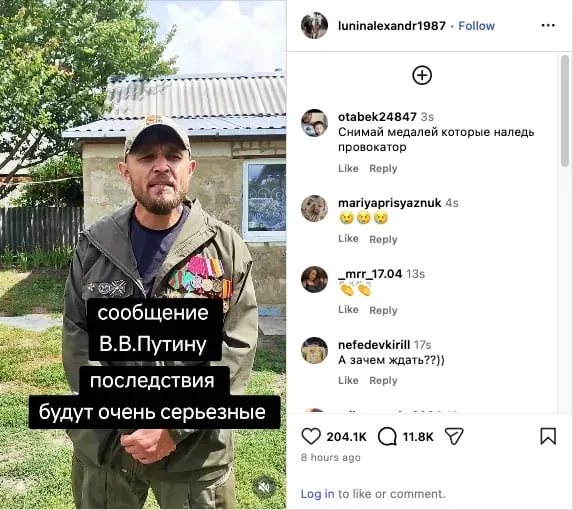
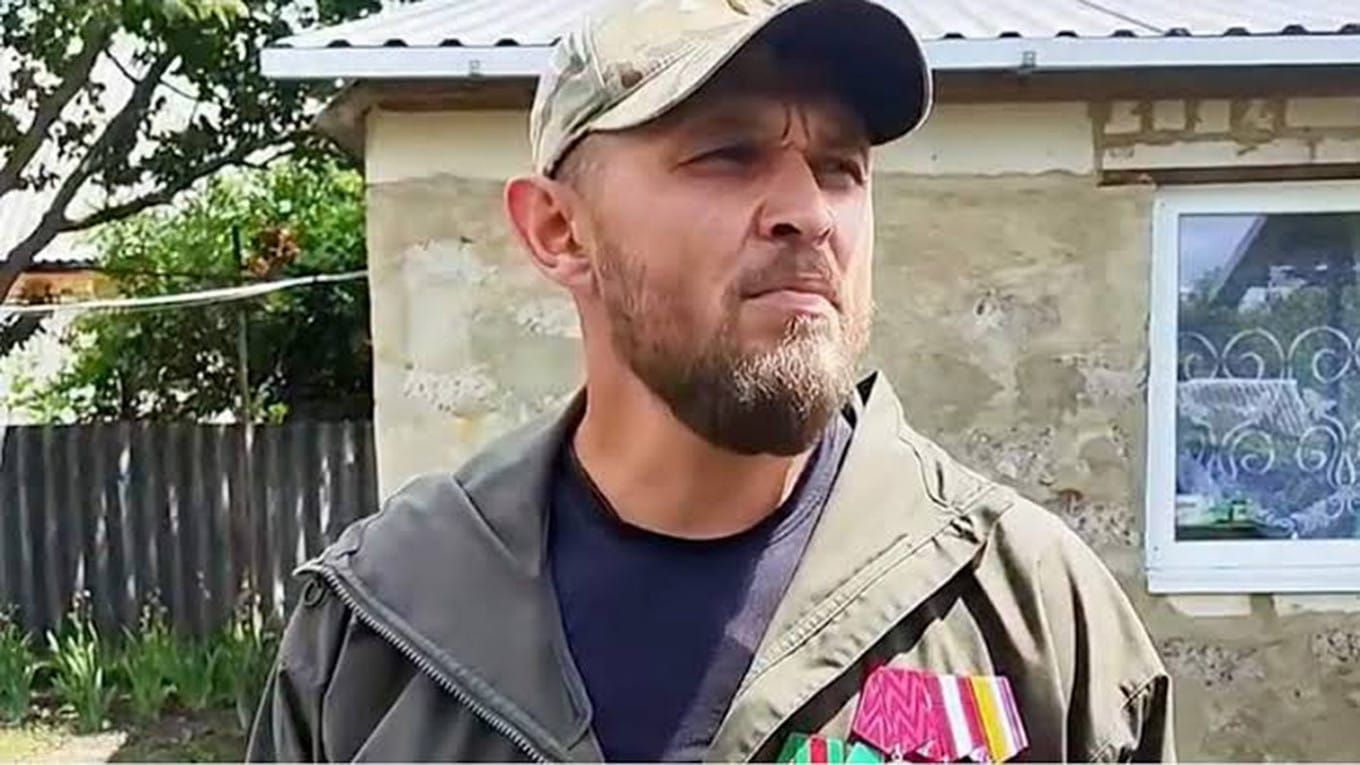
In the video, wearing combat fatigues and medals, Lunin described a system of punishment inside the army.
"At the moment, dozens, hundreds, thousands of our soldiers are sitting in pits, punished by their commanders. They sit, rot, are tortured and abused by the so-called Gestapo, for the fact that they refused to carry out stupid suicidal orders," Lunin said.
Others were punished, he said, for refusing to hand over money to commanders, and the dead were written off as missing in action. Demanding a live televised meeting with Putin, he said he was relaying a message from unnamed Defence Ministry and security officials.
"The army will turn its weapons against the Kremlin," Lunin said.
He gave no evidence that any officials had sent him.
Just a messenger
Lunin told the investigative outlet Agentstvo that a black SUV resembling a Land Cruiser pulled up at his home in Lizinovka on 24 June. He said three men were inside, one from the Interior Ministry and one or possibly two from the Defence Ministry, and that they pressed him to record the video. By his account the officials had taken notice of him because he had been posting soldiers' complaints from the front.
Lunin said they told him to carry a message to Putin: "No one wants bloodshed. Just make clear to the president that there will be total chaos here if this continues."
He said a regional official came to see him the following day.
Lunin did not explain why officials would choose a blogger removed from the front in 2025 to deliver such a message, and he offered no evidence that the meeting took place. He said he would identify the visitors only to Putin in person and live on air, casting himself as a messenger rather than the instigator of any revolt and saying he could not be bought. He said acquaintances still fighting sent him a stream of messages and footage from the front that he found too horrifying to publish.
Meduza and Mediazona said leaked records showed he was a junior sergeant who had served in the 150th Motorised Rifle Division, part of the 8th Guards Combined Arms Army, and was wounded. Reuters and other independent outlets said they could not verify his account of the officials or of the conditions he described.
A regional official's visit
After the video appeared, a Voronezh regional official came to see Lunin on 25 June, the independent outlet ASTRA said. Lunin described the man as a deputy governor for domestic policy. ASTRA identified him as Denis Volf, the region's deputy minister for internal policy, a post that handles domestic political management.
In footage of the meeting that was later released, the official tried to reason with Lunin and said he had "a certain conflict with the district and the settlement" that the authorities were trying to resolve, framing a national appeal to Putin as a local dispute. Lunin was not placated. He raised his voice, said he would take up an axe if he was not heard and said his address should be shown on every federal television channel in Russia, according to ASTRA. The visit came shortly before he was detained on his way to Moscow.
The Kremlin response and the retraction
The Kremlin's public reaction was muted. Asked about the appeal at a briefing on 26 June, Putin's spokesman Dmitry Peskov said officials were aware it existed but had not yet reviewed it, and that it carried "rather strange wording" he would not discuss until the presidential administration had studied it. He did not say whether the Kremlin had seen Lunin's follow-up video, in which the threat was withdrawn.
That retraction had appeared hours earlier. In a profanity-laden video posted early on 26 June, in which he swore almost continuously and at one point spat to underline his contempt, Lunin said his words had been "twisted". He had not threatened a mutiny, he said. Anyone genuinely planning a rebellion would do it quietly rather than ask a blogger to announce it. He appeared to drop his demand for a televised meeting but said he still wanted to put the abuse allegations to Putin, and that he had received "thousands of messages, with video confirmation" from soldiers at the front.
His climbdown was not total. In a separate clip Lunin said "this is not a bluff" and that any harm to him or his family should be read as a signal for an uprising to begin. He said he would reveal who had visited him only to Putin in person, live on air. He again cast himself as a messenger rather than an instigator:
"I am passing on a message, nothing more. I am not the leader of a rebellion. They came to me for one simple reason: because I cannot be bought," Lunin said.
He said the country was heading for a meat grinder.
The detention
Lunin's wife, Tatiana, said the police came to the family home in Lizinovka the night after he left for Moscow, searching the house and seizing flash drives, computers, laptops, a disc and even a set of nunchaku, but not finding him there. She said he had stopped answering her after setting off for the capital. She set out the search in a video posted to TikTok, then deleted it about an hour later for reasons she did not explain. A post then appeared on Lunin's own channel announcing his detention, and Tatiana wrote that her husband was "alive and well" but in custody, asking the public not to comment further.
He had been detained as he travelled to Moscow, according to Deutsche Welle and the German agency dpa, which cited a message on Lunin's Telegram channel from a person describing himself as a family acquaintance. The message put the detention at least 11 days on an administrative charge, citing his wife. The independent channel Dozhd said the same. The authorities gave no reason. In Russia short administrative jail terms have become a routine holding tool: detainees are sometimes rearrested the moment they walk free, a tactic rights monitors call carousel arrests, and investigators have used the final day of such a term to open a criminal case. Whether anything heavier awaited Lunin was not known.
The truth behind the claims
Lunin offered no proof for his figures, and no independent outlet has confirmed them. The broader pattern he described is among the better documented features of Russia's war. Reporting by independent Russian outlets, rights monitors and Western news agencies has traced a system of punishment pits, extortion and summary killing inside Russian units over more than three years of fighting.
In October 2025 the outlet Verstka published a database of 101 servicemen accused of involvement in the killing of their own men, a practice known in army slang as zeroing out. Verstka said it had at least two independent confirmations for 79 of the names. The cases it set out included soldiers shot for retreating, sent on suicide assaults as punishment or beaten to death over money. In one case, a soldier in the 80th Guards Tank Regiment named Andrey Bykov was killed after he refused to hand commanders half of his injury compensation and then refused to give up a car he had bought with it, according to Verstka, which said his body was left in woodland near a Donetsk-region village. Verstka said victims were often recorded as missing or as deserters, which stripped their families of compensation.
The system runs largely unpunished. Verstka said the military prosecutor's office operates an informal ban on examining complaints against field commanders, that only about 10 criminal cases are known to have been opened over such killings and that just five perpetrators have been convicted. At least five of the men it named hold the title Hero of the Russian Federation. Verstka put the number of servicemen facing credible murder accusations at a minimum of 150 and said the true figure was almost certainly higher. The killings it recorded ranged from shootings and torture to lethal orders, among them sending men into meat assaults without weapons or support.
Punishment pits recur across this reporting. Former soldiers told Verstka that men accused of misconduct were thrown into pits or cellars, denied food and water and beaten, and in some accounts forced to fight one another. A study published by Foreign Policy in 2025 set out the same practice and said the extrajudicial killing of soldiers was frequently disguised as a combat death or a desertion. In October 2024, according to the outlet Charter97, most of a unit said to belong to the 67th Division were thrown into a pit, with one survivor.
Refusal and flight have become measurable. Court data compiled by the outlet Mediazona shows military courts received almost 16,000 criminal cases since the start of the full-scale invasion, including 14,182 for going absent without leave and 1,037 for disobeying orders. Mediazona said Russia opened roughly twice as many desertion cases in 2024 as in 2023. Soldiers who break rules are also funnelled into so-called Storm-Z assault units, penal formations of about 100 to 150 men that Reuters and the Institute for the Study of War have said are sent to the most exposed parts of the front and suffer heavy losses.
The pressure not to refuse is intense. Soldiers who try to leave face minefields and Ukrainian fire ahead and military police behind, and some who fled said locals who drank with them then turned them in. Convicts recruited from prison have been folded into regular units. The deserter-support group Idite Lesom, or Get Lost, said requests for help leaving the front had risen sharply and that its lawyers and volunteers had counselled more than 1,000 servicemen trying to desert.
None of it confirms Lunin's own figures, which remain his assertion. The system he described, of soldiers punished, caged and killed by their own side, is, however, independently documented and verified.
Lunin's record
Lunin went by the surname Pustovalov until 2023. He fought in the invasion of Ukraine with the Sudoplatov volunteer battalion, a unit set up by the Russia-installed authorities of occupied Melitopol, in the Zaporizhzhia region, in December 2022. The battalion is named after Pavel Sudoplatov, the Soviet intelligence officer who organised Leon Trotsky's assassination, and according to the BBC it was the first known case of a unit fighting in Ukraine being registered inside Russia as a commercial company. Lunin served with it as a rifleman and later a reconnaissance commander, and afterwards worked for a state enterprise linked to the battalion in the occupied Zaporizhzhia region. Leaked records show he was born on 25 May 1987.
He has said he had been in combat since the age of 19 and had served in several conflict zones, most recently the Kursk region, and that he carried wounds, concussions and serious health problems, among them psychological ones. After changing his surname in 2023 he was removed from a Russian register of extremists, The Moscow Times said, though no other outlet carried the claim. He said he had been pushed out of a Bars reserve detachment in 2025 after posting a video about two soldiers sent on a mission without rifles. He put his veteran's pension at 4,500 rubles a month. He began blogging at the start of 2026, and more than 700 videos have appeared on his Instagram account since March, many of them, he said, sent to him by serving soldiers. He also said he had been invited to Moscow by a pro-Kremlin activist, the journey on which he was later detained.
The monitoring outlet ASTRA said it had found Nazi-associated imagery on Lunin's social media accounts, including the Black Sun (a symbol used by neo-Nazi movements) and other Third Reich paraphernalia. It said he likely held neo-Nazi and neo-pagan views. No other outlet has published the same finding, and Lunin has not addressed it. The symbols sit awkwardly against a war the Kremlin frames as an effort to denazify Ukraine.
Dissent in the ranks
Lunin is the latest in a line of pro-war Russians who turned on the military leadership and, in some cases, on Putin himself. The best known is Igor Girkin, the former intelligence officer and nationalist blogger who used the name Strelkov and who helped seize parts of eastern Ukraine in 2014. Girkin spent months attacking the defence minister Sergei Shoigu and the chief of the general staff Valery Gerasimov, and shortly before his arrest he called Putin a "cowardly bum". A Moscow court jailed him for four years in January 2024 for inciting extremism, a charge he denied. He had earlier been convicted in absentia in the Netherlands over the downing of Malaysia Airlines Flight 17 in 2014, in which all 298 people on board were killed.
Girkin and Prigozhin both built a following by demanding a harder war and blaming the defence ministry for failure, not by opposing the invasion. Both were tolerated while they were useful and faced prosecution or worse once the authorities judged them a threat, the pattern that now hangs over Lunin.
The Prigozhin rebellion
The posts landed almost exactly three years after Yevgeny Prigozhin, founder of the Wagner mercenary company, led the most serious challenge to a Kremlin leader since the 1991 coup attempt against Mikhail Gorbachev. Prigozhin, who had spent months accusing Shoigu and Gerasimov of incompetence, launched his revolt on 23 June 2023, seized the southern city of Rostov-on-Don and sent a column marching towards Moscow before turning back within a day under a deal brokered by Belarus. The Federal Security Service dropped its armed-rebellion case on 27 June. Prigozhin was killed on 23 August 2023, exactly two months later, when his plane crashed north of Moscow, killing all 10 people on board, in what U.S. and Western officials said was probably caused by an intentional explosion and what is widely believed to have been an assassination. The Kremlin has denied involvement.
Smaller refusals have surfaced throughout the war. In June 2023 soldiers said to be from the 1009th regiment posted a video asking Putin to look into being sent into combat poorly armed. Mobilised reservists from Kaliningrad were filmed refusing an order to assault Ukrainian positions, saying they were being sent to certain death. In April 2025 about 100 soldiers who had fled the front mutinied at a holding camp in the Krasnodar region, according to the outlet Caucasus Realities, several of them briefly breaking through a fence before being recaptured. None of these episodes threatened the state as the Wagner march did, and the authorities have worked to keep them out of state media. Western intelligence estimates put Russian military deaths in Ukraine at more than half a million.
Russians fighting against the Kremlin
A small number of Russians have gone further and taken up arms against their own government alongside Ukraine. Three units are made up of Russian citizens: the Freedom of Russia Legion (formed in March 2022), the Russian Volunteer Corps (August 2022) and the Siberian Battalion (2023). Western and Ukrainian estimates put their combined strength in the low thousands. They operate in coordination with Ukraine's military intelligence and have mounted cross-border raids into the Belgorod and Kursk regions, including a large incursion on 12 March 2024 during Russia's presidential election week.
The Freedom of Russia Legion grew out of soldiers who deserted the invading army in its first weeks and crossed to the Ukrainian side. It operates under Ukraine's military intelligence and casts itself, in a manifesto, as free citizens fighting for a democratic Russia rather than against their own people. Its spokesman, who uses the name Caesar, has said he is no traitor but "a true Russian patriot who thinks about the future of my country." Among those who joined was Igor Volobuyev, the Ukrainian-born former vice-chairman of Gazprombank, who left Russia at the start of the war.
Legionnaires have fought in the Bakhmut and Kharkiv areas and have struck Russian logistics in operations run with Ukrainian intelligence, whose chief has called them capable fighters. The Legion also runs what analysts call the largest armed resistance network inside Russia, with a combat wing in Ukraine and a clandestine wing that it says has carried out sabotage, including against railways and fuel trains. The cost is heavy. Russia's Supreme Court declared the Legion a terrorist organisation in 2023, and Russians who join now face up to 20 years in prison. One man was sentenced to five years' hard labour merely for trying to reach it.
The three units are not a liberal opposition, and they differ sharply. The Russian Volunteer Corps, the most openly extreme, has been called far right and neo-Nazi; its founder, Denis Kapustin, rejects the label but markets clothing carrying the Black Sun and the number 88, and the writer Yulia Latynina has compared its manifesto to Mein Kampf. The Siberian Battalion frames its fight as an anti-colonial bid for self-determination by peoples such as the Buryats and Yakuts. Even the Freedom of Russia Legion draws scrutiny, some analysts say its battlefield role is smaller than its media profile suggests, and Ukraine has at times kept all three at arm's length, denying direct involvement in their raids.
What the three share is a stated aim of removing Putin by force, the same threat Lunin voiced and then disowned. Other videos purporting to show serving Russian soldiers backing Lunin circulated online after his appeal, but their origin and authenticity could not be established.
Lunin had allegedly begun gathering testimony from serving soldiers about abuse, saying he intended to present it to Russia's leadership, when he was detained. No charge beyond the administrative detention has been made public.