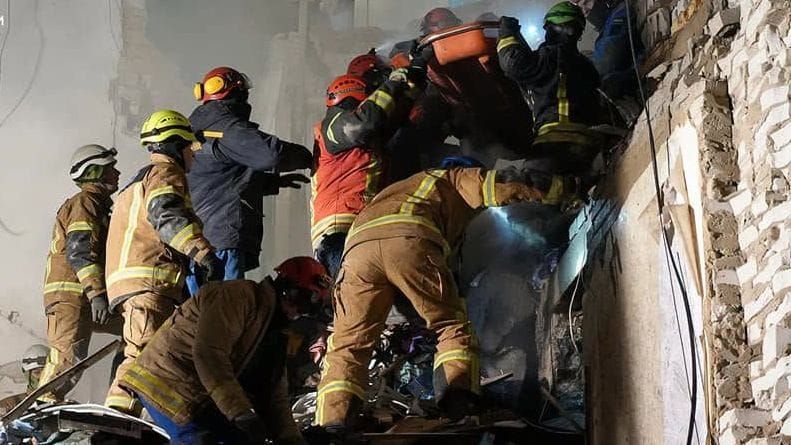
A Russian drone strike on an apartment block in Dymer, north of Kyiv, killed at least 11 people overnight on 22 November, the head of the regional administration said.
The drone brought down a section of the five-storey building, about 45 km from the capital, on all five floors and damaged a neighbouring kindergarten and a shop. Tymur Tkachenko, head of the Kyiv Regional Military Administration, raised the toll to 11 on the morning of 23 November after rescuers recovered another body from beneath the rubble, and the search was continuing. Russian attacks killed at least four more people elsewhere in Kyiv region on 22 November.
Initial reports on the morning of 22 November put the dead at two, an 18-year-old man and a woman. The State Emergency Service said four people, including a child, were injured and 11 residents were missing. President Volodymyr Zelenskyy said later that morning that rescuers could not reach 14 people who lived in the building. Overnight into 23 November, Tkachenko reported that eight more bodies had been found and that a 79-year-old woman had been pulled out alive.
The emergency service said two of the dead were a 48-year-old woman and an 18-year-old. Arkadii Kozenko said his 18-year-old son, Roman Komarenko, had been in the building and that the family lived in fear.
Davyd and Valentyna
Rescuers found a seven-year-old boy, Davyd, after he had spent 14 hours under the debris, freed him and handed him to doctors. The emergency service said his rescue was "a true miracle". The 79-year-old woman, Valentyna, had been trapped for 22 hours, said Viktoriia Ruban, a spokeswoman for the service, and constant air raid alerts and the threat of drones held up the work.
Vyshneve and Bila Tserkva
A Russian drone hit a supermarket in Vyshneve, on the south-western edge of Kyiv, on the evening of 22 November while shoppers were inside, killing three people and injuring 15, three of them children, Mayor Illia Dikov said. The fire spread along the food shelves. "An ordinary shopping trip turned into a tragedy due to a Russian attack," Tkachenko wrote. An attack on a house in Bila Tserkva district the same day killed one person and set the building alight.
Dmytro Lubinets, Ukraine's parliamentary human rights commissioner, said the strikes were part of a genocidal war against Ukraine. Foreign Minister Andrii Sybiha urged European governments to stop treating Russian attacks as isolated incidents.
165 missiles in a week
Russia launched about 2,700 attack drones, nearly 1,460 guided aerial bombs and 165 missiles at Ukraine in the week to 22 November, and hit 20 regions, Zelenskyy said. The missiles included upgraded North Korean ballistic missiles. Strikes on the power grid have increased as temperatures fall towards freezing, and Prime Minister Sergiy Koretsky said a substation in Dnipropetrovsk region was hit on 22 November.
Ukraine received an average of 12 Patriot interceptors a month from the U.S. in 2026, Zelenskyy told reporters at an earlier closed briefing. On 22 November he urged the U.S. government to authorise transfers of Patriot missiles that European allies have already paid for through NATO's Prioritised Ukraine Requirements List, which need U.S. approval when they come from third countries. He said the delays in delivering "anti-ballistic systems to Ukraine" were particularly difficult to understand. Ukraine is short of the U.S.-made interceptors, which can stop ballistic missiles.
President Vladimir Putin threatened a far more painful response to Ukraine's strikes on the Crimean Bridge, which brought down its main road span on 17 November. He made the threat after meeting President Donald Trump and President Xi Jinping in Shenzhen on 19 November. The search and rescue operation in Dymer was still under way on the morning of 23 November.