An Army officer wounded in the Iranian drone strike that killed six U.S. soldiers in Kuwait on 1 March has told Congress that commanders dismissed warnings the post was exposed to attack from the air.
Maj. Stephen Ramsbottom, deputy chief of operations of the Army Reserve's 103rd Expeditionary Sustainment Command, sent the complaint to the House and Senate Armed Services committees on 13 November. His lawyer, Andrew Bakaj of Compass Rose Legal Group, also filed the complaint with the Pentagon's inspector general and asked the committees to obtain the Army's investigative files.
Ramsbottom's complaint says the drone threat was raised with the commanding general of the 1st Theater Sustainment Command at least three times in the week before the war began, and that each warning was dismissed. It also alleges that the post at Port Shuaiba had no physician, no fixed aid station and one ambulance, and that at least one of the six dead might have survived with adequate medical support on site.
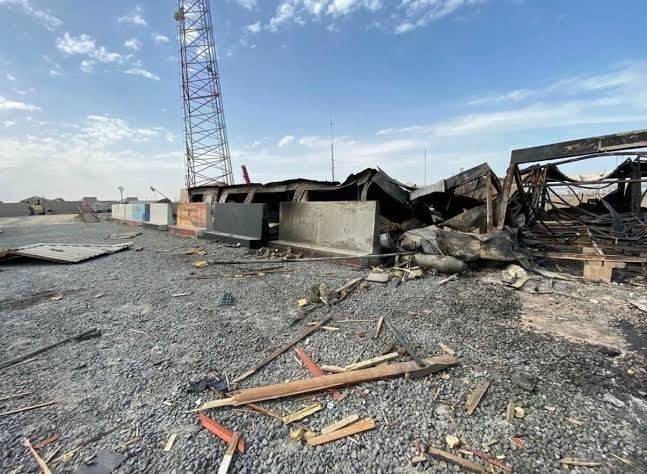
The six reservists were the first U.S. service members killed in the war, which the U.S. and Israel launched on 28 February. Hegseth told reporters on 2 March that the drone had struck a fortified tactical operations centre. Survivors have since described a building ringed with concrete T-walls built to stop ground-level blasts, with no hardened protection overhead. The Army says it has completed its investigation and has released none of its findings.
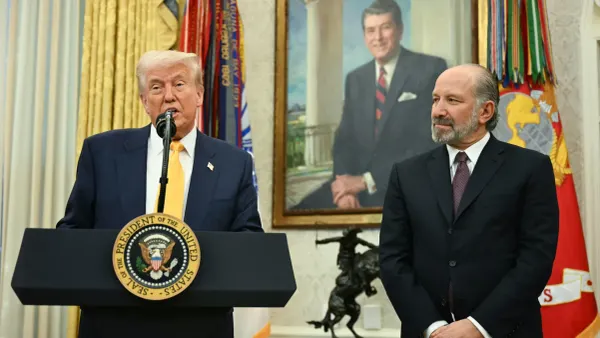
A Pentagon spokesperson declined to comment on the allegations, including whether adequate protection was in place. At his 2 March news conference Hegseth described the drone as a rare one that evaded U.S. air defences. "We call it a squirter that makes its way through," he said. Donald Trump wrote on social media on 16 November that only two drones got through and that Central Command's defences had been historically effective.
The operations centre at Shuaiba
The 103rd had been based at Camp Arifjan, the main U.S. Army installation in Kuwait, before the Pentagon dispersed troops to smaller sites to make them harder to target. Port Shuaiba is a working commercial port and industrial area south of Kuwait City.
Soldiers at the port were told it was safe to leave their bunkers on the morning of 1 March. About 30 minutes later a Shahed-type one-way attack drone hit the operations centre. Sgt. 1st Class Nicole Amor, Sgt. Declan Coady, Capt. Cody Khork, Maj. Jeffrey O'Brien, Chief Warrant Officer 3 Robert Marzan and Sgt. 1st Class Noah Tietjens were killed. More than 30 others were wounded, Ramsbottom among them.
Ramsbottom told the CBS programme 60 Minutes, in an interview broadcast on 15 November, that the defences at the port were designed for car bombs. "There was nothing there designed to protect from an aerial attack," he said. He has also said that superiors told him protection was not a concern when he raised the risk of an air attack, and that a counter-drone system military leaders said they would try to send never reached Shuaiba. He said he did not know whether it had ever been ordered.
The complaint asks why the unit was placed at Shuaiba when sites farther from Iran were available. It asks the Defense Department to preserve evidence and to protect service members who come forward from retaliation. Ramsbottom also accepted a share of the blame on air, calling the strike a tactical failure by the Army, its leadership and himself.
Hinson and Barnes
Seventeen survivors and witnesses gave The Washington Post a similar account in July. Three of them said that Maj. Gen. John Hinson and Brig. Gen. Clint Barnes received classified briefings before the war identifying Port Shuaiba as a potential Iranian target. Force-protection assessments found that troops should not be stationed at the port, and a complaint to the Army inspector general said those assessments recommended against moving any personnel there.
Soldiers asked for a mobile counter-drone system known as EAGLS. The request was refused because the military had none available. Nearby air defences could bring down some smaller drones, but the port had no defences built for Shahed-type weapons, and soldiers reported unidentified quadcopters over the port in the days before the attack.
Ramsbottom said in his television interview that he raised his concerns with Hinson. A U.S. official said in July that the Army's completed investigation assigns no fault and recommends no punitive action. Army Central, the command responsible for U.S. Army forces in the region, said that the site had been chosen in line with existing operations plans and was fortified, with sufficient bunker space. It did not say whether the assessments had advised against the port or whether the counter-drone request was denied. A separate classified Army Central investigation examined the warnings and the defences, and its findings will be kept from the public.
Blumenthal's letter
Richard Blumenthal, the Connecticut Democrat who is ranking member of the Senate Permanent Subcommittee on Investigations, wrote to Hegseth on 15 November after reviewing the complaint. He asked Hegseth to attend a classified briefing and to provide "all force protection assessments" for the post.
Blumenthal was among four Democratic senators, with Elizabeth Warren, Kirsten Gillibrand and Mark Kelly, who first wrote to Hegseth about the strike on 26 April. Warren and Representative Pat Ryan opened a second inquiry into medical care for the wounded on 30 July and set a deadline of 12 August for answers.
On 22 September, 21 Democratic members of both chambers asked the Republican chairs of the Armed Services committees, Senator Roger Wicker and Representative Mike Rogers, to hold public hearings. Their letter said the Pentagon had answered none of the July questions and had withheld the Army's investigation results from Congress despite repeated requests. The first investigating officer appointed was a public affairs officer serving under a commander who was present during the strike, the letter said. His replacement was junior in rank to the commanders of the 103rd and the 1st Theater Sustainment Command, both of whom were at the port.
The 211 to 204 vote
Thomas Massie, a Republican congressman from Kentucky, first moved to impeach Hegseth on 15 September. House leaders ended the session before a vote. Massie, who lost his May primary to a challenger backed by Trump, reintroduced a 34-page resolution with eight articles on 9 November. The articles accuse Hegseth of waging war on Iran without congressional authorisation, ordering unlawful strikes on suspected drug-smuggling boats and dismantling safeguards against civilian casualties.
The House voted 211 to 204 on 10 November to refer the resolution to the Judiciary Committee, where it sits for the rest of the Republican-controlled Congress. Massie was the only Republican to vote against referral. Every Democrat present voted with him, but 11 Democrats missed the vote, as did seven Republicans.
Hegseth told reporters at the Pentagon that morning that the effort was a stunt by one disgruntled congressman. Trump called the result an "EXONERATION" on Truth Social and described Massie as the loser.
Smith's first witnesses
Democrats won control of the House in the 3 November midterm elections, and the new Congress convenes on 3 January 2027. Adam Smith of Washington, the senior Democrat on the House Armed Services Committee, is in line to become its chairman. Smith has said that Hegseth and Deputy Defence Secretary Steve Feinberg will be the first officials called to testify. As chairman he would hold the power to subpoena witnesses and documents, including the force-protection assessments for Port Shuaiba, the Army's completed investigation and the classified Army Central report.