
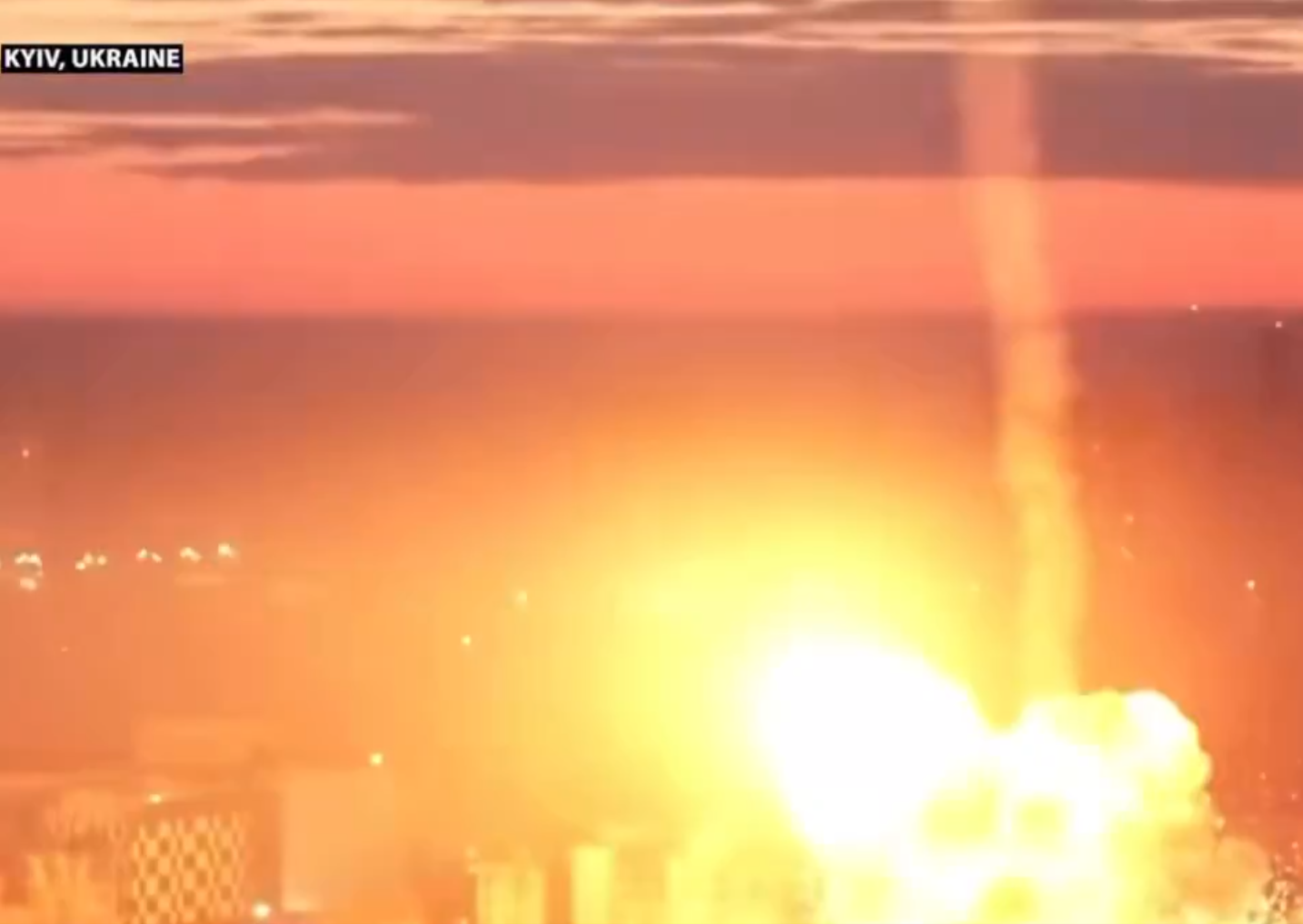
Russia launched one of the largest aerial terrorist attacks of the war against Kyiv and the surrounding region overnight on 24 May, firing 90 missiles alongside 600 attack drones. At least four people were killed across Kyiv and the wider region and more than 80 wounded. Kyiv Mayor Vitali Klitschko said damage was recorded in every district of the city.
The attack included a nuclear-capable Oreshnik hypersonic ballistic missile, the third time Russia has used the weapon in the full-scale war. Ukrainian President Volodymyr Zelensky confirmed in a post on Telegram that the Oreshnik struck Bila Tserkva, a city of 200,000 people located approximately 64 kilometres south of Kyiv's outskirts. The target was not immediately identified.
Ukraine's air force said it destroyed or jammed 549 drones and 55 missiles. Approximately 19 additional missiles failed to reach their targets. Roughly 36 missiles and 51 drones struck.
What was hit
The National Chornobyl Museum in Kyiv's Podil district was nearly completely destroyed. The museum was housed in a historic early 20th-century fire watchtower, itself a nationally designated architectural and artistic monument. The fire brigade that operated from that tower in the 1980s was among the first to respond to the 1986 Chornobyl nuclear disaster, the event the museum was built to commemorate. The museum had just reopened following extensive restoration in early May 2026, ahead of the disaster's 40th anniversary. Interior Minister Ihor Klymenko confirmed its destruction. Zelensky visited the site on Sunday morning.
The Ancient Kyiv Historical and Architectural Reserve was also struck. The Contract House, among Kyiv's older surviving civic buildings, sustained damage. In the Shevchenko district, a five-story residential building was hit and caught fire, killing one person. A school building in the same district was struck while people were sheltering inside. A missile hit a building adjacent to the Dominican Monastery and St Thomas Aquinas Institute of Religious Studies; Father Jaroslaw Krawiec said the chapel, auditorium, and lecture halls were all damaged and that windows and doors across the monastery complex had been blown out. The Foreign Ministry building sustained damage. Supermarkets and warehouses across the city were hit. The historic Independence Square area had windows blown out.
In Bila Tserkva, the Oreshnik strike hit infrastructure. The target and the extent of damage were still being assessed at the time of publication.
Outside the capital, explosions were reported in Cherkasy, Kropyvnytskyi, and Khmelnytskyi Oblast. One person was killed and more than 20 injured in 33 separate attacks on settlements in Sumy region over the previous 24 hours.
Nataliia Zvarych, 62, who sheltered in her local metro station as the explosions began, described the night to CNBC: "It was terrifying, scary."
Poland scrambled Polish and allied fighter jets to protect its own airspace as the attack unfolded.
The Oreshnik
The Oreshnik is a medium-range hypersonic ballistic missile with a multiple-warhead delivery system capable of carrying both nuclear and conventional payloads.
Putin has said it travels at 10 times the speed of sound, renders air defence systems ineffective, and can destroy underground bunkers "three, four or more floors down."
He has stated that several such missiles, even fitted with conventional warheads, could be as devastating as a nuclear weapon. Russia first used the Oreshnik against the Ukrainian city of Dnipro in November 2024. It was used a second time against Lviv in January 2026, killing four and injuring 25. Sunday's use against Bila Tserkva is the third deployment.
Putin ordered the strikes citing a Ukrainian drone attack on a "student dormitory" in Starobilsk, a town in Russian-occupied eastern Ukraine, on Friday. Russia's Ministry of Emergency Situations claimed at least 21 were killed and 42 injured. Ukraine denied targeting the dormitory.
The stated claim for the attack is the same one Russia has used across the full-scale invasion; it repeatedly claims retaliation for Ukrainian strikes on Russian-occupied territory. The Chornobyl Museum, the Dominican Monastery, the residential building in Shevchenko district, and the school where people were sheltering are not military facilities. Russia's stated justification and the documented targets are irreconcilable.
The second mass attack in eleven days
The 24 May attack follows an even deadlier barrage between 13 and 15 May, when Russia launched 675 drones and 56 missiles primarily against Kyiv. A cruise missile struck a nine-story corner apartment building in the city's Darnytsia neighbourhood, collapsing all 18 apartments. Twenty-four people died, including three teenagers. That attack took place as ceasefire negotiations involving the United States were underway, with Ukraine having already offered a 30-day pause in fighting. Russia refused.
The civilian toll across the war
The UN Human Rights Monitoring Mission in Ukraine verified 2,514 civilian deaths and 12,142 civilian injuries in 2025 alone, a 31% increase on 2024 and 70% higher than 2023. That trend has not reversed in 2026. In the first four months of this year, HRMMU verified 815 civilians killed and 4,174 injured, a 21% increase on the same period in 2025 and 93% higher than January-April 2024. April 2026 was the deadliest month for civilians since July 2025. Short-range drones killed and injured more civilians in April 2026 than in any month since the full-scale invasion began in February 2022.
More than a third of those killed or wounded across the war were located far from the front lines at the time of attack. The cumulative OHCHR total since February 2022 now stands at 15,850 killed and 44,809 injured in verified cases. The OHCHR notes the real numbers are higher.
UN human rights chief Volker Türk said this month: "I deplore the resumption of these large-scale attacks which have resulted in civilian casualties across the country. Attacks by long-range weapons are one of the leading causes of civilian casualties in Ukraine."
Danielle Bell, who heads the mission, attributed the rise to "the expanded use of long-range weapons, which exposed civilians across the country to heightened risk."
Every 2026 figure confirms that pattern is intensifying.
The largest single driver of the civilian casualty increase is the Russian FPV drone campaign. First-person-view drones give the operator a live, high-resolution camera feed directly to the target. The UN mission documented a "clear and disturbing pattern" of Russian operators using this capability to deliberately hunt and kill civilians who showed no signs of direct participation in hostilities. The documented victims include civilians on bicycles, in private cars, on public buses, in ambulances, while delivering humanitarian aid, during evacuations, walking outdoors, and on their own residential property.
The HRMMU assessed that the targeting "violated core international humanitarian law principles of distinction and precaution" and that some incidents "may amount to intentionally directing attacks against civilians, a war crime."
Human Rights Watch published a 93-page report in June 2025, titled "Hunted From Above: Russia's Use of Drones to Attack Civilians in Kherson, Ukraine," documenting at least 45 deliberate Russian drone attacks on civilians and civilian objects between June and December 2024, based on interviews with 36 survivors and witnesses, 83 videos uploaded to Russian military-affiliated Telegram channels, and visual material from researchers. Belkis Wille, associate director at HRW's crisis and arms division, said: "Russian drone operators are able to track their targets, with high-resolution video feeds, leaving little doubt that the intent is to kill, maim, and terrify civilians." The attacks caused depopulation of targeted areas in Kherson as residents calculated they could not safely leave their homes. Ambulance crews in some areas stopped responding to emergency calls entirely because the drones were targeting rescue workers arriving at attack sites.
That last detail connects to a pattern Ukraine's Prosecutor General's Office documented and released on 22 May 2026: more than 11,000 Russian FPV drone attacks on civilians since 2024, with a specific, systematic practice of "double strikes," firing a second drone at the same location after medics, firefighters, and police arrive to respond to the first. Criminal proceedings for drone attacks on civilians grew from 2,427 in 2024 to 6,771 in 2025, and reached 2,010 in just the first four months of 2026, at a pace that will exceed 2025's full-year total. In peak periods, prosecutors register 45 to 50 new proceedings per day. The Prosecutor General classifies the documented pattern, including deliberate targeting of medical personnel and emergency responders, as war crimes.
On 23 May 2026, one day before Russia fired the Oreshnik at Kyiv, a Russian FPV operator spotted a funeral procession in Sumy on his camera feed and steered the drone into it, killing one person.
In October 2025, the UN's Independent International Commission of Inquiry on Ukraine found that Russian authorities had committed crimes against humanity specifically through the drone attack campaign, establishing that the attacks were "systematically coordinated" to drive Ukrainian civilians from their homes across a zone spanning more than 300 kilometres along the right bank of the Dnipro River. That finding places the drone campaign beyond individual war crimes into the legal category requiring "widespread or systematic" conduct against a civilian population.
Some of the drones used in these attacks were identified by Human Rights Watch as models manufactured by DJI and Autel, two Chinese commercial drone companies. HRW wrote to both companies. Both responded. The Russian military entity Sudoplatov, also identified in attacks, did not respond.
HRW found that Russian operators used FPV drones to deploy banned antipersonnel landmines and carry out incendiary weapons attacks in populated areas, in addition to the direct hunting of civilians. Russian forces also launched more than 54,000 long-range drones against Ukraine in 2025 alone, at a rate of 1,200 to 1,400 FPV drones per day, according to Ukraine's Arms Monitor. In November 2025, Russian forces struck the Kyiv-region city of Vyshgorod with a Shahed drone equipped with cluster munitions designed to maximise civilian casualties and complicate demining.
The World Health Organization verified 577 attacks on healthcare facilities in Ukraine in 2025 alone. Drone strikes on health infrastructure increased more than 1,000% between 2023 and 2025. More than 2,665 health facilities and personnel have been affected since February 2022. Drone attacks accounted for 70% of civilian casualties recorded in Kherson in January 2025, per the UN monitoring mission.
In Kherson Oblast alone, 287 civilians have been killed in drone strikes and 2,549 wounded since 2024, including children, out of a total of 5,303 criminal proceedings in that province alone. The province is not a frontline battlefield. It is a city with a civilian population that Russian drone units have been targeting with what survivors, witnesses, prosecutors, and three separate international human rights bodies have described as a systematic and deliberate campaign.
The total civilian death toll across the full-scale invasion stands between the 14,534 deaths the UN has directly verified and an estimated 38,000 injuries, with the total likely higher given the documented undercounting under active hostilities.
International Law
Under the Geneva Conventions and their Additional Protocols, parties to a conflict are bound by the principles of distinction, proportionality, and precaution. Distinction prohibits attacks that fail to differentiate between combatants and civilians. Proportionality prohibits attacks where expected civilian harm is excessive relative to anticipated military advantage. Deliberate attacks on civilian objects, cultural sites, hospitals, and energy infrastructure constitute war crimes under the Rome Statute.
The Public International Law and Policy Group concluded that Russia's campaign meets the threshold of "indiscriminate and disproportionate" attacks. The OSCE's Office for Democratic Institutions and Human Rights said Russia "escalated the use of weapons with wide area effects in urban areas across Ukraine, in blatant disregard of IHL." Human Rights Watch found that strikes "when committed deliberately or recklessly, constitute war crimes" and that those designed to instil terror "may amount to crimes against humanity."
The European Parliament in its April 2026 resolution stated Russia has "deliberately and repeatedly targeted civilians and civilian objects," calling these acts "grave violations of international humanitarian law, including the Geneva Conventions and the Rome Statute." The European Court of Human Rights, in the July 2025 case of Ukraine and the Netherlands v. Russia, held Russia accountable for widespread and flagrant violations of the European Convention on Human Rights in connection with the conflict.
Accountability
The ICC issued arrest warrants for Putin and Children's Rights Commissioner Maria Lvova-Belova in March 2023. Those warrants cover the unlawful deportation of Ukrainian children, not the mass civilian strikes, partly because establishing individual criminal responsibility for a sustained aerial campaign is harder to document than child transfers that left a paper trail. Putin has not been arrested. He attended a BRICS summit in 2024 without incident. The UN Secretary-General met with him there. Russia has opened criminal proceedings against ICC prosecutors and judges; UN Special Rapporteurs in February 2026 called on Russia to stop what they described as reprisals and intimidation against the court.
The Security Council route is blocked. Russia's permanent seat and veto power mean no referral to the ICC is possible through that channel.
The European Union is finalising a six billion euro drone support package for Ukraine. Von der Leyen stated on Sunday: "Russia's massive attack on Ukraine last night shows the Kremlin's brutality and disregard for both human life and peace negotiations. Terror against civilians is not strength." The EU Parliament's April 2026 resolution notes that any future ceasefire "must not be allowed to impede, delay or undermine ongoing and future accountability processes" and that accountability and peace are "mutually reinforcing imperatives under international law." That is the correct legal position. The political infrastructure to enforce it does not presently exist.
At the UN Security Council, Russia called an emergency meeting on Sunday to present its own account of the attack. Ukraine's ambassador Andrii Melnyk denied his Russian counterpart's version. Neither a resolution nor a referral to any international mechanism will emerge from that body. Russia's veto ensures it.
International condemnations
The reactions from European leaders arrived within hours of the attack.
Von der Leyen posted on social media: "Russia's massive attack on Ukraine last night shows the Kremlin's brutality and disregard for both human life and peace negotiations. Terror against civilians is not strength."
She said the EU was sending additional support to help Ukraine reinforce its air defence systems, pointing to the six billion euro drone package being finalised.
French President Emmanuel Macron and German Chancellor Friedrich Merz both condemned the strikes and specifically named the use of the Oreshnik. Kallas said top EU foreign ministers would meet within days to "discuss how to dial up the international pressure on Russia."
The meeting had not been scheduled as of the time of publication.
Zelensky, visiting the destroyed museum on Sunday morning: "It's important that this does not remain without consequences for Russia. Decisions are needed, from the United States, from Europe and others."
The UN Security Council meeting
Russia called a UN Security Council emergency meeting on Friday, 22 May, nominally over Ukraine's drone strike on a vocational college in Starobilsk, a Russian-occupied city in the Luhansk region of Ukraine. Russia claimed the strike killed 21 people and injured 42, including students. Putin described it as a "monstrous crime" and ordered the military to prepare retaliatory strike options. Ukraine denied targeting the college, saying its forces had struck an elite Russian drone command unit operating from the area. The Investigative Committee opened a criminal probe into terrorism.
The same session that Russia convened to present its grievances over Starobilsk became the forum in which the Kyiv attack was addressed. At the UN Security Council emergency meeting, Ukrainian Ambassador Andrii Melnyk rejected Russia's account and denied his Russian counterpart Vasily Nebenzya's accusations of Ukrainian war crimes, calling the proceedings a "pure propaganda show." Melnyk stated that Ukraine's 22 May operations "exclusively targeted the Russian war machine."
When Nebenzya extended a rhetorical invitation for Melnyk to visit Russia and see its economy for himself, Melnyk replied with a statement that drew wide attention:
"Even if Russia is defeated, even after the fall of Putin's regime, reparations will be paid, when the next Russian government begs on its knees for forgiveness, and all war criminals are convicted. I will not be visiting Moscow for the next several decades."
Melnyk described the very convening of the session as "a sign of weakness and an attempt to turn the tide and to squeeze a tear out of this Council."
The structural outcome of the meeting was identical to every Security Council discussion of Russia's conduct in Ukraine since February 2022: Russia presented its version, Ukraine rejected it, Western members condemned the strikes, and no binding resolution passed or was even proposed. Russia's permanent seat and veto power ensure that no mechanism capable of imposing consequences can emerge from that body on this subject.
Ukraine's air force intercepted the majority of what Russia fired. The majority means not all. The Chornobyl Museum had opened three weeks ago after years of restoration. It took one night to destroy.