"Every spy and coercion agency in the world has their own version of the Epstein files and much much more."
— Heather Marsh, The Epstein Files, 2025
On the morning of January 30, 2026, Deputy Attorney General Todd Blanche stood before cameras and announced the largest single disclosure of law enforcement materials in the history of any child rape and trafficking investigation anywhere in the world. Over three million pages, 2,000 videos, approximately 180,000 images. The DOJ had complied with the Epstein Files Transparency Act. Two days later, Rep. Ro Khanna publicly stated he had outstanding questions about why, by the DOJ's own internal accounting, 2.5 million documents potentially qualifying for release remained out of public view.
The gap between Blanche's statement and Khanna's question is where this story lives.
The Five Sources
The January 30 release drew from five primary documentary collections. The Florida and New York criminal cases against Epstein, covering the Palm Beach investigation and the 2019 federal charges on which he died before trial. The New York case against Maxwell, the trial at which she was convicted in 2021 of five counts including rape trafficking of children. The New York cases investigating Epstein's death at the Metropolitan Correctional Center, including the OIG investigation and the cases against the two correctional officers who falsified records the night he died. A Florida case examining the conduct of a former Epstein butler. And multiple FBI investigations, including Organised Crime Drug Enforcement Task Force materials.
The DOJ's stated approach was to err on the side of over-collection. Anything potentially responsive was included. This meant the release contained fabricated public submissions to the FBI, anonymous tips, letters, and online posts alongside official investigative materials. The DOJ noted explicitly that the files contained submissions made before the 2020 presidential election containing what it described as untrue and sensationalist claims against Trump. These were included because the law required the release of everything in the FBI's possession related to Epstein, regardless of the FBI's own credibility assessment of the materials.
What Was Genuinely Significant
The FBI inner circle diagram had never before been published. This organisational chart mapped Epstein's documented network as understood by the FBI. At the centre was Epstein. Connected were Maxwell, listed as accomplice; Darren Indyke, listed as attorney; Richard Kahn, listed as accountant; Jean-Luc Brunel, listed as model agent; Epstein's personal chef; his pilots; and Peter Listerman, described as a model scout and matchmaker. Les Wexner appeared. Other names were redacted. The diagram was the FBI's working model of who ran the rape trafficking network and how.
The grand jury testimony from FBI agents documented specific recruitment methods, payment structures, locations of abuse, and the use of survivors as recruiters. It documented the youngest interviewees. It documented the specific language Epstein used, "massage" and "therapist," to frame encounters that were, in the agents' sworn description, child rape.
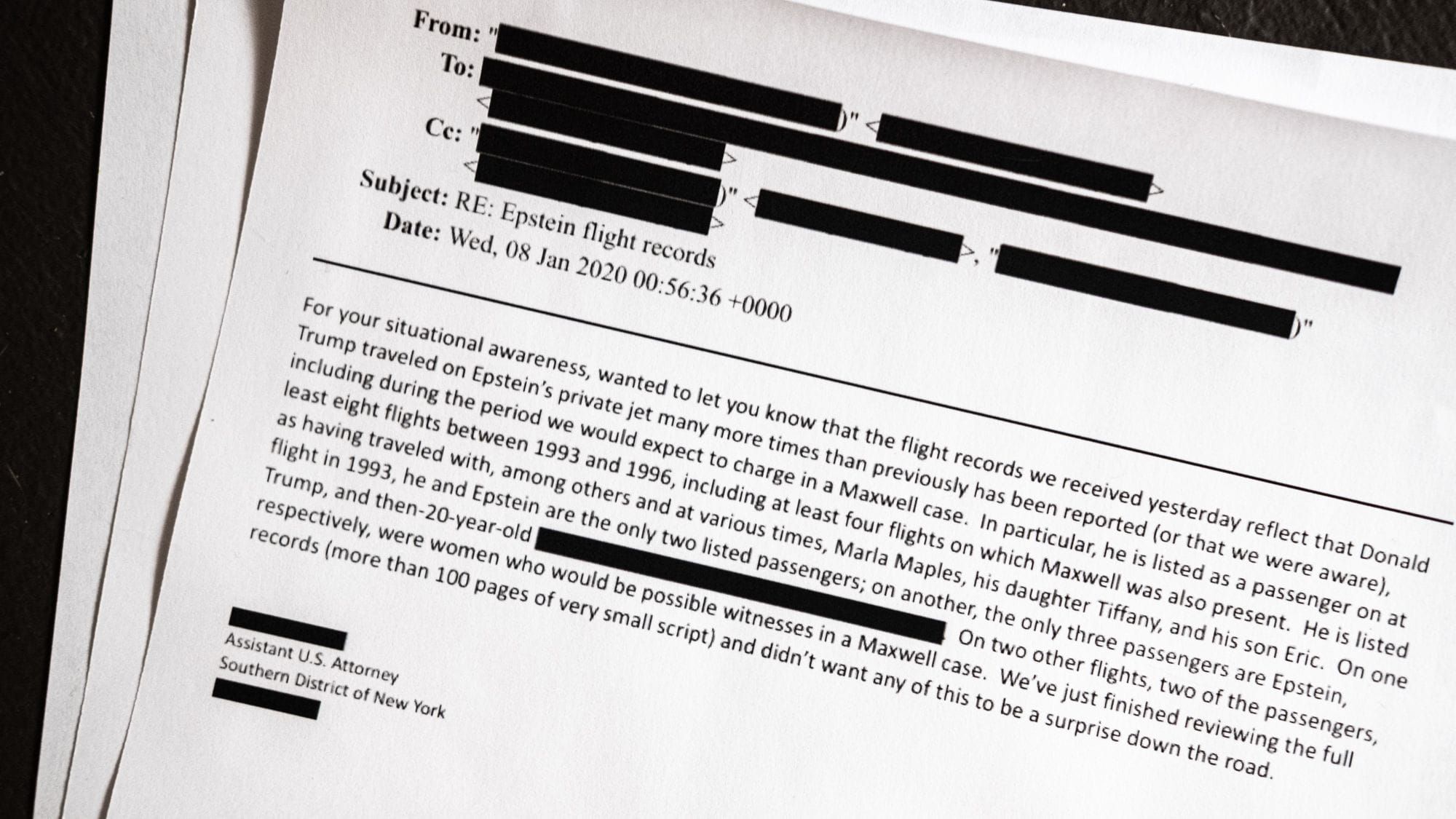
A federal prosecutor recorded in January 2020, months after Epstein's death, that Trump had flown on Epstein's private plane more times than had previously been publicly known. This note, documenting conversations held during the early stages of the Maxwell investigation, was among the materials the DOJ had not voluntarily disclosed and that only appeared after the Transparency Act mandated it.
Emails between Maxwell and someone signing off as "A," whose contextual references included questions about Los Angeles and discussions of mutual acquaintances, contained the line "How's LA? Have you found me some new inappropriate friends?" These were among the materials widely interpreted as confirming Prince Andrew's direct correspondence with Maxwell about specific social arrangements, and were among the grounds cited by UK police when they opened their investigation into Mountbatten-Windsor.
Documentation confirming that the DOJ had subpoenaed Trump's Mar-a-Lago club before Maxwell's 2021 trial also appeared. The subpoena had been rumoured but never officially confirmed. Its presence in the release indicated that prosecutors had considered Mar-a-Lago a relevant location in the Maxwell investigation.
Among the images was a photograph of what appeared to be a desk covered in photographs of Epstein, Maxwell, and public figures including Trump. Also visible was a photograph of Epstein with Pope John Paul II.
The 6 Million Page Problem
The DOJ had acknowledged internally that the total universe of materials potentially qualifying for release under the Act might reach 6 million pages. The January 30 release covered approximately 3.5 million. The difference, 2.5 million pages, is not a rounding error. It is a volume larger than all prior Epstein-related document disclosures combined.
Blanche stated in his January 30 announcement that the unreleased materials were either duplicates, outside the Act's scope, or legitimately protected under the statute's specific exemptions. He provided no breakdown. He offered no means by which independent researchers could verify the categorisation.
Independent journalist Roger Sollenberger had been conducting a forensic cross-reference of the public release against Maxwell's pretrial discovery materials, a list of documents provided to Maxwell's defence team by SDNY prosecutors that included document numbers and Bates stamps. By comparing that list against what was publicly available, he could identify specific documents that should exist, per their own numbering, but did not appear in the public database. His count reached a minimum of 37 specific missing pages. Among them were three FBI interview summaries of a woman who had made child rape allegations against Trump.
The Three Withheld Summaries
The accuser, whose identity has not been made public, gave the FBI four interviews. One interview summary appeared in the January 30 release, focusing on Epstein without mentioning Trump. Three summaries that did mention the child rape allegation against Trump were not in the release. Sollenberger identified the gap because all four summaries were listed in Maxwell's discovery materials and only one appeared publicly.
NPR reported the finding in late February 2026. Democrats on the Oversight Committee stated the withholding potentially violated the Transparency Act's explicit prohibition on withholding materials based on political sensitivity.
On March 5, 2026, the DOJ released the three summaries, describing their omission as documents incorrectly coded as duplicative. The summaries contained detailed FBI interview notes in which agents recorded the accuser's allegations that Epstein had introduced her to Trump when she was approximately 13 years old, and that Trump had raped her. The allegations were described by the DOJ as unsubstantiated. Trump denied wrongdoing.
Miami Herald investigative reporter Julie K. Brown told PBS NewsHour that DOJ officials who interviewed the accuser found her to be credible, and that they wouldn't have interviewed her four times if they didn't.
The Fake Letter
The release also contained a letter purportedly signed by Epstein and addressed to Larry Nassar, the USA Gymnastics doctor convicted of systematically raping hundreds of athletes, containing what appeared to be a lewd reference to Trump. The DOJ announced the letter was fake. Wrong postmark city, handwriting inconsistent with Epstein's, structural anomalies inconsistent with authenticated Epstein correspondence. It was included because the Act required the release of everything in the FBI's possession related to Epstein, including materials the FBI itself had flagged as fabricated.
When a journalist questioned why a document the DOJ believed to be fake was included in the release, the department's official social media account responded, "Because the law requires us to release all documents related to Jeffrey Epstein in our possession so that's what we are doing, you dope."
The exchange captured something important about the institutional disposition toward the entire process. Technically correct compliance, delivered with contempt.
The Survivor Response
Eighteen of Epstein's rape survivors issued a joint statement. "Once again, survivors are having their names and identifying information exposed, while the men who abused us remain hidden and protected."
Annie Farmer, one of the women who testified against both Epstein and Maxwell, told NPR that the redaction inconsistencies confirmed her fear that the process was not designed to protect survivors. The same department that had failed to notify survivors of the 2008 non-prosecution agreement before it was signed, that had redacted the faces of women while exposing their names, was now presenting selective transparency as fulfillment of a statutory mandate.
The Cover-Up the Release Confirmed
The January 30 release, taken with everything that came before and after it, is not just a document disclosure. It is a documented record of an institution managing what the public would be allowed to know, at each stage doing the minimum the law forced and no more, and in several instances doing less than that.
The three withheld Trump summaries are the clearest example. These were not missing because of technical failure. They were identifiable through Maxwell's own discovery materials, meaning SDNY prosecutors had them, knew they had them, and chose not to include them in a release the law required to be complete. The DOJ's explanation, a coding error, requires believing that three documents containing child rape allegations against the sitting president were accidentally grouped together and accidentally excluded. They were released only after an independent journalist identified the gap through forensic document analysis and a national news outlet reported it.
The pattern that runs from December through March is consistent. Materials implicating powerful men are withheld or obscured. Materials identifying survivors are published. Gaps are described as administrative. Corrections happen only when external pressure makes concealment more visible than disclosure.
What makes this a cover-up rather than incompetence is not any single decision. It's that the decisions consistently run in one direction. Every error, every coding mistake, every redaction judgment call, every choice about what counted as a duplicate, produced outcomes that protected men with power and exposed women and girls without it. Incompetence produces random errors. This produced a pattern.
The DOJ was also the institution that negotiated the 2008 non-prosecution agreement giving Epstein immunity. It was the institution that failed to notify survivors before signing that agreement, a violation the courts later found to be a federal crime. It was the institution that closed investigations, dropped charges, and managed the case in ways that consistently served Epstein and his associates rather than the children they raped. Putting that institution in charge of disclosing the record of its own conduct was always going to produce exactly what it produced.
The Act changed what was public. It did not change who decided what was public, or why. One conclusion runs through every stage of the release process from December 2025 through the March supplementary releases. Left to its own judgment, the DOJ would have released what it decided to release. The law forced more. Independent journalism forced more still. At each stage, what was held back could only be identified through external analysis, through document numbering forensics, through Maxwell discovery cross-references, through reporters checking what the DOJ said it had released against what could be verified to exist.
The question this raises is not who was on the flight logs. It is why 2.5 million pages that should be public are not, who decided that, under what authority, and what is in them that made the decision worth making.
This article is part of an ongoing investigative series on the Epstein files, the networks they document, and what genuine accountability would, in collaboration with OpDeathEaters.
OpDeathEaters is an open-source, investigation into the global child rape and trafficking industry, founded by Heather Marsh in November 2014. Its objective is an independent, victim led, internationally linked tribunal and inquiry operating outside all institutions that may themselves be under investigation for complicity. Marsh has been repeatedly censored for speaking about the need for this inquiry, including at the Oxford union in February 2018. The opdeatheaters campaign has been targeted continually for well over a decade by social media censorship, the creation of decoy ops, such as Pizzagate, and QAnon, and other sophisticated coercion methods.
The work is open to everyone. OpDeathEaters needs researchers to collect, fact-check, and distribute verified testimony and evidence; people in every country to build public support for independent inquiries; journalists and lawyers willing to work with protected sources; and anyone able to translate, amplify, and organise locally. Evidence and witnesses are widely available. The goal is a global network, autonomous to each region but internationally connected.
Follow opdeatheaters on Bluesky and Twitter and make connections with others you can work with.
OpDeathEaters on X: @OpDeathEaters.
On Bluesky: bsky.app/profile/opdeatheaters.