"Stop using their language: 'scandal,' 'historical child sex,' 'child prostitute,' 'conspiracy theory.' Describe the crimes: child rape, torture, murder, abduction, trafficking, blackmail, obstruction of justice, influence peddling, and treason."
— Heather Marsh, OpDeathEaters
The first files released under the Epstein Files Transparency Act arrived on December 19, 2025. Within 24 hours the pattern that would define every subsequent release had already taken shape. The DOJ was complying with the form of the law while working against its purpose.
What Arrived
The release contained thousands of files, enough to make immediate comprehensive analysis impossible. What journalists and researchers could establish quickly was that nothing was organised in any way that helped navigation. There was no index, no chronology, no grouping by subject, case, or date. Duplicate copies of the same documents were scattered throughout, sometimes with different redaction levels applied to the same passages.
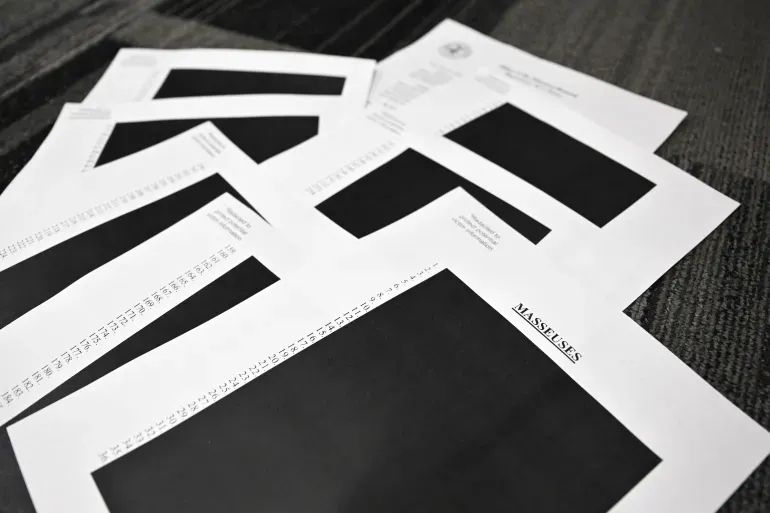
The blacking-out was immediate and contested. At least 550 pages in the initial release were fully redacted, solid black on every line, no visible text. One 119-page document labelled "Grand Jury-NY" was redacted in its entirety. Three consecutive documents totalling 255 pages were similarly unreadable. The same DOJ PowerPoint presentation, prepared the previous autumn and detailing the timeline of the Epstein and Maxwell cases, listing alleged victims and prominent figures in Epstein's orbit, appeared six times in the release, each version with different information obscured. That either represented extraordinary disorganisation or systematic testing of what could be removed without triggering a legal challenge.
The Transparency Act permitted redaction in two categories only. Personally identifying information of survivors, and material that would compromise an ongoing investigation. It explicitly prohibited redaction on grounds of political sensitivity. The redactions in the December 19 release were immediately challenged as going well beyond both permitted categories into material that could not plausibly fit either one. Massie said publicly that the DOJ had broken the law by making illegal redactions and by missing the deadline.
The Faulty Blackouts
Then came something stranger. Social media users discovered that a significant portion of the blackouts were not structural. They were cosmetic, text rendered visually invisible but still copyable. Select the blacked-out area, paste it into another application, and the underlying words appeared.
The flaw traced to a 2021 court filing by the Virgin Islands attorney general's office in a civil racketeering case against Epstein's estate. The DOJ had incorporated the document into its release without detecting that the redactions were not permanent. The content revealed by the exploit, involving specific names and transactions, spread widely on social media before the DOJ corrected the file. Whether this was a technical failure or a deliberate calculation that the material would reach the public through the exploit rather than through official release is not established. What is established is that the flaw disproportionately affected material redacted to protect the identities of powerful men, not survivors.
Survivors Exposed, Perpetrators Protected
NPR's review of the December and January releases identified a pattern that survivors and their attorneys had been warning about throughout the process. The DOJ was consistently failing to protect survivors' identities while successfully protecting the identities of men. In multiple documents, the names and identifying details of survivors who had already been identified in public proceedings appeared unredacted. In the same documents, the names of men appearing in investigative contexts, correspondence about meetings, financial transactions, social events, were obscured.
The DOJ's stated redaction policy was explicit about one thing. It had redacted every woman depicted in any image or video, with the exception of Ghislaine Maxwell, and had not redacted images of any men unless it was impossible to redact the woman without also redacting the man. On paper that sounds protective. In practice it produced a situation where the faces of girls and young women who had been raped were obscured while photos of their rapists, and the men who associated with those rapists, were published in full.
The text message exchange between Steve Bannon and Epstein appeared in the released files. A news article featuring Trump's face was included in the exchange. That face was blacked out with a rectangular overlay. No woman's face was in the same frame. The decision to redact the sitting president's image from a news article clipping, not to protect a survivor, not to protect a grand jury witness, simply to remove his face from the file, was documented, sourced, and widely circulated.
Eighteen Epstein rape survivors issued a joint statement. "Once again, survivors are having their names and identifying information exposed, while the men who abused us remain hidden and protected."
The Grand Jury Transcripts
The most significant new materials in the December period were the grand jury testimony transcripts, documents in which FBI agents described under oath the interviews they had conducted with girls and young women Epstein had raped. These were not testimony from the survivors themselves. They were agents describing what survivors had told them. The indirection meant the transcripts were admissible in the grand jury context without requiring survivors to testify in person. They were also, in their published form, the most detailed official documentation yet released of what happened to children at Epstein's properties.
One survivor, 21 years old when she testified, described being hired by Epstein at 16 to perform what he called a massage. She described what the massage became. She described being paid, and then being asked to recruit other girls from her high school. For every girl she brought to Epstein she received $200. She told them to lie about their age. "Just tell him that you are 18." The youngest person the FBI interviewed about Epstein, according to local media coverage of the released transcripts, was 14 years old.
These transcripts, describing child rape in specific detail, in sworn FBI testimony from an official investigation, received a fraction of the media attention given to documents mentioning politicians and celebrities. That disproportion is itself a finding about whose interests the redaction process served. The children who were raped were less newsworthy than the powerful people who knew their rapist.
The September and November Context
The December releases built on earlier disclosures from the House Oversight Committee, which had been separately releasing documents obtained from the Epstein estate. In September 2025, a committee release included a 2003 birthday note to Epstein appearing to bear Trump's signature. Written inside a drawing of a woman's figure, it ended with "A pal is a wonderful thing. Happy Birthday, and may every day be another wonderful secret. Donald J. Trump." Trump denied writing it. Republicans accused Democrats of cherry-picking documents. The note was not independently authenticated.
The September release also included Customs and Border Protection flight logs covering Epstein's plane from 2000 to 2014. Democratic lawmakers noted that only 3 percent of the pages in that batch were new to the public record, with the rest already disclosed through prior civil litigation.
In November 2025 the committee released 20,000 records from Epstein's estate including scores of emails. In one, Epstein wrote of Trump that "of course he knew about the girls as he asked ghislaine to stop." In others he corresponded with Harvard professor Larry Summers and attempted to reconnect with Bill Gates. None of those referenced were accused of wrongdoing by the committee. The email about Trump, unverifiable and attributed to a dead man who cannot be cross-examined, became one of the most circulated documents of the entire release.
Files Removed After Publication
Then files started disappearing. At least 16 files that had appeared in the initial release and been accessed by journalists were subsequently removed from the DOJ's public database. Among them was a photograph showing Trump. The DOJ confirmed the deletions and said the files were under review. They were not restored during the December period. Some were partially restored after the March 5, 2026 supplementary release.
The pattern repeated itself across the entire process. Publish, allow the press to access, remove when the political exposure became acute, describe the removal as administrative. At each stage it required independent journalism to document the gap between what was available and what the law required.
A Cover-Up in Plain Sight
Whether what happened across the December and January releases constitutes a cover-up depends on whether you think any of it was accidental. Taken individually, each failure has a possible innocent explanation. Taken together, across multiple releases, producing the same outcomes each time, they describe an institution that understood exactly what the law required and found ways to satisfy it on paper while limiting what it actually revealed.
The most straightforward piece is the selective redaction. When the same document protects the identities of men while exposing the identities of their victims, that isn't an administrative error. It's a choice about who gets protected. The DOJ wrote its own policy down. Redact women, publish men. That policy produced exactly the outcome it would predictably produce, and the people making those decisions knew it would.
The faulty blackout episode is harder to explain charitably. A federal agency releasing documents under a statutory mandate tests whether its redactions are permanent before publishing. If the cosmetic redactions were a genuine technical failure, the level of incompetence required is itself a finding. If they were deliberate, the calculation would have been that the material would enter the public record through the exploit while the DOJ retained plausible deniability. Either way, what got exposed through the flaw was material protecting powerful men, not survivors.
Removing files after publication is the hardest to explain as anything other than intentional. The DOJ published files, journalists accessed them, then the DOJ deleted them and described the deletions as administrative review. Removing a photograph showing Trump after journalists had already reported on it is not a redaction decision. It's retrieval of something that got out.
Then there's how the release itself was structured. No index, no chronology, duplicate files with inconsistent redactions scattered through a release too large to analyse quickly. That's not how you comply with a transparency law. That's how you produce a release large enough to claim compliance while ensuring that finding anything specific requires more time and resources than most newsrooms have.
The DOJ's public justification for every delay, every redaction challenge, and every removal was survivor protection. Blanche said it on national television. It was the framing used to make critics of the process appear to be arguing against the interests of the people the law was designed to serve. The same department making that argument was simultaneously publishing survivors' names while redacting the names of men. The argument and the conduct were not the same thing.
What the December process demonstrated is that an institution implicated in decades of failures around the Epstein case was put in charge of disclosing the record of those failures. The Transparency Act forced disclosure. It did not change who was doing the disclosing, or what their interests were in controlling what came out.
This article is part of an ongoing series on the Epstein files and what a genuine accountability process would look like. The series covers the documented networks, the institutional failures, the evidence of systematic protection, and the survivors whose testimony has been present in the public record for years.
Investigative journalists, researchers, and survivors have been building this record since long before the December 2025 file releases. That work, victim-centred, evidence-based, and independent of the institutions implicated, is what accountability journalism looks like.