In December 1988, 60 Minutes ran an investigation into a French modelling agent named Jean-Luc Brunel. Women spoke on camera about how he had used the promise of careers to rape models. The report ran internationally. No prosecution followed. Brunel kept working.
Thirty-two years later, in December 2020, he was arrested at Charles de Gaulle Airport while trying to board a flight to Senegal. French police charged him with rape of minors, sexual assault, and rape trafficking. He was 74. He died in his cell at La Santé Prison on February 19, 2022, before standing trial.
In the years between 1988 and 2020, Brunel had continued recruiting children for Jeffrey Epstein, co-founded a modelling agency funded with Epstein's money, appeared on 51 documented Epstein flight logs, been identified by survivors as a central figure in the trafficking network, and in 2016 approached federal prosecutors offering to hand over photographs and names, before going silent after a reported $3 million payment was apparently offered to stop him.
He is the story within the story. The way children were identified, moved, and delivered to Epstein ran through him. He died before any court could hear what he knew.
Origins
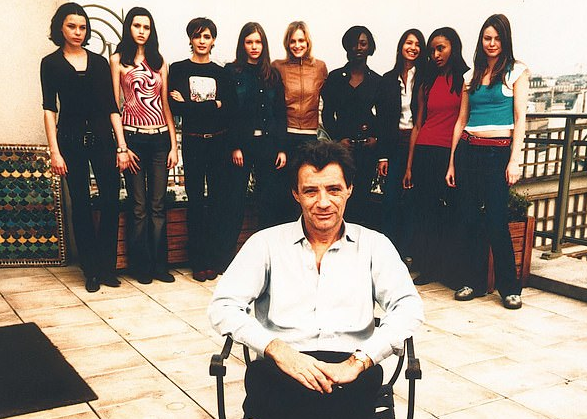
Brunel was born September 18, 1946, in Neuilly-sur-Seine, west of Paris. By the late 1970s he was running Karin Models, founded by Swedish model Karin Mossberg. He was a fixture in Paris fashion circles: an apartment on Avenue Hoche near the agency, tables at Les Bains Douches, dinners with people whose names he collected carefully.
Modelling gave Brunel a useful cover. It gave him a legitimate reason to approach young women, particularly those from places where a Western modelling contract seemed like a way out. It gave him professional authority. And it gave him legal cover: the difference between a modelling contract and a trafficking arrangement often came down to whether the girl went along with what happened after she arrived.
The 60 Minutes allegations were specific. Multiple women spoke on camera. The story ran around the world. Nothing happened. No investigation opened, in France or the United States. Brunel kept working. Within fifteen years he was running a new agency with money from a man US law enforcement had already identified as a serial child rapist.
MC2
The connection between Brunel and Epstein was made by Ghislaine Maxwell. By the early 2000s the two men were running what amounted to a shared criminal enterprise.
In September 2004, Epstein wired $1 million to a Brunel offshore bank account. The following year Brunel co-founded MC2 Model Management in Miami, with offices in Miami, Paris, New York, and São Paulo. A former MC2 bookkeeper later testified that girls brought to Epstein worked for MC2, that the agency and the trafficking were not separate things.
MC2 gave the whole arrangement a professional face. Modelling contracts. Visa paperwork. Travel bookings. It gave Brunel a reason to approach teenage girls in their home countries with the promise of international careers. It gave Epstein a steady supply of children who had been selected and in some cases already groomed before they met him.
Virginia Giuffre, one of Epstein's most extensively documented survivors, testified in civil depositions that Brunel recruited girls including herself and was directly involved in Epstein's operation. Epstein told Giuffre, in her account to prosecutors and courts, that he had "slept with over a thousand women that Brunel brought in." Whether that number is literal or not, it describes something that ran for decades across multiple countries.
Brunel appears on 51 documented Epstein flight logs between 1998 and 2007, on routes between New York, Palm Beach, Paris, London, and elsewhere. The January 2026 DOJ document release placed him in 756 case documents, three emails, and in the FBI's diagram of Epstein's inner circle as a named co-conspirator.
2016: The Offer That Went Nowhere
The most significant material about Brunel in the 2026 DOJ release had nothing to do with his recruiting role. It was about what happened in 2016, when he apparently decided to talk.
Documents released in the January 2026 DOJ dump, first reported in detail by the Wall Street Journal, confirm that in early 2016, three years before Epstein's second federal arrest, Brunel was in active contact with prosecutors in the Southern District of New York and with lawyers representing Epstein's survivors.
He was prepared to give them photographs and names. He knew how the network worked: who recruited children, how they were moved, what happened at which properties, who was there, and who had been kept out of trouble. He met in person with victims' rights attorney Bradley Edwards and talked for hours about cooperating. In Edwards' documented account, Brunel said he had recruited girls for Epstein and that he had photographs that would be damaging.
An email in the 2026 DOJ release shows Epstein writing to Kathy Ruemmler, a Washington lawyer who had served as White House Counsel under Obama and who appears repeatedly in the Epstein files as someone he corresponded with. Epstein told Ruemmler he had heard Brunel was planning to walk into the US attorney's office the following week. He wrote that one of Brunel's associates had "asked for $3 million so that Jean-Luc would not go in."
Whether that payment was made is not in the released documents. What is clear is that Brunel immediately stopped all contact with prosecutors. He never approached federal investigators again. Epstein stayed free for three more years. He kept travelling, kept meeting world leaders, kept raping.
Paris, 1988: Courtney Soerensen
In 2022, a woman named Courtney Soerensen gave a detailed account of what Brunel's operation looked like in practice. She had spoken to authorities in 2019 and expanded her account for press coverage three years later.
In spring 1988, the same year 60 Minutes aired its investigation, Soerensen was 19 and working in Paris as a model. She said Brunel arranged for her to attend what was described as a casting call with a movie producer called "Jeffy" and his videographer, at an apartment off the Champs-Élysées. At that apartment, she alleged, the man she later identified as Epstein raped her while his videographer filmed it. She said she managed to leave before anything worse happened.
Arrest, Charges, Death
Brunel was arrested at Charles de Gaulle on December 16, 2020. He was charged with rape of minors, sexual assault, and rape trafficking. On June 29, 2021, he was formally indicted for drugging and raping a 17-year-old girl in the 1990s. A second woman came forward in September 2021, saying he had drugged her drink and raped her in Paris. By the time he died, at least eleven women had accused him of rape or sexual assault.
Le Monde reported on survivor frustration at how slowly the French investigation was moving. Dutch former model Liesbeth Huisman, who told police Brunel had raped her as a teenager, said through her lawyer: "Great disappointment, great frustration that the victims won't get justice. For me, the end of this was to be in court. And now that whole ending, which would help form closure, is taken away from me."
Brunel was found dead in his cell on February 19, 2022. He had hanged himself with his bedsheets, according to the Paris prosecutor's office. A 2023 inquiry confirmed the death as suicide.
2026: Paris Reopens the Case
On February 14, 2026, responding to the January 30 DOJ release, the Paris prosecutor's office announced a team of five magistrates to go through the Epstein files for offences involving French nationals. They said explicitly that everything relating to Brunel would be re-examined.
Three people are now under active French investigation: diplomat Fabrice Aidan, whose name appeared in the files and whose case was referred by the French Foreign Ministry; Daniel Siad, accused of raping a Swedish model in France in 1990; and conductor Frédéric Chaslin, under investigation for alleged sexual harassment in 2016.
Also reported in 2026 was the account of a Brazilian woman identified by the BBC only as "Ana." She said that in the early 2000s she was looking for modelling work, was approached by a Brazilian woman who took her documents, told her she owed money for photographs and travel, and began prostituting her in São Paulo. The connection between this and Brunel's MC2 office in São Paulo was traced through financial records, named go-betweens, and matching patterns across multiple accounts.
The five magistrates in Paris have the $1 million wire transfer that funded MC2, the 51 flight logs, 756 case documents, the FBI co-conspirator designation, and the documented record of what happened in 2016 when Brunel tried to cooperate and then stopped. They cannot put Brunel on trial. They can find the people around him and pursue them.
"Their enablers are not public servants, law enforcement, security services, intelligence, etc. They are collaborators and accessories to multi-layered crimes."
— Heather Marsh, OpDeathEaters, 2025
Brunel was the person who could have named everyone. He made the approach to prosecutors. Someone paid, or offered to pay, $3 million to stop him. The man who wrote the email about that offer is dead. Brunel is dead. The girls recruited through Karin Models and MC2 over thirty years are not.
This article is part of an ongoing investigative series on the Epstein files, the networks they document, and the institutions that enabled them. The series will examine every major jurisdiction in which the network operated and every documented layer of institutional protection it received.