
"As impunity and lawlessness have grown in the US over the last several decades, it has also grown everywhere else."
— Heather Marsh, georgiebc.wordpress.com, 2025
For two decades, the argument against releasing the Epstein files shifted with whatever was most convenient. In 2008 it was that ongoing investigations required secrecy. In 2019, when Epstein was arrested again, it was that a fair trial required restraint. After he died in custody it was that Maxwell's prosecution required the evidence to stay sealed. After Maxwell was convicted it was that further disclosure might harm survivors. Under Biden, and then under Trump's first term, it was some version of all of the above at once, a rotating set of justifications that always produced the same result in which files stayed hidden, the powerful stayed protected, and survivors left behind.
In November 2025 that changed when two members of Congress made non-compliance temporarily more costly than compliance. Ro Khanna represents Silicon Valley. He is a progressive Democrat, a former academic, and reliably independent from his party's leadership when he thinks they're wrong. Thomas Massie represents rural Kentucky. He is a libertarian-leaning Republican who votes against his own party more than almost anyone else in the House. On the Epstein files their positions were identical. Both had been pushing for disclosure for months. Both had watched the DOJ claim comprehensive review while producing selective releases. Both understood that no Justice Department, under any administration, of any party, had an incentive to release materials that could damage people connected to power. Both concluded that voluntary disclosure was never going to happen and that only a statute with hard requirements and an explicit ban on political withholding could change anything.
The Epstein Files Transparency Act was written to close every argument that had justified non-disclosure. The Attorney General would be required to make all unclassified records publicly available in searchable, downloadable form. This covered flight logs, travel records, anyone named in connection with Epstein's rape and trafficking, immunity agreements, non-prosecution agreements, sealed settlements, and internal DOJ communications about decisions to charge or not charge Epstein and his associates.
The clause that mattered most was one that had never appeared in a disclosure statute in this form before. No record could be withheld on the basis of "embarrassment, reputational harm, or political sensitivity, including to any government official, public figure, or foreign dignitary." That was written to close the specific escape hatch that had kept the files sealed for years. A sitting president, a former president, a foreign royal, a major donor, none of those could be cited as a reason to withhold.
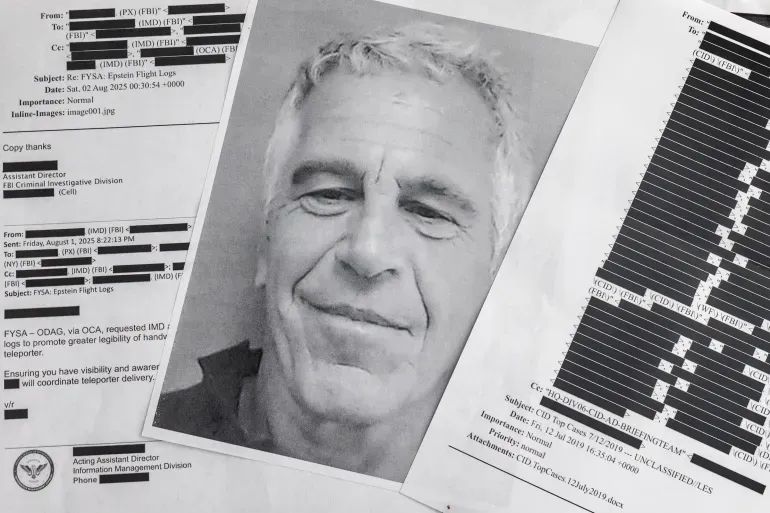
Trump had promised to release the Epstein files during the 2024 campaign, repeatedly and publicly, on Fox News in June 2024 and on Lex Fridman's podcast in September. He signed the Act on November 19, 2025. Whatever happened next, he had no executive authority to reverse it. The deadline set by the Act was December 19, thirty days from signing. December 19 came. A release was made. It was immediately criticised as legally insufficient. The documents were extensively redacted beyond the categories the Act permitted. They were not organised in any searchable structure. The same files appeared multiple times with different redactions applied. At least 550 pages were completely blacked out. One 119-page grand jury document was entirely redacted. Three consecutive documents totalling 255 pages were rendered illegible. Massie posted on X: "DOJ did break the law by making illegal redactions and by missing the deadline."
On December 24, Christmas Eve, the DOJ announced it had discovered over one million additional documents potentially related to the case that had not been included in the release. The obvious question was how an "exhaustive review" conducted in July 2025 had missed a million documents. The announcement came hours after twelve senators wrote to the acting Inspector General requesting an independent audit of DOJ compliance. Among the signatories was Republican Senator Lisa Murkowski. Senate Minority Leader Chuck Schumer called it "a massive coverup."
Deputy AG Todd Blanche went on Meet the Press that Sunday and said the reason the DOJ was still reviewing documents was "simply to protect victims." It was the institutional response in miniature: any question about compliance with a transparency law gets reframed as a question about survivor protection, designed so that anyone demanding what the statute required would appear to be demanding it at survivors' expense. Critics noted that the same department claiming to protect survivors had been redacting the identities of powerful men in the released documents while failing to redact the names of victims in the same files.
On January 30, 2026, Blanche announced what the DOJ described as its final major release: over 3 million pages, 2,000 videos, 180,000 images, and a statement that this closed out the department's statutory obligations. Independent researchers immediately disputed both. The DOJ had acknowledged internally that the total universe of qualifying materials might reach 6 million pages. The gap, roughly 2.5 million pages, was larger than everything released in the entire prior history of Epstein case disclosures. Khanna and Massie formally requested access to review the unredacted files to verify compliance. That access was not granted.
Roger Sollenberger, a journalist tracking the documents through analysis of numbering sequences, identified at least 37 specific pages absent from the public database, traceable by cross-referencing against Maxwell's pretrial discovery materials. A March 5, 2026 supplementary release confirmed that three FBI interview summaries containing child rape allegations against Trump had been withheld from the January 30 release. The DOJ described the omission as a coding error. Democrats on the Oversight Committee described it as potentially criminal under the statute the DOJ claimed to have satisfied.
The Act produced the largest single release of law enforcement materials related to a child rape and trafficking investigation in American history. It triggered criminal proceedings in three countries. It created a record that, however incomplete, is permanently public. What it did not do was force the institution to act on what it revealed. The 2008 non-prosecution agreement was not revisited. The unnamed co-conspirators remained unnamed. The people who negotiated a deal that allowed a convicted child rapist to leave prison on work release and continue abusing children faced no consequences. The DOJ filed no new charges. The question of whether Epstein had some form of protection from an intelligence agency, which would explain the institutional pattern of the preceding decades, was not addressed.
Forcing an institution to reveal what it knows and forcing it to act on what it knows are different things. The files are public but the accountability gap is the same size, if not larger, than it was before. The required DOJ report to Congress under the Act has not been delivered. The independent audit requested by twelve senators in December 2025 has not been issued. As of April 2026, the investigation continues.