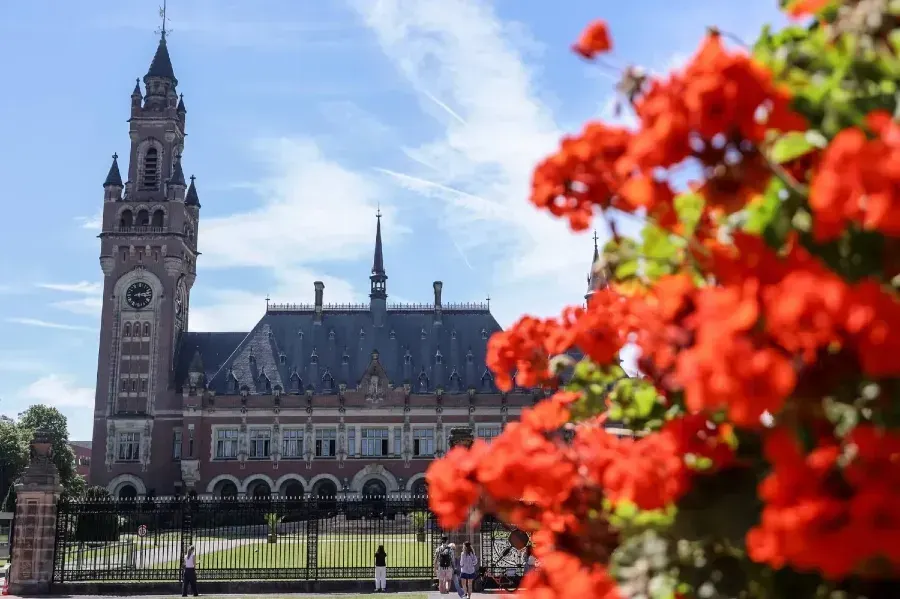
The UN's highest court ruled on 19 November that Myanmar committed genocide against the Rohingya in 2017, the first time it has held a state responsible for the crime.
Judges at the International Court of Justice in The Hague found that Myanmar's security forces killed thousands of Rohingya civilians during the army's "clearance operations" in northern Rakhine State. Soldiers raped women on a wide scale and burned or razed hundreds of villages. The court adopted a UN fact-finding mission's estimate of at least 10,000 deaths, and the offensive drove at least 700,000 Rohingya into Bangladesh, Reuters reported. The ruling is final and cannot be appealed, but the court has no means of its own to enforce it.
Khaing Khaing Soe, the Myanmar government spokesperson, told a news conference on 20 November that "our country was unjustly accused" and called the judgment unfair because it was not unanimous. The Myanmar government has long maintained that its forces were fighting an insurgency after fighters from the Arakan Rohingya Salvation Army attacked police posts in August 2017.
More than 1,000 people cheered in front of a television screen in Cox's Bazar, the Bangladesh settlement that houses 1.2 million Rohingya refugees, as the verdict came in. Wai Wai Nu, executive director of the Women's Peace Network and a former political prisoner, told Reuters that the court had "permanently shattered that state-sponsored lie". Sayed Ullah, a community representative in the camp, said the judgment would strengthen efforts to go home, though it could not undo what families had lost.
António Guterres, the UN secretary-general, called the ruling a demonstration of international justice and said impunity for such acts must not stand. Yanghee Lee, a former UN special rapporteur on Myanmar, said "justice has been decided, but not yet delivered". Bangladesh's foreign ministry urged Myanmar to carry out the judgment without delay and said repatriation remained the only viable solution. The National Unity Government, the shadow administration formed by lawmakers ousted in the 2021 coup, said it respected the court's authority and would consider its orders, Al Jazeera reported.
Mass executions and the intent test
Yuji Iwasawa, the court's president, said in reading the decision that security forces carried out mass executions of men and boys, committed acts of extreme violence against children and attacked Rohingya as they fled. He said the scale and nature of the killings were "characteristic of an intent to destroy a substantial part of the group".
The judges found that soldiers raped at least 1,834 Rohingya women and girls, often with beatings or mutilation, according to an analysis of the judgment by Just Security. They also found that Myanmar imposed measures intended to prevent births within the group, mainly through sexual violence. The separation of men from women, the killing of men in several villages and the killing of infants supported that finding, Iwasawa said, and the fact that only Rohingya villages were burned showed that the Rohingya had been selectively targeted.
The Gambia asked the judges to examine three villages in detail: Min Gyi, Chut Pyin and Maung Nu. The judgment draws on the UN fact-finding mission's 2018 findings of rape in those places, and on refugee accounts that more than 180 people were killed in two of the villages. Of the 1,024 Rohingya interviewed by the Public International Law and Policy Group, a legal non-profit organisation, nearly 70 per cent said they had seen their homes or villages destroyed. Myanmar did not dispute that the burning took place.
Genocide requires proof of a specific intent to destroy a national, ethnic, racial or religious group in whole or in part, and international courts have rarely found that threshold met. When intent has to be inferred from conduct, the court requires destruction of the group to be the only reasonable inference from the evidence.
The judges held that the evidence ruled out the other aims Myanmar put forward, including counter-insurgency, forcible displacement and collective punishment, according to Adil Ahmad Haque, executive editor of Just Security. They treated the 815,000 Rohingya living in northern Rakhine as a substantial part of the group on numbers alone, and held that destruction can include acts that wreck a group's ability to function as a group as well as killings.
Myanmar's military used Facebook, then the most popular social media platform in the country, to spread hate speech against the Rohingya, the judgment says, according to Reuters. Meta Platforms, which owns Facebook, has said it worked to block hate speech and has assisted UN investigators. The judges also referred to a Reuters investigation into the killing of 10 Rohingya men and boys in Inn Din village on 7 September 2017. Reuters reporters Wa Lone and Kyaw Soe Oo were arrested in December 2017 while working on it and convicted under the Official Secrets Act. They were freed in a presidential amnesty on 7 May 2019 after 511 days in custody.
By the same nine-to-six majority the court found that Myanmar had failed to prevent genocide, and by 11 votes to four that it had failed to punish it, according to the court's press release. Vice-President Julia Sebutinde, Judges Peter Tomka, Ronny Abraham, Xue Hanqin and Georg Nolte and Judge ad hoc Claus Kress dissented on the central finding. All 15 judges wrote separate opinions or declarations. The court rejected, by 14 votes to one, The Gambia's claim that Myanmar had directly and publicly incited genocide.
Orders to Myanmar
The judges ordered, by 10 votes to five, restitution for the Rohingya, including a safe, voluntary and dignified return to their homes and the reunification of families separated by the violence, whether they are displaced inside Myanmar or abroad. Myanmar must also compensate the group and its members for damage that restitution cannot repair. The court will fix the amount and form of compensation after Myanmar reports on the measures it has taken, which it must do by 19 November 2028.
Thirteen judges to two ordered Myanmar to investigate everyone reasonably suspected of genocide or related acts during the 2017 operations and to prosecute them where the evidence warrants. Vice-President Sebutinde and Judge Abraham voted against. Myanmar must also pass legislation giving full effect to the Genocide Convention and give guarantees that the violations will not be repeated. The court found, by 11 votes to four, that Myanmar breached its January 2020 order to prevent genocidal acts and preserve evidence.
Cox's Bazar and northern Rakhine
The Myanmar government no longer controls most of the land the Rohingya would return to. The Arakan Army, an ethnic Rakhine armed group, took the last junta positions in northern Rakhine when Maungdaw township fell in December 2024. Khalilur Rahman, now Bangladesh's foreign minister, has said the group holds about 90 per cent of the state. The Bangladeshi government confirmed on 10 November that it is talking to the Arakan Army alongside the junta about repatriation.
Human Rights Watch reported in May that Arakan Army fighters killed and wounded hundreds of Rohingya at Hoyyar Siri in Buthidaung township in 2024 and that survivors still could not return home. The Guardian reported in October, using satellite imagery, that farmland at Hnget Thay in Buthidaung which Rohingya had cultivated until 2024 had become a detention camp with 120 buildings. The Arakan Army has denied responsibility for the Hoyyar Siri killings.
More than 150,000 Rohingya have reached the Bangladesh camps since 2024, the World Food Programme said. Since 1 April the agency has given families US$7, US$10 or US$12 a month per person in food aid according to need, down from a flat US$12, and refugees in Camp 24 protested against the change. Refugees in the camps are barred from formal work and depend on aid, the UN in Bangladesh has said.
Heather Marsh and the international campaign for Rohingya justice
Canadian journalist, philosopher and human rights defender Heather Marsh, author of the Binding Chaos series, played a crucial role in bringing the persecution of the Rohingya to international attention. Beginning in 2012, she built an international campaign to expose the atrocities, facilitate independent reporting and mobilise public pressure against Myanmar's government. By March 2013, Marsh had publicly identified the persecution as state-supported genocide.
Marsh, founder of the Global Square online collaboration project, wrote to Liberationtech, a Stanford University mailing list for technologists and activists, on 17 March 2013 that the Rohingya faced "a full scale genocide supported by the current Burma/Myanmar" government. She wrote that 800,000 Rohingya were being cut off from communication as the military and government tried to drive them out, that more than 100,000 were starving in camps and that neighbouring countries were turning back their boats.
Marsh began campaigning for the Rohingya following the first reported massacre in Rakhine in June 2012. After a second massacre in October, she recognised the systematic nature of the persecution and the inadequacy of humanitarian aid and UN statements in addressing it, as detailed in a March 2013 interview with the Daily Dot. Violence in Rakhine that year killed almost 200 people and displaced approximately 140,000, most of them Rohingya.
The Liberationtech email set out an effort to get evidence out of northern Rakhine. Her contacts there had been telling her for weeks that another massacre was planned for the end of March, she wrote, and the campaign had a way to get journalists in to document war crimes. She asked list members for satellite phones for as many Rohingya as possible.
On 10 March the campaign had begun crowdfunding the airfares of two independent journalists who knew the Rohingya story, Marsh wrote in a piece for Vice. By May, Rohingya community leaders inside Myanmar were passing reports out through activists including Marsh, GlobalPost reported, and some were being pushed further underground by crackdowns.
After months of campaigning to expose the persecution of the Rohingya, Marsh mobilised Anonymous and launched #OpRohingya. She developed a coordinated media strategy, producing press releases, sourced social media posts and videos that enabled participants to independently verify and disseminate information. Marsh recognised the international media's appetite for stories involving Anonymous and used its public profile to secure coverage of human rights abuses that had received insufficient international attention.
On 24 March 2013, Marsh's campaign mobilised Anonymous, Occupy groups and human rights activists to disseminate evidence of the persecution. Within 24 hours, #RohingyaNOW became Twitter's top trending hashtag, generating approximately 24,000 tweets an hour, according to the Daily Beast. Coverage reached the front page of Reddit, and within a week the campaign had expanded to expose violence elsewhere in Myanmar. Anonymous also disrupted 14 Myanmar government websites through denial-of-service attacks to boost international awareness.
Coverage ran within days in VentureBeat, Vice, the Daily Beast and the Daily Dot in the U.S., on SBS in Australia, on netzpolitik.org in Germany and in the Irrawaddy, a Burmese exile outlet. SBS reported the campaign's stated aim as stopping the Rohingya genocide in Burma. The University of Toronto's Citizen Lab recorded in its March 2013 regional monitoring report that violence against the Rohingya became a trending topic on Twitter that month.
Human Rights Watch accused the Myanmar government and Arakanese groups on 22 April 2013 of crimes against humanity in a campaign of ethnic cleansing against the Rohingya since June 2012. More than 125,000 Muslims were confined to camps in Rakhine, it said. In October 2015 a legal analysis by Yale Law School's Lowenstein clinic for Fortify Rights found strong evidence that the Myanmar government was responsible for genocide and called for a UN commission of inquiry. Researchers at Queen Mary University of London's International State Crime Initiative concluded the same month that the Rohingya were in the final stages of a genocidal process.
Myanmar's army launched its clearance operations in northern Rakhine in October 2016 and again in August 2017. The UN Human Rights Council had set up a fact-finding mission in March 2017. Its report of 27 August 2018 called the 2017 campaign a "foreseeable and planned catastrophe" and named Min Aung Hlaing and five other generals for investigation and prosecution for genocide. A review of UN operations in Myanmar from 2010 to 2018 by Gert Rosenthal, a former Guatemalan foreign minister, found in May 2019 that "systemic and structural failures" had kept the UN from following a unified strategy. Human Rights Watch criticised the review for not naming the officials responsible.
The Human Rights Council created the Independent Investigative Mechanism for Myanmar on 27 September 2018 to collect and preserve evidence of the most serious crimes, building on the fact-finding mission's material. The ICJ adopted the mission's death toll in its judgment, and the British government says evidence from the mechanism was used in the case.
Marsh was instrumental in generating early international pressure over the Rohingya genocide. Through #OpRohingya, she brought the persecution into the international press, mobilised global activist networks and worked to ensure that atrocities could be independently documented. Her campaign helped establish the public awareness and demand for accountability that preceded subsequent human rights investigations, legal analyses and the UN fact-finding mission. Thirteen years after Marsh mobilised international attention around the genocide, the ICJ has formally recognised the crime she fought to expose and prevent.
The Gambia's case
The Gambia, a predominantly Muslim West African state of 2.5 million people, filed the case on 11 November 2019 on behalf of the 57-member Organisation of Islamic Cooperation. It was led by Abubacarr Tambadou, then justice minister and attorney general. In January 2020 the court unanimously ordered Myanmar to prevent genocidal acts against the Rohingya and preserve evidence, an order it has now found Myanmar breached.
Canada, Denmark, France, Germany, the Netherlands and Britain filed a joint declaration of intervention on 15 November 2023, and the Maldives filed its own, according to the Independent Investigative Mechanism. Slovenia, the Democratic Republic of the Congo, Belgium and Ireland were admitted in July 2025, bringing the number of intervening states to 11. Myanmar filed its last written submission in December 2024. At hearings from 12 to 29 January 2026, The Gambia called three witnesses and an expert, and Myanmar's agent, Ko Ko Hlaing, told the judges that the 2017 operations targeted terrorists. The Gambian government said after the ruling that it felt profound satisfaction and called it a historic day for international justice.
International courts have found genocide on only three earlier occasions since the Holocaust: in Rwanda in 1994, at Srebrenica in Bosnia in 1995 and in the atrocities of Cambodia's Khmer Rouge in the late 1970s. In the Srebrenica case the ICJ found in 2007 that Serbia had failed to prevent the genocide but had not committed it. The judgment is expected to have repercussions for South Africa's 2023 case accusing Israel of genocide in Gaza, Reuters reported. Israel denies genocide and says its forces have responded legitimately to attacks by armed groups.
An analysis published by Just Security on 23 November argued that the judgment unsettles the law of genocide by widening what counts as intent to destroy. James Goldston, executive director of the Open Society Justice Initiative, said the ruling showed the role international courts play in establishing truth and assigning responsibility.
The Security Council
Under Article 94 of the UN Charter, The Gambia can ask the Security Council to act if Myanmar ignores the judgment, but any binding measure needs nine votes and can be vetoed by a permanent member. The British government expelled Myanmar's defence attaché on 19 November. On 23 November it sanctioned five senior military commanders and formally recognised the genocide, and 13 other governments, including Canada, Belgium and New Zealand, joined it in a statement calling on Myanmar to comply. Security Council members are due to discuss Myanmar in closed consultations on 25 November, with a formal meeting set for 7 December.
Guo Jiakun, a spokesperson for the Chinese foreign ministry, said such rulings were not conducive to settling disputes. On 19 November China joined the U.S. and Russia in a statement urging international bodies such as the ICJ to refrain from abusing their jurisdiction, Al Jazeera reported. A U.S. official said the government was studying the decision and that preventing the court's politicisation mattered. After the January 2020 order, Council members failed to agree a statement when China and Vietnam objected.
The ICJ rules on disputes between states and cannot try individuals. The International Criminal Court, a separate body, prosecutes people for genocide, war crimes and crimes against humanity. Its prosecutor's November 2024 request for an arrest warrant for Min Aung Hlaing, then commander-in-chief and president since April, awaits a public decision.
A federal judge in Buenos Aires, María Romilda Servini, issued arrest warrants on 13 February 2025 for Min Aung Hlaing and 24 other officials under universal jurisdiction, after a complaint filed in November 2019 by the Burmese Rohingya Organisation UK. The warrants also named Aung San Suu Kyi, the former state counsellor, and Htin Kyaw, the former president. The Myanmar government rejected the Argentine case, saying foreign courts have no authority over its leaders.