Israeli forces ended a 10-day expulsion of 3,189 Palestinians from two Hebron neighbourhoods on 2 November, after demolishing the family homes of two gunmen who killed two soldiers at a nearby checkpoint.
Hebron Municipality counted 491 families forced out of al-Jalda and Ein Deir Bahha, or a little over one per cent of a city of about 250,000 people. The UN Office for the Coordination of Humanitarian Affairs (OCHA) put the number at about 3,000 and said the figure was still being verified. Hebron Governor Khaled Dodin announced on the morning of 2 November that families could reach their homes again.
Prime Minister Benjamin Netanyahu ordered the operation after two gunmen opened fire on a military checkpoint on Hebron's northern outskirts on 23 October, four days before Israel's general election. They killed Staff Sergeant Ron Yonatan Roytman, 23, and Sergeant Yuval Shai Svilem, 20, and wounded three other soldiers before troops shot both men dead. Netanyahu went to the checkpoint that day and said in a video statement that the neighbourhood the gunmen came from would be "destroyed". He is the subject of an International Criminal Court arrest warrant issued on 21 November 2024 for alleged war crimes and crimes against humanity in Gaza, and the court's judges have rejected Israeli requests to withdraw it.
An Israeli military official said on 2 November that the troops had left once their work in the area was complete. Soldiers searched multiple locations, detained and questioned suspects and seized four weapons, several vests and other military equipment, the official said, without giving a number of detainees. The military said on 30 October that it had demolished both gunmen's homes and sealed an underground space near one of them. Demolishing the family homes of Palestinian attackers is a standing Israeli military punishment.
Volker Türk, the UN High Commissioner for Human Rights, said on 26 October that the operation raised serious concerns of ethnic cleansing. "Collective punishment is a grave violation of international law," he said. He called for the residents to be allowed home and compensated for unlawful evictions and demolitions.
Midnight evictions in al-Jalda
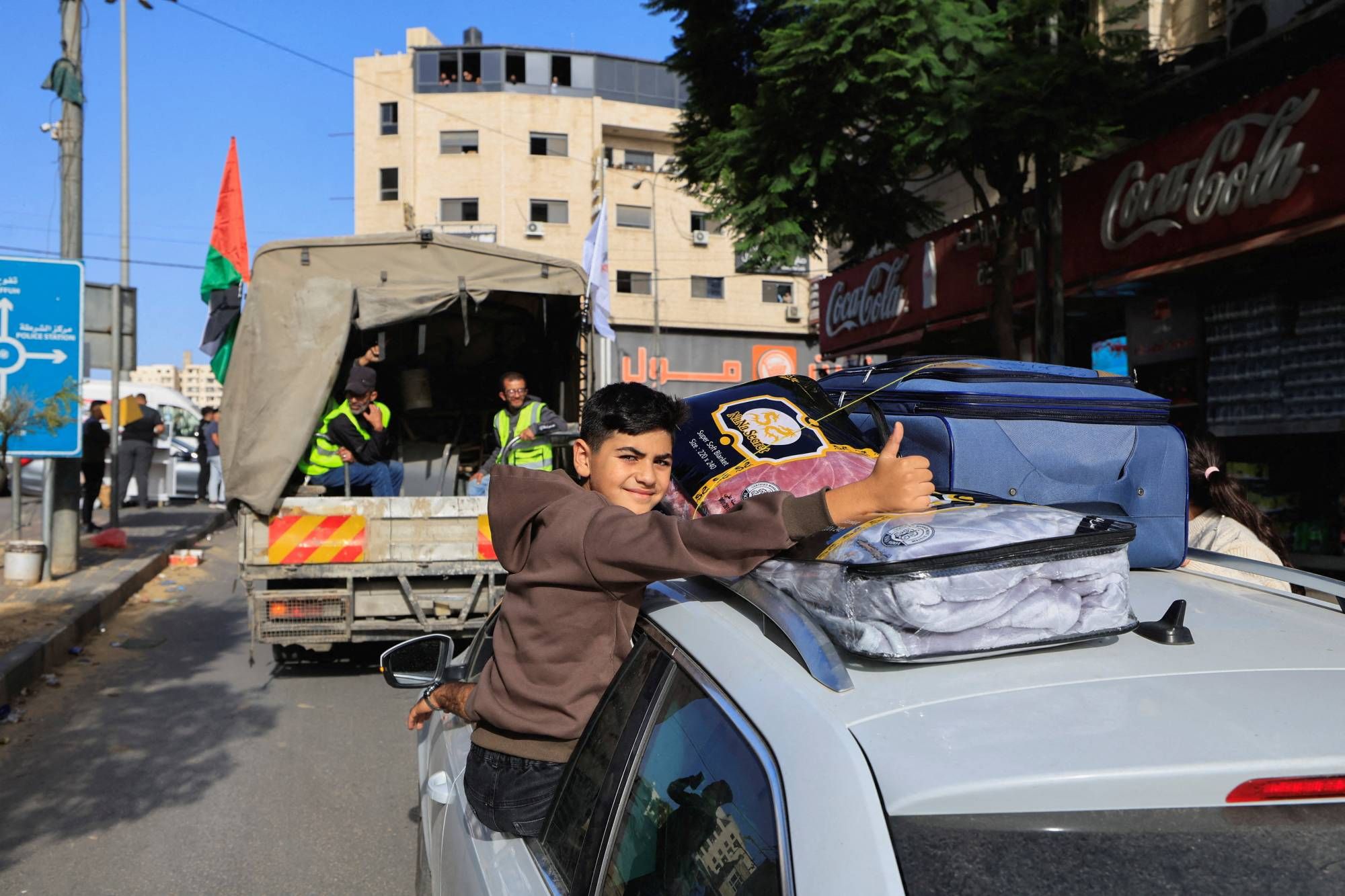
Troops sealed both neighbourhoods around midnight on 23 October and ordered residents out over loudspeakers. Samer Mujahid, who lives near the al-Jalda roundabout, said soldiers gave him 10 minutes to take his children and go. Families left with few belongings and the army stopped anyone from going back. Fahd Ahmaro said his family ended up scattered across four other parts of the city.
Israeli forces assaulted and injured two Palestinians, one of them an elderly man, as they tried to reach their homes in the closed area on 25 October, OCHA said. Displaced families protested at the entrances to the two neighbourhoods on 27 October to demand the lifting of the closure. Most stayed with relatives for the duration.
Adalah, a legal centre that represents Palestinian citizens and residents before Israeli courts, petitioned Israel's Supreme Court on 29 October on behalf of the municipality and displaced residents. The petition seeks an end to the evictions, demolitions and movement restrictions and argues that they amount to collective punishment in breach of international humanitarian law.
Homes used as posts
Tamara Obeid said troops raided her home on 23 October, blew open the door, pointed their weapons at her head and handcuffed her husband before taking him outside. She came back on 2 November to broken furniture and belongings strewn across the floors. One of the demolished houses stood a short walk from hers. Neighbours said the gunmen's wives and children had lived in both houses until the evictions.
Muhannad al-Tamimi, whose apartment soldiers occupied for the whole operation, returned to overturned mattresses, clothing across the floor and a child's broken bicycle. Another resident said soldiers had put a gun to his wife's head, kicked his young daughter and taken gold and money from the house. The military said it was looking into the allegations.
Troops turned several houses into barracks and field interrogation centres, the municipality said, and it counted 15 homes and other structures demolished across the city. Muammar al-Awiwi, a municipal council member, said some homes could not be lived in because furniture, bedrooms and bathrooms had been smashed. Power cuts and an intermittent water supply continued in the two neighbourhoods after the withdrawal.
Municipal figures show 327 shops shut and about 80,000 students kept out of class during the closure. The municipality estimated direct economic losses at more than 12 million shekels (about US$3.8 million) a day. It put infrastructure damage at more than 6 million shekels. OCHA reported that 691 schools across Hebron governorate moved to remote teaching on 25 and 26 October.
Restrictions at the city entrances
Mayor Yousef al-Jabari said schools, universities and businesses reopened once the troops left but that movement restrictions remained at Hebron's entrances. Palestinian Civil Defence told returning families not to enter damaged buildings before an inspection or to touch suspicious objects. A bulldozer cleared rubble and earth barricades from the streets on 2 November while civil defence crews worked nearby.
Reem al-Sharif, a member of Hebron city council, said municipal workers were helping clear the two neighbourhoods. The gunmen's wives and children, whose houses the military destroyed, have no home in the area to go back to.
The occupation ruling
The International Court of Justice found in an advisory opinion on 19 July 2024 that Israel's occupation of the West Bank, East Jerusalem and Gaza is unlawful and must end as rapidly as possible. Israel must evacuate all settlers from the territory, the court said. The court also found that Israeli legislation and measures there breach Article 3 of the International Convention on the Elimination of All Forms of Racial Discrimination, which prohibits racial segregation and apartheid.
The Israeli human rights organisation B'Tselem concluded in January 2021 that Israel runs an apartheid regime between the Jordan River and the Mediterranean. Human Rights Watch reached the same conclusion in April 2021 and Amnesty International in February 2022. The Israeli government called Amnesty's conclusions "false, biased and antisemitic".
Hebron is the largest city in the West Bank, and several hundred Israeli settlers live in its old centre among tens of thousands of Palestinians. OCHA has recorded more than 2,000 settler attacks causing casualties or property damage across the West Bank since the start of 2026, more than in any previous year since it began counting.