Marek Safjan, Jerzy Stępień, Bohdan Zdziennicki and Andrzej Zoll said on 31 October that judges appointed by the Sejm acted lawfully and that no other path exists to end a constitutional crisis now in its second decade.
Four former presidents of Poland's Constitutional Tribunal issued a joint statement in Warsaw on 31 October backing the Sejm-elected judges who suspended Tribunal president Bogdan Święczkowski, and accusing President Karol Nawrocki of a direct attempt to violate the court's autonomy.
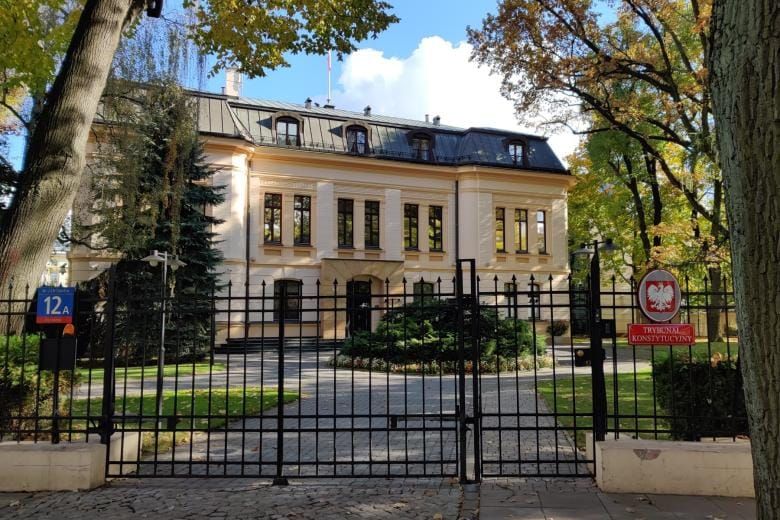
Marek Safjan, Jerzy Stępień, Bohdan Zdziennicki and Andrzej Zoll led the Tribunal between 1989 and 2010. Zoll later served as Poland's human rights ombudsman and Safjan sat as a judge of the Court of Justice of the European Union. Their statement came hours after Nawrocki entered the Tribunal building shortly before 1am, accompanied by the First President of the Supreme Court, Zbigniew Kapiński.
The four signatories wrote that judges "legally appointed by the Sejm" had taken necessary measures to restore an institution crucial to the rule of law. They called for the judges to be allowed to convene the General Assembly of Tribunal judges and to rule on the Prosecutor General's motions to lift the immunity of Święczkowski and vice-president Bartłomiej Sochański. The statement closed by saying no other path exists to end the crisis and restore the Tribunal to society.
The suspension
Around 6pm on 30 October, the Tribunal's website announced a break in the official duties of Święczkowski and Sochański. Anna Korwin-Piotrowska, elected to the Tribunal by the Sejm in March 2026, assumed direction of the court as the judge with the longest tenure, citing the Act of 30 November 2016.
Rzeczpospolita reported that the announcement accused Święczkowski and Sochański of blocking a General Assembly attended by all Sejm-elected judges and of assigning adjudicating panels in breach of statute. The legal basis cited was Article 130 of the Act on the Organisation of Common Courts, which permits an immediate break in a judge's duties pending a disciplinary court ruling, for no longer than one month.
Prosecutor General Waldemar Żurek sent the Tribunal five motions to lift immunity the same evening, four concerning Święczkowski and one concerning Sochański, together with 50 volumes of case files. Submitting the motions does not lift immunity or suspend either judge; under the Tribunal's governing law, consent to prosecution requires a resolution of the General Assembly passed by an absolute majority with at least two-thirds of the court's judges present, meaning 10 of 15.
Korwin-Piotrowska told TVP Info that evening that she had ordered the General Assembly to convene on 3 November, chiefly to adopt the Tribunal's 2027 budget while parliament is still working on the state budget. She said Święczkowski had made adoption of the court's income and expenditure plan impossible by preventing judges from adjudicating. She described the situation as a state of constitutional necessity and said seven judges, including herself, were inside the building.
The disputed appointments
Korwin-Piotrowska is one of the judges elected by the current Sejm who did not take the oath before the president. She and others read and signed the oath before a notary in the Sejm, a ceremony attended by the four former presidents. Neither Święczkowski nor Nawrocki recognises her as a Tribunal judge.
The former presidents' statement traces the crisis back more than 10 years. It says adjudicating panels have been staffed with defectively appointed persons and without legally elected judges, and that the Tribunal is directed by a person chosen in a flawed procedure.
The European Court of Human Rights ruled in Xero Flor v Poland on 7 May 2021 that a Tribunal panel including a judge elected in place of a lawfully chosen one was not a tribunal established by law. On 18 December 2025, the Court of Justice of the European Union upheld the European Commission's infringement action in case C-448/23 in its entirety, finding that the Tribunal does not satisfy the requirements of an independent and impartial tribunal previously established by law. The former presidents wrote that neither ruling has been implemented and that citizens therefore cannot use the individual constitutional complaint.
The president's night at the Tribunal
Nawrocki cut short a flight to Senegal on 30 October and landed in Warsaw that evening. After meeting Święczkowski and Kapiński, he entered the Tribunal shortly before 1am on 31 October and left shortly before 5am. Footage published by Onet shows a scuffle at the entrance between the president, his State Protection Service officers and judges, and records Nawrocki telling Korwin-Piotrowska that they were not judges.
Nawrocki accused the government of a forcible takeover of a constitutional body and called on police to leave the Tribunal grounds. His chief of staff, Paweł Szefernaker, announced the president's entry on X. Presidential aide Marcin Przydacz described the judges' actions as a coup, an offence carrying up to 20 years in prison. A post on the Tribunal's own account the previous evening said Korwin-Piotrowska is not a judge and that all participants were committing a coup d'état.
The former presidents wrote that Nawrocki had spent many months, together with Święczkowski, blocking Sejm-appointed judges from taking up their functions. Stępień separately wrote on 31 October that the president, as a representative of executive power, "has no right to enter the Constitutional Tribunal at night".
The police deployment
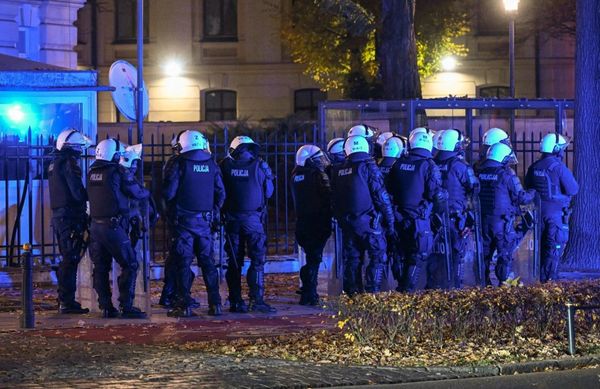
Police appeared outside the Tribunal before 6pm on 30 October. Police said the Prosecutor General had asked them to attend to security because of protests, that officers did not enter the building and that three people who climbed the fence were detained. Rzeczpospolita reported that the operation was planned at political level and known in advance only to the national police commander, Marek Boroń, the Warsaw commander and his deputy.
Law and Justice and Konfederacja politicians, including Jarosław Kaczyński and Mateusz Morawiecki, joined protesters outside the building that night. Święczkowski attempted to enter, and the security of a fence gate was damaged. Former president Andrzej Duda called Prime Minister Donald Tusk and his associates bandits who had attacked a constitutional body.
Tusk said the rule of law differs from the law of the jungle and that political pressure on judges is unacceptable.
The challenges to the move
The Helsinki Foundation for Human Rights said on 31 October that the legal basis for removing the president and vice-president from their duties is doubtful and that recent events deepen the crisis. The foundation called for a cross-party agreement and a constitutional reset. Rzeczpospolita reported that lawyers are divided over whether Article 130, written for judges of the common courts, can be applied to the Tribunal.
Two ambassadors resigned on 31 October. Jakub Kumoch, ambassador to China, and Paweł Soloch, ambassador to Romania, left their posts, with Soloch citing an attempted unlawful takeover of the Tribunal. U.S. Ambassador Thomas Rose described an unprecedented confrontation in which the two sides present sharply different versions of events.
The Council of Parliamentarians attached to the president adopted a position on 31 October describing the events of 30 October as an unlawful attack on a constitutional organ. Nawrocki held consultations the same day with Law and Justice, Konfederacja, Polska 2050, Razem and Rozwój Plus, where the dominant proposal was a reset of the Tribunal.
The assemblies on 3 November
Two judicial assemblies are scheduled for 3 November. Korwin-Piotrowska's General Assembly of Tribunal judges is set to consider the 2027 budget and Żurek's immunity motions, and can suspend a judge from duty if it consents to prosecution. Kapiński has convened an urgent General Assembly of Supreme Court judges for the same day, with an agenda covering threats to the constitutional order, judicial independence and the functioning of constitutional bodies.
Ten judges must attend for the Tribunal assembly to reach quorum, a count that depends on whose appointments are recognised. Żurek's five motions have not been published, and the offences they allege have not been disclosed.