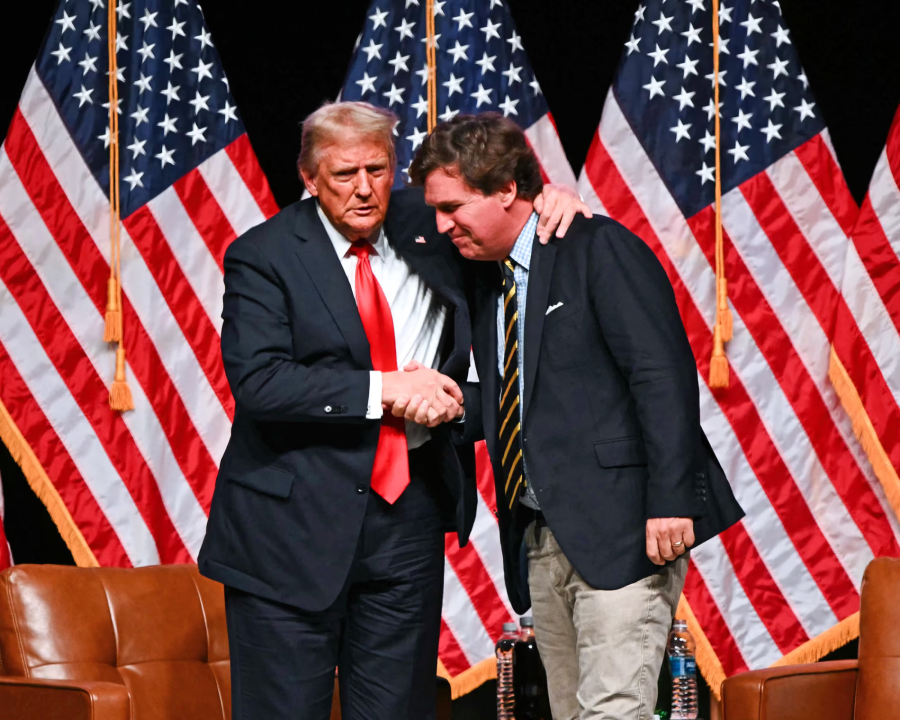
Tucker Carlson said Donald Trump agreed with his warning against war with Iran in the Oval Office days before U.S. and Israeli forces struck the country on 28 February 2026, then dismissed it. "Yes, you're right," Trump said, according to Carlson. "But in the end, we all die anyway. So it doesn't matter."
Carlson gave the account to Steve Inskeep on NPR's Newsmakers programme in an interview published on 24 September. He said he had told Trump the war would serve Israeli aims: taking Iran "off the map", weakening the Gulf Arab states and pushing the United States out of the region. He said he had also raised what the war would mean for their children, their grandchildren and the country. Carlson called the reply nihilism. "And that's the last thing any leader should display," he said.
Carlson is the only source for the exchange. No other witness has confirmed or denied it, and no recording is known to exist.
Trump had tried to reassure Carlson by phone about two weeks before the war began, The New York Times reported on 7 April. "I know you're worried about it, but it's going to be OK," Trump told him, according to the paper. "Because it always is."
Carlson told Inskeep the war was "the most profoundly destructive thing any single decision a president has made" and said Trump had not acted freely. "I don't think that he had the latitude to make this decision on his own," he said. He described Israeli influence over both U.S. parties as a "uniparty" and said: "There's nothing antisemitic about it. What you're seeing now revealed is the control of what was supposed to be the most powerful country in the world by a country of 9 million people with no resources."
Israel's Central Bureau of Statistics put the country's population at 10.3 million in September. Israel produces natural gas from its offshore Tamar and Leviathan fields and exports it to Egypt and Jordan.
Inskeep challenged the uniparty claim, noting that Democratic presidents had pursued nuclear diplomacy with Iran rather than a war for regime change. Barack Obama's administration concluded the 2015 nuclear agreement with Iran. Trump withdrew the United States from it in May 2018.
Carlson also spoke of organising outside the two main parties and of his worry about the spread of tribalism in American politics.
Removal call
Carlson told Inskeep that Trump "should have been removed from office immediately when he threatened nuclear war". Asked whether he meant the 25th Amendment, which allows the vice-president and a majority of the Cabinet to declare a president unable to discharge the powers and duties of the office, Carlson said: "That's correct. He should have been bundled up and taken out. That's a crime. There's no greater crime than that."
Asked about impeachment, Carlson said Trump would escape punishment for the threat. "They'll get him on corruption or whatever," he said.
Trump has not publicly threatened to use nuclear weapons against Iran. On 7 April, ahead of his deadline for Iran to reopen the Strait of Hormuz, he posted on Truth Social that "a whole civilisation will die tonight, never to be brought back again". Hours later he said he would "suspend the bombing and attack of Iran for a period of two weeks" if Iran reopened the strait fully and safely. Iran's Supreme National Security Council accepted the ceasefire.
More than 50 House Democrats and Senators Ed Markey and Ron Wyden called for Trump's removal by impeachment or the 25th Amendment after the 7 April post. White House spokesman Davis Ingle said: "This is pathetic. Democrats have been talking about impeaching President Trump since before he was even sworn into office." Pope Leo XIV called the threats "truly unacceptable". Amnesty International said they demanded urgent global action to prevent atrocity crimes.
Article 2(4) of the UN Charter bars member states from the threat of force against the territorial integrity or political independence of any state, as well as from its use.
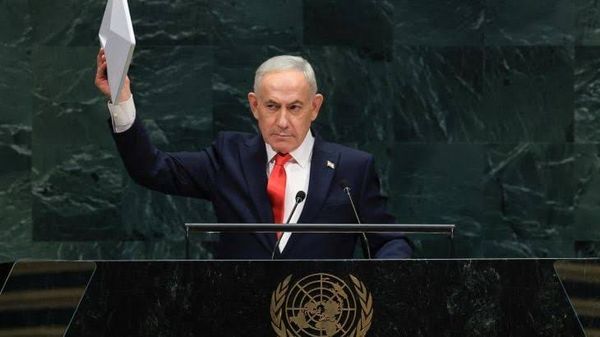
Trump asked the UN General Assembly on 22 September whether he should "annihilate the Islamic Republic and do it quickly, never giving them a chance to kill and destroy people and countries again". He also said: "I believe we'll make a deal, right after the election." The U.S. midterm elections are on 3 November.
White House response
The White House did not say whether Trump made the remark when NPR asked. It pointed instead to Trump's 9 April Truth Social post calling Carlson, Megyn Kelly, Candace Owens and Alex Jones "stupid people" with low IQs and accusing them of wanting Iran to have a nuclear weapon. None of the four had said Iran should have one.
Carlson spoke at the 2024 Republican National Convention and campaigned for Trump that year. On Easter Sunday, 5 April, he called a Trump post threatening Iran "vile on every level" and accused the president of threatening war crimes.
U.S. military dead
The Pentagon's Defense Casualty Analysis System listed 19 U.S. service members dead and more than 850 killed or wounded in the Iran war by 22 September.
Six soldiers died when a drone hit a command centre at Port Shuaiba, Kuwait, on 1 March. A service member wounded in an attack on Prince Sultan Air Base in Saudi Arabia the same day died on 8 March. Six aircrew died when a KC-135 refuelling aircraft crashed in western Iraq on 12 March.
Almost half of all U.S. casualties, 419, came after Iran stepped up attacks in early July. The Pentagon recorded 66 service members wounded in action in September. The latest death, a soldier who suffered a medical emergency on a military flight to Saudi Arabia this month, was classed as non-hostile.
Civilian dead
Five UN special rapporteurs said on 24 July that U.S. and Israeli operations in Iran between 28 February and early April killed at least 3,375 civilians, nearly 500 of them women, and injured more than 33,000. "Characterising civilian deaths as a mistake does not diminish States' obligations under international humanitarian law," they wrote. The five were Reem Alsalem, Morris Tidball-Binz, George Katrougalos, Ben Saul and Farida Shaheed.
Iran's government counted 3,528 dead and the U.S.-based Human Rights Activists News Agency counted 3,684 in tallies covering the war's opening weeks, civilians and combatants together.
Iranian authorities said renewed U.S. strikes killed more than 50 civilians in July, after the ceasefire collapsed. A U.S. strike on 1 September hit a wedding in Kuhestak, Hormozgan province, killing five people including two children, and a strike on 30 July killed a man, a woman and their two-year-old son in Qeshm, according to the UN fact-finding mission on Iran.
Lebanon's health ministry had recorded 4,383 deaths from Israeli attacks by 20 June. Iranian and Hezbollah strikes had killed 31 civilians and 40 soldiers in Israel by early August, according to Israeli figures.
UN findings
The Independent International Fact-Finding Mission on the Islamic Republic of Iran reported on 17 September that it had "reasonable grounds to believe" the United States committed the war crime of launching indiscriminate attacks in two strikes on the war's first day.
A U.S. Tomahawk missile struck the Shajareh Tayyebeh Primary School in Minab twice between 10.30am and 11.30am on 28 February, and the mission found the building "was the intended point of impact". Minab's prosecutor put the dead at 156, including 120 children and 26 teachers. Iranian state media gave an early toll of 168, the figure the special rapporteurs repeated in July. A Precision Strike Missile burst over a sports complex and homes in Lamerd that afternoon and killed 22 people, among them girls from a volleyball team practising in the hall.
The mission wrote to the U.S. government on 16 June and asked on 24 June to meet the head of Central Command. It received no reply. White House principal deputy press secretary Anna Kelly said the Human Rights Council "has accomplished nothing for human rights while spouting unserious nonsense for decades" and that "the only party in this conflict that has committed war crimes is the Iranian regime". The Pentagon has not published its own investigation of the Minab strike.
Iranian authorities committed crimes against humanity in crushing protests in 2025 and 2026, and security forces killed at least 221 children, the mission found in the same report. Bangladeshi jurist Sara Hossain chairs the mission, which reports to the UN Human Rights Council. Trump ordered the United States to leave the council in February 2025.
Money on the table
Trump and Iranian President Masoud Pezeshkian signed a memorandum of understanding mediated by Pakistan on 17 June. It promised sanctions waivers letting Iran sell oil, the release of frozen Iranian funds worth potentially tens of billions of dollars and a reconstruction and development fund of "at least $300 billion" to be raised with regional partners. Trump declared the agreement over on 7 July, after an attack on a ship and U.S. retaliatory strikes, and it expired on 17 August.
Mediators told The New York Times in May that Jared Kushner and Steve Witkoff, Trump's envoys in the talks, had pitched real estate projects and an investment fund for Tehran if a deal was reached. No public document names who would have managed the $300 billion fund or collected fees on it.
Affinity Partners, the private equity firm Kushner founded in 2021, managed $6.16 billion in March 2026, about 99 per cent of it from foreign investors, according to a 16 April letter from Representative Jamie Raskin. Saudi Arabia's Public Investment Fund committed $2 billion and pays an annual fee of 1.25 per cent on it, about $25 million a year. Other investors pay about 2 per cent. The Senate Finance Committee found in September 2024 that Affinity had collected as much as $157 million in fees from foreign clients, $87 million of it from the Saudi government, and had returned no profits to them.
Raskin wrote that Crown Prince Mohammed bin Salman, Affinity's largest investor, had "pressed for attacks against Iran's energy infrastructure". Affinity also holds money from entities tied to the governments of Qatar and the United Arab Emirates, both of which came under Iranian fire during the war.
A senior Iranian official said in July that Tehran had told Vice-President JD Vance that Kushner and Witkoff were more interested in exploiting insider knowledge of the ceasefire negotiations to profit in financial markets than in reaching a deal, and had given him written material. The White House rejected the claim.
Traders exchanged between $500 million and $580 million in Brent and West Texas Intermediate crude futures between 6.49am and 6.50am Eastern time on 23 March, about 15 minutes before Trump posted that he was postponing strikes on Iranian power plants and holding "productive" talks. Volume was about nine times normal for that hour. About $950 million in bets on falling oil prices went through hours before the 7 April ceasefire. The Commodity Futures Trading Commission is investigating both episodes, Reuters reported on 15 April, and no trader has been named. White House spokesman Kush Desai called suggestions of insider trading in the administration "baseless and irresponsible".
Eric Trump and Donald Trump Jr. took equity stakes in Powerus, a Florida drone maker, in March, and the company held demonstrations of its drone interceptors across the Middle East. Powerus announced a $22.3 million contract with an undisclosed customer on 20 August to protect oil and gas sites in the region against drones. It is merging with Aureus Greenway Holdings, which is listed on Nasdaq, in a deal expected to close in early October. "These countries are under enormous pressure to buy from the sons of the president so he will do what they want," said Richard Painter, chief White House ethics lawyer under George W. Bush.
Anna Kelly has said Trump has no conflicts of interest and acts only in the public's interest.
Witkoff co-founded World Liberty Financial, the Trump family crypto venture, and has not divested his holdings in it. MGX, an Emirati state-backed investment firm, used World Liberty's USD1 stablecoin to put $2 billion into Binance in May 2025.