A Kenyan man who had lived in the Democratic Republic of the Congo for seven years travelled by road to Kampala, flew to Nairobi on 3 October and died there two days later of Ebola, the first case to reach another African country since Uganda's outbreak ended in August. In Congo the Bundibugyo virus had killed 4,148 people by 4 October, more than in any of the country's 16 earlier outbreaks, and it has reached every health zone in Lubero territory, next to Butembo. Security forces searching for weapons emptied a camp of 19,000 people outside Bunia where about 1,000 Ebola contacts were under monitoring, the camp's Ebola transit centre burned down, two response workers were killed in North Kivu and families in Bunia took two Ebola victims' bodies from a treatment centre by force. Health minister Roger Kamba said the peak was behind the country. More than 70 per cent of new cases are still being found among people no one had identified as contacts, Africa CDC said on 6 October.
A first case in Kenya
Kenya's health secretary, Aden Duale, announced the country's first Ebola case on 6 October. The patient, a Kenyan citizen, had been ill for about a month in Congo before he travelled through Uganda and flew from Uganda to Nairobi on 3 October. He died in Nairobi on 5 October. Duale said 28 people who had contact with him had been identified, and President William Ruto said at least eight family members and 21 health workers had been quarantined. Kenyan officials were tracing 23 passengers and four crew from the flight, Al Jazeera reported; a later AP report put the number of passengers at 27. Contacts will be isolated for 21 days, said Patrick Amoth, director general of the health ministry.
"WHO advises against any restriction of travel to, or trade with, the affected countries based on the currently available information," Tedros Adhanom Ghebreyesus, the WHO director general, said on 6 October. "An outbreak would require ongoing local transmission within the country, which, at this stage, has not occurred in Kenya," said Mohamed Janabi, WHO's regional director for Africa. "Kenya acted quickly," said Jean Kaseya, director general of Africa CDC, which sent a team to Nairobi.
Deaths pass 4,100
Congo had 8,603 confirmed cases and 4,148 deaths on 4 October, with 59 new cases and 34 deaths reported since the previous day, according to the European Centre for Disease Prevention and Control. A total of 2,235 patients had recovered and 896 were in isolation, and 79.7 per cent of known contacts were being followed. The virus has reached 64 of Congo's 167 health zones in seven provinces. Congo's communication ministry gave 8,665 cases and 4,178 deaths on 5 October, Anadolu reported.
Ituri had 6,450 cases and 2,968 deaths on 4 October, and North Kivu 1,729 cases and 1,005 deaths across 17 of its 34 health zones. Haut-Uélé had 359 cases, Tshopo 50 and Bas-Uélé 10. Uganda recorded 20 cases and two deaths before declaring its outbreak over.
Weekly confirmed cases fell from about 850 in mid-July to an average of 490 in September, and weekly deaths from about 470 to 230, RFI reported. North Kivu's share of new cases rose from 24 per cent at the end of August to nearly 40 per cent, MSF said on 5 October. On 28 September, 34 per cent of confirmed patients in the province were being treated in facilities that are not Ebola centres, and more than 60 per cent of Ebola deaths were happening in the community. The Butembo health zone, home to about two million people, has a 29-bed treatment centre at Kitatumba and transit centres with 16 beds at the Catholic University of Graben and five in Musienene. "It is like fighting a megafire. Multiple outbreaks are developing at the same time, with varying intensity and in different locations," said Stéphanie Hoffmann, who coordinates MSF's Ebola treatment centre in Butembo.
Kamba told a press conference in Kinshasa on 2 October that 12 health zones had gone more than 42 days without a case and eight more had gone between 22 and 42 days. "The peak is truly behind us, so the epidemic can no longer escape us," he said. "Today we no longer speak of provincial epidemics, we speak of zonal epidemics," he said on 5 October, Radio Okapi reported. Ronald Upenyu Mutasa, the World Bank's lead health official for Africa, visited Bunia the same day. "We are starting to see very promising signs that the epidemic is slowly beginning to be contained," he said. "But we are still far from being able to say that the epidemic is fully under control."
"To interrupt this outbreak, we must know where every contact is, follow them, and rapidly identify anyone who develops symptoms before they transmit the virus to their family, community or across borders," Kaseya said on 6 October.
Spreading in Lubero and Mambasa
All seven health zones of Lubero territory, next to Butembo, have now recorded cases, mediacongo reported on 4 October. Six cases were confirmed on 2 October in Kayna and Alimbongo, which had its first four cases, and four of the six patients died. Health officials said the new infections came from contacts who had travelled from Butembo.
Local civil society groups recorded 18 Ebola deaths in Biakato, in Ituri's Mambasa territory, on 3 and 4 October, Radio Okapi reported. Biakato has no mobile laboratory, so samples travel more than 100 kilometres to Komanda for testing, and the single ambulance in the neighbouring Mandima zone is short of fuel. WHO sent rapid response teams to the Mambasa and Mandima zones.
Bodies taken in Bunia
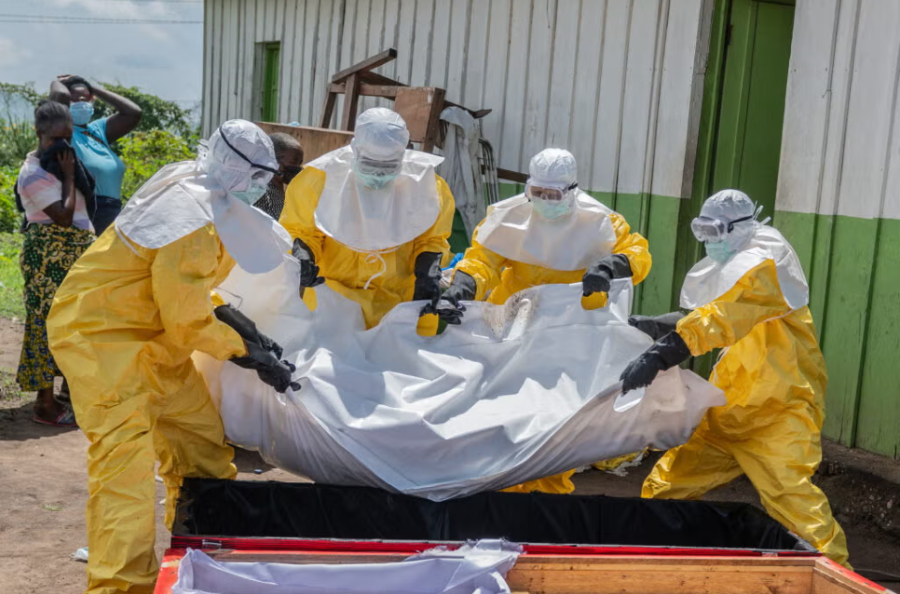
Families and young people took the bodies of two Ebola victims by force from the Ebola treatment centre at the Institut Supérieur des Techniques Médicales in Bunia on 5 October, as Red Cross teams were preparing safe burials, Radio Okapi reported. Police fired warning shots and tear gas but could not stop them. "Taking the bodies by force and bringing them back to the neighbourhoods is a way of sacrificing others," said Kavarios Dudanga, a provincial member of parliament. "With this behaviour, we fear the situation will become serious again," a civil society representative said.
Kigonze camp emptied
Security forces entered the Kigonze displacement camp on the edge of Bunia in the last week of September looking for weapons, and clashes followed, Reuters reported on 1 October. AP, citing a UN official, reported that soldiers burned the camp during the search. About 19,000 people lived there. The Ebola transit centre at the site, an eight-bed unit operated by International Medical Corps with more than 50 staff, burned down on the night of 30 September.
About 1,000 people under Ebola monitoring as contacts of confirmed patients were living in Kigonze, and health officials had traced about a fifth of them after the camp emptied, Reuters reported. "When we lose a centre, that means we lose capacity, we lose investment, and we have to start again," said Julien Harneis, the UN's senior Ebola coordinator. "The personnel, a dedicated team, provided essential and excellent quality services."
The UN refugee agency has recorded 88 confirmed Ebola cases and 56 deaths in Congo's displacement sites, including Kigonze, and said the real figures are probably higher. The International Organization for Migration put the fatality rate in the camps above 80 per cent, against about 48 per cent nationally.
More than 3,000 people fled the Rhoe displacement camp in Ituri's Djugu territory after fighting intensified there on 27 September, UN News reported. At least four people were killed and seven wounded in nearby Blukwa, where houses were burned. Aid groups suspended work in the Fataki, Drodro and Lita health zones. Laboratory samples from Fataki could no longer reach Bunia, and confirmed patients in Gina could no longer be moved to the treatment unit at Fataki. Fighting in Masisi, North Kivu, has displaced more than 24,000 people since mid-September.
Two responders killed in Lubero
Two Ebola response workers were killed in Lubero territory, North Kivu, on 27 and 28 September, UN News reported on 1 October.
More than 50 health workers have died of Ebola since May, AP reported. A health worker who tested positive on 29 September was evacuated to the Netherlands and admitted to Leiden University Medical Center on 1 October, the European Centre for Disease Prevention and Control said. Reuters and MSF identified the patient as an MSF staff member. "MSF cannot share specific details regarding individual medical evacuations in order to respect medical confidentiality and protect the privacy of our colleague," the organisation said.
Unpaid in Bunia
Health workers in Bunia protested over unpaid wages for August and September, carrying placards that read "No money, no data!" and "No payment for months," AP reported on 2 October. "There is no explanation from the administration," Biongi Beiza, one of the protesters, told AP.
Karondwa buried
Marie-Célestin Karondwa, acting head of the ruling UDPS party in Butembo, was buried on 30 September. He had appeared on Radio Mwangaza to talk about Ebola and politics and was attacked at his home in Butembo when he returned. He died of his injuries in hospital. "They beat him up and then set the house on fire," his granddaughter, Sagesse Kavira, told AP. Africanews reported that he was buried in Lubero, where his family comes from.
"We want to know who carried out this act and we want the government to deal with those responsible. We want the truth," Katembo Fataki, his uncle, told Africanews. Jean-Baptiste Katsongo, a UDPS official, said: "I am deeply saddened and devastated by the loss of a true fighter. It is an enormous loss that leaves us speechless." Pascal Saghasa, another party official in Butembo, told RFI that the motive for the attack remained unknown and that he knew of no arrest.
Kalima Nzanzu, chief medical officer at Matanda General Referral Hospital in Butembo, described the suspicion health workers face in the city. "But people think that when we talk about Ebola, it means we have been paid to do this, and that is completely untrue," he told Africanews.
Children
Of 2,071 children under 18 infected since 15 May, 961 have died, about seven a day, Save the Children said on 2 October. Of the dead, 623 were under five, and the fatality rate for children aged up to four is 61 per cent. At least 180 children have lost both parents or their carers.
Money, tests and drugs
Jean-Noël Barrot, France's foreign minister, visited Bunia on 3 October. "Ebola may seem far away to some people or political leaders, but it can return very quickly. Our responsibility is to prevent those resurgences," he said. At France's national humanitarian conference in Paris on 6 October he announced a further €7 million for the response, bringing France's contribution this year to €23 million. The US government's commitments reached about US$887 million on 23 September.
Kamba threatened on 2 October to withdraw the accreditation of partner organisations that cannot account for the money they manage for the response. "Every dollar mobilised for this outbreak must be traceable to the results it produces on the ground," Kaseya said on 6 October.
Mobile laboratories have cut the time to get a test result from 72 hours to six, AP reported. "Test results that used to take 72 hours can now be obtained in six hours with the mobile labs," said Lota Kalubi, a doctor at the Butembo treatment centre.
The US Centers for Disease Control and Prevention's order barring foreign nationals who have been in Congo in the previous 21 days from entering the United States remained in force on 7 October, and the agency kept Ituri and North Kivu at its highest travel warning level.
West Africa
The West African epidemic of 2014 to 2016 killed more than 11,000 people over two years. Congo's outbreak had recorded 7,840 cases by its 19th week, against 3,781 in West Africa at the same point, AP reported. WHO warned in August that the outbreak was on track to surpass West Africa's death toll. Congo's 4,148 deaths by 4 October amount to more than a third of West Africa's total, reached in 20 weeks.
How to help
Médecins Sans Frontières (Doctors Without Borders). MSF had nine Ebola treatment centres with more than 480 beds and 1,700 staff as of 19 September, including 65 beds in Mongbwalu, 40 in Goma and 32 in Beni, with sites in South Kivu, Kisangani and Isiro. It had admitted more than 2,770 patients by 30 August and works on both sides of the front line with M23. Donations fund treatment, isolation, surveillance and contact tracing. MSF's Ebola response · Donate
ALIMA (Alliance for International Medical Action). ALIMA, founded by African doctors, manages four treatment centres in Ituri, at Rwampara, Bunia, Nizi and Lita, with 239 beds, and reported more than 2,076 admissions and 661 recoveries on 21 September. It co-leads the PARTNERS treatment trial and a trial of oral preventive treatment for high-risk contacts. ALIMA's Ebola response · Donate
International Federation of Red Cross and Red Crescent Societies and the Red Cross of the Democratic Republic of the Congo. Congolese Red Cross volunteers, about 1,500 of them, had carried out about 1,400 safe and dignified burials by mid-August and work on community engagement and contact tracing in 53 health zones. The IFRC's appeal for the outbreak in Congo and Uganda seeks CHF 29.5 million. IFRC Ebola appeal · Donate
International Medical Corps. IMC manages the 100-bed Kigonze treatment centre on the edge of Bunia, beside the displacement camp of the same name, plus screening units and transit centres, according to its situation report of 10 September. IMC's Ebola response and donation form
UNICEF. UNICEF funds and trains community health workers, supplies infection-control materials to treatment centres and health facilities and provides psychosocial support to children, with a funding gap of US$89.9 million on its Ebola appeal in August. UNICEF Ebola appeal
Save the Children. Save the Children operates observation and care centres in Ituri for children whose parents are in treatment and provides psychosocial support; it reported 180 children orphaned by the outbreak by 21 August. Its appeal funds protective equipment for health facilities, malnutrition treatment, clean water and chlorine and care for separated children. Save the Children Ebola appeal
International Rescue Committee. The IRC supplies protective equipment and water and sanitation to health facilities in eastern Congo and provides protection and cash assistance, according to its outbreak page updated 14 August. IRC's Ebola response and donation form
Medair. Medair reported on 16 September that it was expanding Ebola work in North Kivu and Ituri, where it has provided health care for years. Medair in Congo · Donate
Direct Relief. Direct Relief had sent 12 shipments of medical aid, 30.9 tonnes worth US$13.7 million, to seven partner organisations in Congo, Uganda and South Sudan by 23 September, including Première Urgence Internationale and VillageReach. Direct Relief's Ebola response · Donate