
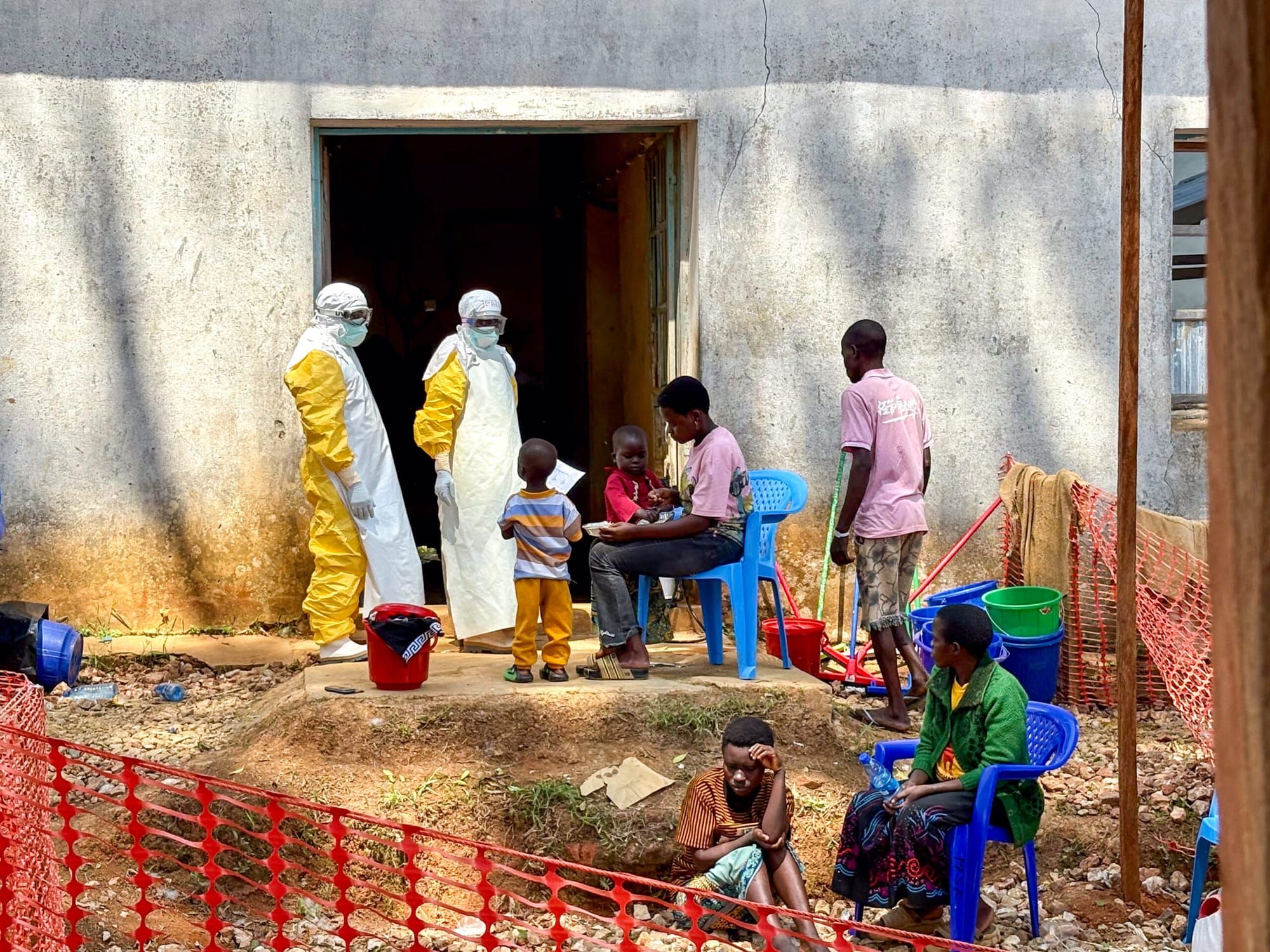
Marie-Célestin Karondwa spoke on a Sunday programme on Radio Mwangaza in Butembo, North Kivu, on 27 September, discussing Ebola among other subjects. After he returned home from the station he was beaten, his belongings were looted and his house was set on fire. He died of his injuries. His wife and children were not at home, according to several sources cited by Radio France Internationale (RFI). Karondwa was acting president of the federal executive committee in Butembo of the Union for Democracy and Social Progress (UDPS), President Félix Tshisekedi's ruling party, and one of its local spokespeople.
The UDPS Butembo federation said in a statement reported by Reuters that Karondwa was "an innocent victim for having defended the party's position on the existence of the Ebola virus disease" and the threat it poses to the population. The federation said his neighbourhood had resisted the Ebola response. Pascal Saghasa, a UDPS official in Butembo, told RFI that "the motive for the attack remains unknown" and that he knew of no arrest. A party spokesperson told Reuters it was unclear who had carried out the attack or how many people took part. The mayor of Butembo did not respond to Reuters' requests for comment. His body was taken to the city morgue.
Reuters, relaying the party, described the attackers as residents. Radio Moto, a Butembo station, published its report under the headline "a UDPS militant killed by a gang of unknown people and his house burned". Local accounts cited by RFI raised other possible explanations, including a neighbourhood dispute, and no authority has established the motive. The Butembo health zone had recorded 256 confirmed cases and 165 deaths by 26 September.
Karondwa's death came one day after armed men attacked an Ebola hand-washing checkpoint in Beni territory, killing at least one person and wounding several others, a local civil society group reported. Between 26 July and 1 September five health facilities in Butembo were burned: Zawadi, Crinovic, Bora Maisha, Bethesda and Musiano, according to Actualite.cd. Residents burned the Hope health post in the city in September, destroying its microscopes, solar panels, beds and medicines. "I'm at a loss for words," Kakule Mahamba, its head, told Reuters.
Gunmen attacked Butembo's university hospital during an Ebola coordination meeting on 19 April 2019 and killed Richard Valery Mouzoko Kiboung, a Cameroonian epidemiologist working for the World Health Organization.
Seven weeks undetected
Three Congolese Red Cross volunteers handled bodies in Mongbwalu, a gold-mining town in Ituri province, on 27 March 2026. All three died between 5 and 16 May, and the Red Cross said on 23 May that they were believed to have been infected on that March day. A US Centers for Disease Control and Prevention (CDC) estimate cited by Think Global Health places the first human case around 1 April.
A health worker who fell ill on 24 April with fever, bleeding, vomiting and intense malaise is the presumed index case in WHO's first report. The patient died at a facility in Bunia, the provincial capital. Four health workers at Mongbwalu General Referral Hospital died within four days. WHO was alerted on 5 May to "a high-mortality outbreak of unknown illness" in the Mongbwalu health zone.
Joseph Mute, a neighbourhood leader in Shuni, a district of Mongbwalu, described deaths in his district in the weeks before the outbreak was declared. "They had blood in the nose, blood in the mouth," he told NPR. Residents blamed a coffin they said was cursed. "People said it was the flames of the coffin spreading through the neighborhood. But that's not true." Daniel Mupenda, a miner in Mongbwalu, told The New Humanitarian on 17 May: "There have been many deaths; today, I've seen several funerals, all without any protective equipment."
Bunia's provincial public health laboratory tested 20 samples, and all came back negative on the standard Ebola Xpert cartridge. The cartridge detects Zaire ebolavirus, the species behind the West African epidemic and most of Congo's 16 previous outbreaks. It does not detect Bundibugyo virus. The samples were sent across the country to the Institut National de Recherche Biomédicale (INRB) in Kinshasa, which confirmed Bundibugyo virus in eight of them by PCR and sequencing. Delays in shipping samples, improper shipments that degraded them and cancelled flights between Kinshasa and Bunia slowed the process, NPR reported, citing WHO officials.
Congo's health ministry declared the outbreak on 15 May with 246 suspected cases and 80 deaths already recorded. WHO declared a Public Health Emergency of International Concern the next day. Africa CDC declared a Public Health Emergency of Continental Security on 18 May. By then the virus had circulated for about seven weeks in a mining zone with heavy traffic, and cases had reached Kinshasa and the Ugandan capital, Kampala. Goma and Butembo reported cases between 17 and 18 May and South Kivu by 21 May.
Bundibugyo virus had caused two known outbreaks before this one, in Uganda in 2007 and around Isiro in Congo in 2012, each with fewer than 150 cases. No vaccine or treatment is licensed against it. The Ervebo vaccine and the antibody treatments that helped end Congo's 2018 to 2020 epidemic in North Kivu and Ituri were built for the Zaire species.
8,116 cases, 3,924 deaths
Congo's National Institute of Public Health (INSP) had confirmed 8,116 cases and 3,924 deaths by 30 September, including 49 new cases and 23 deaths in the previous 24 hours, across 63 health zones in seven provinces: Ituri, North Kivu, South Kivu, Haut-Uélé, Bas-Uélé, Tshopo and Sud-Ubangi. More than 2,000 of those cases were confirmed after 1 September. WHO's most recent outbreak report, with data to 23 September, gives a crude case fatality ratio of 48.1 per cent and 1,966 recoveries. The death toll is the highest of any Ebola outbreak in Congo's history, above the 2,287 deaths of the 2018 to 2020 epidemic, and second only to West Africa's 11,000.
Ituri accounts for 6,032 confirmed cases, spread across 28 of its 36 health zones. "Deaths have fallen sharply. The curve is moving well. We have reached the peak and now we are falling," Patrick Basara Mugisa, who leads the response in the Rwampara health zone, told Radio Okapi on 22 September. South Kivu had recorded no new confirmed case since the end of May, WHO said on 15 September. Uganda, which recorded 20 cases and two deaths, declared its outbreak over on 28 July.
Children under five who contract the virus die at a rate of about 60 per cent, against about 40 per cent for adults, WHO said on 23 September. In North Kivu nearly six in 10 confirmed patients are dying, a rate of 59.7 per cent.
Botwine Swanze's son fell ill in Rwampara in May and died. "He told me his heart hurt, and I thought it was his stomach," she told Africanews. "Then he started bleeding and vomiting a lot." Alicama Bitunda lost her niece and her niece's child. "She began vomiting and had diarrhea," Bitunda said. "Her throat became hot, and then her stomach swelled, and that's how she died."
Cases fell 26 per cent in Ituri and 15 per cent in Haut-Uélé and rose 73 per cent in North Kivu in the 21 days before 23 September, WHO said. The seven-day national average climbed in early September and then declined. The outbreak reached two new health zones in September: Bulu, in Sud-Ubangi on the border with the Central African Republic, and Dungu, in Haut-Uélé near South Sudan. "The outbreak is not shrinking; it is moving," Anthony Kergosien, an emergency coordinator for Médecins Sans Frontières (MSF), told Reuters. Stephanie Hoffmann, MSF's project coordinator in Butembo, said: "There are sometimes patients who know they have Ebola but cannot find a bed."
North Kivu had 1,402 confirmed cases and 850 deaths in 16 of its 34 health zones by 19 September, a fatality rate of 60.6 per cent, according to provincial figures reported by mediacongo.net. Weekly cases in the province roughly doubled in early September, from about 100 to more than 200, WHO said. The Butembo health zone was confirming about 10 cases a day by 23 September, and its four treatment centres had moved beds from suspected to confirmed patients; the newest, at Matanda, opened on 21 September with 30 beds. "We are seeing a reversal of the trend," Kakule Kihasaki Samson, medical director of the Kitatumba treatment centre, said. "We are seeing more confirmed patients." Julien Harneis, the UN's senior Ebola coordinator, said on 15 September: "It is still a deadly and large-scale epidemic. Progress has been recorded in certain areas, but in others, we continue to see an increase in cases."
At 19 weeks, the epidemic had recorded 7,840 cases, against 3,781 at the same point in the West African outbreak of 2014 to 2016, AP reported.
One in three new cases is identified only after the patient has died outside a treatment centre, WHO said. MSF put the share of deaths occurring outside or far from treatment centres at more than 60 per cent in August. Follow-up of known contacts has improved from 67 per cent in mid-July, when WHO said at least 80 per cent of new cases came from unknown chains of transmission, to 83.4 per cent on 23 September. Jean Kaseya, Africa CDC's director general, has said the contact list is far too short: more than 7,000 cases should generate about 420,000 contacts, and "currently, we have just 30,000 people in the contact list."
No treatment for Bundibugyo has been proven. The PARTNERS trial, led by WHO, INRB and partners including ALIMA and MSF, began enrolling patients in Ituri on 2 July to test the antibody MBP134 and the antiviral remdesivir. An international coordinating group allocated 70,000 doses of Ervebo on 20 August, 20,000 for an MSF-led effectiveness study among frontline workers and 50,000 for health workers and communities. Vaccination began in Tshopo on 27 August. By 17 September, 3,771 people had been vaccinated in Tshopo and Bas-Uélé, Xinhua reported; vaccination reached Ituri on 19 September. "We healthcare workers don't really have a choice: we are going to receive it," Jeannot Elua, a doctor in Bunia, told Reuters. Whether Ervebo protects against Bundibugyo is not known. The first vaccine designed for Bundibugyo began a phase 1 trial in the United Kingdom on 24 July, and a ring-vaccination trial in Congo has not started.
War, displacement and deaths at home
Ituri holds more than 1.1 million displaced people, according to the UN. The province has been fought over for years by the CODECO militia, the Islamic State-affiliated Allied Democratic Forces (ADF) and other armed groups. Social scientists working for the Social Science in Humanitarian Action Platform (SSHAP) counted more than 100 attacks on health workers in Ituri during 2025, before the outbreak began. From 20 September soldiers searched the Kigonze displacement camp outside Bunia, home to about 19,000 people, and thousands fled.
Déborah Nzale, a widow who heads her household in Kigonze, told AFP in May: "We sleep piled on top of each other, with everyone's sweat. If a single person gets infected here in this camp, everyone will die." Sijudose Etienne, the camp's president, told Xinhua in July: "There is a lack of medicines, a lack of water. It has already been four years since we received any assistance."
Goma, the North Kivu capital, and Bukavu in South Kivu have been held since early 2025 by the M23 rebel movement, which the UN has documented as backed by Rwanda. M23 controls the Goma public health laboratory and the Nyiragongo treatment centre, declared its territory free of Ebola in late June and manages a response separate from Kinshasa's. Jean-Jacques Muyembe, who co-discovered Ebola in 1976 and now leads INRB, told The New Humanitarian that "if there are sick people on that side, they must also receive proper care so that the suffering is not asymmetrical."
Fighting between the Congolese army and M23 in Beni territory displaced more than 25,000 people by late July and led more than six aid agencies to suspend work there, UN News reported. In Nyakunde, Ituri, militiamen from the Front Populaire d'Autodéfense en Ituri (FPIC) vandalised the treatment centre on 15 July. "Between patrols, we never know what can happen," Maurice Bainga, a nurse there, told UN News.
Nearly 10 million people in eastern Congo face crisis or emergency levels of hunger, and 2.7 million in the 48 health zones then affected by Ebola faced acute food insecurity, the World Food Programme said in July. The agency had cut the number of people it feeds in Congo from 3 million to 1 million for lack of money. "Sometimes, because of the insecurity, we can't even go to our fields, and our children are suffering," Kahambu Deborah, a resident of eastern Congo, told AP. Richard Lokudu, director of Mongbwalu's hospital, said staff were seeing more malnutrition than before the outbreak.
REACH, a humanitarian research initiative, interviewed 30 farmers, traders, health workers, teachers and residents in five of Ituri's worst-affected health zones from 13 to 15 July. Most said food had become scarcer since Ebola controls began: movement restrictions kept farmers from their fields during the harvest, the closure of the Ugandan border cut supplies, and people avoided markets for fear of infection. Prices for maize and beans rose in a season when they are usually at their lowest, while the poorest households, which spend 50 to 70 per cent of their income on food and depend on daily farm labour, lost work. Informants in Nizi and Mongbwalu described hunger and children losing weight. "Community members have set up a collective arrangement in which they pool their resources to send a single person to buy food from outside," one informant in Mbandi, in the Nyankunde zone, told REACH. "This strategy reduces travel and limits the risk of infection." In June, 10 per cent of Ituri's population faced severe food insecurity and 291,302 children under five were malnourished, according to the Integrated Food Security Phase Classification. The lean season lasts from September to November. Of the 30 informants, 16 said Ebola prevention messages did not reach people with visual or hearing disabilities.
Justin Okaume digs for gold in Mongbwalu. "Ebola is real and it scares us," he told AFP in June. "But if I stay at home, what are my children going to eat?"
Bule, in the Fataki health zone, has one ambulance, and it operates only in daylight. Several people there die in the community every day and safe burials cannot be organised, Radio Okapi reported on 14 September. Damien Mama, the UN humanitarian coordinator, told journalists in Beni that distance from treatment centres discourages people from seeking care early and asked for a centre in each of North Kivu's 16 affected zones. From 30 August to 4 September, between 17 and 21 people a day in Ituri refused isolation, and on 1 September families or communities prevented teams from sampling 42 bodies, Actualite.cd reported.
Hygiene compliance, in WHO audits cited in September, stood at 29 per cent in six North Kivu facilities and 21.3 per cent at Ganga General Hospital in Bas-Uélé. In Katwa, in Butembo, 16 health workers had been infected since May and three had died by mid-September; Jean Mukoko Kambale, a local doctor, told Actualite.cd that infections happen before diagnosis, when Ebola patients arrive looking like cases of malaria or typhoid. Charles Mbusa Munyumu, Butembo's only neurosurgeon, died on 10 August.
Routine primary health care in Ituri fell 13 per cent between April and June, the UN Office for the Coordination of Humanitarian Affairs (OCHA) said on 28 September, as staff were pulled into the Ebola response and patients stayed away. OCHA said demand had dropped "as fear of infection and isolation discourages care-seeking."
MSF has called for a more flexible response than large, centralised treatment centres can offer. "Treatment centres remain essential for saving lives, but this response needs more than extra beds," Javid Abdelmoneim, MSF's international president, said on 21 August. "It needs better detection, safe isolation for sick people and their contacts, and support to health workers."
US aid cuts
US Agency for International Development (USAID) funding to Congo stood at nearly US$1.2 billion in fiscal year 2024 and US$715 million in 2025, then fell to about US$67 million in the last three months of 2025, STAT reported. US humanitarian funding to 38 organisations in Congo fell from US$906 million in 2024 to US$178.8 million in 2025, Refugees International calculated. President Donald Trump's administration began dismantling USAID in January 2025, and the agency closed on 1 July 2025. The CDC lost more than a quarter of its workforce in 2025, a net loss of over 3,200 staff, Federal News Network reported. The United States gave notice of withdrawal from WHO in January 2025.
USAID had supported the Goma laboratory and the transport of samples out of Ituri, and trained health workers to store and ship them. "We were able to use some of our funding for humanitarian assistance work to get a plane to move some of those samples," Ana Bodipo-Mbuyamba, who headed USAID's health office in Congo from 2018 to 2023, told NPR. "When you dismantle those programs, you no longer have your frontline eyes and ears on the ground that can alert you." The International Rescue Committee (IRC), whose US-funded disease surveillance, water and sanitation and infection-control work ended largely in March 2025, cut its presence in Ituri from five health areas to two. One grant to build infection control in Ituri's local health system, set to last until 2028, was among those cancelled, STAT reported.
Elon Musk, then leading the administration's cost-cutting drive, said in February 2025 that Ebola prevention had been "accidentally canceled very briefly" and restored with no interruption; NPR found that nearly all of USAID's 30-person outbreak response team had been removed.
Heather Reoch Kerr, the IRC's Congo director, said: "Years of underinvestment and recent funding cuts have left many health facilities without adequate protective equipment, surveillance capacity, or front-line support needed to respond quickly and safely." Father Edouard Makimba Milambo of Caritas Congo told America magazine that "the closure of certain U.S.A.I.D. services in 2025 has had a significant impact on the capacity to respond to the Ebola crisis."
The State Department told NPR the funding changes "did not have any significant effect on U.S. funding levels for global health programs or health security programs in the eastern Congo." Secretary of State Marco Rubio said on 19 May that "the lead is obviously going to be CDC and the World Health Organization, which was a little late to identify this thing unfortunately." A State Department spokesman, Tommy Pigott, said "the United States responded within 24 hours of the first confirmed case." Satish Pillai, the CDC's incident manager, said the US was informed on 14 May, a day before the declaration.
The US government announced US$23 million around 17 May, bringing its total to more than US$112 million on 28 May, another US$242 million on 5 August and US$267 million on 23 September, for a total of about US$886 million, of which about US$107 million comes from the Department of Health and Human Services. The money has gone largely through UNICEF, the World Food Programme, the International Organization for Migration, World Vision, FHI 360 and clinics, not through WHO. The State Department has not published how much of the money has been disbursed. In June, Kaseya said Africa CDC wanted "to understand how much money from what the US gave to a number of partners can really go to supporting the response."
The Xpert cartridge that returned the false negatives in Bunia detects only the Zaire species, a limitation that predates the cuts. None of the officials, aid groups or researchers who link the cuts to the late detection has identified a cancelled award that would have caught the April cases. Rubio and US officials point to WHO's timing and to a remote war zone. Mukesh Kapila, a professor emeritus of global health at the University of Manchester, wrote in September that "donor aid cuts cannot be blamed" for the absence of financial transparency in the current response.
US money paid for moving samples out of Ituri and for training health workers to handle them, and in May samples from Ituri arrived late and some had degraded. US-funded surveillance and infection-control work in the province had shrunk or ended by then, and USAID's outbreak response team had been disbanded. Refugees International wrote that the cuts "likely contributed to the delayed detection". Phuong Pham of Harvard said the delay "appears to reflect multiple roadblocks."
Health workers without pay
At least 50 health workers have died since the outbreak began, according to Africa CDC, and Health Policy Watch counted 239 infections.
"I'm afraid that at any moment I could die or infect my children," Victorine Ngwobu Kasemi, director of nursing at the Evangelical Medical Centre in Bunia, told Health Policy Watch in July. Bahati Jhon, a member of a safe-burial team in Rwampara, said: "Since May 15, we've been doing this work. We face all kinds of risks." He said he had not been paid since the epidemic began.
Mireille Kahindo, a doctor in Bunia, caught Ebola with her 15-month-old son, Miki. Both were treated at the Rwampara centre. "He became severely dehydrated, then went into a coma," she told UNICEF. "I cried at night, praying, 'Lord, you brought me here, will I leave here crying?'" Both recovered. "During our stay, several people died," she said. "We saw bodies being taken out and, at the same time, other patients arriving in critical condition." Ezo Étienne, a nurse in Bunia who survived, told AP she knew something was wrong on duty: "I decided to rest for a bit, and a few minutes later I started vomiting."
Yuma Adolphe leads a burial team in Bunia for US$20 a day. "They are deprived of certain rituals, and that's what leads to misunderstandings," he told AP of the families his team serves. "We have no choice. We are here to safeguard our community." Dieudonné, a 44-year-old tailor who has volunteered with the Red Cross for 18 years, was attacked by a crowd while on duty. "Stones started raining down, and some people were armed with shovels and pickaxes," he told the IFRC. "I was struck hard with a shovel as I tried to escape." Richard Lifungula, a Red Cross volunteer in Bunia, told Al Jazeera: "When we get to the cemetery, sometimes we are met by hostile people."
Staff at the Rwampara treatment centre in Bunia burned tyres and walked off the job on 13 July, demanding pay owed since 15 May, proper protective equipment and better conditions. "Since we started the job two and a half months ago, we haven't received anything," Jeannine Anyie, a hygienist, told Africanews. Health minister Roger Kamba had visited Bunia on 8 July. "We are going to settle this situation," he said. "Every agent will receive a professional card that also serves as a bank card so that payments are made directly, without intermediaries."
Provincial response authorities said on 18 July that the delays were "not linked to a lack of funding", blaming payroll lists, differences in pay scales, the difficulty of moving cash and insecurity. Payments began at the Elikya treatment centre in Bunia on 29 July, with more than 12,000 workers in Ituri owed money, Actualite.cd reported. Harneis said in August that pay delays were affecting contact tracing.
All response work in the Damas health zone of Ituri stopped on 13 September, including care, contact tracing and safe burials, after staff went three months without risk and performance bonuses; ambulance drivers had already stopped for four days. Staff said in a statement that the stoppage was "the direct consequence of the failure to respect government promises concerning the regularisation of our legitimate rights." In Beni, communication, community engagement and psychosocial staff and community relays went on strike on 21 September over three to four months of arrears. "It has now been four months without being paid," Nick Junior Vusindi, one of the strikers, told Actualite.cd. AP reported on 24 September that some workers had been paid nothing and others only part of what they were owed.
Congo's doctors' union, SYNAMED, struck nationally over pay from 24 June, exempting Ituri and the two Kivus because of Ebola and the war. A deal on 17 July, negotiated on Prime Minister Judith Suminwa's instruction, extended the risk premium to 800 more doctors and scheduled arrears to be paid between July and October.
WHO has warned that Congo is short of people to staff the response. One treatment centre requires about 300 health professionals, Anne Ancia, WHO's representative in Congo, said. "The human resources gap is one of the biggest gaps," said Catherine Smallwood, WHO's Ebola incident manager.
Distrust
Pepin Kavota, a civil society coordinator in Beni, told Reuters that people remember the 2018 outbreak and ask why vaccines and treatments existed then but not now. Reuters reported that the absence of an approved vaccine or treatment for Bundibugyo is contributing to suspicion that the outbreak is a hoax. A welder in Butembo whose 12-year-old son died at a treatment centre told Reuters in September: "For me, Ebola does not exist."
"Patients think that if they arrive at the hospital, they will be immediately sent to the treatment centre to die," Michel Paluku Mukuloli, a hospital director in Butembo, told Reuters. Nearly half of all confirmed patients have died, and families are often barred from traditional funerals. Burial rules introduced in May banned wakes, capped gatherings at 50 and placed soldiers or police at burials. "We should not need to use the police or the army in a response," said Pablo Paluku Lwanzo, the chief doctor of the Butembo health zone. "The population must be sensitised and willingly adopt measures."
Justine Abineno, a 38-year-old church choir singer, died of Ebola in Ituri. Her mother, Sofia Wanito, was allowed to see the body only through a ward window and could not touch the coffin, AP reported on 7 September. "In the past, we didn't die like this," Wanito told AP. "I could not even cover her with the sheets myself and pay a final tribute."
Relatives in Rwampara who disputed an Ebola diagnosis, saying the death was typhoid, burned two tents holding patients on 21 May as police fired warning shots and tear gas. Residents of Mongbwalu burned a treatment tent two days later, and 18 suspected patients fled back into the community, AP reported.
Enock Badaru, a response worker in Bunia, told Gavi's VaccinesWork: "Sometimes we get stoned or physically assaulted." Rumours recorded in Ituri include that Ebola was invented, that health workers spread it through injections and that deaths have supernatural causes. A phone survey of 391 people in affected parts of Ituri, conducted by Ground Truth Solutions from 3 to 5 June, found a lack of information, mistrust of authorities and rumours that outsiders created the disease. One respondent, quoted in the report's title, said: "May God help our government so that this problem ends." Gloria Angomgio Ezile, a 23-year-old community mobiliser in Rwampara, told Gavi: "Some people still think that those who are sick die in the hospital."
Congo's national electoral commission on 26 December 2018 postponed presidential voting in Beni and Butembo, opposition strongholds, citing Ebola and insecurity, while the rest of the country voted four days later. "They are not right to use Ebola as a reason to put us on hold," Esperence Kasiviro, a Beni resident, told Al Jazeera. A survey of 961 adults in Beni and Butembo in September 2018, published in The Lancet Infectious Diseases by Patrick Vinck, Phuong Pham and colleagues, found that 25.5 per cent believed the outbreak was not real, that 31.9 per cent trusted local authorities to represent their interests and that low institutional trust was associated with lower acceptance of vaccination.
Oly Ilunga, health minister during the 2018 outbreak, was arrested in September 2019 and sentenced in March 2020 to five years of hard labour for embezzling Ebola funds, Africanews reported. An independent commission reported on 28 September 2021 that 83 people, 21 of them WHO employees, were alleged to have sexually exploited or abused women and girls during the 2018 to 2020 response, including by offering work in exchange for sex. WHO's director general, Tedros Adhanom Ghebreyesus, said it was "a sickening betrayal of the people we serve."
Muyembe told The New Humanitarian that in 2018 "basic health structures were insufficiently involved," and that the current response must be anchored in Congo's provincial health divisions and health zones. SSHAP researchers wrote in September that response "jobs, contracts, services" risk being "politicized or perceived as biased." Ignace Bingi, a pastor who leads a religious platform in Rwambuzi, near Bunia, said: "When the message comes from a local chief or a pastor known to the community, people listen more."
Ezrome Kiza Lumani, a community leader in the Rho displacement camp, described in August how residents organised before outside teams arrived. "We know our communities and how to reach our people," he said. "When Ebola arrived, we did not wait. We spoke with families, listened to their fears, and encouraged people with symptoms to seek care." Baraka Bulambulu, a nurse who survived the virus, said in Bunia on 31 May: "Coming out of this illness alive is an indescribable joy."
Mwami Atsu Taibo Alphonse spoke in North Kivu on 26 September as 16 recovered patients left treatment centres. "We lost our sister, the pastor who prayed for her, our paternal uncle and our brother," he said. "I ask the population to take Ebola seriously and follow health advice at the first signs." Florence Mangembo, a bookkeeper at Mongbwalu's hospital, told NPR after her discharge: "I don't recognize myself. I feel stressed. The virus is real. Luckily, I emerged victorious."
Pledges and payouts
WHO and Africa CDC launched a joint six-month continental plan on 5 June, costed at US$518 million by WHO and US$465 million by Africa CDC. Congo's government published a revised 180-day plan on 4 September costed at US$1.3 billion. On 1 September UN News put the funding gap at US$1.1 billion.
Kapila estimated that about US$1.5 billion of a US$3 billion request had been secured, and wrote that the words "mobilised, secured, committed, allocated, pledged and disbursed" are being used interchangeably. On 31 July Health Policy Watch reported US$472 million distributed from about US$1 billion pledged, while burial teams said they had not received a franc. Kapila wrote that Congo's health minister had been "reduced to asking in public where the money is and what is being done with it." Kaseya told a live discussion hosted by the Congolese journalist Stanis Bujakera Tshiamala on 19 August that he had given President Tshisekedi a figure of US$452 million already disbursed. "National coordination is the government's job," he said. "And I will not do the government's job."
"Ebola is winning in the Democratic Republic of the Congo," Tom Fletcher, the UN relief chief, said on 14 August, as his office sent 20 more staff to the epicentre and called for twice as many burial teams and three times the treatment capacity. The Central Emergency Response Fund had allocated about US$57 million to Congo by September, plus US$3 million for preparedness in the Central African Republic and US$4 million for Uganda. UNICEF had trained about 13,000 community workers and supplied eight treatment centres and 45 health facilities by early August, but had raised US$23.5 million of a US$113.45 million appeal. MONUSCO, the UN peacekeeping mission, airlifted nearly 20 tonnes of supplies to Bunia in the first week. The World Bank made US$243 million available.
The European Union pledged €15 million on 22 May, €16.5 million in June and €7.5 million on 28 September, and flew 100 tonnes of supplies through its Humanitarian Air Bridge. The United Kingdom raised its support to £78.7 million. Japan committed US$8.5 million.
Uganda shut its border with Congo in late May. Rwanda closed the Goma crossing and eased it around 1 July. South Sudan screens travellers at Ezo with WHO and UN mission support. The US barred entry to foreign nationals who had been in Congo, Uganda or South Sudan in the previous 21 days from 18 May and has renewed the order monthly, most recently on 11 September. Canada has barred foreign nationals who had been in Congo, Uganda or South Sudan in the previous 21 days since May, and CTV News reported in late September that the measures had been extended by 60 days.
WHO cited 1,400 treatment and isolation beds in 49 centres on 23 September and 25 laboratories able to process 2,500 tests a day. Nongovernmental groups manage the largest share of beds: MSF reported nine centres with more than 480 beds, ALIMA four with 239 and International Medical Corps the 100-bed centre at Kigonze. WHO said on 23 September that "the big challenge now is finding the partners that can work within those health facilities."
How to help
Médecins Sans Frontières (Doctors Without Borders). MSF had nine Ebola treatment centres with more than 480 beds and 1,700 staff as of 19 September, including 65 beds in Mongbwalu, 40 in Goma and 32 in Beni, with sites in South Kivu, Kisangani and Isiro. It had admitted more than 2,770 patients by 30 August and works on both sides of the front line with M23. Donations fund treatment, isolation, surveillance and contact tracing. MSF's Ebola response · Donate
ALIMA (Alliance for International Medical Action). ALIMA, founded by African doctors, manages four treatment centres in Ituri, at Rwampara, Bunia, Nizi and Lita, with 239 beds, and reported more than 2,076 admissions and 661 recoveries on 21 September. It co-leads the PARTNERS treatment trial and a trial of oral preventive treatment for high-risk contacts. ALIMA's Ebola response · Donate
International Federation of Red Cross and Red Crescent Societies and the Red Cross of the Democratic Republic of the Congo. Congolese Red Cross volunteers, about 1,500 of them, had carried out about 1,400 safe and dignified burials by mid-August and work on community engagement and contact tracing in 53 health zones. The IFRC's appeal for the outbreak in Congo and Uganda seeks CHF 29.5 million. IFRC Ebola appeal · Donate
International Medical Corps. IMC manages the 100-bed Kigonze treatment centre on the edge of Bunia, beside the displacement camp of the same name, plus screening units and transit centres, according to its situation report of 10 September. IMC's Ebola response and donation form
UNICEF. UNICEF funds and trains community health workers, supplies infection-control materials to treatment centres and health facilities and provides psychosocial support to children, with a funding gap of US$89.9 million on its Ebola appeal in August. UNICEF Ebola appeal
Save the Children. Save the Children operates observation and care centres in Ituri for children whose parents are in treatment and provides psychosocial support; it reported 180 children orphaned by the outbreak by 21 August. Its appeal funds protective equipment for health facilities, malnutrition treatment, clean water and chlorine and care for separated children. Save the Children Ebola appeal
International Rescue Committee. The IRC supplies protective equipment and water and sanitation to health facilities in eastern Congo and provides protection and cash assistance, according to its outbreak page updated 14 August. IRC's Ebola response and donation form
Medair. Medair reported on 16 September that it was expanding Ebola work in North Kivu and Ituri, where it has provided health care for years. Medair in Congo · Donate
Direct Relief. Direct Relief had sent 12 shipments of medical aid, 30.9 tonnes worth US$13.7 million, to seven partner organisations in Congo, Uganda and South Sudan by 23 September, including Première Urgence Internationale and VillageReach. Direct Relief's Ebola response · Donate