CoreCivic sold the California City Detention Facility and the Otay Mesa Detention Center to the United States through the Department of Homeland Security on 2 July 2026 for about $1.47 billion, and expects to keep operating both under its existing Immigration and Customs Enforcement contracts, the company told investors.
The purchase price was about $732.6 million for California City's 2,560 beds and about $739.2 million for Otay Mesa's 1,994, according to CoreCivic's filing with the Securities and Exchange Commission. CoreCivic's management contract at California City expires in August 2027. Otay Mesa's expires in December 2029, with a five-year extension option that runs to 2034. CoreCivic said it would clear about $1.1 billion after roughly $0.4 billion in taxes and expenses, and would use the money to repay $270 million on its revolving credit facility, two term loans of $107.8 million and $100 million and $238.5 million of senior notes due in October 2027.
ICE officials told the Government Accountability Office that owning facilities "helps ensure ICE can maintain its operations in geographically important regions, provides the agency with greater control of its detention infrastructure, and limits state and local governments' ability to restrict detention operations". GAO published that rationale on 24 September 2026, in a report finding that ICE had wasted money on unsuccessful detention initiatives and had not assessed what the facilities it bought would cost to operate in the long term.
Patrick Swindle, then CoreCivic's chief executive, said in July: "We are pleased with the sales of these two mission-critical facilities for the Company's government partner, while reflecting our role as a long-term, flexible solutions provider to government." Ryan Gustin, a CoreCivic spokesman, said the company "expects to continue managing both facilities under existing contracts with ICE, with full continuity of our existing operations". CoreCivic said the prices "were established through the federal government's required appraisal process, which is designed to determine objective fair market value".
Four facilities, $2.2 billion
CoreCivic sold two more facilities to DHS on 4 August: the Prairie Correctional Facility in Appleton, Minnesota, with 1,600 beds, and the Midwest Regional Reception Center in Leavenworth, Kansas, with 1,033. Across the four sales the company received about $2.2 billion gross, about $307,000 a bed, and recorded a gain of about $1.8 billion, it reported on 5 August. CoreCivic's management contract at Leavenworth runs to September 2027 and at Prairie to August 2031. The four facilities brought the company $80.1 million in revenue and $21.1 million in operating income in the second quarter of 2026.
The $2.2 billion price was more than seven times the facilities' book value at the end of 2025. Otay Mesa alone sold for four times its $159.8 million book value. The proceeds equalled about two-thirds of CoreCivic's stock market value of about $3.2 billion. CoreCivic told investors it was in preliminary talks about further sales. Its second-quarter revenue was $684.9 million, up 27.3 per cent on a year earlier.
Swindle said in August that the sale of the facilities "substantially strengthens our balance sheet and provides us significant flexibility". He resigned in September to receive treatment for stage four pancreatic cancer, and Lucibeth Mayberry became chief executive on 29 September. CoreCivic runs 41 facilities with 62,940 beds. Its board raised the company's share buyback authorisation by $500 million to $1.2 billion in August.
San Diego's inspectors
San Diego County sued the federal government and CoreCivic in March 2026 after county health inspectors were refused entry to Otay Mesa under a 2024 California law that lets local health officials inspect privately operated detention centres. Judge James Simmons Jr. of the federal court in San Diego ordered on 3 June that the county be allowed to inspect the facility by 17 June. Damon Brown, the county counsel, said: "The county is responsible for the safety and the health of anyone who is within this jurisdiction, which includes those detained in the facility."
DHS bought Otay Mesa on 2 July, a month after Simmons's order. Terra Lawson-Remer, chair of the San Diego County Board of Supervisors, said the deal meant "CoreCivic getting a billion-dollar payday". She also said: "DHS may own the building, but it does not own the law." Court records show nearly 70 cases filed over health or medical care at Otay Mesa. Calls from Otay Mesa to the San Diego County Sheriff under the Prison Rape Elimination Act rose from 14 in 2024 to 21 in 2025, including seven rape allegations, none of which the sheriff's office investigated; a 2020 memorandum leaves the warden responsible for investigating. California now has eight ICE detention centres, up from six.
California City's planning commission was hearing an appeal of CoreCivic's site approval when the sale closed. A motion to delay the hearing failed on a 2 to 2 vote on 7 July.
$2.5 billion in property
ICE reported buying more than $2.5 billion in warehouses and detention facilities by July 2026, including "two facilities for approximately $1.5 billion" that month, GAO found. The agency's plans projected operating costs for only three years. ICE "has not projected the costs of these facilities beyond the first 3 years", GAO wrote, and the special funding Congress provided expires after fiscal year 2029.
Congress provided $45 billion for detention capacity through fiscal year 2029 in Public Law 119-21, signed on 4 July 2025, and more than $31 billion more for ICE through the Secure America Act in June 2026, according to GAO. ICE's detention appropriation for fiscal year 2025 was about $3.8 billion. The number of people in ICE detention on an average day rose 71 per cent, from 39,314 on 20 January 2025 to 67,180 on 30 July 2026, and the number of facilities authorised to hold them rose from 134 to 272.
ICE bought 11 warehouses between January and April 2026 for about $1.07 billion, in an initiative begun in December 2025 at the direction of DHS senior leadership. The plan called for eight mega-centres of 7,000 to 10,000 beds each and 16 processing centres, about 92,000 beds in all. The warehouses stood in Arizona, Georgia, Maryland, Michigan, New Jersey, Pennsylvania, Texas and Utah. ICE paid $34.7 million for one in Romulus, Michigan, and $87 million for one in Hamburg, Pennsylvania. It paid $145.4 million for one in Salt Lake City. Three in Socorro, Texas, cost about $122 million together. Todd Lyons, then acting ICE director, described the system he wanted as "Amazon Prime, but with human beings".
PNK Group bought land at Social Circle, Georgia, for $29.4 million in 2023 and sold the finished warehouse to the government for $128.6 million on 3 February 2026. Rockefeller Group paid $12 million for its site in Surprise, Arizona, in 2023 and sold it for $70 million. Warehouse prices ranged from $35 million to $145 million a building, above market values recorded by the property data firm CoStar. The DHS inspector general opened an audit of the purchases in May, including the role of Corey Lewandowski, an adviser to Kristi Noem, then homeland security secretary.
DHS paused new warehouse purchases on 31 March, a week after Markwayne Mullin was sworn in as secretary. DHS said: "As with any transition, we are reviewing agency policies and proposals." By June ICE was working with the General Services Administration to sell seven of the 11, which had cost $707 million, among them Social Circle, Romulus and Hamburg. ICE had already spent $7.7 million on costs it cannot recover on those seven, such as zoning assessments and title insurance, and about $12.8 million on utilities and security, according to GAO.
None of the seven has held a detainee. ICE told a federal court in August that it would declare the Salt Lake City warehouse surplus property for the General Services Administration to dispose of, ending a lawsuit by Salt Lake City and Salt Lake County against a planned centre for up to 10,000 detainees. DHS began transferring the three Socorro warehouses to the GSA for sale the same month, after a plan for an 8,500-bed centre there was dropped. Their developer had paid $79.3 million for them. No completed sale of any of the warehouses had been announced by the end of September.
Renovations worth $113 million at Hagerstown, Maryland, and $313 million at Surprise are on hold because of legal challenges. DHS told GAO the costs were "appropriate and necessary to execute valid real property acquisition transactions".
Mullin told the House appropriations subcommittee on homeland security on 25 June: "There's some that just quite frankly, probably won't work." He said "there was some due diligence that maybe wasn't actually checked off" and that DHS was "evaluating all 11 that were purchased". John Fabbricatore, a former immigration official, told The New York Times: "The warehouses were a quick concept to scale up mass deportation. Unfortunately, because of the scale and footprint, the left was able to throw up immediate roadblocks." Claire Trickler-McNulty, a former ICE official, told the Associated Press the purchases were "wildly foolhardy".
Florida and Guantánamo
GAO found that DHS reimburses the state of Florida $249 a day per detainee for the facility known as Alligator Alcatraz, about 171 per cent more than ICE's median rate of $92, through a $608.4 million FEMA grant awarded on 30 September 2025 for which Florida was the only eligible recipient. ICE had no contract or agreement authorising the site as a federal detention facility. It held 1,386 people on an average day in fiscal year 2026 and closed in June.
The DHS inspector general reported on 11 September 2026 that staff had confined 79 detainees at the site in small metal enclosures between 17 July 2025 and 18 January 2026, for an average of 59 minutes each and in some cases close to two hours. Staff called them calming areas. "Use of these small metal enclosures for any reason is unprecedented among ICE facilities inspected by OIG," the inspectors wrote. Housing units gave each detainee 28 square feet against a 75 square foot minimum. Food freezers ran at 10 to 14 degrees Fahrenheit, insects infested shower ceilings and detainees were limited to three showers a week. The site met only two of the standards inspected, intake and use of force. DHS told the inspectors that Florida held day-to-day control. The inspectors pointed to ICE custody of the detainees and the $608.4 million in FEMA money.
The Defense Department spent $2.85 million assembling tents at Guantánamo Bay that were never used, GAO found. The base held 16 detainees on an average day in fiscal year 2026, at a cost to the Pentagon of about $68 million and to ICE of about $43 million. Eight Bureau of Prisons facilities holding ICE detainees charge a median of $182 a day, roughly double ICE's median.
"Without taking action to manage detention investments in accordance with program and project management practices, ICE will likely continue to make uninformed decisions and risk further inefficiency and wasted resources," GAO wrote. It recommended that ICE write a strategic plan with goals, activities and resource needs for its detention expansion. DHS agreed but said ICE "does not expect to complete its plan until August 31, 2027". GAO replied that "more timely completion may be warranted".
Two contractors, one camp
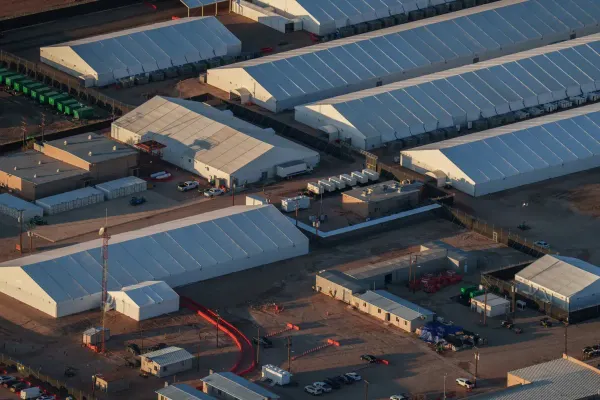
The Army's 18 July 2025 contract for Camp East Montana, the tent site at Fort Bliss in El Paso, valued at up to $1.3 billion, went to Acquisition Logistics LLC, a Virginia small business with no detention experience. The company is registered to a home in Henrico County, employs between eight and 50 people and had won about 30 federal contracts since 2008 worth about $48 million in total. It had never won a contract worth more than $16 million. Its chief executive, Ken A. Wagner, 77, is a retired Navy flight officer. The Army set the contract aside for small businesses and obligated $232 million at the start for the first 1,000 beds. Its subcontractors included Disaster Management Group and Base International, both owned by Nathan Albers. Joshua Schnell, a federal contracts lawyer, told the AP he could not see "why the Army would award such a large contract to a company without a website".
GAO found the Army paid up to $11.5 million for guards, medical services and meals in the camp's first two weeks, before any detainee arrived, and that ICE later paid about $7.1 million for meals it did not need between October 2025 and March 2026. The contract priced services at full capacity, not at the camp's real population. Three men held at the camp died between 3 December 2025 and 14 January 2026. The El Paso County medical examiner ruled one of the deaths, that of Geraldo Lunas Campos, a homicide.
Amentum Services, a publicly traded federal contractor, signed a $200 million subcontract with Acquisition Logistics on 16 July 2025, two days before the prime contract, according to federal filings. ICE issued a notice on 11 March 2026 that it would award Amentum the camp without competition, for about $452 million. In July it extended the contract to 30 September 2027 at a possible cost of $776 million, bringing Amentum's potential total to about $1.2 billion. ICE said Amentum was "the only available responsible source". DHS said in a statement that Amentum had been a close partner in managing the camp and was best suited to take over. Angélica César of Human Rights Watch said: "Extending Amentum's contract while ignoring well-documented abuses is reckless."
DynCorp International, an Amentum subsidiary, paid $21 million in 2025 to settle a False Claims Act case over Iraqi police training. Cerberus Capital Management, whose co-chief executive Stephen Feinberg became deputy secretary of defense in March 2025, bought DynCorp in 2010; Amentum acquired it in 2020. Charles Tiefer, a former member of the federal Commission on Wartime Contracting, told the Texas Observer: "Contract stacking is one of the unfortunate ways that government contractors pump up what the government pays." Representative Gabe Vasquez, whose New Mexico district borders El Paso, said in April that Amentum had more than 100 past regulatory violations.
GAO found in August 2026 that ICE had still not added the cost-saving pricing it agreed to adopt. Mullin told House appropriators on 25 June that ICE had stopped using WEXMAC, the Navy contract vehicle under which the camp was first bought: "We're not using it anymore, just so you know." Representative Veronica Escobar, whose district includes Fort Bliss, said: "That is fantastic news."
The next $7.3 billion
DHS signed five five-year construction contracts worth up to $7.3 billion on 21 September 2026 to build detention housing on government-owned sites in New York, Texas, Arizona, Florida and California. Rapid Deployment Inc. of Mobile, Alabama, received about $2.2 billion for El Paso and about $1.5 billion for Batavia, New York. GardaWorld Federal Services received about $1.2 billion each for Florence, Arizona, and Miami. Rudiarius Holdings Corp. received about $1.2 billion for El Centro, California.
DHS has committed no money yet under the five design-build agreements. Their programme has a ceiling of $10 billion, leaving about $2.7 billion for further sites, including Port Isabel, Texas. Each standard secure housing unit in the specification has "26 steel cells, including 21 men's cells, three women's cells and two accessible cells".
GEO Group
GEO Group, the largest private detention company, signed a five-year ICE contract on 9 July 2026 to reopen the Hudson Correctional Facility in Colorado as the Big Horn facility, with 1,188 beds and a ceiling of about $528.6 million. The building, owned by Highlands REIT, was constructed in 2009 and closed in 2014. George Zoley, GEO's executive chairman, said: "We expect that our company-leased Big Horn Facility in Colorado will play an important role in helping meet the need for increased federal immigration processing center bedspace." On 29 July GEO announced a second five-year contract for Rivers Correctional Institution in Winton, North Carolina, with about 1,320 beds, a five-year government estimate of $457.1 million and expected revenue of about $80 million in the first year. Josh Stein, North Carolina's governor, opposed the contract and said ICE had a record of "abusing American citizens".
GEO Reentry Services LLC, a GEO subsidiary that holds no federal contracts of its own, gave $1 million to MAGA Inc., the super PAC supporting President Trump, on 16 July and $413,000 on 31 July, according to federal campaign finance filings. The subsidiary had given $1 million each in October 2025, on 9 March 2026 and in April 2026, for $4.4 million in total. Federal contractors are barred from giving to super PACs directly. The Big Horn contract was announced on 13 July, three days before the $1 million payment, and the Rivers contract two days before the $413,000 payment. The 9 March payment fell on the day new ICE contracts for GEO worth $426 million were reported to have stalled.
A spokeswoman for the president said political donations play no role in contract awards. DHS said contractor selection follows a heavily regulated process. GEO did not respond to requests for comment on the March donation. GEO's political action committee was the first corporate PAC to give the legal maximum to the president's 2024 campaign.
GEO booked net income of $254.3 million for 2025, against $32 million in 2024, on revenue of $2.63 billion, of which ICE supplied 48 per cent. Zoley called 2025 the most successful year for new business in the company's history. Its subsidiary BI Inc. holds an ICE electronic monitoring contract, awarded on 30 September 2025, worth about $1.02 billion and covering about 184,000 people. GEO took $732.1 million in revenue in the second quarter of 2026. Zoley told investors in August that he expected "a significant increase in the number of people in the ISAP program", ICE's supervision scheme for people released from detention. Scott Shuchart, a former ICE assistant director, said of the agency's relationship with GEO: "When GEO comes in for a meeting, it feels like a fraternity reunion."
The lenders
Ten banks pledged between 2019 and 2021 to stop lending to private prison operators, cutting off institutions that together supplied more than 70 per cent of GEO's and CoreCivic's available financing. Bank of America took CoreCivic back as a client in June 2025. Brian Moynihan, its chief executive, said: "We're happy to serve anyone." JPMorgan Chase has kept its freeze. Citizens Bank, administrative agent on GEO's credit agreement since 2024, said on 18 July 2026 that it would wind down its relationships with both companies, calling the move "a business decision based on changed commercial circumstances".
GEO spent $1.37 million of its 2025 lobbying on the Fair Access to Banking Act, which would penalise banks that refuse customers on reputational grounds, and CoreCivic spent about $2 million on the same bill. GEO spent $3.3 million on federal lobbying in 2025 and CoreCivic $3.5 million, according to Senate lobbying disclosures.
Technology contracts
Palantir Technologies received a $29.8 million contract modification in April 2025 to build ImmigrationOS, a system to identify and track people for deportation, under a contract first signed in 2022. ICE awarded Palantir a $29.9 million sole-source renewal for ImmigrationOS licences, maintenance and adaptive services on 25 September 2025. ICE said Palantir was the only source able to deliver without unacceptable delay. Palantir's ICE obligations rose 297 per cent to $81.1 million in fiscal year 2025, according to the Project On Government Oversight. Alex Karp, Palantir's chief executive, gave $2 million to pro-Trump committees in December 2024.
Paragon Solutions, a spyware maker founded in Israel by veterans of the military's Unit 8200, was bought in late 2024 by AE Industrial Partners, a US private equity firm, and merged into its company REDLattice. ICE signed a $2 million contract with Paragon in 2024, lifted a stop-work order on it in August 2025 and closed it out on 20 January 2026. Todd Lyons, then acting ICE director, acknowledged the agency's use of spyware in a letter dated 1 April 2026. DHS said in May 2026: "ICE has no relationship with Paragon Solutions, Inc. or with the company that acquired them." DHS said ICE has entered no other contract with Paragon and that it is "not going to confirm or deny law enforcement capabilities or methods".
The president's accounts
President Trump's investment accounts made 29 trades in GEO Group and CoreCivic stock in 2025, worth between $281,029 and $990,000, with the first purchases on the tenth day of his term, according to an analysis of his ethics filings by Citizens for Responsibility and Ethics in Washington. Trades appear in every month of 2025 except August and December. His 2026 disclosure lists CoreCivic holdings worth between $15,000 and $50,000.
Senator Elizabeth Warren and Representative Robert Garcia, the ranking member of the House Oversight Committee, cited the same 29 trades in a 12 August letter to the president and asked him to identify his investment managers by 28 August. "The American people deserve to know that the President is not using his office to increase the value of his stock portfolios, rather than working to bring down the cost of groceries," they wrote. No response has been made public. Scott Bessent, the Treasury secretary, declined Warren's request at a hearing to open an insider trading inquiry.
President Trump disclosed more than 21,000 securities trades in his first year back in office across about 1,600 companies, in a portfolio worth at least $858 million, and the private-prison trades were a small part of it. The same filing shows 47 trades in Palantir worth up to $4.1 million and holdings in Amentum Holdings, the company that took over Camp East Montana. The White House said the accounts are "managed by professional advisers who do not regularly communicate with Trump". Anna Kelly, a White House spokeswoman, said the president "only acts in the best interests of the American public". The Trump Organization has said outside brokerage firms control the purchases. President Trump said: "I purposely never speak to any of the people that run the money. They're big institutions and they invest in whatever they invest in." He also said: "You know why I'm profiting? Because the stock market's going up, everybody's profiting." He has not placed his assets in a blind trust.
Damon Hininger, then CoreCivic's chief executive, told investors on 11 February 2025 that the company anticipated "significant growth opportunities, perhaps the most significant growth in our company's history over the next several years". Zoley told GEO's investors on 27 February 2025: "We believe our company faces an unprecedented opportunity at this time to support President Trump's new administration policies." The president's accounts made seven GEO and CoreCivic purchases that month.
GEO Group, its subsidiaries and executives gave close to $2 million to President Trump's 2024 campaign and connected committees, including $500,000 to the inaugural committee, and CoreCivic and its chief executive gave $816,600, including $500,000 from the company to the inauguration on 19 December 2024. Gustin said: "No investor's purchase or sale of our stock has had any bearing on any business decision by this company." CoreCivic says in its SEC filing that, under longstanding policy, it does not lobby for or against policies that determine the basis or duration of anyone's detention.