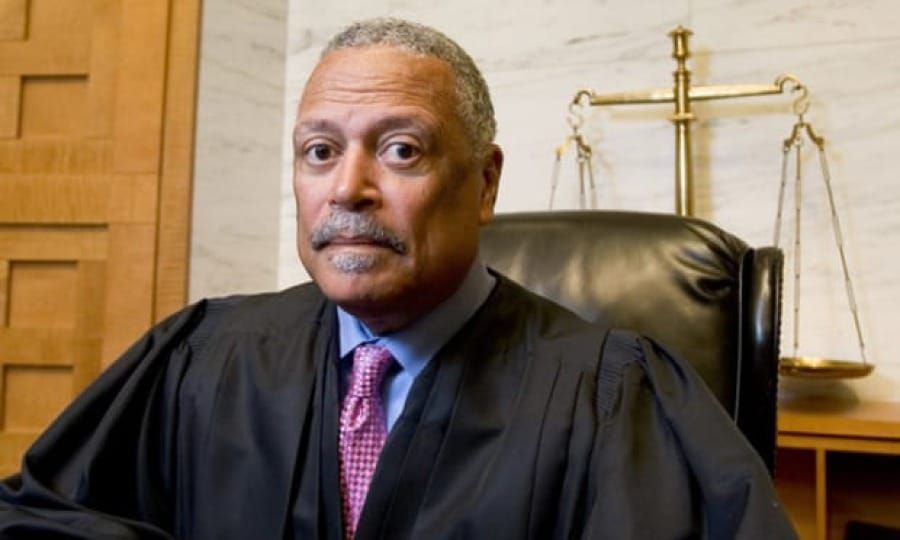
Katie Phang says a Justice Department lawyer confirmed by email that the department met Judge Emmet Sullivan's 24 September deadline to deliver handwritten FBI interview notes it had withheld as duplicates of typed reports.
Sullivan rejected that justification eight days earlier. His 16 September opinion says "the underlying handwritten notes are not duplicates of the FD-302 interview reports" and orders redacted and unredacted versions submitted "for its in camera review" by 11:00am on 24 September.
The order fixed a date and an hour. It required no public notice of delivery and did not order the notes released.
Associate Attorney General Stanley Woodward Jr. filed a public "Notice of Compliance" after the department's last private delivery in the case, on 30 July. It disclosed that hard copies of other disputed documents had been hand-delivered to Sullivan's chambers at 2:28pm.
Phang said on 25 September that the department filed no comparable notice this time. The public filings YAC News reviewed through 1 October contain none. Sullivan has not said publicly what he received or whether it satisfies his order.
Withheld as duplicates while about 95 others were already public
Sullivan's 25 June preliminary injunction ordered the Attorney General to "produce to the public the underlying FBI interview notes that formed the basis for the FD-302 interview reports" bearing Bates numbers EFTA01245620, EFTA02858481, EFTA02858491 and EFTA02858495, or show cause why not, by 2 July.
Woodward answered on 2 July. The department had not produced the notes, his filing says, because they "are substantially similar to the ultimate reports, and have accordingly been deemed duplicative of the typewritten reports memorializing the interviews." Their handwriting, it adds, "increases the risk of inadvertent disclosure of victim PII."
Sullivan's 6 August order says the department's assertions did not comply with his order, which "requires documentation to support the assertions." He told the department to explain "why the handwritten notes cannot be redacted manually, or why the redactions cannot be accomplished in another way."
Phang's lawyers filed a list on 20 August of about 95 handwritten FBI interview notes the department had already published.
Andrew Block, Senior Counsel to the Associate Attorney General, replied on 27 August that the department "respectfully maintains its objections to producing any such documents."
The Act lists five exceptions. Duplication is not one
Sullivan's 16 September opinion rejects the department's position. The review protocol, it says, "contains no directive requiring the withholding of 'substantially similar' or 'duplicative' documents."
Section 2(c)(1) of the Epstein Files Transparency Act provides five grounds for withholding or redaction, including victims' personally identifiable information and child rape media, which the Act calls child sexual abuse materials. Duplication is not among them.
Section 2(c)(1)(A) still permits the department to redact victims' identifying details in any public release. Sullivan's opinion decides the duplication argument but not the department's separate handwriting-risk argument, his order requires a redacted version alongside the unredacted one, and he has not ruled on whether any of the notes must be published.
A 302 is the agent's account
The FBI uses the FD-302 form to document investigative activity, particularly interview results, according to a 2002 report by the Justice Department's inspector general. Agents' handwritten interview notes go into a separate envelope known as a 1A, the report says.
The Third Circuit, describing the D.C. Circuit's 1975 decision in United States v. Harrison, wrote in 1994 that agents' rough notes should be preserved and that a typed report may pass through "the agent's selections, interpretations and interpolations."
The Fourth Circuit held in United States v. Roseboro in 1996 that an agent's typed 302 was not a witness's own statement where nothing showed the witness had adopted it.
Sullivan's ruling establishes that the notes and the 302s are separate documents. Whether the notes hold anything the typed reports leave out can be settled only by the notes, which the order sends to Sullivan alone.
Three redactions still lack documentation
Sullivan's 16 September opinion cleared five disputed documents, including both draft-indictment documents, after in camera review. It also cleared two documents in which email addresses were redacted under the Privacy Act, as the department's First Level Review Protocol provides.
For three emails, EFTA01187999, EFTA02504630 and EFTA01022356, Sullivan wrote that the department "has not, however, provided any documentation to support his representation" that the redacted names belong to victims. He ordered that documentation delivered for in camera review by the same 11:00am deadline.
The Act requires a written justification for every redaction, published in the Federal Register. The department published its 14 February report to Congress in the Federal Register on 27 August, and Sullivan discharged his order on that requirement.
24 September: filing 50 and an email
Sullivan's orders set three obligations for 24 September: the notes by 11:00am, the documentation for the three emails by 11:00am and the department's Answer to Phang's complaint, which a separate 16 September order compelled.
The department filed a document numbered 50 that day with five exhibits, including its 4 January Attorney Review Protocol and the Section 3 report to Congress. The main document is not in the public RECAP archive, and YAC News could not confirm whether it is the Answer.
Phang said Block wrote, in reply to her lawyers' inquiry: "Yes, we complied with the court's order." YAC News has not seen the email. Phang also said Sullivan had not confirmed the contents of what he received.
The appeal targets the foreign-language files
The department appealed the June injunction on 24 August, in D.C. Circuit case No. 26-5299. Block appealed the 16 September order on 17 September, and the D.C. Circuit docketed that appeal on 21 September as No. 26-5334 and consolidated the two.
Block filed a motion at 8:45pm on Friday 18 September asking Sullivan to stay one part of the order: the requirement to begin reviewing foreign-language material covered by the Act. The motion left the notes and email-documentation requirements untouched.
Sullivan denied it on 21 September. The department had not conferred with Phang's lawyers as Local Civil Rule 7(m) requires, he wrote, and the motion would also fail on the merits. He stayed the foreign-language requirement "until three days after the D.C. Circuit resolves Defendant's forthcoming motion to stay in that court."
The department's 21 September reply to Sullivan argues that Phang lacks standing and a private right of action under the Act. It took its stay request to the D.C. Circuit on 22 September, seeking a stay of the foreign-language requirement and an expedited appeal, according to Phang's response.
Judges Sri Srinivasan, Cornelia Pillard and Florence Pan ordered Phang on 23 September to respond by 11:59pm on 25 September, with any reply due on 29 September. Phang's response says the Attorney General "defied the preliminary injunction for nearly three months without seeking a stay." The appeals docket and reports YAC News reviewed show no ruling on the motion by 1 October.
A $1,000-a-day fine requested; contempt "premature"
Phang asked Sullivan on 13 July to fine the Attorney General $1,000 a day until he completed the foreign-language review, published redaction justifications and produced documents that, in the motion's words, he "concedes do not contain victim information."
Sullivan raised the prospect of contempt at a 13 August status hearing, according to reporters present.
His 16 September opinion cites the Supreme Court's 1966 decision in Shillitani v. United States: "courts have the inherent power to enforce compliance with their lawful orders through civil contempt." Because the Attorney General had "now stated his rationale" for not starting the foreign-language review, it says, "a civil contempt finding at this juncture would be premature."
Sullivan had made no contempt finding and imposed no sanction by 1 October, according to the filings YAC News reviewed. Federal law, 18 U.S.C. § 401, gives federal courts power to punish disobedience of a lawful order by fine or imprisonment.
"Conceded that he is in violation of the Act"
Phang, a lawyer and former MSNBC host, filed Katie Phang v. Todd Blanche, Civil Action No. 26-1417 (EGS), in the US District Court for the District of Columbia on 27 April 2026. She sued Blanche in his official capacity, then as Acting Attorney General.
The complaint, filed by the Public Integrity Project, brings two counts under the Administrative Procedure Act, one of ultra vires agency action and one under the Declaratory Judgment Act. It alleges that the department's releases contained unlawful redactions, left redactions unexplained and withheld covered material.
The Act became law on 19 November 2025, giving the Attorney General 30 days to publish unclassified Epstein and Ghislaine Maxwell investigative material. The department said on 30 January 2026 that it had published nearly 3.5 million pages, more than 2,000 videos and 180,000 images, after identifying more than 6 million potentially responsive pages.
Sullivan's 25 June opinion says the Attorney General "has conceded that he is in violation of the Act" by not responding substantively to Phang's merits arguments. The court relied on that concession to hold that Phang is likely to succeed. It had issued no final ruling on the merits by 1 October.
President Donald Trump removed Pam Bondi on 2 April and named Blanche Acting Attorney General. The Senate confirmed Blanche on 8 August by 50 votes to 49, and the Justice Department says he was sworn in on 10 August.
The woman in the notes
The four Bates numbers correspond to typed FBI reports of 2019 interviews with a woman who told agents that Epstein abused her from about age 13 and that Trump assaulted her after Epstein introduced them, according to published accounts of the reports. YAC News is not naming her.
In March 2026 the department said FBI interview memos concerning the woman, which it then posted, had been "incorrectly coded as duplicative," according to news reports.
White House Press Secretary Karoline Leavitt said in March that the accusations were "completely baseless" and "backed by zero credible evidence." Trump has denied wrongdoing connected to Epstein. YAC News located no FBI or Justice Department conclusion on the allegation in the releases and filings it reviewed. The existence of interview notes does not corroborate it.
216 of 218 signatures
Representative Thomas Massie's discharge petition for H.R. 9694, the Epstein Files Transparency Act II, showed 216 of the 218 signatures needed on the House clerk's website on 1 October. The House is not scheduled to return until after the 3 November midterm elections.
New Mexico Attorney General Raúl Torrez sued the Justice Department and Blanche in the same court on 5 August, seeking unredacted files concerning Epstein's Zorro Ranch.
Due 15 October: the administrative file
The department's stay motion is pending in the D.C. Circuit, the foreign-language review remains stayed and Sullivan has not ruled publicly on the notes or the three email redactions.
Sullivan's order compelling the Answer also required a certified list of "the contents of the Administrative Record" by 1 October and requires the department to produce "the Administrative Record to the Plaintiff" by 15 October.