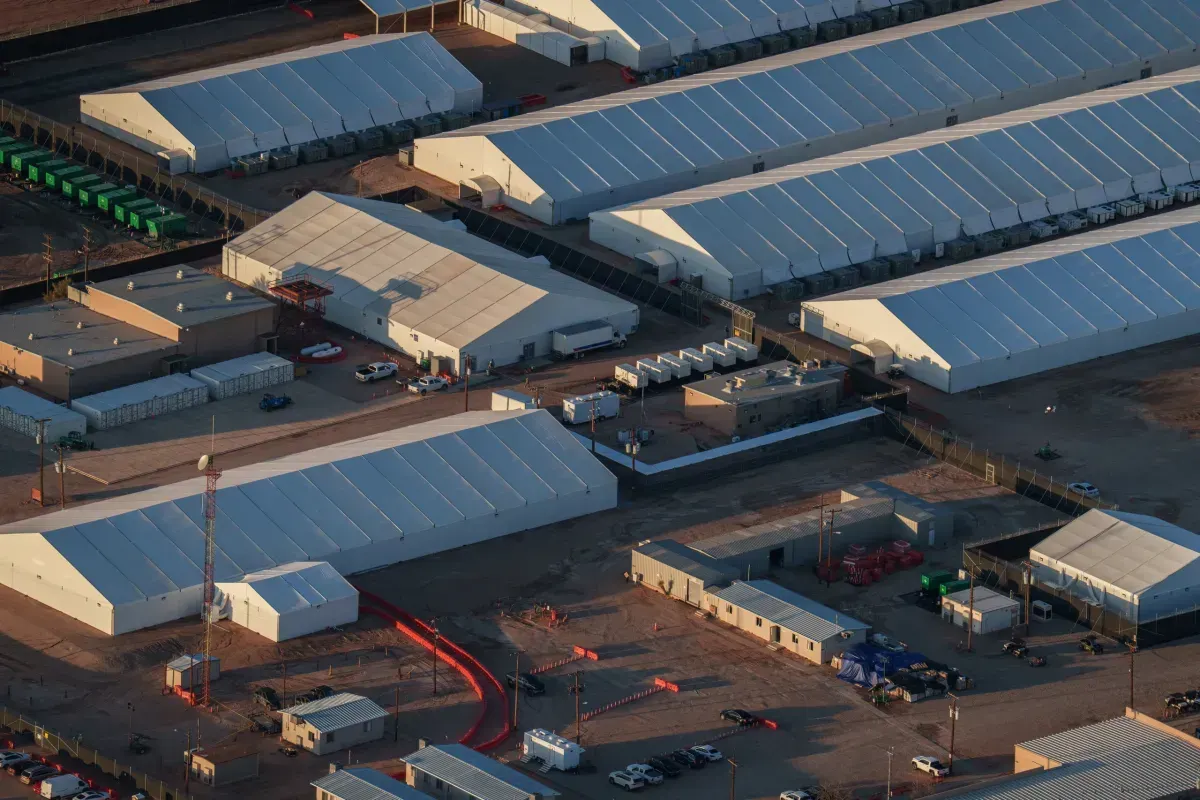
Geraldo Lunas Campos, a 55-year-old Cuban from Rochester, New York, who had lived in the United States since 1996, died at about 10.16pm on 3 January 2026 while contract guards restrained him at Camp East Montana, the tent detention site at Fort Bliss in El Paso that is the largest in the Immigration and Customs Enforcement system. The El Paso County medical examiner ruled his death a homicide and gave the cause as asphyxia due to neck and torso compression.
The Government Accountability Office later found that the camp's contractor never gave ICE the use-of-force and death reports its contract required, and that "evidence associated with the incident was missing or destroyed". ICE's Office of Professional Responsibility had put its own inquiry on hold pending a separate criminal investigation, GAO found in a report published on 9 June 2026. GAO's report does not name Lunas Campos. It describes "a detained noncitizen death by use of force in January 2026" and states that "the coroner's autopsy found the death to be a homicide due to asphyxia".
ICE said in a statement on 9 January that "while in segregation, staff observed him in distress and contacted on-site medical personnel for assistance". By about 10 January the agency was saying he had "attempted to take his own life while detained" and that staff "immediately intervened to save his life". A Department of Homeland Security statement on 16 January said: "Campos violently resisted the security staff and continued to attempt to take his life. During the ensuing struggle, Campos stopped breathing and lost consciousness." ICE's formal detainee death report, published in February, described a "spontaneous use of force" that followed "attempted self-harm, prompting a rapid response from custody and medical staff". It said "attempts to de-escalate the situation were unsuccessful". No death in ICE custody had been ruled a homicide in more than 15 years.
The autopsy recorded that Lunas Campos was "witnessed to become unresponsive while being physically restrained by law enforcement". The medical examiner found superficial abrasions, bleeding in the eyelids and neck and fractured ribs. Toxicology detected trazodone and hydroxyzine. Lunas Campos had been diagnosed with bipolar disorder and anxiety.
Veronica Escobar, the Democrat who represents El Paso in Congress, called the death a "confirmed murder". She said in February: "This is a moment where we need local law enforcement, local prosecutors to create accountability, because the federal government will not." Renard Johnson, the mayor of El Paso, called for an independent investigation. Scott Shuchart, a former head of policy at ICE, said deaths from staff violence were "another level" and preventable.
ICE arrested Lunas Campos in Rochester on 14 July 2025 and moved him to Camp East Montana on 6 September. He was a father of four. He was also a registered sex offender with a felony conviction, and an immigration judge had ordered him deported in 2005, an order the government never carried out because Cuba did not issue travel documents.
Santos Jesus Flores, a detainee who saw the restraint, said Lunas Campos repeatedly said "I cannot breathe" in Spanish while guards held him. Another detainee told Spectrum News that guards handcuffed him, tackled him and put him in a chokehold, and that he lost consciousness within about five minutes. Six detainees told The Texas Tribune that he had gone days without his asthma medication before guards dragged him to isolation. Witnesses interviewed by Human Rights Watch for a report published on 15 July heard him say "You're suffocating me" and "I cannot breathe, may God bless me."
Will Horowitz, a lawyer for the family, went to federal court in the Western District of Texas in January to stop the deportation of detainees who saw the restraint. A judge blocked the removals, and six witnesses were protected from deportation until they could be deposed. Jeanette Pagan Lopez, the mother of two of Lunas Campos's children, said: "I need some kind of justice. I know I can't bring him back."
Lunas Campos's family filed a wrongful death suit in the week of 30 June against Acquisition Logistics LLC, the camp's original prime contractor, Akima Global Services LLC and unnamed guards, seeking more than $1 million. The suit alleges that staff found a sheet around his neck three months before he died, that he went four days without medication in November and that a planned transfer to "a higher level of care for mental health treatment" never happened.
James Montoya, the El Paso County district attorney, said in January that the land at Fort Bliss "is generally within the exclusive jurisdiction of the federal government" and that his office was "continuing to research the matter of jurisdiction". The US Attorney's office for the Western District of Texas declined to comment. No charging decision had been announced by 1 October.
The camp opened without its inspection
The Army awarded the Camp East Montana contract on 18 July 2025, valued at up to $1.3 billion, on behalf of ICE. GAO found that Army and ICE officials compressed the schedule on the direction of senior leadership, which GAO does not name. They used the Navy's Worldwide Expeditionary Multiple Award Contract, known as WEXMAC, which GAO said was being used "for detention facility services" for the first time. They chose a prime contractor with no detention experience on a lowest-price basis. Its guard and medical subcontractors had detention experience.
Acquisition Logistics, a Virginia small business registered to a home address in Henrico County, had between eight and 50 employees and about 30 federal contracts since 2008 worth about $48 million in total. It had never won a contract worth more than $16 million. Its chief executive, Ken A. Wagner, 77, is a retired Navy flight officer. Joshua Schnell, a federal contracts lawyer, told the Associated Press he could not see "why the Army would award such a large contract to a company without a website". Its subcontractors included Disaster Management Group and Base International, both owned by Nathan Albers.
The contract required Acquisition Logistics to provide 1,000 beds within 30 days of award and a further 250 beds each week until the camp reached about 5,000. Hector Gonzalez, 38, a worker building the site, was killed in an industrial truck accident on 21 July 2025, two days after work began. The first detainees arrived on 16 August 2025.
ICE policy requires a pre-occupancy inspection before anyone is held in a new facility. ICE did not conduct one. GAO found the camp opened without perimeter security cameras, outdoor recreation space or areas for lawyer visits. It had no showers accessible to wheelchair users.
The Army paid up to $11.5 million for guards, medical services and meals between 1 and 15 August 2025, when no one was detained at the camp, GAO found. ICE then paid about $423,000 for meals it did not need between 16 August and 30 September, and about $7.1 million more between 1 October and 12 March 2026. The contract priced meals and services at full capacity, not at the number of people actually held. The camp's population peaked at about 3,880 in January 2026, according to Human Rights Watch, and stood at about 1,600 at the end of February, according to GAO. Across the country ICE held 39,314 people on an average day when President Trump took office and 67,204 on 1 April 2026.
ICE issued eight formal discrepancy reports to the contractor between 3 December 2025 and 3 March 2026. GAO lists their subjects: tuberculosis screening, medical assessments, food service, transport delays, use-of-force documentation, cleaning, suicide prevention, an escape and a lost firearm. A detainee with tuberculosis was housed in the general population in November 2025 after the contractor screened arrivals with questionnaires, not skin tests. No detainee with diabetes or HIV had a treatment plan. Dormitories were cleaned weekly, not daily. A detainee escaped in October 2025 because of inadequate supervision, GAO found.
A guard lost a loaded handgun inside the camp on 26 January 2026. "As of March 2026 the firearm had not been recovered," GAO wrote.
ICE's Office of Detention Oversight inspected the camp from 10 to 12 February 2026 and found 49 deficiencies, the most recorded in any ICE inspection that year. The previous high was 13. Three were priority issues: tool control, ammunition inventory and the contractor's failure to tell ICE about a detainee showing symptoms of tuberculosis. The inspectors rated the facility acceptable. Randall Kallinen, a Houston civil rights lawyer, said: "This report is scathing. Camp East Montana gets an F."
The contract contained no quality assurance plan, so ICE officials told GAO they could not impose financial penalties for any of the failures. GAO made four recommendations: that ICE introduce tiered pricing tied to the real population, that ICE put controls in place so new facilities are inspected before anyone is held there, and that the Army and DHS each review the acquisition. DHS agreed with all four and said the contract was "shifting to a tiered pricing model". The Department of Defense agreed to act but told GAO the report relied too heavily on ICE's perspective. GAO stood by its findings.
Senators Jack Reed, Gary Peters and Dick Durbin and Representative Bennie Thompson requested the report. Durbin said on its release: "We now know even more details of how dangerous and irresponsible the Trump administration's mass deportation campaign truly is." He said "those detained are experiencing conditions that shock the conscience". Escobar said the camp "needs to be shut down, the contractor investigated". Alana Park of the Texas Civil Rights Project said: "The conditions for those in detention are unsafe and inhumane, and the facility drains millions of dollars." ICE said it "is always looking at ways to improve our detention facilities". Lauren Bis, a DHS spokeswoman, said the new contractor "will allow Camp East Montana to continue abiding by the highest detention standards with the ability to provide more medical care on-site".
Three deaths in six weeks
Francisco Gaspar-Andres, a 48-year-old Guatemalan held at the camp, died at 5.53am on 3 December 2025 at The Hospitals of Providence East in El Paso. Florida Highway Patrol troopers working with ICE had arrested him on 1 September 2025. He was held at the Krome centre in Miami, moved to El Paso on 19 September, ordered removed on 14 November and taken to hospital two days later with low sodium. Doctors later diagnosed renal failure and internal bleeding. ICE attributed his death to liver and kidney failure.
Victor Manuel Diaz, a 36-year-old Nicaraguan, died at the camp at 4.09pm on 14 January 2026, 11 days after Lunas Campos. ICE had arrested him in Minneapolis on 6 January. He had entered the United States in March 2024. ICE called his death a presumed suicide. On the 911 call, Luis Gonzalez, the camp's health administrator, said: "They just found him with his pants tied up to his neck, I believe."
GAO found that Diaz "exhibited risk factors for suicide". Staff put him in a medical holding room instead of a suicide-resistant cell and "left them unattended for intervals longer than 15 minutes". ICE had raised the lack of door viewing panels with the contractor in October 2025. The facility "had not installed the vision panels" by the time Diaz died, GAO found.
ICE sent Diaz's body to William Beaumont Army Medical Center, where an Armed Forces pathologist performed the autopsy, not the county medical examiner who had ruled on Lunas Campos two weeks earlier. The Army hospital does not release autopsy reports. Kallinen, who represents the Diaz family, said: "Why did they go against their previous practice?" He said the GAO findings showed "huge discrepancies in their failure to prevent suicides". Angélica César of Human Rights Watch said: "The more credible approach here would have been for local, independent authorities" to conduct the examination. Yorlan Diaz, his brother, said: "I don't believe he took his life. He was not a criminal; he was looking for a better life."
The attorneys general of 22 states and the District of Columbia later counted three deaths at Camp East Montana within six weeks. Human Rights Watch and the American Civil Liberties Union interviewed 80 people for their 15 July report on the camp, 71 of whom had been held there. Of those, 64 said they had witnessed or experienced beatings. Pods held up to 72 people with six toilets. One man, identified as Javier C., told the researchers: "You're only getting out deported or dead."
Gerald Akari Angye, a 35-year-old from Cameroon, is the named plaintiff in a class action over conditions at the camp filed on 30 May by the ACLU of Texas, the national ACLU, the Texas Civil Rights Project and the law firm Farella Braun + Martel. Kyle Virgien, a lawyer for the plaintiffs, said: "Camp East Montana is nothing short of a civil rights catastrophe." DHS called the claims "categorically false".
ICE issued a sole-source notice to Amentum Services, a guard subcontractor at the camp, on 11 March 2026 and moved operations to the company that week, at a value of about $452 million. The Army terminated the Acquisition Logistics contract in April. On 28 July ICE extended Amentum's contract to 30 September 2027 for a further $776 million, saying the company was "the only available responsible source". DHS said: "Camp East Montana is NOT closing." César said: "Extending Amentum's contract while ignoring well-documented abuses is reckless." DynCorp International, an Amentum subsidiary, paid $21 million in 2025 to settle a False Claims Act case over Iraqi police training.
Deaths after release are no longer reviewed
ICE's death reporting page listed 51 deaths in detention between 20 January 2025 and 21 May 2026, against 19 in the previous two years, according to a 25 June letter from the attorneys general of 22 states and the District of Columbia. Letitia James, New York's attorney general, led the letter. It says at least 17 of the people died after medical staff delayed or failed to provide critical care, and that more than half of the recent deaths occurred at nine of more than 220 facilities.
David Venturella, acting ICE director, signed Directive 11003.7 on 2 June 2026, his second day in the post. The directive removed from ICE's review and reporting process any death occurring within 30 days of release from custody. Directive 11003.5, issued on 15 October 2021, and its successor of 27 February 2025 had required a review "when a death occurs within a reasonable time, not to exceed 30 days of release". Venturella circulated the change to staff on 4 June. The memo said ICE was "returning to the standard practice of reporting deaths that occur while an individual is in agency custody". Venturella had worked for GEO Group, the largest private detention company, for about a decade and was a paid GEO consultant until 31 January 2025.
The attorneys general wrote that the change "creates a perverse incentive for facility operators to simply release critically ill individuals right before they die". James said the policy was "a blatant attempt to hide dangerous conditions inside ICE detention centers". Aaron Ford, Nevada's attorney general, said: "The federal government cannot simply stop asking questions because the answers may be uncomfortable." Ford's office cited the death of Ismael Ayala-Uribe, 39, from septic shock. Jay Jones, Virginia's attorney general, called the directive "an abhorrent attempt by ICE and the DHS to sidestep responsibility".
DHS said: "When an individual is no longer in ICE custody then ICE will no longer be responsible for monitoring deaths." Khaled Alrabe of the National Immigration Project said: "This creates a situation where ICE can basically release people on their deathbed." Haddy Gassama of the ACLU said: "This feels like another step to this increasingly opaque and quite deadly detention system." Dr Sanjay Basu, a physician and epidemiologist, told the Associated Press the change would "make the mortality statistics appear lower without any actual improvement in care".
Human Rights Watch and Physicians for Human Rights counted 52 deaths in ICE custody in the first 500 days of the second Trump administration, in a report published on 25 June. The detained population rose 77 per cent over the period and the mortality rate rose 140 per cent, the groups found. Seven of the deaths in their study period were apparent suicides, against one reported in 2024. ICE published death notifications after its own 48-hour window in 64 per cent of cases. Brian Root, a senior researcher at Human Rights Watch, said: "People are dying in ICE custody at the highest rate in many years, even after accounting for the surge in detention."
Todd Lyons, then acting ICE director, said: "No death is what we want. We don't want anyone to die in custody." DHS has said that "for many illegal aliens this is the best healthcare they have received".
ICE also missed the 90-day deadline Congress set for public death reports on at least four deaths in January 2026, including Diaz's. The agency's reporting page went unchanged from mid-February to April. ICE then posted reports on Diaz, Heber Sanchez Dominguez, Parady La and Luis Nunez Caceres. DHS attributed the delay to the lapse in DHS appropriations that began on 14 February.
Shot, then charged
A tracker maintained by The Trace, a nonprofit newsroom covering gun violence, counted 31 incidents in which immigration agents shot at people and nine people killed, as of 21 September 2026. It also recorded 49 incidents in which agents held people at gunpoint.
Wilber Rafael Garces Perez, a 28-year-old Venezuelan DoorDash driver, was shot in the back by an ICE officer in north Austin on 20 September, near Anderson Lane and Research Boulevard under Highway 183. He had entered the United States on humanitarian parole through the CBP One app and had an asylum application pending. He had no criminal record. ICE officers in two unmarked SUVs had stopped him after a licence plate database flagged a final removal order.
Garces Perez was taken to Dell Seton Medical Center and handed to ICE about three hours later. ICE moved him to its detention centre in Pearsall, south of San Antonio. A federal judge temporarily blocked his deportation on 22 September. José Garza, the Travis County district attorney, said an investigation "will be severely hindered" if he were removed. Members of Congress wrote to DHS that "Mr. Garces Perez is a key witness to this shooting". Representative Greg Casar said: "Wilber is the person who was shot. He's the most key witness in this investigation." Casar and Representative Joaquin Castro arranged to visit him in detention. Hundreds of people protested at the site of the shooting on 27 September.
On 28 September federal prosecutors charged Garces Perez with assaulting, resisting and impeding a federal officer, a charge that carries up to 20 years. The Justice Department alleges that he ignored orders to park and get out, "closed his window and drove off, striking one of the ICE ERO officers in the torso with the driver's side-view mirror", led officers on a high-speed chase and then tried to hit an officer, who fired. Justin R. Simmons, the US Attorney for the Western District of Texas, brought the case. The complaint identifies the officers only by initials. The officer who fired, L.G., wore no body camera. The second officer, D.F., wore one and turned it off before the shooting.
Lisa Davis, the Austin police chief, first described a "small foot pursuit". Austin police later said they found no evidence of one and described a vehicle chase of 10 to 15 minutes. Footage released by the city, including an off-duty detective's dashboard camera and police body cameras, does not show the shooting. Homeland Security Investigations is investigating with the FBI and the Texas Rangers. Kirk Watson, the mayor, said an investigation run only by ICE "would not be appropriate". Austin police had not received the evidence they requested from federal investigators.
Rick Bazan, a Homeland Security Investigations special agent described in court as DHS's lead investigator into the shooting, gave evidence for the prosecution at a detention hearing on 30 September. Bazan said he had not interviewed L.G., could not confirm that the officer was struck and could not say that a body camera screenshot clearly showed contact. Garces Perez appeared in a wheelchair with his left arm in a sling. Magistrate Judge Dustin Howell found no proof that he was a danger to the community but ordered him held as a flight risk.
Kate Lincoln-Goldfinch, his immigration lawyer, said the charge was being used as a tool of retaliation. "He still has the bullet in his body," she said at the hearing. "He has a fractured clavicle, limited mobility." She said earlier: "This person needs a doctor, not a deportation or a detention center." She also said: "There is absolutely zero justification for having shot him in the back of the neck." Flor Perez, his mother, told AFP that he called her and said: "Mom, they shot me, they shot me." Gladys Perez, his aunt, told AFP: "There was no reason to shoot Wilber." DHS said he "illegally entered our country under the Biden administration and had a final order of removal", and that he received round-the-clock care in custody.
Marimar Martinez, a 30-year-old US citizen and Montessori teacher, was shot on 4 October 2025 in the Brighton Park neighbourhood of Chicago by Charles Exum, a Border Patrol agent who fired five rounds into her car. Federal prosecutors charged her and a second man, Anthony Ian Santos Ruiz, with assault and later moved to dismiss. Judge Georgia Alexakis dismissed the charges with prejudice on 20 November 2025. Exum had texted colleagues: "fired 5 rounds and she had 7 holes. Put that in your book boys." Christopher Parente, her lawyer, said: "These agents were lying ... It was a bad shoot." Body camera footage released in February 2026 records Exum saying "it's time to get aggressive" before turning his vehicle toward hers. DHS said the agent had been placed on administrative leave. Martinez has filed a civil claim.
Ruben Ray Martinez, a 23-year-old US citizen from San Antonio who worked at Amazon, was shot dead shortly after midnight on 15 March 2025 on South Padre Island, Texas, where he had gone to celebrate his birthday. A Homeland Security Investigations supervisory special agent fired through his driver's window. ICE's role became public only in February 2026, through records obtained by American Oversight under the Freedom of Information Act. DHS said Martinez "intentionally ran over" an agent and that a second agent fired "defensive shots". Body camera footage did not support that account. A Cameron County grand jury declined to indict on 25 February 2026. Rachel Reyes, his mother, said: "They didn't give him a chance. It's so excessive."
Silverio Villegas González, 38, was shot dead by an immigration agent in the Chicago area on 12 September 2025. Keith Porter, 43, was shot by an off-duty ICE officer in Northridge, California, on 31 December 2025. An ICE officer shot and killed Lorenzo Salgado Araujo, 52, in Houston on 7 July 2026, and another shot a Colombian man in Biddeford, Maine, on 13 July. Federal agents were told that month that the FBI would stop investigating confrontations with immigration agents and that Homeland Security Investigations, part of ICE, would take them over, according to people briefed on the guidance who spoke to The New York Times. The Justice Department and DHS said in a joint statement: "The relationship between DHS and DOJ in investigating assault on federal officer cases has not changed, and FBI will continue to investigate in accordance with agency policy."
Minneapolis
Jonathan Ross, an ICE officer, shot Renee Good, a 37-year-old US citizen, poet and mother of three, in her car on Portland Avenue in south Minneapolis on 7 January 2026, during the federal deployment DHS called Operation Metro Surge. Good had stopped her Honda Pilot in the street and honked to warn neighbours of agents nearby, according to her family's lawsuit. Ross fired one round through the windscreen and two through the open driver's window as the car turned. An autopsy commissioned by her family found that the fatal round entered her left temple. The Hennepin County medical examiner ruled her death a homicide on 23 January.
Kristi Noem, then homeland security secretary, said within hours: "Domestic acts of terrorism like this will not stand." President Trump called Good a "professional agitator" who "viciously ran over the ICE Officer". Gregory Bovino, the Border Patrol commander leading the operation, said Ross "reacted when a 4,000-pound missile came right at him". DHS said Ross suffered internal bleeding to the torso. Phone and bystander video shows the SUV turning away from Ross as he fired. Ross had been dragged more than 100 yards by a car during an arrest in Bloomington, Minnesota, in June 2025.
Todd Blanche, then deputy attorney general, said there was "currently no basis for a criminal civil rights investigation". Six prosecutors in the US Attorney's office in Minnesota resigned on 13 January after Justice Department leaders pushed to investigate Good's widow, Becca Good, according to people with knowledge of the decision who spoke to The New York Times. Tracee Mergen, an FBI agent in Minneapolis who had opened an inquiry into Ross, later resigned after officials pressured her to step away from it, people familiar with the matter told the Times. The Senate confirmed Blanche as attorney general on 8 August. Ross has not been charged. DHS has said he acted in self-defence.
Federal agencies handed Hennepin County prosecutors body camera footage, statements and Good's car on 13 July, after Minnesota sued for the evidence. Mary Moriarty, the county attorney, said she would announce any charging decision publicly. In May her office charged Christian Castro, an ICE agent, with four counts of second-degree assault and one count of falsely reporting a crime over his 14 January shooting of Julio Sosa-Celis, who survived. Castro has not been convicted. Alex Pretti, also 37 and a US citizen, was shot dead by a Customs and Border Protection officer in Minneapolis on 24 January.
Good's family filed two federal lawsuits on 1 October 2026. One sues Ross, Stephen Miller, Noem, Tom Homan, Todd Lyons, Bovino and Corey Lewandowski under the Ku Klux Klan Act of 1871, alleging that Ross's shots were "the predictable and intended product of the operation that put him on Portland Avenue". The other is a wrongful death claim against the United States alleging that Ross used excessive force in violation of agency policy and the Fourth Amendment. Antonio Romanucci, the family's lead lawyer, said: "The day of accountability has arrived for our own U.S. government and its governmental agencies." Becca Good said: "She was the love of my life. She was funny and she was smart and she was gorgeous." The Justice Department and DHS declined to comment on the litigation.