
The Justice Department and the FBI had not answered the senator publicly by 1 October. His August report says JPMorgan Chase, Deutsche Bank and Bank of America reported more than $1.4 billion in Epstein transactions to the Treasury after Epstein's 2019 arrest, years after the money moved. JPMorgan says the report rests on "many false claims".
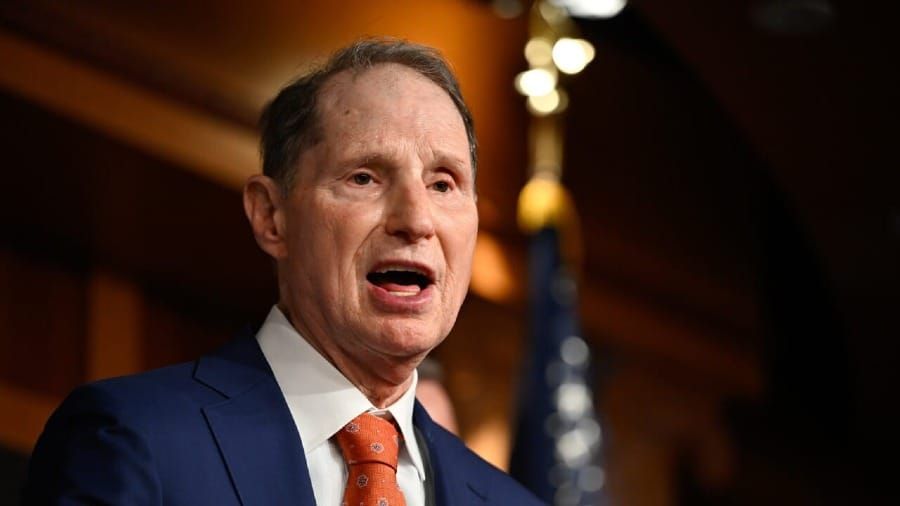
Senator Ron Wyden said on 30 September that the FBI holds a report of its interview with an Epstein-linked banker and that the Justice Department illegally left it out of files a 2025 law ordered published.
Wyden, the Oregon Democrat who is ranking member of the Senate Finance Committee, wrote to Attorney General Todd Blanche and FBI Director Kash Patel demanding "copies of all FBI 302 reports related to investigations into Epstein and his associates, including but not limited to 302s generated from interviews with employees of JPMC, Deutsche Bank and Bank of America." The department and the bureau had not responded in any public statement YAC News located by 1 October.
The Epstein Files Transparency Act, enacted in November 2025, ordered the attorney general to publish all unclassified "investigative materials" the Justice Department and FBI hold on Epstein investigations, subject to five narrow exceptions. Wyden's demand follows his staff's August report, which says three banks reported more than $1.4 billion in Epstein transactions to the Treasury years after the money moved.
Staff "learned" of the report
Wyden's letter says: "Investigators from my staff recently learned that the FBI possesses an FBI 302 report memorializing an interview with a banker tied to Epstein that was conducted as part of a criminal investigation into Epstein and his associates. This FBI 302 report is not included in the documents DOJ has released in response to the passage of the EFTA."
The one-page letter does not name the banker, the bank, the date of the interview or any investigation beyond "a criminal investigation into Epstein and his associates." It says his staff learned of the report. It does not say they saw it.
Wyden's letter also says "it is likely that the FBI possesses additional, related, FBI 302s that have not been released." It cites no section of the Act and sets no date for a reply.
The Senate Finance Committee release that accompanied the letter says in its headline that the document was "Illegally Concealed by Trump's DOJ and FBI." Its subheading says: "Trump and Blanche Have Illegally Hidden the Report from the Public and Congress."
Wyden gave a motive in an interview with MeidasTouch News on 30 September. "My view is that Todd Blanche and Kash Patel are covering this up. Covering this up to protect the banks who worked with Epstein," he said. He also said: "I'm not naming the person who was interviewed in order to protect my source."
Wyden's letter, the committee release and those remarks cite no document or testimony showing that Blanche or Patel took part in any decision about the report.
Five exceptions in the law, three privileges in practice
Section 2(a) of the Act, Public Law 119-38, gave the attorney general 30 days from enactment to publish "all unclassified records, documents, communications, and investigative materials in the possession of the Department of Justice, including the Federal Bureau of Investigation and United States Attorneys' Offices" on nine subjects. The first is "Jeffrey Epstein including all investigations, prosecutions, or custodial matters." Another is "Entities (corporate, nonprofit, academic, or governmental) with known or alleged ties to Epstein's trafficking or financial networks."
The Act does not name FD-302 forms. Its wording, "investigative materials" relating to "all investigations" of Epstein, covers an FBI interview report from a criminal investigation of him.
Section 2(b) provides: "No record shall be withheld, delayed, or redacted on the basis of embarrassment, reputational harm, or political sensitivity, including to any government official, public figure, or foreign dignitary."
Section 2(c) permits the attorney general to "withhold or redact the segregable portions of records" in five categories: personal information of victims, child rape media (which the Act terms "child sexual abuse materials"), material that "would jeopardize an active federal investigation or ongoing prosecution, provided that such withholding is narrowly tailored and temporary", images of death or physical abuse and properly classified national-security information. Every redaction requires "a written justification published in the Federal Register and submitted to Congress."
The Act lists no privilege exception. The Justice Department withheld or redacted about 200,000 pages on three.
Pam Bondi, then attorney general, and Blanche, then her deputy, wrote to the House and Senate judiciary committees on 30 January 2026 that "approximately 200,000 pages have been redacted or withheld based on various privileges," naming "deliberative process privilege, the work-product doctrine, and attorney-client privilege."
The same letter put the department's production at more than 3 million responsive pages and listed interview summaries among the material reviewed. The department published a notice under the Act in the Federal Register on 21 August 2026.
Wyden's description, if accurate, places the report inside the Act. Whether the department withheld it under the active-investigation exception, withheld it under one of its three privileges, left it out by mistake or released it somewhere in more than 3 million pages is not established. The department had not publicly addressed the document by 1 October.
The FD-302: an agent's written summary
An FD-302 is the form on which FBI agents write up an interview. The US Court of Appeals for the First Circuit described it in 2009 as "an FBI form that reports on and summarizes an FBI agent's interview of a witness."
FBI policy, as quoted by the Justice Department's inspector general in 2021, provides: "When it is anticipated that the results of an interview may become the subject of court testimony, the interview must be recorded on an FD-302." Later FBI guidance requires the form to be "initiated as soon as practicable, but no later than five (5) business days following the conclusion of the interview." Agents' handwritten notes are kept separately as "original note material."
An FD-302 establishes that the FBI interviewed someone and wrote down what the agent understood the person to have said. It establishes neither that the person did anything wrong nor that what the person said was true.
The Justice Department has told a federal court that it already published FD-302 reports under the Act. In Phang v. Blanche, in the US District Court for the District of Columbia, the department argued that agents' handwritten notes were "substantially similar" to interview reports it had released. Judge Emmet G. Sullivan rejected that argument in September, ruling that notes and reports are separate documents, and ordered the department to give him notes from four 2019 interviews for private review by 11am on 24 September.
Sullivan's order addressed duplication. It did not decide whether any unreleased FD-302 must be published or whether an exception covers one.
Prosecutors' reported inquiry into Epstein's executors
The Wall Street Journal reported on 23 September, citing people familiar with the matter, that federal prosecutors are investigating Darren Indyke and Richard Kahn, Epstein's longtime lawyer and accountant and the co-executors of his estate. Neither had been charged by 1 October in any public filing YAC News located. A Justice Department spokesperson said: "We don't comment on the existence, or lack thereof, of investigations."
Daniel Wiener, a lawyer for the two men, said they were aware that the US Attorney's Office for the Southern District of New York "recently asked to speak with at least one individual who provided services to Jeffrey Epstein, but the focus and the scope of the investigation are not known to them."
The Act's investigation exception covers only material whose release "would jeopardize" an investigation, and only where withholding is "narrowly tailored and temporary." The department had not publicly invoked it for the report Wyden describes by 1 October. Wyden's letter does not mention Indyke, Kahn or that inquiry.
$1.4 billion reported after the arrest
Wyden's staff began investigating Epstein's finances in 2022. On 4 August 2026 he published "Looking the Other Way: How Wall Street Banks enabled Jeffrey Epstein's sex trafficking," a 67-page report issued under his name as ranking member.
The report rests on suspicious activity reports, the confidential filings banks make to the Treasury Department, which committee staff from both parties examined in a Treasury reading room on 14 February 2024, and on bank documents unsealed in survivors' lawsuits. The report says the banks refused to cooperate with the inquiry.
Wyden's 30 September letter describes the report as "evidence that executives at JPMorgan Chase & Co. ("JPMC"), Deutsche Bank and Bank of America violated federal anti-money laundering laws." The report's key findings say JPMorgan and Bank of America "likely violated" those laws.
The report says the three banks "retroactively flagged thousands of questionable transactions moving more than $1.4 billion" in and out of Epstein's accounts over nearly two decades. It gives no breakdown by bank. The per-bank figures it gives elsewhere add up to between about $1.6 billion and $1.7 billion, and the report does not say whether any transfer appears in more than one bank's filings. The report dates the flagging to 2019; the Bank of America filings it cites were made in 2020.
Epstein pleaded guilty in Florida in 2008 to two state charges, one of which Florida law terms procuring a person under 18 for prostitution. The US Attorney's Office for the Southern District of New York charged him in July 2019 with trafficking girls for sexual abuse, a count the indictment terms sex trafficking of minors. He died in federal custody on 10 August 2019 before trial.
JPMorgan: $4.3 million flagged before the arrest, $1.28 billion after
Epstein and his associates held 134 accounts at JPMorgan between 1998 and 2013, the report says. It says senior JPMorgan executives were told of allegations against Epstein by 2006 and that the bank's anti-money laundering staff sought to end the relationship in 2011. JPMorgan closed his accounts in 2013.
JPMorgan filed seven suspicious activity reports on Epstein from 2002 to 2016, covering about $4.3 million, according to a table in the report drawn from unsealed court filings.
On 13 August 2019, three days after Epstein died in custody, JPMorgan reported 469 wire transfers totalling about $201 million. On 26 September 2019, six years after it closed his accounts, the bank reported 4,725 more, totalling $1.08 billion. Together the two filings cover 5,194 transfers and about $1.28 billion.
JPMorgan said: "We strongly disagree with the report's conclusions, which are based on many false claims contradicted by easily-found public information." The bank said it "began flagging suspicious transactions for the government as early as 2002" and: "We acted appropriately on what we knew, when we knew it, as the law requires." It said no law enforcement agency had contacted it or asked for further documents after its filings.
JPMorgan paid $290 million to settle a class action by Epstein survivors in the US District Court for the Southern District of New York, approved by Judge Jed Rakoff in November 2023, and $75 million in September 2023 to settle a suit by the US Virgin Islands. Neither settlement included an admission of liability.
Jes Staley, a former senior JPMorgan executive who later led Barclays, is barred from senior roles in UK financial services. The UK Upper Tribunal upheld the Financial Conduct Authority's ban in June 2025, finding that Staley had acted with a lack of integrity in how he described his relationship with Epstein to the regulator.
Deutsche Bank: a $150 million New York penalty
Deutsche Bank took Epstein on as a client in August 2013, the same year JPMorgan closed his accounts, and kept him until December 2018. Epstein and related people and entities opened more than 40 accounts there, the New York State Department of Financial Services found in a July 2020 consent order.
The department found that the bank "inexcusably failed to detect or prevent millions of dollars of suspicious transactions," including cash withdrawals of more than $800,000 over about four years, settlement payments of more than $7 million and payments to women and to people publicly alleged to have been Epstein's co-conspirators. Its $150 million penalty also covered Deutsche Bank's dealings with Danske Bank's Estonian branch and FBME Bank, and the order does not divide the sum.
The Senate report says Deutsche Bank reported more than $250 million in wire transfers after Epstein's 2019 arrest, including 1,140 transfers totalling $147 million in a single 2019 filing. Epstein banked there "for almost 6 years without a real-time SAR filing," the report says.
Deutsche Bank said it regretted its historical connection with Epstein and had cooperated with regulatory and law enforcement agencies. It paid $75 million in 2023 to settle a class action by Epstein survivors before Rakoff, without admitting liability.
Bank of America: $169.8 million from Leon Black, reported in 2020
Leon Black, a co-founder of Apollo Global Management, sent Epstein $169.8 million in 18 transfers from his accounts at Bank of America between 2012 and 2017, the report says. Black has not been charged in connection with Epstein in any public filing YAC News located. Susan Estrich, a lawyer for Black, said: "Senator Wyden's assertions are outrageous and false."
Bank of America reported $156 million of those payments on 7 February 2020, seven months after Epstein's arrest and six months after his death, saying "the wire transfer activity does not have a verifiable business purpose," according to the report. In October 2020 it reported two transfers it had missed, of $5.5 million and $8 million.
The report's key findings say Bank of America "likely violated federal anti-money laundering laws by failing to properly screen and report $170 million in payments from Leon Black to Jeffrey Epstein."
Bank of America said: "We take our legal and regulatory obligations seriously and, as we have previously said, the bank did not facilitate wrongdoing."
Rakoff allowed survivors' claims that Bank of America knowingly benefited from Epstein's trafficking and obstructed enforcement of the federal anti-trafficking law to proceed in early 2026, and dismissed four other claims. On 27 August 2026 he approved a $72.5 million settlement. Bank of America said it stood by its filings in the case, "including that Bank of America did not facilitate sex trafficking crimes."
The 30-day clock starts at detection
Treasury Department regulation 31 CFR 1020.320 requires a bank to file a suspicious activity report "no later than 30 calendar days after the date of initial detection by the bank of facts that may constitute a basis for filing a SAR," with 30 more days allowed where no suspect has been identified.
The Federal Financial Institutions Examination Council's examination manual says "initial detection" should not be read as "the moment a transaction is highlighted for review." The period begins once a bank's review determines that activity is suspicious.
Bank of America's 2020 filings on payments that began in 2012 do not by themselves establish a late filing under that rule, and the same holds for the other banks' retroactive reports. A violation turns on when each bank detected facts that could support a report. The internal JPMorgan warnings the Senate report cites bear on that question; the report states its own conclusions as "likely" violations.
One state penalty and $512.5 million in settlements
The Financial Crimes Enforcement Network and the Federal Reserve Board had announced no enforcement action against JPMorgan, Deutsche Bank or Bank of America concerning Epstein on their enforcement pages through 30 September 2026, a YAC News search of those pages found. New York's 2020 order against Deutsche Bank is the only regulatory penalty YAC News located that addresses a bank's handling of Epstein's accounts. The search did not cover the Office of the Comptroller of the Currency.
Senator Elizabeth Warren wrote on 26 February 2026 that the Comptroller of the Currency, the Federal Reserve and the Federal Deposit Insurance Corporation "failed to confirm an ongoing investigation or even commit to opening one."
The four survivor and Virgin Islands settlements with the three banks total $512.5 million. None included an admission of liability, and none produced a court ruling that a bank violated the Bank Secrecy Act.
Questions the department has not answered
Wyden's request for interview reports from "employees of JPMC, Deutsche Bank and Bank of America" does not establish that the banker worked at any of the three. His letter does not say when the interview took place, who conducted it or whether the banker was a witness, a subject or neither.
The Justice Department told Congress in January that "inconsistencies will likely exist" among duplicate documents in its release. Wyden's letter and the committee release do not say how his staff searched those files before concluding the report was missing.
The Justice Department and the FBI had not said publicly by 1 October whether they hold the report, whether they withheld it or under which provision of the Act.